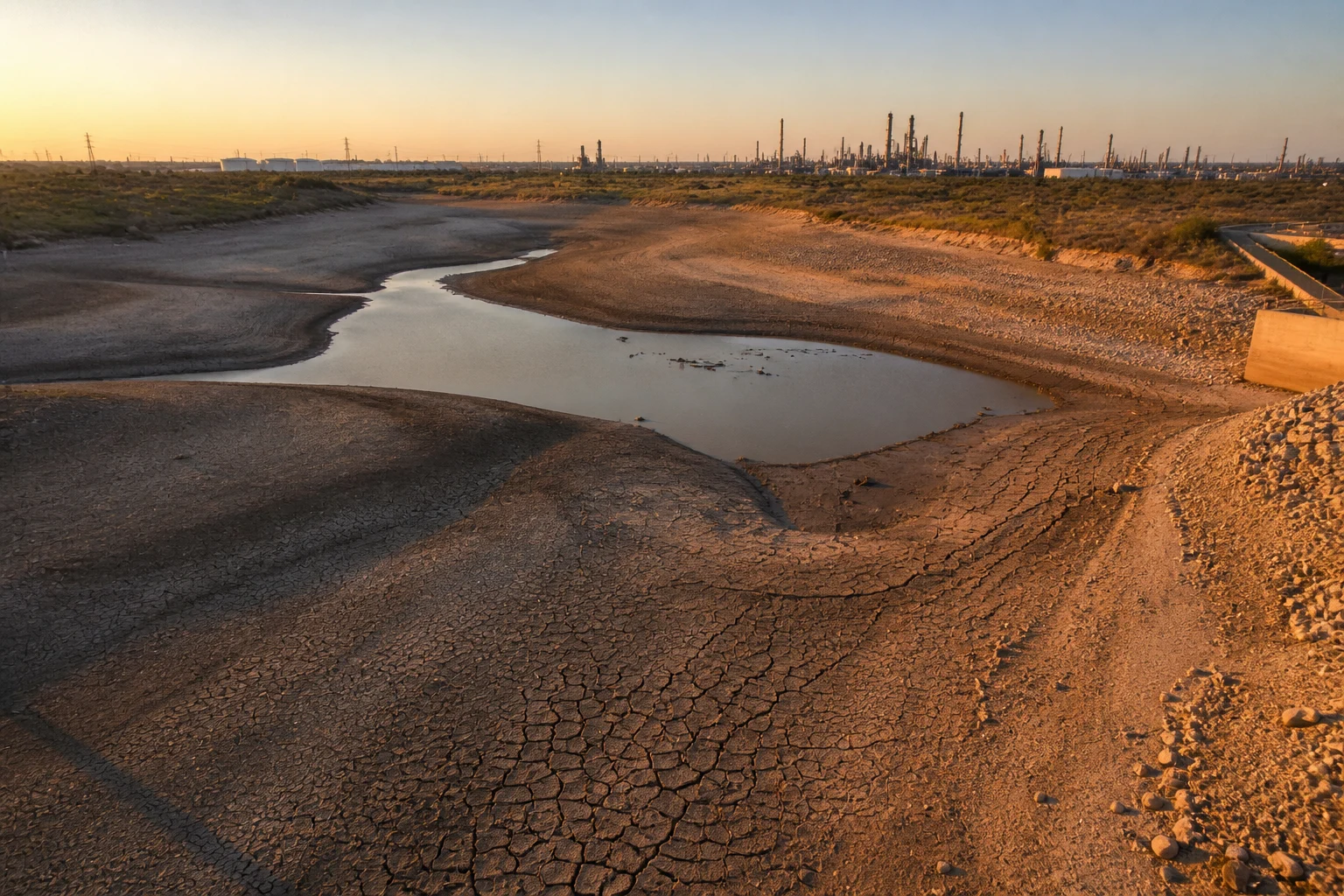
Florida Escalates to Phase III Extreme - SJRWMD Tightens Rules Across 18 Counties
Florida's St. Johns River Water Management District (SJRWMD) escalated to Phase III Extreme Water Shortage on Tuesday May 12, 2026, effective May 13. The most severe stage under district rule 40C-21.251 F.A.C. now applies across 18 counties and roughly 4.73 million residents, about 23 per cent of Florida's population. Phase III tightens an already-active Modified Phase II that had been in effect since March 3.
What changed on May 13
The SJRWMD Governing Board voted to escalate at its Tuesday meeting at the district headquarters in Palatka. The decision cited groundwater levels below the 10th percentile in Duval and St. Johns counties, reduced St. Johns River flows, and below-average rainfall across the 18-county service area. SJRWMD Director of Water Supply Planning Clay Coarsey told board members the decision came before the typical late-May / June wet-season relief window because conditions had deteriorated faster than the district was willing to wait out.
The 18 counties affected include 12 entirely within SJRWMD (Brevard, Clay, Duval, Flagler, Indian River, Lake, Marion, Nassau, Putnam, Seminole, St. Johns, Volusia) and 6 partially within the district (Alachua, Baker, Bradford, Okeechobee, Orange, Osceola). Major urban centres caught in the declaration: Jacksonville (Duval County), Orlando (Orange County, excluding the Disney-area Central Florida Tourism Oversight District which is SFWMD), Ocala (Marion County, excluding the Dunnellon SWFWMD pocket), Daytona Beach (Volusia), St. Augustine (St. Johns), Palm Coast (Flagler), and Palatka itself, the SJRWMD headquarters town in Putnam County. Sanford on Lake Monroe, Melbourne on the Space Coast, Vero Beach in Indian River County, and Clermont in Lake County are also covered. Gainesville sits on the SJRWMD / SRWMD boundary; only the east-Alachua side escalated.
Why now: rainfall deficit + groundwater decline
Three indicators converged to push SJRWMD to Phase III in mid-May rather than waiting out the wet season. First, groundwater levels in Duval and St. Johns counties have dropped below the 10th percentile of historical observation, the threshold the district uses to trigger Phase III consideration. Second, surface water flows in the St. Johns River system have declined enough that the river's environmental and water-supply functions are competing for the same diminished baseflow. Third, the US Drought Monitor places much of northeast and east-central Florida in severe to extreme drought, with the percentage of the state in some level of drought now exceeding what the district's planning models had projected for mid-May.
North Florida's wet season historically begins in late May or early June. The May 13 declaration came before that window, which means the district was unwilling to bet on rainfall that may or may not arrive on schedule. If significant rainfall does arrive in late May or June, Phase III can be downgraded back to Modified Phase II. If rainfall is below average, Phase IV is the next escalation under rule 40C-21.251 F.A.C.
What Phase III means for residential users
The headline number: 1 day per week. Odd-numbered addresses water Wednesdays only; even-numbered addresses water Thursdays only. This is unchanged from Modified Phase II in terms of weekly frequency; what changed at Phase III is the tightening of the daily blackout window and the broader restrictions on commercial and aesthetic water use.
Under Phase III, landscape irrigation is prohibited between 8 a.m. and 6 p.m. on any day, including the assigned day. The watering window is effectively before 8 a.m. or after 6 p.m. on your assigned Wednesday or Thursday. Maximum water volume is three-quarters of an inch per zone, and maximum run time is one hour per zone. Hand watering with a shut-off nozzle remains permitted any day, any time, for trees, shrubs, vegetable gardens, and flower beds; micro-irrigation and drip systems are exempt from the day-of-week schedule. Newly installed landscapes still receive a 60-day SJRWMD exemption, registered through sjrwmd.com.
Beyond residential lawns, Phase III restricts vehicle washing at home, prohibits aesthetic water use (decorative fountains without aquatic life), limits pressure washing to surface-prep for paint or essential safety/sanitation only, and caps golf course fairway irrigation at 1 day per week. Pool filling for new installations is restricted; top-offs typically remain allowed. Commercial, industrial, and institutional water users must suspend certain non-essential uses with specifics negotiated per-account.
Cross-district confusion: SJRWMD vs SRWMD vs SWFWMD
Florida is divided into five water management districts and each operates independently. SJRWMD is now at Phase III Extreme. SWFWMD (Tampa Bay south to Sarasota) has been at its own Modified Phase III since April 3, 2026 with similar but not identical rules (1 day per week, but with 12:01 AM to 4 AM and 8 PM to 11:59 PM watering windows rather than the SJRWMD before 8 AM / after 6 PM windows). SRWMD (Suwannee River watershed in the north-central panhandle) is holding at Phase II since March 17. SFWMD (Everglades, Miami-Dade, Disney CFTOD area) and NWFWMD (Panhandle) operate under their own separate frameworks.
This creates real confusion at three specific geographic interfaces. First, the SJRWMD / SRWMD boundary cuts through Alachua County; Gainesville's east side is now Phase III while the west side stays Phase II. Same city, different rules, different watering days. Second, the SJRWMD / SWFWMD boundary touches in Marion County (Dunnellon is SWFWMD while most of Marion including Ocala is SJRWMD) and in Lake County (most of Lake is SJRWMD; some southern Lake / Polk County parcels are SWFWMD). Third, the Walt Disney World area and the Central Florida Tourism Oversight District are technically SFWMD, not SJRWMD, despite being surrounded by Orange County SJRWMD territory. The Villages straddles the Marion / Sumter county line and is SWFWMD-served despite Marion County mostly being SJRWMD. Verifying which district your address is in is now essential.
HOA protections under Florida Statute 720.3075
Florida Statute 720.3075 explicitly prohibits homeowners associations from enforcing rules that require homeowners to violate water management district restrictions. Brown or dormant lawns caused by following SJRWMD Phase III are legally protected from HOA fines. The statute is among the strongest HOA water-rule protections in the United States and predates this drought; it applies regardless of CC&R language, deed restrictions, or condo association bylaws. Document the May 13, 2026 SJRWMD declaration if your HOA challenges a brown lawn. The Florida courts have repeatedly upheld 720.3075 in homeowner disputes over drought-driven lawn condition.
What happens next
SJRWMD monitors rainfall, groundwater, and St. Johns River flows weekly. The district will reassess Phase III status as the wet season develops through June and July. Three scenarios over the next 60 days: rainfall returns on schedule and rebuilds reservoir / aquifer margin, in which case Phase III can be downgraded back to Modified Phase II during summer. Rainfall returns but is below average, in which case Phase III holds through summer. Rainfall stays below average and groundwater continues to decline, in which case Phase IV (the maximum stage under rule 40C-21.251 F.A.C.) becomes the next escalation. Phase IV would tighten the schedule further and could impose hard caps on residential and commercial water use.
Parallel context elsewhere in Florida: SWFWMD Phase III runs through July 1, 2026 with a similar review timeline. SRWMD has been at Phase II since March 17 and could escalate to Phase III later in 2026 if Suwannee basin conditions worsen. Statewide drought response is coordinated through the Florida Department of Environmental Protection, but each district sets its own stage independently based on local hydrology. For the 4.73 million residents now living under SJRWMD Phase III, the next milestone is the SJRWMD Governing Board's June meeting at Palatka headquarters, where the first formal Phase III review is expected.
Related water restrictions
- → Jacksonville water restrictions
- → Jacksonville Beach water restrictions
- → St. Augustine water restrictions
- → Palm Coast water restrictions
- → Fernandina Beach water restrictions
- → Daytona Beach water restrictions
- → Orlando water restrictions
- → Ocala water restrictions
- → Gainesville water restrictions (SJRWMD/SRWMD split)
- → Orange Park water restrictions
- → Palatka water restrictions (SJRWMD HQ town)
- → Sanford water restrictions
- → Melbourne water restrictions
- → Vero Beach water restrictions
- → Clermont water restrictions
- → Florida water restrictions hub
Community Reports & Questions
Share an update, ask a question, or report a change in your local restrictions.
No community reports yet
Be the first to share a local update, ask a question, or report a change in your area's restrictions.
More news

Coastal Bend Water Crisis Spreads - Aransas Pass and Beeville Declare Disasters as Corpus Christi Hits 7.8%
May 12, 2026
UK Braces for Summer 2026 Drought as Key Reservoir 'Will Not Fully Recover'
May 2, 2026
Boise Forced Into Early Stage 2 Water Restrictions as Snake River Hits Record Lows
May 2, 2026
Charlotte Metro Hits Stage 2 Water Restrictions — First 'Exceptional Drought' Since 2008
May 2, 2026
Neighbors Turn 'Water Police': Community Reporting of Violations Rises
May 2, 2026

Water Companies Proactively Restrict Customer Usage Across Drought-Affected Regions
May 2, 2026

Europe's Water Crisis Worsens: Continental Aquifer Depletion Accelerates
May 2, 2026
Charlotte Issues Voluntary Water Restrictions and Burn Ban Amid Ongoing Drought
May 2, 2026
Denver Implements Mandatory Water Restrictions with 'Hundreds of Dollars' in Fines
May 2, 2026
California Water Violation Fines Set to Increase 20-Fold Under New Legislation
May 2, 2026

Alberta Orders Provincial Investigation Into Calgary's Recurring Water Main Breaks
May 2, 2026
Raleigh Activates Stage 1 Water Restrictions as Falls Lake Drops to 84% Capacity
May 2, 2026
Auburn, Alabama Enacts Mandatory Water Restrictions and Drought Surcharges
May 1, 2026
Vancouver Bans All Lawn Watering — Why BC Skipped Straight to Stage 2
May 1, 2026
Charlotte Imposes First Mandatory Water Restrictions Since 2007 — What Homeowners Need to Know
May 1, 2026
Corpus Christi Could Become the First American City to Run Out of Water
May 1, 2026