Neighbors Turn 'Water Police': Community Reporting of Violations Rises
Citizen-submitted reports of water-restriction violations have surged across cities with active mandatory restrictions in 2026. Raleigh's 311 system received 214 water-violation reports in April — a 15× increase over the same month in 2025 and the highest single-month total since the system began categorising water complaints separately in 2008. Charlotte's parallel reporting system shows a 3× increase. Denver Water has logged a 5× increase in customer-submitted complaints. The phenomenon is shaping how utilities deploy enforcement and is producing some surprising social dynamics in affected neighbourhoods.
The Raleigh data
The City of Raleigh's 311 system categorises customer requests into more than 200 service types, including a dedicated 'water restriction violation' category that has existed since the 2008 drought. The category receives steady but minimal traffic in non-drought years — typically 14 to 30 reports per month, primarily about commercial-property irrigation operating during prohibited hours. April 2026 broke entirely from that pattern. The 214 reports in the month equate to roughly 7 per day, with most filed in the first week after mandatory Stage 1 took effect on April 20.
The reporting curve has continued to climb through early May. Partial data for the first three days of May shows 47 reports — on track for roughly 470 in the month. If that trajectory holds, May 2026 will become the highest single-month total in the 18-year history of Raleigh's 311 water-restriction category. The city's 311 supervisor told the News and Observer that the system is processing reports faster than the inspector roster can investigate them in real time, leading to a growing backlog of unresolved complaints.
What people are reporting
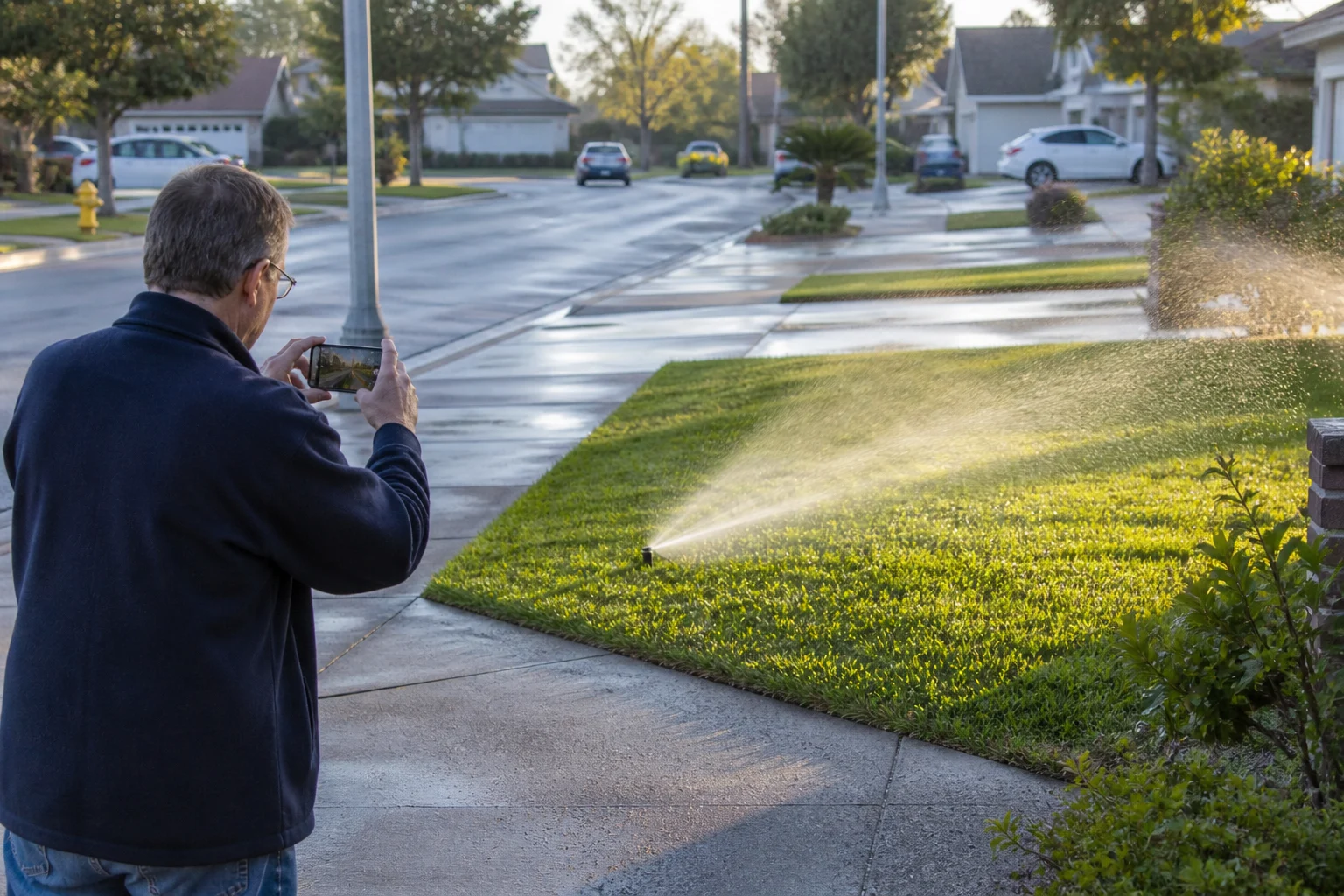
The Raleigh and Charlotte 311 systems both publish anonymised data on reported violation types. The dominant category in both cities is sprinkler systems running on the wrong day or at the wrong time — accounting for roughly 64% of all reports across the two cities combined. Sprinklers are visible, audible, and impossible to ignore from a neighbouring property; they are also the violation that most directly attracts attention precisely because they imply that the offending homeowner has not bothered to update their automated controller.
The next-largest category — vehicle and driveway washing — accounts for roughly 12% of reports. Pool and fountain filling accounts for 9%. Hose-left-running and runoff complaints account for another 8%. The 'other' category captures unusual situations: filling a garden ornament with water, washing exterior building windows during a restriction, irrigation systems with broken heads producing visible water waste, and a small number of reports about commercial properties that fall under separate enforcement frameworks. The pattern in both cities suggests citizens are reporting what they can see — and what they perceive as unfair to themselves and their compliant neighbours.
The social dynamics
The phenomenon has produced complicated social dynamics in affected neighbourhoods. Several Raleigh and Charlotte residents interviewed by the Charlotte Observer in late April characterised the reporting surge as a constructive expression of civic responsibility — neighbours holding each other accountable to a shared sacrifice. Others described it more uncomfortably as 'snitch culture' or as tit-for-tat retaliation in neighbourhoods with pre-existing disputes. Several reports have come in waves from properties that had previously been the subject of unrelated noise or property-line complaints, suggesting that water restrictions have become a new vehicle for older neighbourhood tensions.
The class and racial dimensions of the reporting pattern have drawn attention. Anecdotal evidence — not yet systematic — suggests that lower-income postcodes generate fewer reports per capita than wealthier postcodes, despite roughly equivalent rates of automated-sprinkler ownership across most of Raleigh's residential service area. The disparity may reflect differences in awareness of the 311 system, comfort engaging with city government, or willingness to formally report neighbours. The City of Raleigh's 311 division has not published an analysis of reporter demographics; doing so would require linking 311 reports to reporter address records, which the city has historically declined to do for privacy reasons.
Several Raleigh and Charlotte neighbourhood-association leaders interviewed by local press have expressed concern that the reporting pattern reinforces existing divisions rather than producing the civic solidarity utilities had hoped voluntary conservation appeals would generate. The concern is not that reporting is inappropriate — it is that the reporting infrastructure may be amplifying suspicion in neighbourhoods that were already operating with fragile social cohesion before drought restrictions added a new layer of perceived stakes.
What utilities do with the data
Both Raleigh Water and Charlotte Water use complaint data to drive inspector route planning rather than treating each report as a guaranteed inspection. Complaint clusters — multiple reports of the same property, or multiple reports clustered in the same neighbourhood block — get higher priority. A single report about a property with no prior complaint history typically generates a soft inquiry rather than an inspection visit. The approach reflects a practical reality: with eight to twelve total inspectors per utility, the math of investigating every individual report does not work.
Inspector visits triggered by complaint clusters are more likely to produce warning letters than fines in the first 60 days of mandatory restrictions. Both utilities have committed publicly to a 'compliance through communication' approach during the early-restriction period, with citations reserved for properties that ignore initial warnings or that have multiple substantiated repeat violations. Of the 214 Raleigh reports filed in April, roughly 40 produced a warning-letter visit and 6 produced citations. The conversion rate from report to enforcement action is intentionally low.
The technology layer
Several of the 2026 cluster utilities have begun using advanced metering infrastructure (AMI) data to supplement citizen reporting. Aurora Water's 15-minute smart-meter intervals can detect off-schedule watering directly without requiring inspector observation or citizen complaint — a usage spike at 11 AM on a Tuesday on an even-numbered address, for instance, is structurally diagnostic of off-schedule sprinkler operation. The combination of citizen reporting (which finds sprinkler systems visible from the street) and AMI data (which finds usage patterns that violate the schedule regardless of visibility) is meaningfully more comprehensive than either approach alone.
Privacy-rights advocates have pushed back on the AMI surveillance dimension of restriction enforcement. The Electronic Frontier Foundation's 2025 brief on water-meter data argued that 15-minute usage intervals reveal household behaviour patterns substantially beyond what is necessary for billing or restriction enforcement — information about sleep schedules, occupancy patterns, and dishwashing or laundry habits that constitutes meaningful privacy intrusion. Several US state legislatures have introduced bills in 2025 and 2026 to restrict utility access to sub-daily meter data without explicit customer consent or court order. None of those bills has yet passed.
The broader question
The Raleigh and Charlotte experience surfaces a question that the broader literature on community enforcement has debated for decades: does formalised citizen reporting strengthen or weaken the social fabric of neighbourhoods over the long term? Research on related contexts — noise-ordinance enforcement, parking-violation reporting, code-compliance complaints — suggests the answer depends heavily on whether enforcement is perceived as fair, transparent, and applied consistently across socioeconomic lines. Where those conditions hold, community reporting tends to reinforce shared norms. Where they do not, reporting can entrench division.
Whether the 2026 cluster of restrictions will leave affected cities with stronger or weaker community cohesion is unlikely to be clear for several years. The most rigorous comparable data — from the 2014–22 California drought — suggests communities that paired strong utility communication with transparent, consistent enforcement preserved or even strengthened social cohesion through the restriction period. Communities where enforcement was perceived as arbitrary or selectively applied saw measurable declines in self-reported neighbourhood trust that persisted for years. The Raleigh and Charlotte utilities are currently navigating exactly that question in real time, with the choice of inspection-trigger threshold playing a much larger role than most customers realise.
For residents of cities with active mandatory restrictions, the practical implications are simple. If you have an automated sprinkler system, programme it to comply with the schedule before next Tuesday — both because non-compliance attracts a meaningful financial penalty and because non-compliance increasingly attracts a complaint from a neighbour. If you observe what looks like a violation, the utilities ask that reports go through 311 rather than direct confrontation; both Raleigh and Charlotte have specifically discouraged residents from approaching neighbours directly about suspected violations, citing safety concerns and the inability of bystanders to verify which exemptions might apply. The water police, in 2026, are increasingly the city's official enforcement infrastructure — supported by, but distinct from, the eyes of the neighbourhood.
Related water restrictions
Community Reports & Questions
Share an update, ask a question, or report a change in your local restrictions.
No community reports yet
Be the first to share a local update, ask a question, or report a change in your area's restrictions.
More news
Florida Escalates to Phase III Extreme - SJRWMD Tightens Rules Across 18 Counties
May 13, 2026
Coastal Bend Water Crisis Spreads - Aransas Pass and Beeville Declare Disasters as Corpus Christi Hits 7.8%
May 12, 2026
UK Braces for Summer 2026 Drought as Key Reservoir 'Will Not Fully Recover'
May 2, 2026
Boise Forced Into Early Stage 2 Water Restrictions as Snake River Hits Record Lows
May 2, 2026
Charlotte Metro Hits Stage 2 Water Restrictions — First 'Exceptional Drought' Since 2008
May 2, 2026
Water Companies Proactively Restrict Customer Usage Across Drought-Affected Regions
May 2, 2026
Europe's Water Crisis Worsens: Continental Aquifer Depletion Accelerates
May 2, 2026
Charlotte Issues Voluntary Water Restrictions and Burn Ban Amid Ongoing Drought
May 2, 2026
Denver Implements Mandatory Water Restrictions with 'Hundreds of Dollars' in Fines
May 2, 2026
California Water Violation Fines Set to Increase 20-Fold Under New Legislation
May 2, 2026
Alberta Orders Provincial Investigation Into Calgary's Recurring Water Main Breaks
May 2, 2026
Raleigh Activates Stage 1 Water Restrictions as Falls Lake Drops to 84% Capacity
May 2, 2026
Auburn, Alabama Enacts Mandatory Water Restrictions and Drought Surcharges
May 1, 2026
Vancouver Bans All Lawn Watering — Why BC Skipped Straight to Stage 2
May 1, 2026
Charlotte Imposes First Mandatory Water Restrictions Since 2007 — What Homeowners Need to Know
May 1, 2026
Corpus Christi Could Become the First American City to Run Out of Water
May 1, 2026