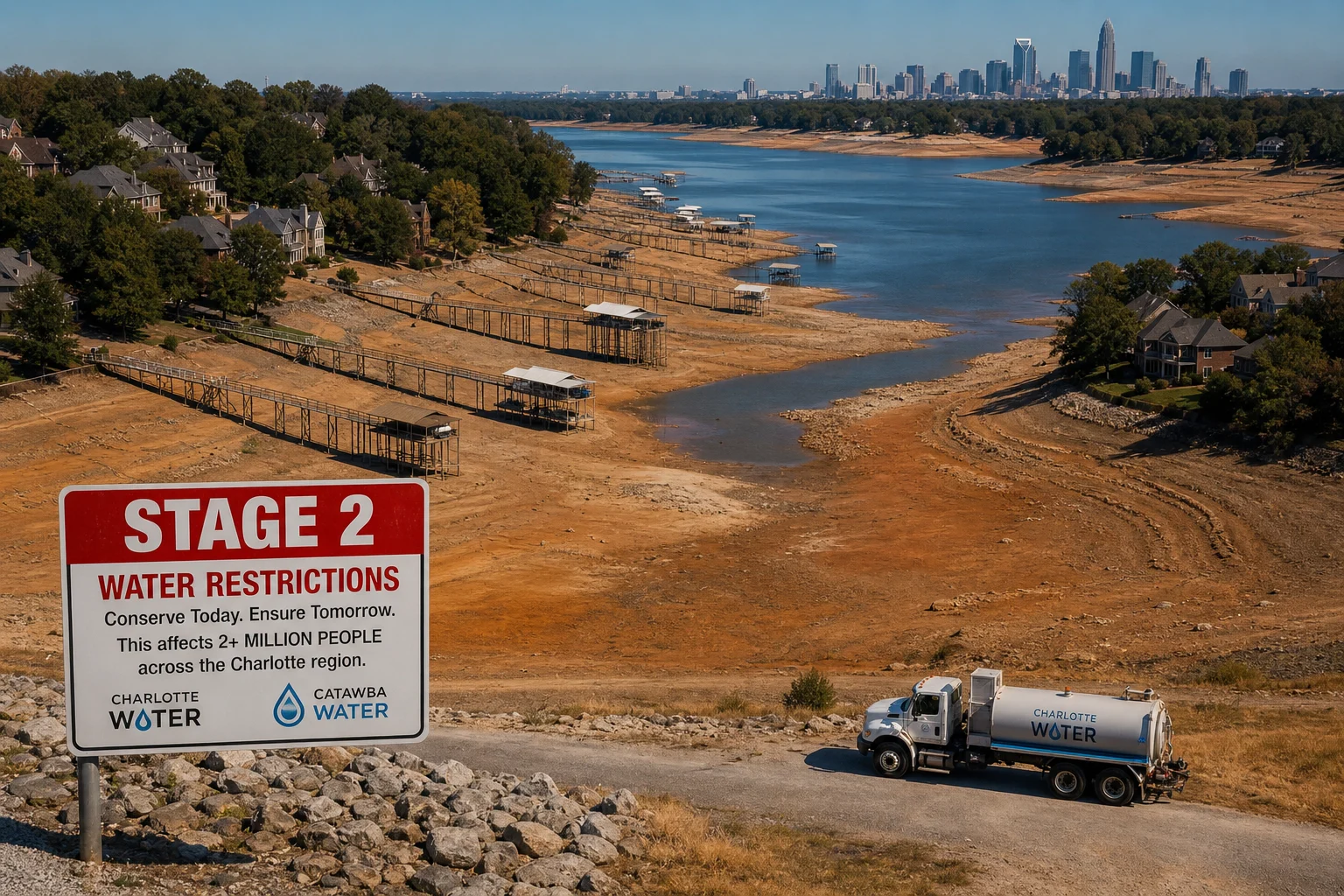
Charlotte Metro Hits Stage 2 Water Restrictions — First 'Exceptional Drought' Since 2008
Charlotte and the wider Catawba-Wateree region activated Stage 2 mandatory water restrictions on May 1, 2026 — the first basin-wide Stage 2 declaration since the historic 2007–2008 drought. The Catawba-Wateree Drought Management Advisory Group, which coordinates response across 11 member utilities serving more than two million people across 24 counties in North and South Carolina, voted unanimously to escalate after combined reservoir storage fell to 58% of capacity, more than 40 percentage points below seasonal normal. NC DEQ formally classified Mecklenburg, Cabarrus, Stanly, and Union counties as D4 Exceptional Drought on April 30, the first such classification in the Charlotte region since 2008.
What Stage 2 means for residents
Charlotte Water's Stage 2 framework, effective May 15, 2026, limits residential lawn and landscape irrigation to two days per week, overnight only, between 6:00 PM and 6:00 AM. Odd-numbered street addresses water Tuesdays and Saturdays. Even-numbered addresses water Wednesdays and Sundays. The schedule is enforced under the Charlotte Water Stage 2 ordinance with first-offence fines of $100 and escalating penalties for repeat violations. Pool top-ups are restricted to Thursdays and Sundays, 6:00 PM – 6:00 AM. Filling new residential pools, washing vehicles at home, operating decorative water features that do not support aquatic life, and power washing for aesthetic purposes are all prohibited.
Hand watering with a shut-off hose, watering can, or bucket is permitted any time outside the 6 AM to 6 PM blackout window for landscape plants, trees, shrubs, and food crops. Drip irrigation for ornamentals and food gardens is permitted any time. Vegetable gardens are exempt from the day-of-week schedule when watered by hand or drip. The exemption framework is identical to the 2008 Stage 2 schedule and reflects basin-wide policy from the Drought Management Advisory Group rather than Charlotte-specific decisions.
Why the basin reached Stage 2 so quickly
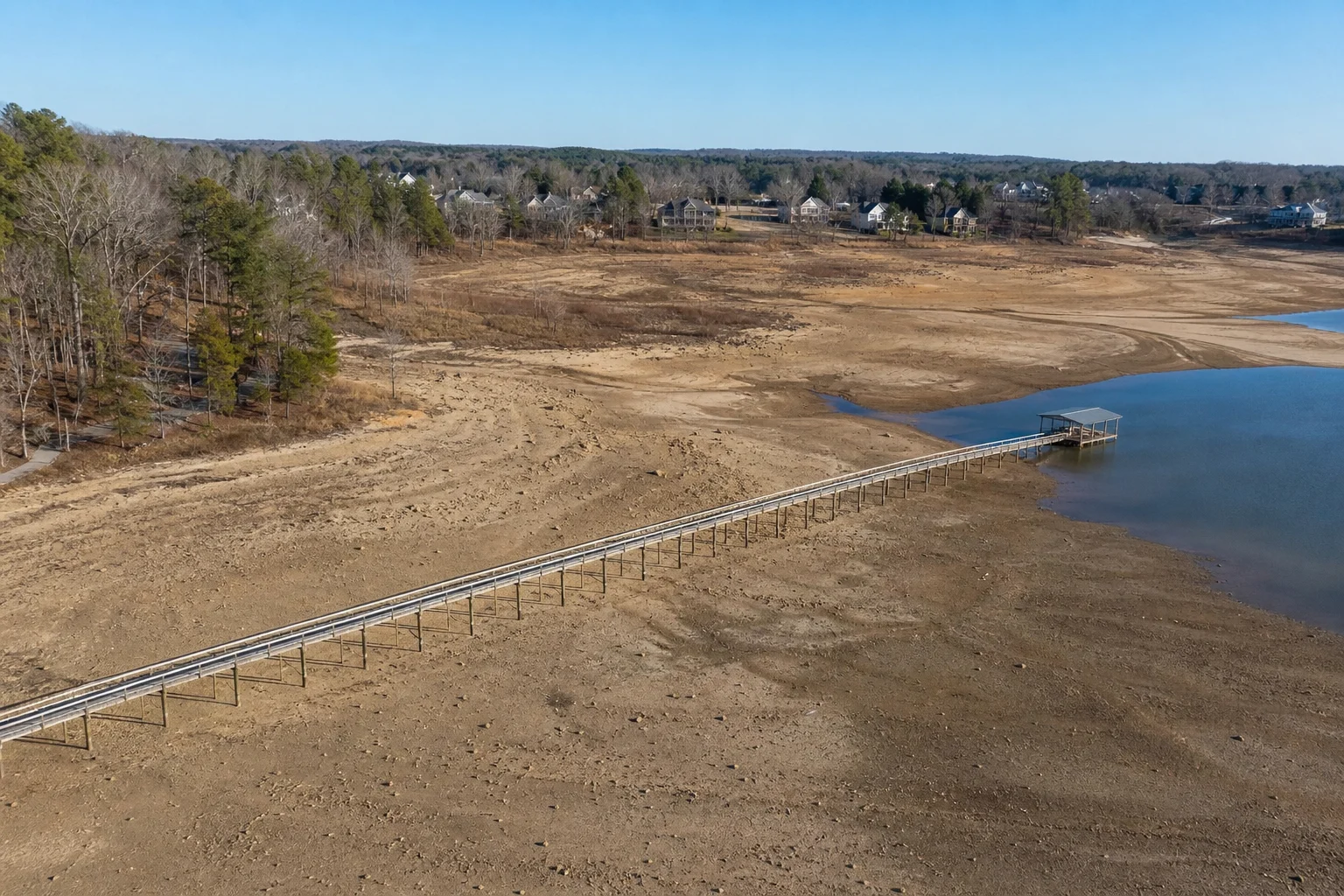
The Catawba-Wateree River Basin had its driest October-to-March recharge period since records began in the early 1970s. Combined reservoir storage entered May at 58% of capacity — well below the historical Stage 2 trigger threshold of 60% and on a steeper decline trajectory than any year since 2002. Lake Norman, the largest reservoir on the system, is showing visibly low water; boat ramps in several access areas no longer reach open water, and several marinas have begun managing dock heights for the summer.
Snowpack is not a meaningful factor in Carolina hydrology — the basin depends on rainfall throughout the year — but the prolonged dry recharge season has left storage well below seasonal targets heading into summer. The Drought Management Advisory Group, which meets at least twice monthly during active drought, voted to activate Stage 2 of the Low Inflow Protocol on May 1. Recreational flows from the basin's reservoirs were suspended at the same time, a measure aimed at conserving storage for drinking-water supply.
D4 'exceptional drought' — the worst category
NC DEQ declared D4 Exceptional Drought in Mecklenburg, Cabarrus, Stanly, and Union counties on April 30, 2026 — the first D4 declaration in the Charlotte region since 2008. D4 is the worst category on the US Drought Monitor, indicating exceptional and widespread crop and pasture losses, water emergencies, and shortages of well water leading to emergency restrictions on residential supply. 100% of North Carolina is currently in some category of drought; the western Piedmont and Catawba-Wateree basin counties carry the worst classifications. USDA has declared western North Carolina an agricultural disaster, opening the path for federal emergency loans and crop-insurance adjustments.
Statewide rainfall is at the lowest recorded total for the October-to-April period in the 130-year observation record. NC Assistant State Climatologist Corey Davis told media this week that the current drought 'shares traits with the 2007 benchmark' — the historic 2007–2008 event that lasted more than 460 days and reached Stage 3 of the basin Low Inflow Protocol with severe mandatory cutbacks across the region. The 2007 drought is the most cited comparison point in current basin discussions, and several utility managers have begun publicly preparing customers for the possibility of a Stage 3 declaration later in summer.
Affected cities and the regional framework
The Stage 2 declaration affects more than two million people across 24 counties in North and South Carolina. The 11 member utilities of the Drought Management Advisory Group include Charlotte Water, Duke Energy (which owns the basin's hydroelectric reservoirs), the City of Gastonia, the City of Hickory, the City of Morganton, the City of Lenoir, Iredell County, Caldwell County, Catawba County, Lincoln County, and several smaller water districts. Each utility implements Stage 2 through its own local ordinance, with reduction targets and fine schedules that vary by jurisdiction.
Charlotte and Gastonia both target a 10% system-wide demand reduction with first-offence fines of $100 and maximum repeat fines of $500–$600. Hickory targets 8% with fines up to $500. Morganton and Lenoir, smaller utilities serving rural Catawba foothills communities, target 8% with maximum fines of $250. The reduction targets are coordinated to deliver an aggregate basin-wide reduction of approximately 7%, which the basin hydraulic model projects will keep storage on the right side of the Stage 3 trigger curve through July if rainfall returns to even 80% of seasonal normal.
Voluntary first, then mandatory
Charlotte Water issued voluntary Stage 1 conservation requests in mid-April, asking residents to reduce outdoor watering to two days per week and to forgo non-essential outdoor uses. Voluntary participation climbed steadily through the second half of April but plateaued at roughly 76% of households by week five — short of the 80% threshold the utility had set as the marker for whether voluntary measures would be sufficient. The May 1 vote of the Drought Management Advisory Group, which considered both basin-wide storage trends and Charlotte's customer participation data, concluded that escalation to mandatory Stage 2 was warranted.
The two-week gap between the May 1 announcement and the May 15 effective date is deliberately structured to give residential customers time to update sprinkler controllers, complete any outdoor washing tasks that will become prohibited, and adjust water-intensive outdoor projects. Charlotte Water has issued bilingual customer communications across paid social media, neighbourhood-association partnerships, and the city's 311 system. Bylaw inspectors will operate on a calibrated enforcement model — first-offence written warnings for minor schedule violations, with $100 fines reserved for confirmed wilful or repeat offences.
What homeowners should do now
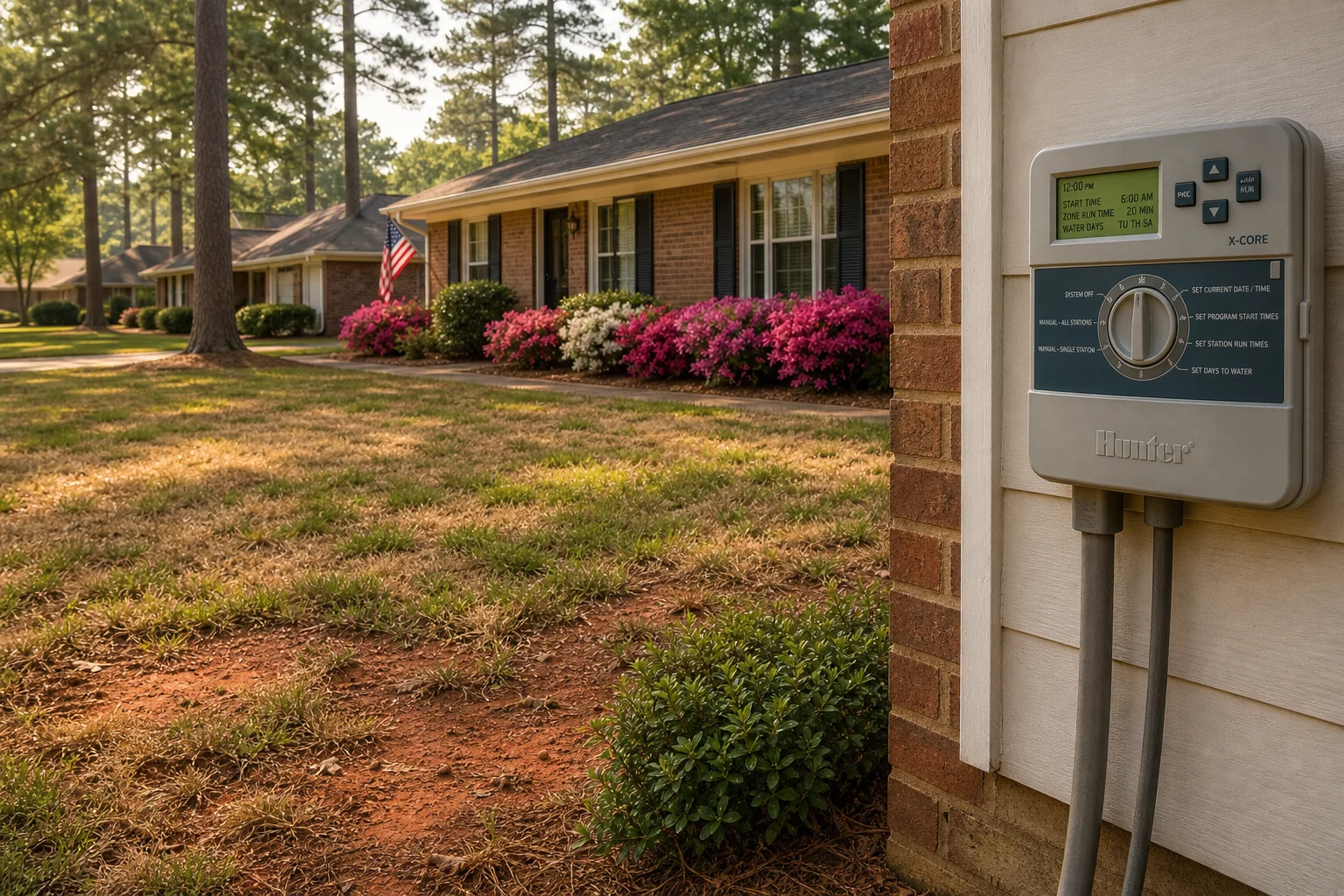
The single most useful action for any Charlotte-area homeowner with an automated sprinkler system is to verify the controller programme matches the new schedule before May 15. Many controllers were programmed last autumn for the 2025 watering season and have not been touched since. A controller still set to the 2025 schedule will quickly attract a warning notice — and a $100 fine if the inspector returns. Most modern controllers can be reprogrammed in under five minutes; Charlotte Water's website includes step-by-step instructions for the most common models.
For homeowners willing to accept some lawn browning, the simplest path through Stage 2 is to skip irrigation entirely and let warm-season grasses go semi-dormant. Bermuda and Zoysia, the dominant Charlotte lawn grasses, both handle short-term dormancy well and recover reliably with autumn rain. Tall Fescue — common in shaded yards — is more vulnerable but still survives 4 to 6 weeks of drought if mowed high and not fertilised. Mulched landscape beds need a fraction of the water bare soil does; a 50–75 mm bark or compost layer is the highest-leverage move a homeowner can make this week.
What happens if it gets worse
The 2007 drought lasted more than 460 days and reached Stage 3 of the Catawba-Wateree LIP. Stage 3 would ban all outdoor watering — including hand watering of lawns, ornamentals, and most food crops — and impose stricter caps on industrial and commercial users. The Drought Management Advisory Group will reconvene in mid-June to evaluate whether further escalation is warranted. Without significant rainfall in the basin — multi-inch events distributed across the watershed, not just in Charlotte — Stage 3 becomes increasingly likely as summer demand peaks.
Charlotte Water has indicated it will communicate any planned Stage 3 escalation through both city channels and Duke Energy basin updates, with at least 14 days notice before any new restrictions take effect. The two-week notice window is consistent with the May 1 to May 15 framework now in effect for Stage 2 and gives residents time to adjust controllers, complete outdoor projects, and prepare for stricter rules. For now, the message from Charlotte Water is consistent: programme the controller, follow the schedule, watch the basin levels, and accept that the lawn may go semi-dormant. Charlotte residents who programme their controllers, mulch their beds, and prepare their lawns for dormancy this month will be in the best position if Stage 3 arrives.
Related water restrictions
Community Reports & Questions
Share an update, ask a question, or report a change in your local restrictions.
No community reports yet
Be the first to share a local update, ask a question, or report a change in your area's restrictions.
More news
Florida Escalates to Phase III Extreme - SJRWMD Tightens Rules Across 18 Counties
May 13, 2026

Coastal Bend Water Crisis Spreads - Aransas Pass and Beeville Declare Disasters as Corpus Christi Hits 7.8%
May 12, 2026
UK Braces for Summer 2026 Drought as Key Reservoir 'Will Not Fully Recover'
May 2, 2026
Boise Forced Into Early Stage 2 Water Restrictions as Snake River Hits Record Lows
May 2, 2026
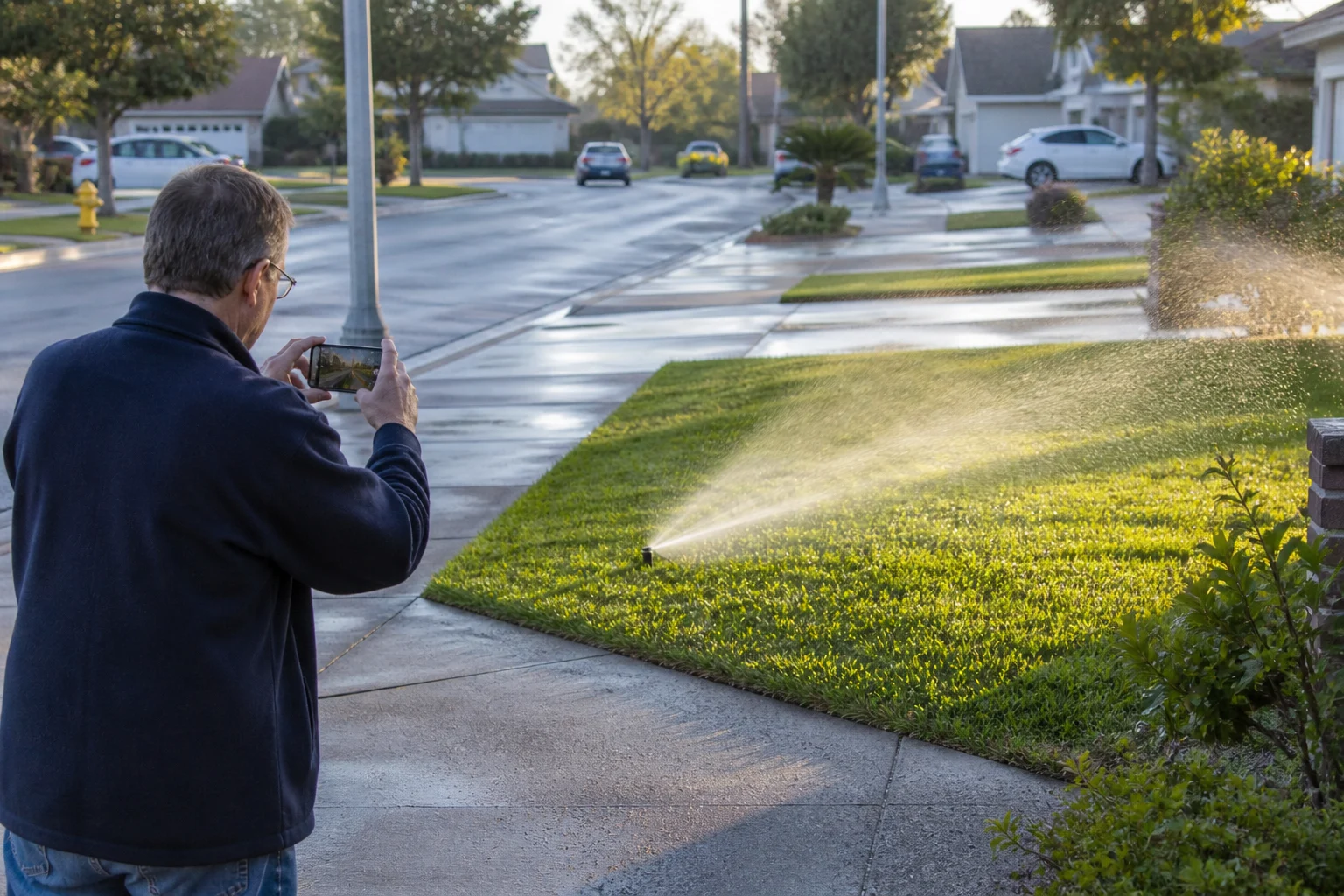
Neighbors Turn 'Water Police': Community Reporting of Violations Rises
May 2, 2026

Water Companies Proactively Restrict Customer Usage Across Drought-Affected Regions
May 2, 2026

Europe's Water Crisis Worsens: Continental Aquifer Depletion Accelerates
May 2, 2026
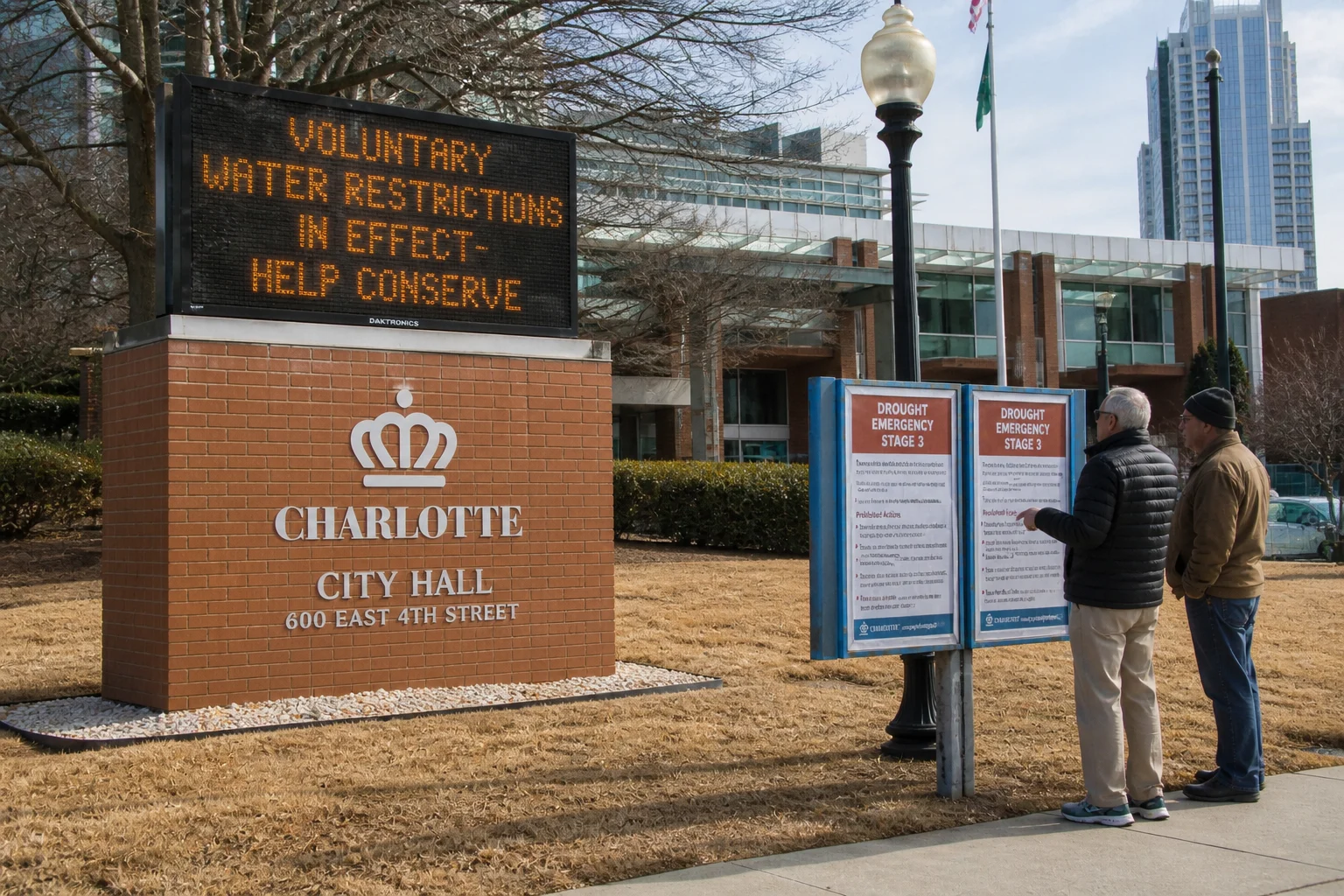
Charlotte Issues Voluntary Water Restrictions and Burn Ban Amid Ongoing Drought
May 2, 2026
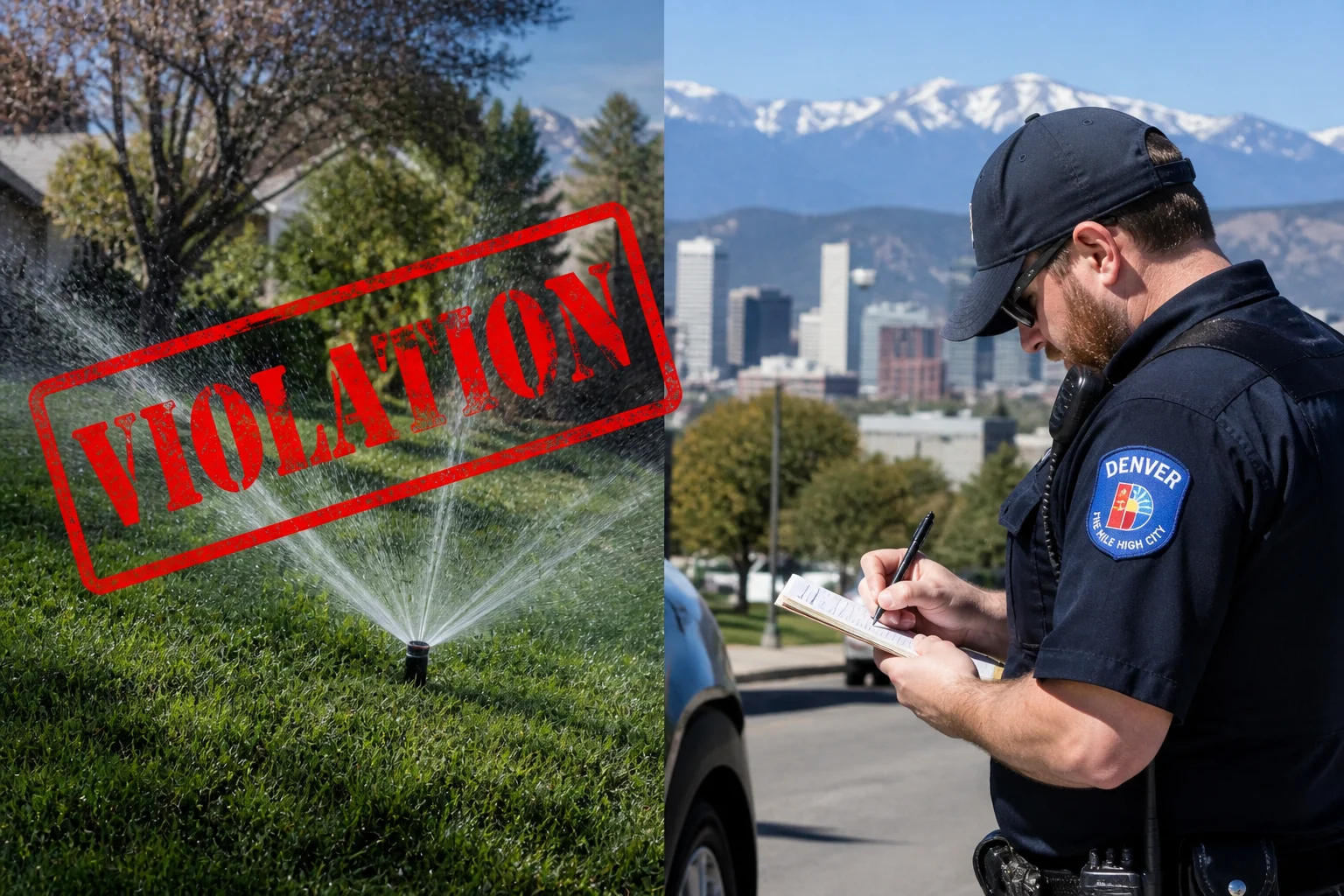
Denver Implements Mandatory Water Restrictions with 'Hundreds of Dollars' in Fines
May 2, 2026
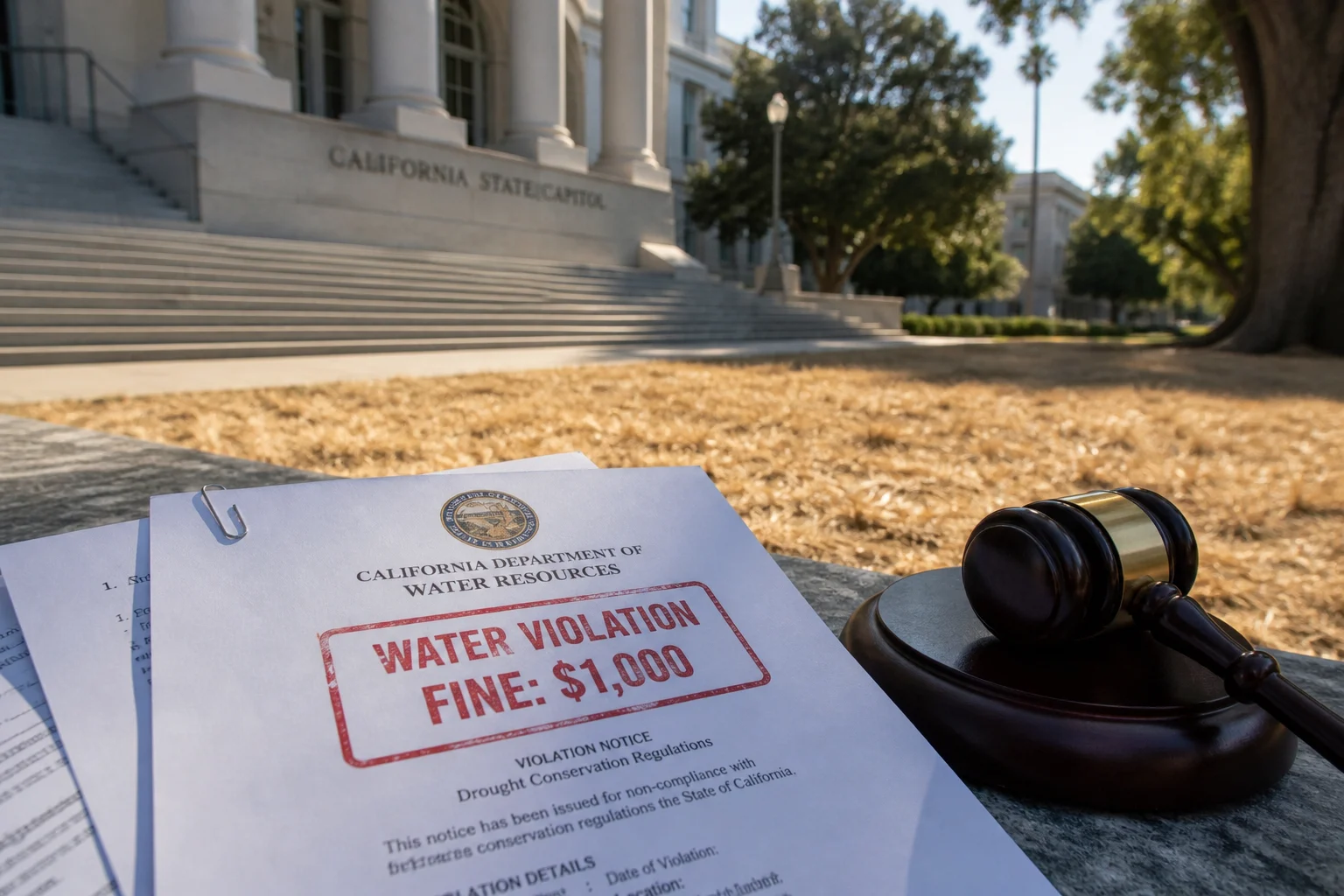
California Water Violation Fines Set to Increase 20-Fold Under New Legislation
May 2, 2026

Alberta Orders Provincial Investigation Into Calgary's Recurring Water Main Breaks
May 2, 2026
Raleigh Activates Stage 1 Water Restrictions as Falls Lake Drops to 84% Capacity
May 2, 2026
Auburn, Alabama Enacts Mandatory Water Restrictions and Drought Surcharges
May 1, 2026
Vancouver Bans All Lawn Watering — Why BC Skipped Straight to Stage 2
May 1, 2026
Charlotte Imposes First Mandatory Water Restrictions Since 2007 — What Homeowners Need to Know
May 1, 2026
Corpus Christi Could Become the First American City to Run Out of Water
May 1, 2026