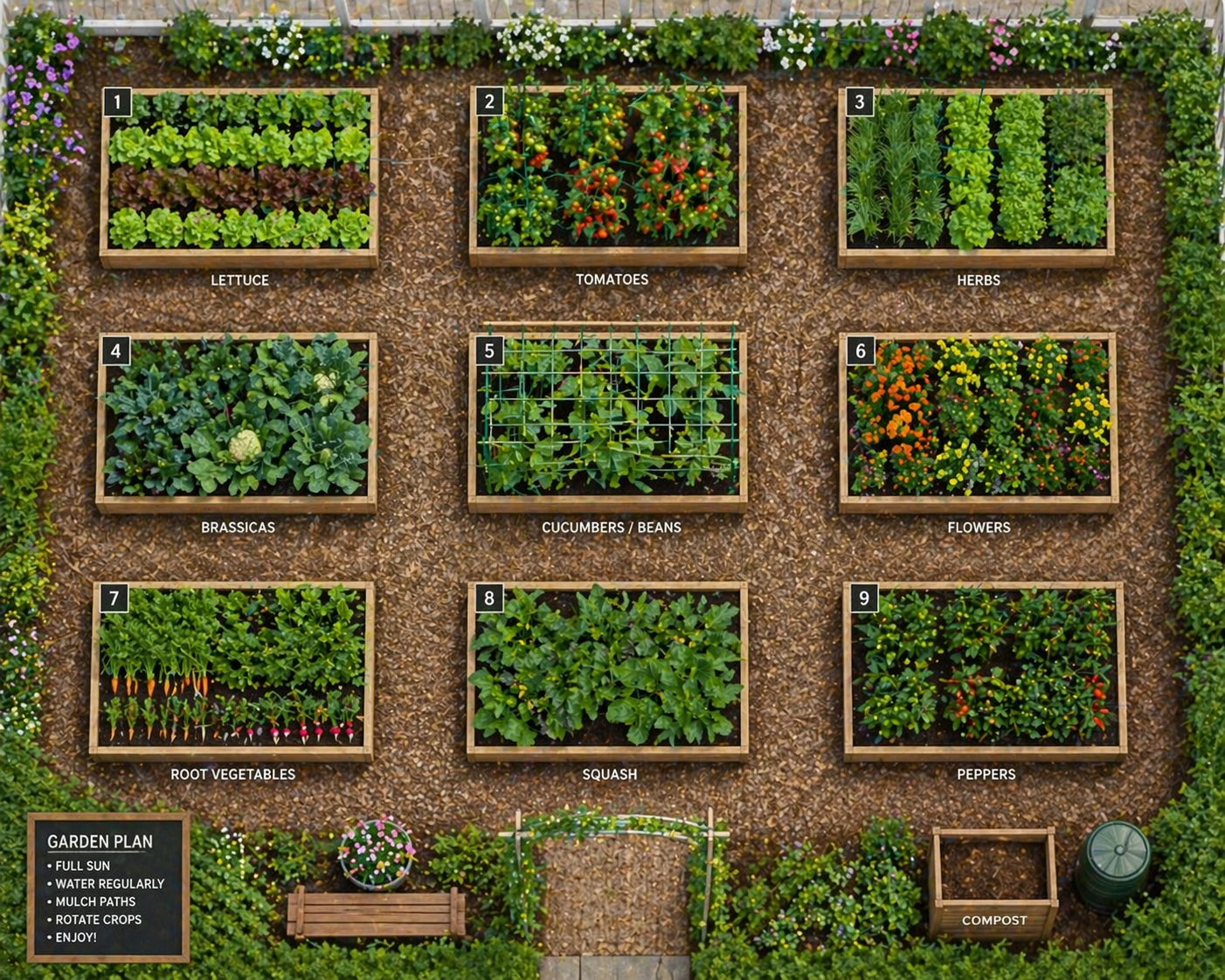
Layout is the decision most beginners skip and the one that quietly limits yield for years afterward. Where you place the beds, how you orient them to the sun, how wide the paths are, and how you group them for rotation — all of these choices are baked in the day you build. This guide walks through the five decisions that define a working raised bed layout, plus three proven patterns for 2-bed, 4-bed, and 6-bed gardens.
Sun Mapping — The First and Most Important Decision
Vegetables need 6 to 8 hours of direct sun to produce well. Before placing any bed, spend one full day — from 8am to 6pm — checking which parts of your yard receive direct sun hour by hour. Note shade patterns from nearby trees, buildings, and fences. The ideal spot gets unbroken sun through midday (roughly 10am to 4pm), which is when photosynthesis peaks.
Always orient the long axis of each bed north–south. This ensures every row along the length of the bed gets roughly equal sun through the day. An east–west orientation leaves the south-facing row shading its northern neighbors as the sun tracks across the sky. Plant tallest crops on the north end — corn, trellised beans, and staked tomatoes shade southward; putting them at the south end would shade the rest of the bed.
Path Widths — How Much Space Between Beds
Path width is the second decision people get wrong. Too narrow and you cannot kneel comfortably or fit a wheelbarrow; too wide and you waste growing space. The tested minimums:
- 18 inches minimum between beds. This is the absolute minimum for one person to stand and work. Below 18 inches, beds start getting stepped on and soil compacts at the edges.
- 24 inches recommended for standard home gardens. Enough room to kneel comfortably without the bed frames digging into your shins.
- 36 inches for main paths. Any path used regularly for wheelbarrow access should be 36 inches wide. This is critical around soil delivery days or when hauling compost in.
Gravel or wood-chip paths drain better than bare soil and prevent weeds. A 3-inch layer of wood chips over landscape fabric is the standard low-maintenance choice.
Proven Layout Patterns
The 2-bed starter. Two 4×8 beds side by side with a 24-inch path between them. Total footprint: 8×8 feet. This is the most common starter setup — enough production for a family of 4 without overwhelming a first-time gardener. Orient both beds long-axis north–south, paths running east–west between them.
The 4-bed square. Four 4×8 beds arranged around a central cross-path. A 24-inch perimeter path encircles the whole garden. Total footprint: roughly 11×19 feet. This layout supports proper 4-year crop rotation — each bed hosts a different crop family (nightshades, brassicas, legumes, alliums/roots) and rotates each year.
The 6-bed kitchen garden. Six 4×8 beds in two rows of three, with 24-inch paths between and a 36-inch wheelbarrow path down the center. Total footprint: roughly 11×26 feet. Enough production to supply a family's fresh vegetable needs from May through October in most climates.
Spacing Between Beds
A common mistake is placing beds tight against each other to maximize growing area. Don't. Tight spacing means paths become unmaintainable mud tracks, beds compete for root-zone moisture through the gaps, and harvest work becomes miserable. 18 inches is a hard minimum; 24 inches is the practical sweet spot for kneeling and working comfortably.
Water Access Planning
Every bed should be within 50 feet of a hose spigot — preferably within 30 feet. Longer runs mean pressure drop and frustration at watering time. If you plan drip irrigation, place a manifold at the spigot with separate zones running to each bed; this lets you water beds independently based on what's planted there. A single timer can drive up to 6 beds on one manifold system, which takes the daily watering decision off your to-do list entirely.
Crop Rotation Across Beds
A 4-bed layout enables proper crop rotation. Rotate each crop family (nightshades, brassicas, legumes, alliums/roots/other) to a new bed each year on a 4-year cycle. This breaks pest and disease cycles that build up when the same family grows in the same soil repeatedly. Label your beds 1 through 4 and keep a simple annual record of what went where. A 2-bed garden can still rotate — just alternate heavy feeders with legumes (nitrogen fixers) year to year.