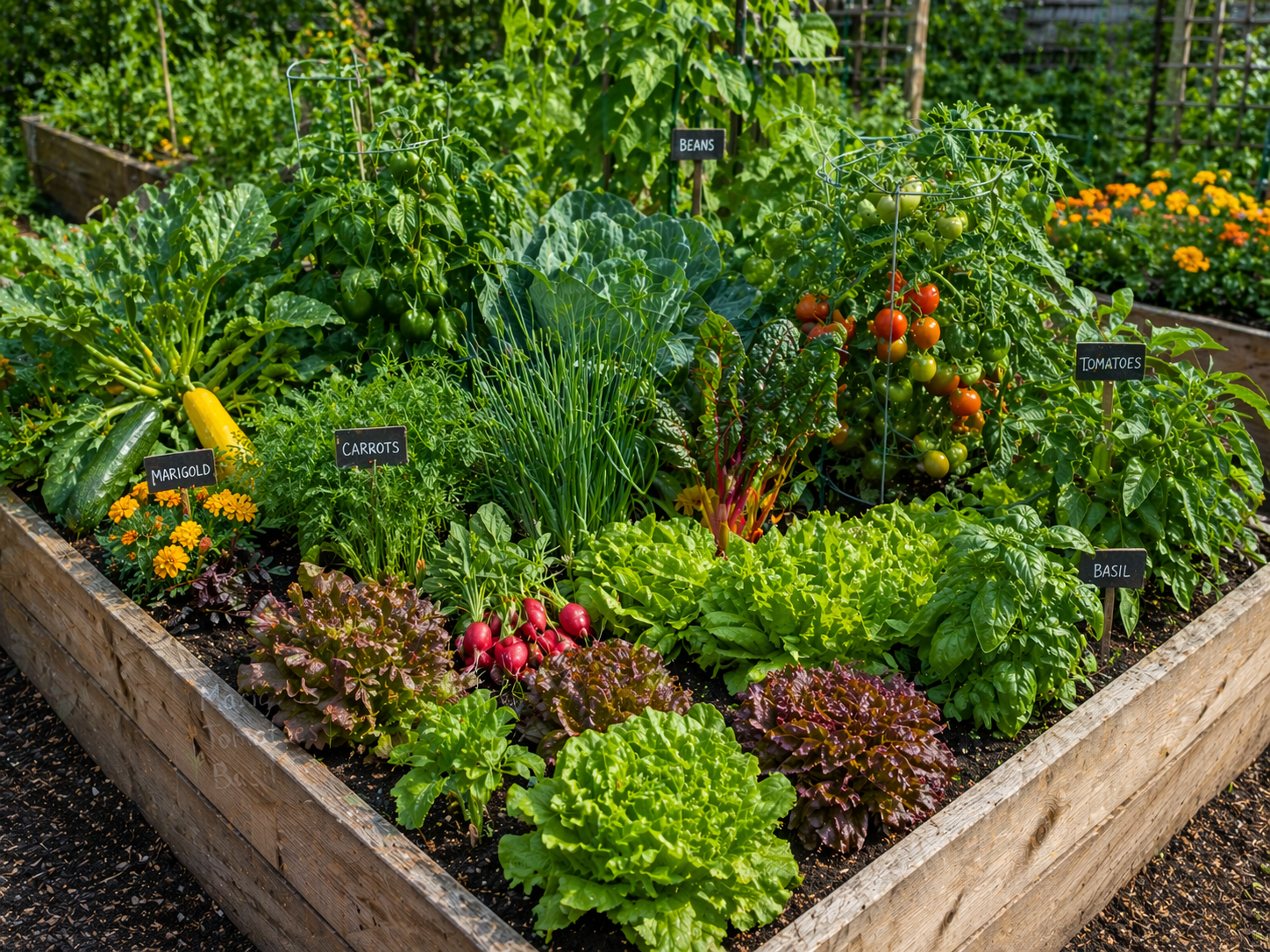
Why Raised Beds Suit Companion Planting
Raised beds solve three problems that limit companion planting in ordinary gardens. First, spacing is controlled — with no paths to navigate around, you can place companions at exactly the distance that works. Second, soil conditions are uniform — the same compost-amended soil extends across the whole bed, so companions that share water and nutrient needs perform consistently. Third, no foot traffic compacts the root zones — paths stay outside the bed, and root systems grow freely through fluffy amended soil. These three factors together typically produce 25 to 40 percent better yields than in-ground companion plantings of the same species.
Key Principles for Raised Bed Companion Planting
Sun mapping. Tall plants go on the north end of the bed; low plants on the south. This keeps everything in full sun through the day. Reverse this in the southern hemisphere or for cool-season crops that benefit from afternoon shade.
Edge planting. Marigolds, nasturtiums, and low-growing herbs (thyme, oregano) go at the bed perimeter. They form a pest-deterrent ring around the main crop without crowding the center. The edge zone is usually 6 to 12 inches wide.
Succession interplanting. Between slow-growing main crops (tomatoes at 75 days, peppers at 85 days), interplant fast crops like radishes (30 days) and lettuce (45 days). These mature and are harvested before the main crop fills in. Effectively doubles your yield per square foot.
4×4 Raised Bed Layout — Tomato + Basil + Marigold
A 4×4 bed (16 square feet) supports one main crop plus two companions:
- Center: 2 indeterminate tomatoes at 24-inch spacing along the center axis.
- Between tomatoes: 2 basil plants (one between each tomato pair), 12 inches from stems.
- Four corners: 1 marigold in each corner.
- North edge: Optional row of 3 carrots, 6 inches from the back edge.
Total planting density: 2 tomatoes, 2 basil, 4 marigolds, 3 carrots = 11 plants in 16 square feet. Yield from this combination typically runs 15 to 25 pounds of tomatoes over the season, plus basil for the year, plus 3 to 4 pounds of carrots from the front row.
4×8 Raised Bed Layout — Mixed Vegetables
A 4×8 bed (32 square feet) supports 3 to 4 main crops with companions:
- North row (1 foot wide): 4 pole beans on a trellis — nitrogen fixer.
- North-center row (1 foot wide): 2 zucchini plants 36 inches apart.
- Center row (1 foot wide): 3 peppers at 18-inch spacing plus basil interplanted between.
- South-center row (1 foot wide): 2 tomatoes at 24-inch spacing plus carrots as ground cover.
- South row (1 foot wide): Lettuce and radishes in succession — harvest fast, replant through spring.
- All 4 corners: Marigolds.
Top 5 Companion Combinations for Raised Beds
- Tomato + Basil + Marigold. The classic. Basil repels whitefly and aphids from tomatoes; marigolds kill soil nematodes. Works in any raised bed from 4×4 up.
- Corn + Beans + Squash (Three Sisters). Needs a larger bed (4×8 minimum). The oldest documented companion system in the Americas. Full guide here.
- Carrot + Onion + Lettuce. Three-depth layering — carrots deep, lettuce shallow, onions between. Onions deter carrot fly. All three crops harvest within 60 to 90 days.
- Cucumber + Radish + Dill. Radishes deter cucumber beetle while maturing in 30 days. Dill attracts beneficial wasps. Add nasturtiums at the edges as a trap crop.
- Broccoli + Onion + Dill. Onions deter cabbage moths that devastate broccoli. Dill attracts parasitic wasps that prey on cabbage worms. Plant in early spring or late summer for fall harvest.
What NOT to Do in Raised Beds
Overcrowding. Raised beds tempt gardeners to squeeze in too much. If plants mature touching neighbors, they compete for water and light; disease spreads more easily through dense foliage. Respect spacing even when it feels wasteful.
Wrong companions in tight space. In-ground gardens give you room to separate fennel, potatoes, and brassicas from their incompatible partners. In a raised bed, there is no room — so put these crops in separate beds entirely rather than risk the competition.
Over-amending with nitrogen. Raised beds that get compost every year build up excess nitrogen, which drives leafy growth at the expense of flowers and fruit. Once beds are producing well, skip compost in heavy-feeder years and add instead at the start of next season.