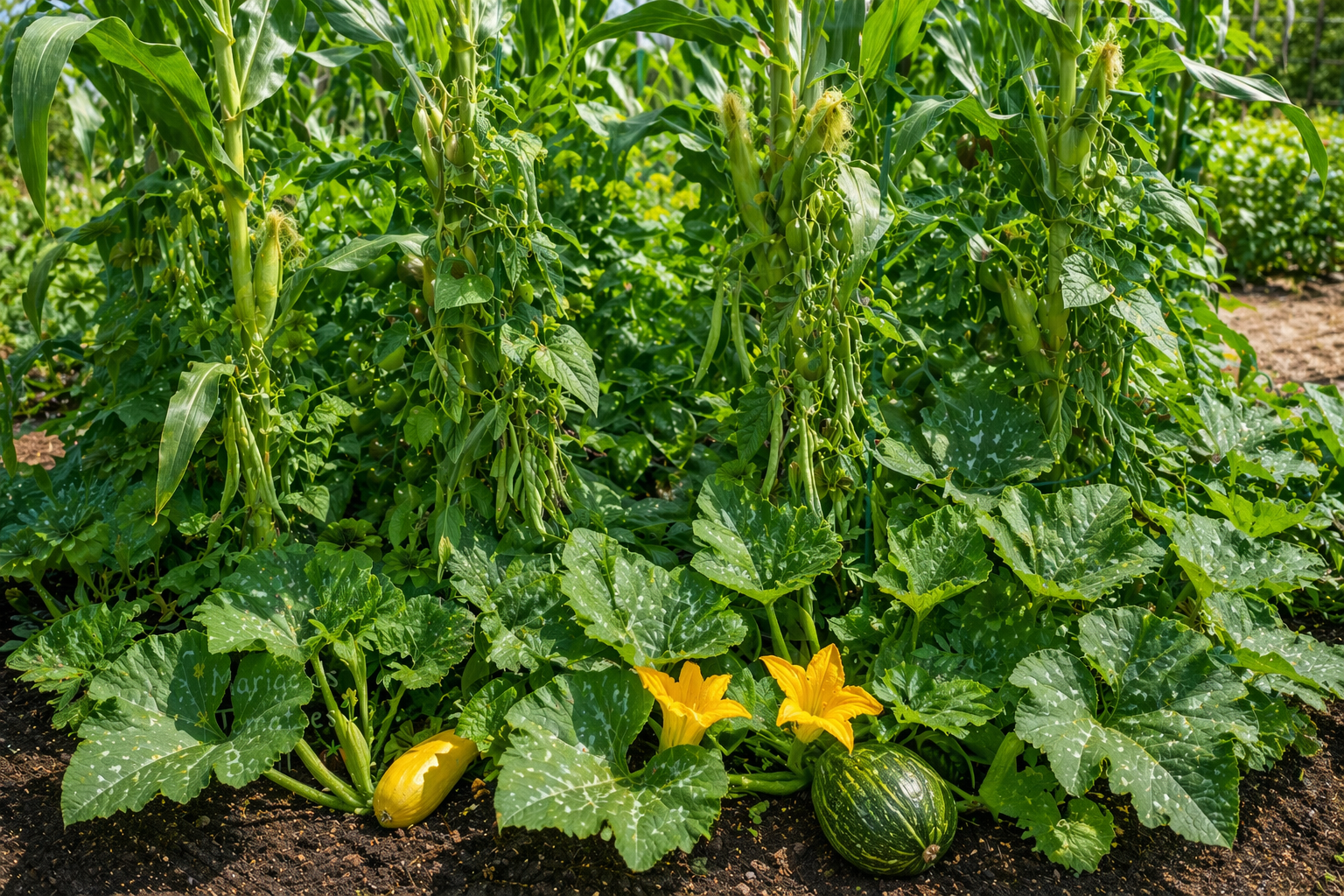
The Three Sisters — corn, beans, and squash — is the oldest documented companion planting system in the Americas. Haudenosaunee (Iroquois) Confederacy agricultural records describe the method in detail, and Pueblo peoples of the American Southwest practiced related versions for a thousand years or more. Mesoamerican milpa farming used similar combinations across what is now Mexico and Central America. The combination was not metaphorical — it produces genuinely higher yields than any of the three crops grown alone.
Why the Three-Way Symbiosis Works
Each of the three plants solves a specific problem for the others. Corn grows tall and straight, providing a natural trellis that pole beans climb — no stakes or cages needed. Corn is also highly visible, which deters raccoons from the bean and squash harvest below. Beans carry nitrogen-fixing bacteria on their roots, pulling atmospheric nitrogen out of the air and converting it to plant-available nitrogen in the soil. This directly feeds the corn (a heavy nitrogen user) and the squash. Squash produces large leaves that shade the soil, suppressing weeds and holding moisture. Squash stems are prickly, deterring raccoons and other mammals that would otherwise eat corn and beans.
How to Plant the Three Sisters
Timing matters. The three crops do not go in on the same day — they are planted in sequence over 3 to 4 weeks so that each has room to establish before its neighbors crowd it. The standard sequence:
- Week 1 — Plant corn. Build mounds of loose soil 12 inches tall and 18 inches wide, spaced 4 feet apart. Plant 4 corn seeds in a square pattern at the center of each mound. Thin to the strongest 3 seedlings per mound after germination.
- Week 2–3 — Plant pole beans. When corn reaches 4 to 6 inches tall, plant 4 pole bean seeds around each corn stalk (one bean at each of the 4 compass points, 6 inches from the corn). Do not use bush beans — they do not climb and will be shaded out.
- Week 3–4 — Plant squash. In the flat soil between mounds, plant 3 squash seeds 12 inches apart. Winter squash varieties (butternut, pumpkin) work better than summer squash because they sprawl and cover more ground. Thin to the strongest plant per location after germination.
- Ongoing — Water and minimal maintenance. Water deeply once per week during dry spells. Do not apply nitrogen fertilizer once beans are established — the bacterial fixation supplies what corn needs. Weed only the first 3 weeks; after that, squash leaves suppress weeds automatically.
Planting Calendar by USDA Zone
| USDA Zone | Corn Planting | Bean Planting | Squash Planting |
|---|---|---|---|
| 3–4 | Late May | Mid-June | Late June |
| 5 | Mid-May | Early June | Mid-June |
| 6 | Early May | Late May | Early June |
| 7 | Mid-April | Early May | Mid-May |
| 8 | Early April | Late April | Early May |
| 9–10 | Mid-March | Early April | Mid-April |
Variations — Adding a Fourth Sister
Some Indigenous traditions add a fourth plant to the combination. Common additions:
- Sunflowers. Planted at the edges of a Three Sisters plot, sunflowers attract pollinators, provide seeds for winter food, and offer additional trellising for beans at the plot perimeter. The Wampanoag tradition is the most documented sunflower-inclusive version.
- Bee balm (bergamot). Attracts pollinators and has traditional medicinal uses. Added at the edges of Pueblo-style Three Sisters plots.
- Amaranth. A grain crop that tolerates full sun and provides additional food yield. Mesoamerican milpa farming commonly included amaranth alongside the three sisters.