Lawn Pest Identification: Every Common US Lawn Pest
Published:

Lawn pest damage looks remarkably similar across species at first glance — brown patches, thinning turf, yellowing, visible insect activity — but correct identification is essential because treatments vary dramatically by pest. Grubs, chinch bugs, armyworms, billbugs, cutworms, sod webworms, and mole crickets all produce distinctive damage patterns and require specific insecticides. Applying a grub insecticide on chinch bugs wastes money and lets the actual pest destroy the lawn. This guide uses damage patterns, diagnostic tests (the float test for chinch bugs, soap test for mole crickets, peel-back test for grubs), and regional prevalence to identify every common US lawn pest with confidence, then covers integrated pest management, pesticide safety, and treatment selection by species.
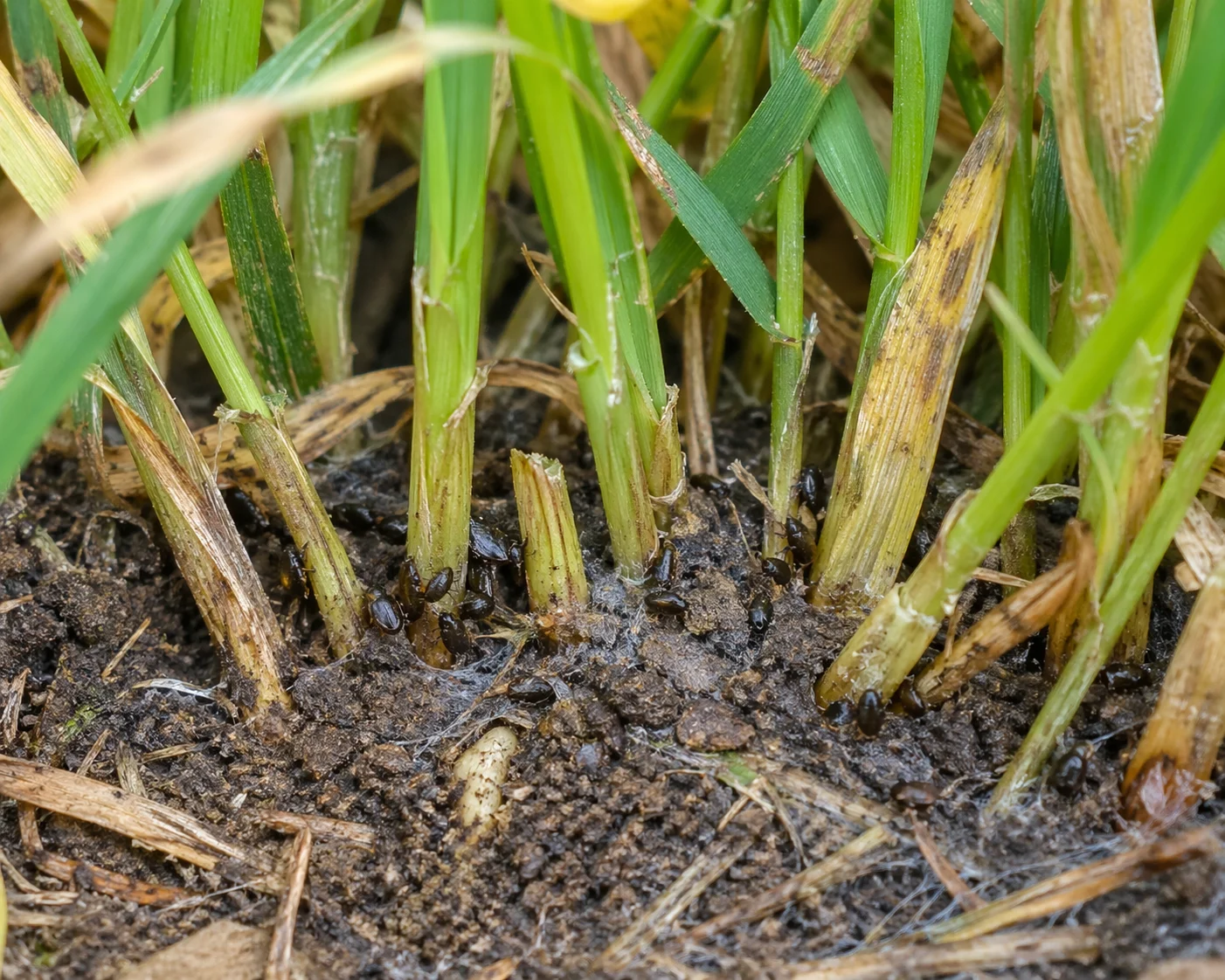
Diagnose by Damage Pattern
Match the damage pattern you see to the most likely pest candidate. Confirmation testing (described in each pest's section below) is essential before treatment.
The damage pattern narrows the candidate list, but confirmation testing is essential. The four key tests are: (1) peel-back test for grubs — pull up a patch of dead grass and look for white C-shaped larvae; (2) float test for chinch bugs — cut a can with both ends removed, push into affected turf, fill with water, look for bugs floating to surface; (3) soap test for mole crickets and cutworms — mix 2 tablespoons dish soap in 4 liters water, pour onto 30 cm² area, count insects that surface within 5 minutes; (4) morning inspection in thatch — dig through thatch at dawn to find caterpillars that feed at night.
| Damage Pattern | Most Likely Pest | Season | Confirmation Test |
|---|---|---|---|
| Peeling turf; bare soil beneath | Grubs (most likely) or Billbugs | August–October | Peel-back test; look for C-shaped larvae |
| Yellow patches expanding in hot sunny areas | Chinch Bugs | July–September | Float test — fill hole with water |
| Rapid overnight defoliation, grass chewed short | Armyworms | August–October | Dig in turf at dawn; find caterpillars |
| Silky webbing in grass, small caterpillars | Sod Webworms | June–September | Moths flying at dusk + inspect thatch |
| Stems pull away from roots easily | Billbugs | July–September | Sawdust-like frass in hollow stems |
| Spongy raised soil tunnels | Mole Crickets | May–October | Soap test with dish soap + water |
| Round bare circles (golf) or scattered dead (home) | Cutworms | Spring and Fall | Floodwater test with soapy water |
| Witch's broom tufted growth on Bermuda | Bermuda Grass Mite | Summer | Hand lens reveals tiny mites |
| Holes dug by birds/animals | Any grub or larva | Any season | Birds are eating something — investigate |
White Grubs (Japanese Beetle, European Chafer, June Bug)
Grubs are the single most damaging lawn pest in the US on a national basis. They are the larval stage of scarab beetles — most commonly Japanese Beetles, European Chafers, and June Bugs. All share the same diagnostic features: white C-shaped larvae 15–40 mm long with visible brown head capsules and three pairs of legs near the head, found in the top 5–10 cm of soil below affected grass.
Damage appears as irregular brown patches 30 cm to several meters in diameter that do not respond to irrigation. The definitive test is pulling back affected turf — grub-damaged grass lifts easily like loose carpet because roots are eaten. Secondary signs include increased bird feeding, skunk and raccoon digging, and mole tunnels.
Treatment: see our dedicated /grubs-in-lawn guide for the complete grub treatment protocol. Summary: preventive chlorantraniliprole or imidacloprid in May–July, or curative trichlorfon in August–September. Organic: Heterorhabditis bacteriophora nematodes applied in August with consistent soil moisture. Treatment threshold: 5–10 grubs per 30 cm² depending on grass type.
Regional distribution: Japanese Beetle nationwide with concentration in Northeast and Midwest; European Chafer Northeast and upper Midwest; June Bug southern US; masked chafers Southwest. Species identification matters because Milky Spore controls only Japanese Beetle and nematode species selection varies.
Chinch Bugs — The Southeast Specialist
Chinch bugs (Blissus insularis in the South — Southern Chinch Bug; Blissus leucopterus in northern areas — Common Chinch Bug) are the primary insect pest of St. Augustine grass in Florida, coastal Texas, and Gulf Coast states. They also affect Bermuda, Zoysia, and Kentucky Bluegrass in other regions. Chinch bugs are tiny — adults are only 3–4 mm long — black-and-white to orange-brown insects that feed by sucking sap from grass blades and injecting toxins that kill the tissue.
Damage appears as irregular yellow-to-brown patches expanding in hot sunny areas during July–September. The patches often start near hot edges (sidewalk margins, south-facing slopes) and expand outward as bug populations increase. On St. Augustine, chinch bug damage can kill 500+ square foot sections within 2–3 weeks during severe outbreaks. Damage looks superficially like drought but doesn't respond to irrigation.
The float test is definitive. Take a large coffee can or equivalent with both ends removed. Push it 3–5 cm into the soil at the edge of a yellow patch (transition zone between dying and still-green grass). Fill the can with water. Within 5 minutes, chinch bugs will float to the surface. Count: 20 or more bugs in a can-sized sample (roughly 80 cm²) is the treatment threshold for St. Augustine. Lower thresholds apply for Bermuda and cool-season grasses.
Treatment: bifenthrin (Talstar, Ortho Bug B Gon), clothianidin (commercial-grade), and lambda-cyhalothrin (Ortho Home Defense) are all effective. Apply at label rates to affected areas plus a 3-meter buffer into healthy turf. Target the transition zone where chinch bugs are actively feeding. Water in lightly (1/4 inch) to move product into the thatch layer where chinch bugs live. Follow up with a second application 14 days later.
Prevention: maintain higher mowing height (St. Augustine at 90–100 mm rather than 60 mm), avoid excessive nitrogen fertilization (rapid tissue growth is attractive to chinch bugs), improve thatch management through annual aeration (thick thatch provides chinch bug habitat), and address drainage in chronically wet areas where populations establish. Irrigation timing: morning only, avoid overwatering which can mask chinch bug damage initially.
Armyworms (Fall and True)
Armyworms are caterpillar larvae of moth species — Fall Armyworm (Spodoptera frugiperda) and True/Beet Armyworm (Spodoptera exigua) most commonly. Fall Armyworm is the primary damaging species in the US South, particularly Southeast (Georgia, South Carolina, Alabama, Florida, Louisiana) where late summer and fall infestations can defoliate entire lawns within 48–72 hours.
Damage is dramatic and unmistakable. Lawn appears to have been mowed overnight — grass blades chewed off at soil level or near soil level, with ragged edges showing insect mandible damage rather than the clean cut of a mower blade. Affected areas are often shaped like moving fronts — a line of damage that advances across the lawn as the armyworm population moves. The name 'armyworm' comes from this military advancing behavior.
Diagnostic confirmation: caterpillars are active at night and hide in thatch during the day. Inspect at dawn by digging through the thatch at the edge of active damage. Fall armyworms are 30–40 mm long, greenish-gray with dark stripes along the body, and have a distinctive white inverted Y-shape on the head capsule (the vertical stripe is the key identifier). True armyworms are similar size but more striped, greenish-brown, without the head Y-mark.
Treatment must be immediate — armyworms can strip a lawn completely in 2–3 days of active feeding. Apply bifenthrin (Talstar), lambda-cyhalothrin (Ortho Home Defense), chlorpyrifos (restricted in many states), or spinosad (organic option). Target active damage areas plus 3-meter buffer. Apply in late afternoon or evening when caterpillars begin surface activity. Do not water in for 24 hours — contact insecticide action depends on product remaining on grass blades.
Treatment threshold: any visible active infestation with 2–3 caterpillars per 30 cm² triggers immediate treatment. Fall armyworm outbreaks can arrive suddenly via moth migration — lawns that were unaffected can be attacked within 72 hours of moth arrival. Monitor for moth activity in late July through September (look for gray-brown moths 25–35 mm wingspan flying at dusk), particularly after major weather fronts that can carry moths northward.
Sod Webworms
Sod webworms are caterpillar larvae of small crambid moths (Crambus spp.). Larvae are small green-gray caterpillars 12–18 mm long that live in silk-lined tunnels in the thatch and feed on grass blades at night. Damage appears as irregular brown patches of chewed-off grass at soil level — similar appearance to armyworm damage but smaller areas and slower progression.
Diagnostic features: silk-lined tunnels in the thatch layer — dig through thatch at the edge of damaged areas and look for small silk tubes with caterpillars inside. Birds pecking intensely at specific lawn areas is an early indicator (birds are feeding on caterpillars). Moths flying at dusk is another early warning — the small buff-colored moths (15 mm) fly in a distinctive bobbing pattern just above grass level in late afternoon through early evening. Active damage period is June through September, with peak in July–August.
Treatment: Bacillus thuringiensis var. kurstaki (Bt-K, sold as Dipel, Thuricide, BioWorks Gnatrol) is an effective organic control. Bt is a bacterial pathogen specific to lepidopteran larvae — sod webworms and other moth caterpillars are susceptible; beneficial insects, pollinators, birds, and pets are unaffected. Apply at dusk when larvae surface to feed. The product is ingested with grass blades; larvae stop feeding within hours and die within 2–4 days.
Chemical options: bifenthrin (Talstar), lambda-cyhalothrin (Ortho Home Defense), or carbaryl (Sevin) provide effective control. Apply at dusk when larvae surface; water in lightly after 24 hours. Treatment threshold: 10+ caterpillars per 30 cm² justifies intervention on home lawns. Lower thresholds (5–7 per 30 cm²) apply on golf courses where aesthetic standards are higher.
Prevention: maintain appropriate mowing height (upper end of grass type's recommended range), avoid excessive nitrogen which encourages thick succulent growth favorable for webworm establishment, and reduce thatch through annual aeration. Sod webworm populations tend to build in the same areas year-over-year — lawns with thick thatch and overhead tree cover are particularly susceptible.
Billbugs — The Slow-Moving Destroyers
Billbugs (Sphenophorus spp.) are weevils — small snouted beetles — whose larvae cause significant lawn damage by boring into grass stems and eating roots. Both adult weevils and larvae damage turf, making billbugs unusual among lawn pests. The most common species are Bluegrass Billbug (Sphenophorus parvulus), Hunting Billbug (S. venatus), and Denver Billbug (S. cicastrinus).
Damage pattern is distinctive and diagnostic: grass stems pull away from the roots easily when tugged — the crown and lower stem have been eaten, leaving just the upper blade and root system disconnected. This is different from grub damage (where the root mat is gone and turf peels up like carpet) — with billbugs, the roots remain in place but the connection between roots and leaf tissue is severed. Affected patches thin and yellow gradually through July–September rather than appearing as sudden dead zones.
Confirmation test: pull affected stems gently. If the stem breaks at the soil line and the broken end has a hollow interior filled with sawdust-like frass (insect droppings mixed with plant debris), billbugs are confirmed. The hollow stem with frass is diagnostic — no other lawn pest produces this specific pattern. Adult weevils (5–8 mm long, gray-black with distinctive snouts) may also be visible walking on sidewalks or driveway edges near the lawn, particularly in spring and early summer.
Treatment: clothianidin (preventive, commercial-grade) applied in May before egg-laying begins is the most effective control. Imidacloprid (Bayer Grub Killer Plus) provides some billbug control as secondary benefit to grub applications. For curative control of active billbug infestations: trichlorfon (Bayer 24 Hour Grub Killer Plus) applied in late July–August when larvae are small and feeding. Surface-active pyrethroids (bifenthrin, lambda-cyhalothrin) target adult weevils in spring.
Treatment threshold: billbugs are difficult to threshold-test because damage is gradual. If you identify billbug damage (hollow stems with frass) across more than 10% of the lawn, treatment is warranted. Prevention: maintain healthy, deep-rooted turf through proper irrigation and mowing. Billbugs prefer stressed lawns with thin or chronically mowed turf.
Cutworms
Cutworms are larvae of gray-brown moths (Agrotis and Peridroma species) that feed at night on grass blades at soil surface. Damage is round bare circles on golf course greens (where the insects are most problematic) or scattered dead spots on home lawns. Individual caterpillars tend to hide in soil burrows during the day and surface at night to feed — one caterpillar can damage 10–30 grass plants in a single night.
Home lawn cutworm damage is usually less visually dramatic than other pests — scattered 5–10 cm dead spots across the lawn rather than large contiguous damage areas. The scattered pattern is actually diagnostic: cutworm individuals feed in relatively small radii around their burrow locations, producing the scattered pattern. Larger damage areas suggest armyworms or sod webworms rather than cutworms.
Diagnostic test: floodwater test. Mix 2 tablespoons dish soap in 4 liters of water. Pour slowly onto a 30 cm² area near visible damage. Cutworms surface within 3–5 minutes as the soap disrupts their burrows. Count visible caterpillars; 3+ per 30 cm² is the treatment threshold. Cutworms are 25–40 mm long gray or brown caterpillars, often with dark spots or stripes, that curl into a C-shape when disturbed.
Treatment: bifenthrin (Talstar), lambda-cyhalothrin (Ortho Home Defense), or azadirachtin (organic, Azamax) applied in late afternoon or evening. Cutworms surface to feed at night, so evening applications provide direct contact when caterpillars are most active. Water in lightly (1/4 inch) 24 hours after application. Bt-K (Bacillus thuringiensis var. kurstaki) provides effective organic control for lepidopteran larvae.
Prevention: cutworms are less consistently damaging than grubs or chinch bugs, so preventive programs are generally unnecessary on home lawns. Scout for damage in spring (March–May) and fall (September–October) when cutworm activity peaks, and treat only if damage exceeds threshold.
Mole Crickets
Mole crickets (Scapteriscus spp.) are large (25–40 mm) brown crickets with modified forelegs for digging — they tunnel through soil eating roots and occasional grass crowns. Primary pest in the Southeast United States: Florida, Georgia, South Carolina, North Carolina, Alabama, and coastal parishes of Louisiana. Three species are present, with Southern Mole Cricket (Scapteriscus borellii) being the most destructive.
Damage pattern: raised soil tunnels running through affected turf, visible as slightly elevated ridges in the soil surface. Dying grass above the tunnels — often yellow-green before turning brown. Spongy feel underfoot where tunnels are extensive. Increased bird, armadillo, and raccoon digging (following mole cricket trails). Damage is most severe in Bermuda Grass lawns in the Southeast during April–September.
Diagnostic test: soap test. Mix 2 tablespoons liquid dish soap in 4 liters of water. Pour slowly onto a 30 cm² area where tunnels are visible. Mole crickets surface within 2–5 minutes if present. Count: 2+ mole crickets per 30 cm² indicates active infestation warranting treatment. Adult mole crickets also fly at dusk during spring and fall mating periods — if you see large cricket-like insects flying to outdoor lights in May or September, mole cricket populations are established in the area.
Treatment: bifenthrin (Talstar Pro) is the most effective broad-spectrum mole cricket insecticide. Apply in June–July when second-generation nymphs are small and surface-active. Granular applications must be watered in with 1/2 inch of irrigation for effectiveness. Imidacloprid (Bayer Grub Killer Plus) and fipronil (commercial-grade) also provide control. Baits containing acephate or cryolite are effective for smaller infestations.
Biological control: Steinernema scapterisci nematodes are specific to mole crickets and provide excellent long-term control once established. Apply in July–August with consistent soil moisture for 2 weeks after application. Nematodes establish permanent populations that continue to kill mole crickets for years after application — making them the best long-term mole cricket control available.
Aphids and Mites (Bermuda Grass Mite, Banks Grass Mite)
Bermuda Grass Mite (Eriophyes cynodoniensis) is a microscopic eriophyid mite that attacks Bermuda Grass in the southern US. Damage appears as distinctive tufted, stunted, witch's broom growth — the grass produces abnormally short, densely-packed leaves in small rosettes. The tufts are diagnostic; no other lawn pest produces this growth pattern. Damage is most visible in summer during active Bermuda Grass growth periods.
Banks Grass Mite (Oligonychus pratensis) is a spider mite that attacks Bermuda Grass and some cool-season grasses in hot, dry conditions. Damage appears as bleached, yellowing grass with fine silk webbing visible with magnification. Most severe in southwestern lawns (Arizona, New Mexico, Texas) during summer droughts. Banks Grass Mite damage can progress rapidly in heat waves.
Confirmation requires magnification. Use a hand lens (10x minimum) to inspect affected grass blades. Bermuda Grass Mites are visible as tiny elongated creatures within grass leaf sheaths. Banks Grass Mites are visible as moving specks on leaf surfaces, often accompanied by fine silk webbing. Mites are not visible to the naked eye in most cases.
Treatment: bifenazate (Floramite), spiromesifen (Forbid 4F), or abamectin (commercial-grade) are effective specialty miticides. Consumer-grade insecticidal soap (Safer Brand) provides modest control for small infestations. Horticultural oil and neem oil applied to active damage areas suppress mite populations. Repeat applications at 7–10 day intervals are typically required because miticide chemistry has limited residual activity against mites.
Prevention: address drought stress that makes lawns more susceptible to Banks Grass Mite. Adequate irrigation and healthy turf resist mite damage better than drought-stressed lawns. Bermuda Grass Mite is not as closely linked to stress; prevention focuses on avoiding introduction of infested sod or seed from affected areas.
Integrated Pest Management for Lawns
Integrated Pest Management (IPM) is a structured approach that emphasizes monitoring, threshold-based decisions, cultural controls, selective pesticides, and resistance management. Effective IPM reduces pesticide use 30–60% compared to calendar-based spraying while providing equivalent or better pest control. The core principle: treat only when damage exceeds economic threshold, and use the least-intensive effective intervention.
Monitoring is the foundation. Walk your lawn weekly during the active growing season looking for damage patterns, insect activity, and overall health indicators. Keep a simple log of observations — what you saw, where, when. Patterns emerge over 2–3 seasons that allow you to anticipate pest pressure in specific areas before major damage occurs. Many lawns show consistent pest pressure in the same geographic neighborhoods year after year.
Threshold-based decisions mean applying treatment only when damage exceeds a level justifying intervention. For most home lawn pests, thresholds are 5–10 individuals per 30 cm² depending on species and grass type. Counts below threshold indicate insect presence but not damage-producing levels; counts at or above threshold justify treatment. Skipping treatment below threshold saves money and avoids resistance development.
Cultural controls should always be the first response to pest pressure. Proper mowing height, adequate (not excessive) fertilization, morning irrigation timing, annual core aeration, and thatch management all reduce pest pressure before insecticide becomes necessary. Healthy lawns tolerate significantly more pest pressure than stressed lawns. Addressing cultural issues first often prevents pest outbreaks entirely.
Selective pesticides protect beneficial insects. Bifenthrin controls many lawn pests effectively but is broadly toxic including to beneficial insects (spiders, ground beetles) that contribute to pest control. Spinosad, chlorantraniliprole, Bt, and nematodes are more selective options that preserve beneficial insect populations. Where equivalent efficacy is available, choose the more selective option.
Resistance management requires chemistry rotation. Do not use the same active ingredient repeatedly on the same pest. Rotate between 2–3 unrelated chemistry classes (pyrethroid, neonicotinoid, biological) across a season and across years. Insect resistance to common lawn insecticides is emerging in some regions and reduces product effectiveness over time if rotation is not practiced.
Pesticide Safety and Application Guide
Read the label. The label is the law — following label directions is not optional, it's legally required. Labels specify application rates, timing, re-entry intervals, protective equipment requirements, environmental restrictions, and post-application watering requirements. Read the full label before application, not just the front panel summary.
Water in granular products immediately. Most granular insecticides (Scotts GrubEx, Bayer Grub Killer Plus, BioAdvanced Season Long Grub Control) require 1/4 to 1/2 inch irrigation within 24 hours to be effective. Without watering-in, products sit on the surface and provide minimal pest control. Schedule applications before expected rain or immediately before normal irrigation cycles.
Keep pets and children off treated areas. Re-entry intervals range from 2 hours (dried liquid applications) to 24 hours (just-watered-in granulars). Many liquid products specify 'until dry' as the re-entry requirement. When in doubt, wait 24 hours before allowing pet or child activity on treated areas. Granular products should be watered in completely so no visible granules remain on the surface before children or pets return.
Storage and disposal. Store pesticides locked and dry, in original containers with labels intact, away from food and water storage, and out of reach of children and pets. Dispose of empty containers per label directions — many require triple rinsing before recycling, others require special hazardous waste disposal. Most US communities offer household hazardous waste collection events at least annually for pesticide disposal.
Calibrate spreaders and sprayers before application. A spreader that over-applies by 25% can burn the lawn and waste product; an under-applying spreader leaves untreated gaps where pests persist. Calibrate by running a measured area of lawn (typically 100 square meters) with a weighed amount of product, and adjusting spreader setting until actual application matches label rate. Recalibrate annually.
Frequently Asked Questions
How do I know if lawn damage is from insects or disease?
Damage pattern diagnostics: insect damage often produces rapid progression (armyworms can strip a lawn overnight), physical damage to grass blades (chewing, cutting, holes), and visible insect activity (caterpillars, bugs floating in flotation tests, grubs when turf is peeled back). Disease damage produces slower progression with characteristic patterns (circular patches, colored mycelium, distinctive blade lesions). The peel-back test, float test, and soap test target specific insect groups; fungal mycelium and smoke ring patterns identify disease. When in doubt, use both tests — insects and disease can occur simultaneously.
What is the most destructive lawn pest in the US?
By total national impact, grubs (Japanese Beetle, European Chafer, June Bug larvae) cause the most US lawn damage annually because of their wide distribution and the large acreage affected. Chinch bugs cause more dramatic per-property damage in Florida St. Augustine lawns. Fall armyworm outbreaks can destroy entire lawns within 72 hours in the Southeast. Mole crickets dominate damage in Southeast Bermuda lawns. Ranking depends on whether total acreage, per-property severity, or speed of damage is the metric.
Are lawn pest treatments safe for pets?
When used per label, yes — lawn pest treatments are safe after the specified re-entry interval. Granular products become safe after thorough watering-in; liquid sprays are safe once dried. Keep pets off treated areas during the re-entry period (typically 2–24 hours). Never allow pets to eat treated grass or drink irrigation water during the re-entry period. Store all products locked and out of reach. Individual pets with unusual sensitivities may require extended re-entry — consult veterinarian if concerned.
What attracts pests to a lawn?
Stressed turf attracts most pests — drought stress, compacted soil, thick thatch, and shallow root systems all make lawns more vulnerable. Excessive nitrogen fertilization attracts chinch bugs and sod webworms. Evening irrigation attracts adult scarab beetles seeking egg-laying sites (moist soft soil is ideal for egg-laying). Lights attract moths (armyworm, sod webworm) which then lay eggs on nearby lawn. Proximity to turfgrass farms or heavily-infested neighbors can introduce populations. Generally: healthy dense turf with deep roots and moderate nitrogen resists most pest pressure.
Can I treat for multiple pests at the same time?
Sometimes. Some insecticides have broad spectrum activity and control multiple pest groups simultaneously — bifenthrin, for example, controls chinch bugs, sod webworms, cutworms, and some grub species with a single application. Other treatments are pest-specific — Milky Spore controls only Japanese Beetle grubs and won't affect chinch bugs or mole crickets. Read labels to confirm which pests each product controls. If multiple pest issues exist, a broad-spectrum product often addresses all simultaneously; if only one pest is confirmed, a selective product preserves beneficial insects.
About the Author
Lawn Care Expert & Writer · Denver, Colorado · Florida State University
Jason Allen is a lawn care expert and freelance writer based in Denver, Colorado. He studied turfgrass science and horticulture at Florida State University before founding his own lawn care operation serving the Denver metro area. With over a decade of hands-on experience managing cool-season lawns in Colorado's challenging high-altitude climate, Jason specializes in aeration, fertilization timing, drought management, and water-restriction compliance. His practical, science-backed approach to lawn care has helped thousands of homeowners achieve healthy turf despite Colorado's short growing seasons, clay soils, and frequent drought conditions.