Dollar Spot: How to Identify and Get Rid of It
Published:

Dollar Spot is the most widespread fungal disease on US home lawns, affecting virtually every common grass species from Bermuda to Kentucky Bluegrass. The disease gets its name from the distinctive silver-dollar-sized (5–7 cm) bleached or tan circular patches it produces — small enough to be mistaken for drought spots but distinctive enough to diagnose confidently with a few diagnostic tests. Active in spring and fall when daytime temps are mild and overnight dews are heavy, Dollar Spot can affect the same lawn for years if underlying conditions aren't addressed. This guide covers how to identify Dollar Spot versus look-alike problems, the surprising nitrogen-deficiency connection, fungicide selection, and the cultural controls that prevent recurrence.
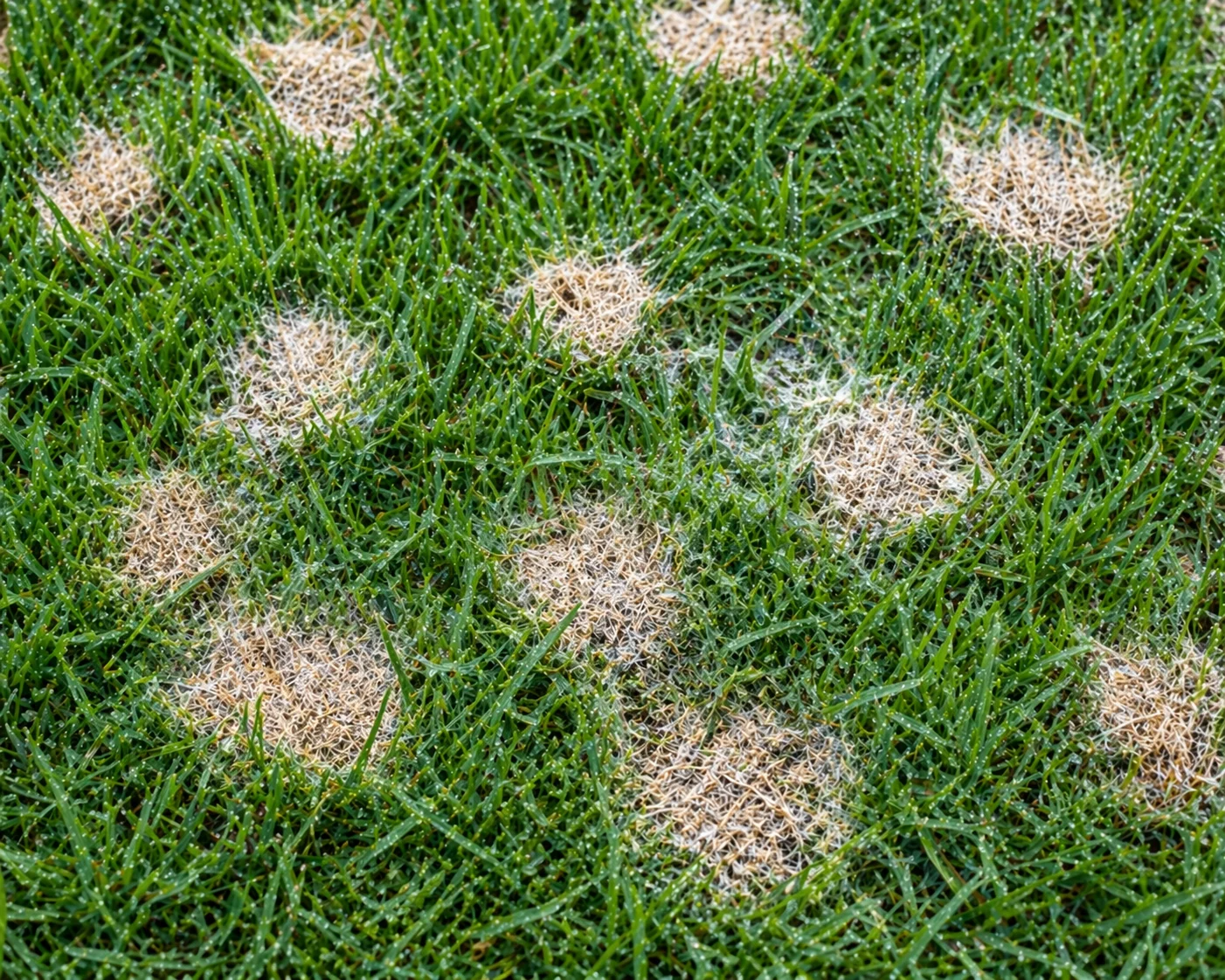
What Does Dollar Spot Look Like?
Dollar Spot produces small, circular, distinctively bleached or tan patches that are remarkably consistent in size — the silver-dollar comparison (roughly 5–7 cm diameter, or about 2–3 inches) is apt and diagnostic. On close-mowed turf like golf courses, patches stay discrete and small. On home lawns mowed at normal heights, patches can merge into larger irregular areas, but the individual component circles usually remain visible as distinct 5–7 cm units within the larger merged area.
Individual grass blade lesions are highly diagnostic. Pull a grass blade from the edge of a Dollar Spot and examine it in good light. You'll see hourglass-shaped lesions — a tan or bleached center band surrounded by reddish-brown or purple-brown margins, spanning the width of the blade. The hourglass shape is unique to Dollar Spot; no other lawn fungus produces this pattern. Multiple lesions per blade are common, producing a banded or striped appearance.
White cottony mycelium is visible on grass blades in early morning dew during active infections. The mycelium looks like thin spider webs draped across blades. This is one of the most diagnostic features when present, and it disappears as dew dries — so early morning inspection is essential. Combined with the characteristic small patch size and hourglass blade lesions, these three features identify Dollar Spot with high confidence.
Differentiation from similar problems: Brown Patch produces much larger circular patches (15 cm to 1 m+) with a dark smoke ring. Red Thread produces pink-red mycelium rather than white, and typically affects Fine Fescue rather than most grass types. Drought produces blade-tip browning rather than banded blade lesions. Dog urine produces dark green rings around dead centers without banded blade patterns.
What Causes Dollar Spot?
Dollar Spot is caused by the fungus Clarireedia jacksonii (formerly classified as Sclerotinia homoeocarpa — the name changed in 2018 after reclassification). Unlike Brown Patch which thrives in hot humid summer conditions, Dollar Spot is a cool-season disease with two distinct peak periods each year: spring (April through June) and fall (September through October) when daytime temps are 15–25°C and nights are cool and dewy.
The fungus survives between active seasons as stromata — small black fungal resting structures — embedded in thatch and surface soil. These stromata can persist for years, producing infectious mycelium whenever environmental conditions favor disease. This is why Dollar Spot tends to recur in the same specific areas of a lawn year after year — once the stromata are present in a particular spot, reinfection is likely.
Environmental triggers are cool night temperatures combined with heavy morning dew. Dews that persist into mid-morning (rather than drying at sunrise) provide the sustained leaf wetness required for infection. Unlike Brown Patch which needs sustained warm nighttime temperatures, Dollar Spot thrives in the temperature transition zones of spring and fall — essentially anytime nights are cool enough to produce heavy dews and days are warm enough for active grass growth.
Which Grasses Are Most Affected?
Dollar Spot affects virtually every common lawn grass species — no grass is truly resistant. Susceptibility varies but the disease is the most universal US lawn fungus.
Creeping Bentgrass on golf course putting greens and fairways is the primary target of Dollar Spot nationally — the combination of very close mowing (2–3 mm) and sustained moisture creates ideal conditions for the disease. Residential lawns with Bentgrass are rare, but the disease pressure is the same. For home lawn owners, Bermuda Grass and Kentucky Bluegrass are the most commonly affected species, with Perennial Ryegrass (often present in overseeded southern lawns) also showing significant pressure.
No grass variety is truly Dollar Spot resistant — the fungus has such a broad host range that all breeding programs have focused on tolerance rather than immunity. Some newer cultivars show improved tolerance: Dollar Spot-tolerant Bentgrass varieties (Declaration, Flagstaff) have 40–50% lower disease severity than older cultivars. Tall Fescue varieties show natural variation in susceptibility with newer RTF varieties slightly more tolerant than older Kentucky 31. Variety selection can moderate but not eliminate Dollar Spot pressure.
| Grass Type | Susceptibility | Primary Season | Notes |
|---|---|---|---|
| Creeping Bentgrass | VERY HIGH | Year-round | Golf course primary target |
| Bermuda Grass | HIGH | Spring + Fall | Hybrid varieties particularly vulnerable |
| Perennial Ryegrass | MODERATE–HIGH | Spring + Fall | Common on overseeded lawns |
| Kentucky Bluegrass | MODERATE | Spring + Fall | Widespread home lawn issue |
| Zoysia | MODERATE | Spring + Fall | Less damaging than cool-season impact |
| Tall Fescue | LOW–MODERATE | Spring + Fall | Deep roots provide some resistance |
| St. Augustine | LOW–MODERATE | Cool periods | Less common in Florida year-round climate |
| Centipede | LOW | Rare | Rarely affected |
| Fine Fescue | LOW | Rare | Generally resistant |
The Low Nitrogen Connection
Dollar Spot is uniquely linked to low nitrogen fertility — the opposite of Brown Patch, which is worsened by excessive nitrogen. Nitrogen-stressed, slow-growing turf is significantly more susceptible to Dollar Spot than adequately-fertilized turf. University trials consistently show 40–70% lower Dollar Spot incidence on plots receiving adequate nitrogen versus under-fertilized plots.
The biological mechanism is straightforward: rapidly growing grass tissue produces more active defense compounds (phenolic antifungals, wound-response proteins) than slow-growing tissue, and actively growing plants recover from disease damage faster through tillering and new leaf production. Nitrogen-starved plants grow slowly, mount weaker defenses, and cannot outpace disease progression through active growth.
The practical implication: applying a light nitrogen dose during active Dollar Spot infection can actually help suppress the disease — essentially the only lawn fungal disease where this is true. Apply 10–15 g/m² actual nitrogen (e.g., a 20-0-10 fertilizer at 50–75 g/m²) at the first sign of Dollar Spot symptoms. Response is visible in 10–14 days as grass tillering fills in affected patches. This nitrogen-response approach is the primary treatment for mild Dollar Spot outbreaks on home lawns.
The fertilization timing implication for prevention: don't underfertilize cool-season grasses in spring and fall when Dollar Spot pressure is highest. Spring applications of 15–20 g/m² actual N in April and May, plus fall applications of 15–25 g/m² actual N in September and October, provide the sustained moderate nitrogen levels that keep Dollar Spot pressure at bay.
Dollar Spot Calendar — When to Expect It
Peak Dollar Spot periods are spring and fall when daytime temps are 15–25°C and overnight dews are heavy. Summer and winter are typically Dollar Spot-free.
Coastal regions with mild summers can see extended Dollar Spot seasons that don't fully break during summer heat. The Pacific Northwest (Seattle, Portland) often sees continuous Dollar Spot pressure from April through October with only brief midsummer reductions. California coastal regions (San Francisco Bay Area) similarly see year-round pressure on susceptible lawns. In these climates, continuous preventive management is more cost-effective than spot treatment.
The summer gap in most of the country is a useful window for cultural work. Overseeding into thin areas, aeration, and thatch management are safer during the summer gap than during active spring or fall disease periods. Plan major cultural interventions for the July–August period rather than risking stress on actively-diseased turf.
| Region | Spring Peak | Summer Gap | Fall Peak | Winter Status |
|---|---|---|---|---|
| Northeast (NY, PA, NJ) | April–June | July–Aug (rest) | September–October | Dormant |
| Mid-Atlantic (VA, MD, DC) | April–June | July–Aug (rest) | September–October | Dormant |
| Southeast (GA, FL, SC) | March–May | June–Sept (active) | Oct–Nov | Year-round possible |
| Transition Zone (NC, TN, KY) | April–June | July–Aug (partial) | September–November | Dormant |
| Midwest (OH, IL, IN) | May–June | July–Aug (rest) | September–October | Dormant |
| Pacific NW (WA, OR) | April–July | Varies | September–November | Dormant |
| California Coastal | March–May | Varies | September–November | Year-round possible |
| Upper Midwest (MN, WI) | May–June | July (rest) | August–October | Dormant under snow |
Mowing Height and Dollar Spot Risk
Mowing height has a dramatic effect on Dollar Spot severity — the relationship is essentially exponential with close mowing. Golf course putting greens mowed at 2–3 mm receive Dollar Spot pressure that requires 10–15 fungicide applications per season to manage. Home lawns mowed at 65 mm receive occasional pressure manageable with cultural controls alone. The same grass species at 25 mm can have 10x higher Dollar Spot incidence than at 75 mm.
The mechanism combines several factors: closely-mowed turf produces denser humid microclimates at the soil surface, reduces air circulation, limits root depth (shallower water uptake means more drought stress), and physically reduces the leaf surface area available for photosynthesis and defense. All of these factors increase Dollar Spot susceptibility simultaneously.
For home lawns, the practical recommendation is: mow at the high end of your grass type's recommended range during Dollar Spot seasons. Tall Fescue: 90–100 mm in spring and fall. Kentucky Bluegrass: 75–90 mm. Bermuda Grass: 40–50 mm during cool season transitions (higher than summer recommendations). Perennial Ryegrass: 50–75 mm. Avoid scalping — never remove more than one-third of blade height in a single mowing.
Spring scalping is a common practice that dramatically increases spring Dollar Spot. Many homeowners do a very-low first mow in early spring to remove winter debris and 'reset' the lawn. This scalping stress combined with the cool wet spring conditions creates ideal Dollar Spot environments. Skip the spring scalp — do a normal-height first mow, then gradually remove debris over 2–3 subsequent mowings.
Thatch and Drought Stress
Thatch over 12 mm thick provides a reservoir for Dollar Spot stromata (resting structures) between active seasons. The stromata persist in moist thatch for years and release fresh infectious mycelium whenever conditions favor the disease. Lawns with chronic thatch problems experience continuous Dollar Spot pressure because the pathogen population never declines even in adverse conditions.
Thatch also reduces water infiltration into the soil, forcing grass to rely on shallow surface moisture and creating chronic mild drought stress. Drought-stressed grass is more susceptible to Dollar Spot because the plant cannot mount full defense responses and cannot recover quickly through tillering. This compounds the thatch problem — thick thatch simultaneously houses the pathogen and weakens the host.
Annual core aeration is the single most effective long-term control for lawns with persistent Dollar Spot problems. Fall aeration (September–October for cool-season grasses) pulls physical thatch cores, reduces thatch accumulation over time, and improves drainage and root depth. Combined with overseeding, fall aeration can reduce Dollar Spot pressure by 50% or more within 2–3 seasons on chronically-affected lawns.
Improve drainage in chronic wet areas. If specific sections of your lawn remain wet for 24+ hours after rain, they will develop Dollar Spot repeatedly regardless of other controls. French drains, grading adjustments, or conversion to drought-tolerant native plantings in wet zones are permanent fixes. Consumer-grade soil wetting agents (Revolution, Hydraway) can help in mildly wet areas but are not sufficient for chronic drainage problems.
Dollar Spot Fungicide Guide
Multiple chemistry classes provide effective Dollar Spot control. Resistance management through rotation is important given the disease's widespread nature.
Resistance management is essential for long-term Dollar Spot control. The disease has developed documented resistance to iprodione, thiophanate-methyl, and certain SDHI fungicides in regional outbreaks. Best practice is to rotate between chemistry classes: apply a strobilurin (azoxystrobin, fluoxastrobin) one cycle, a triazole (propiconazole, myclobutanil) the next cycle, an SDHI (boscalid, penthiopyrad) the next. Never apply the same active ingredient three consecutive times.
Consumer homeowner products: Scotts DiseaseEx (azoxystrobin), Spectracide Immunox (myclobutanil), BioAdvanced Fungus Control (propiconazole), and Ortho MAX Lawn Disease Control (various combinations) are the most common retail options. Apply at label rates every 14–21 days during active disease periods. Typical DIY cost is $25–$40 per 5,000 sq ft per application, making the season-long cost $100–$200 for a standard home lawn.
Professional applications run $80–$150 per 5,000 sq ft per visit, typically scheduled every 21–28 days using commercial-grade fungicides with longer residual activity. For lawns with chronic Dollar Spot, 4–6 professional applications per year typically provide complete control; total annual cost $400–$900. Many homeowners find the professional route more cost-effective than DIY because commercial products provide longer control intervals.
| Active Ingredient | Efficacy | Application Interval | Notes |
|---|---|---|---|
| Propiconazole | Excellent | 14–21 days | Curative + preventive, broad use |
| Thiophanate-methyl | Good | 14 days | Cleary's 3336; low cost |
| Iprodione | Excellent | 14 days | Resistance documented; rotate |
| Azoxystrobin | Good (preventive) | 21–28 days | Best used preventively |
| Boscalid (SDHI) | Excellent | 21–28 days | Resistance emerging; rotate |
| Penthiopyrad (SDHI) | Excellent | 21–28 days | Newer chemistry; rotate |
| Chlorothalonil | Good (preventive) | 14–21 days | Contact fungicide; multi-site action |
| Fluoxastrobin | Excellent | 21–28 days | Strobilurin; rotate with triazoles |
Organic and Cultural Control
Compost topdressing is the most effective organic Dollar Spot management practice. Research trials show 30–50% reduction in Dollar Spot severity in topdressed plots versus non-topdressed plots over 2–3 years. The mechanism is introduction of beneficial soil microorganisms that compete with and antagonize Clarireedia, combined with improved soil structure that reduces drought stress and thatch accumulation. Apply 6–10 mm compost topdressing once or twice annually in fall.
Adequate nitrogen during active disease is itself an organic control. Apply light nitrogen (10–15 g/m² actual N) at first symptoms and again 3 weeks later. Use organic sources like alfalfa meal, feather meal, or pelletized poultry manure for slower-release nitrogen that supports continued tillering without the disease flush risk of synthetic urea.
Biofungicides based on Bacillus subtilis (Serenade, Rhapsody) show modest but real efficacy on Dollar Spot — approximately 40–50% of the control provided by conventional chemical fungicides. These products are worth considering for mild outbreaks on smaller lawns where fungicide exposure is a concern. Apply every 14 days during active disease periods.
Rolling has emerged as a surprising partial control. Research from Wisconsin-Madison demonstrates that daily or twice-weekly lawn rolling with a standard turf roller reduces Dollar Spot incidence by 40–50% on golf course greens. The mechanism is debated but likely involves physical disruption of developing mycelium and denser turf canopy that resists infection. For home lawns, rolling is impractical but the finding confirms that any cultural practice improving turf density helps Dollar Spot resistance.
Recovery and Overseeding
Dollar Spot rarely kills grass permanently on home lawns — the characteristic small patches contain dead leaf blades but the crowns and roots typically remain viable. Recovery through natural tillering fills in damaged areas over 3–4 weeks in favorable conditions. This natural recovery is significantly faster than Brown Patch recovery because the individual patches are smaller and the surrounding healthy turf is closer to the dead zones.
For accelerated recovery, apply a light nitrogen dose (10–15 g/m² actual N) once disease pressure subsides and the fungicide treatment has stopped active infection. The nitrogen stimulates tillering and accelerates fill-in of dead spots. Water deeply after nitrogen application. Recovery is typically complete in 2–3 weeks rather than the 4–6 weeks it would take without fertilization.
Persistent thin or bare areas may benefit from overseeding in fall (September–October for cool-season grasses, late winter through early spring for warm-season). Apply Dollar Spot-tolerant varieties at label rates on prepared soil in affected areas. Good seed-to-soil contact is essential — rake the area lightly or top-dress with compost before applying seed. Water 2–3 times daily for the first 10 days to maintain soil moisture during germination.
For severely affected lawns (more than 25% affected cumulatively), consider complete fall overseeding across the entire lawn with improved disease-tolerant varieties. RTF Tall Fescue, Declaration Bentgrass (if applicable), and newer Kentucky Bluegrass cultivars with improved Dollar Spot tolerance can substantially reduce pressure in subsequent seasons. Fall overseeding also addresses thatch and density issues simultaneously.
Dollar Spot vs. Other Similar Lawn Problems
Accurate identification is essential — the wrong treatment on the wrong disease wastes money and lets the actual problem spread.
The single most reliable Dollar Spot diagnostic is the hourglass blade lesion combined with white cottony mycelium visible in morning dew. If you see both of these features, the diagnosis is confirmed. If you see patches of the right size but the blade lesions don't show the hourglass pattern, consider other causes — particularly drought stress on close-mowed lawns, which can produce similarly-sized dead spots without the characteristic fungal signatures.
| Condition | Patch Size | Blade Lesion | Mycelium | Best Diagnostic |
|---|---|---|---|---|
| Dollar Spot | 5–7 cm silver dollar | Hourglass, tan band + dark edge | White in morning dew | Hourglass blade lesion |
| Brown Patch | 15 cm – 1 m+ | Blighted from sheath up | White, only at patch edge | Smoke ring border |
| Red Thread | 5–25 cm | Bleached with pink threads | Pink-red threads | Pink threads definitive |
| Drought stress | Variable, follows dry areas | Brown from tip down | None | Blade-tip browning |
| Dog urine | 10–30 cm with dark ring | Dead center, green ring | None | Pattern near trees/dog paths |
| Fertilizer burn | Variable, follows pattern | Uniform yellowing | None | Spreader track pattern |
| Chinch bug damage | Expanding yellow-to-brown | Sucked/desiccated look | None | Sunny hot edges first |
Frequently Asked Questions
Why does dollar spot come back every year?
Dollar Spot survives between seasons as stromata — black fungal resting structures — embedded in thatch and surface soil. These persist for years, producing fresh infectious mycelium whenever conditions favor disease. The same areas of a lawn tend to recur year after year because the local stromata population is established. Reducing thatch, improving drainage, and applying compost topdressing annually reduces stromata populations over 2–3 seasons and breaks the recurrence cycle.
Can fertilizing really help get rid of dollar spot?
Yes — this is the one lawn disease where nitrogen fertilization can actively suppress the disease. Nitrogen-stressed grass is significantly more susceptible to Dollar Spot, and nitrogen application during active infection stimulates tillering and defense responses that help the lawn outpace disease damage. Apply 10–15 g/m² actual N at first symptoms. This is the opposite of Brown Patch, where nitrogen worsens disease.
Is dollar spot worse after aerating?
Temporarily yes — the wounds from aeration create short-term infection sites. However, annual aeration reduces long-term Dollar Spot pressure significantly by reducing thatch (which houses the pathogen). The best timing is aeration in early fall after summer stress has passed but before active Dollar Spot pressure resumes — typically early September in the transition zone. Avoid aerating during active disease outbreaks.
Can I overseed dollar spot patches in fall?
Yes — fall overseeding is an excellent strategy for persistent Dollar Spot damage. Apply Dollar Spot-tolerant varieties (newer RTF Tall Fescue, improved Kentucky Bluegrass cultivars) at label rates after disease pressure subsides. Good seed-to-soil contact is essential — rake the area or top-dress with compost first. Water 2–3 times daily for 10 days to support germination. Young seedlings are less susceptible to Dollar Spot than older stressed stands.
What's the difference between dollar spot and brown patch?
Size is the primary distinction — Dollar Spot produces 5–7 cm silver-dollar-sized circles, while Brown Patch produces much larger 15 cm to 1 m+ patches. Season: Dollar Spot peaks in spring and fall; Brown Patch peaks in summer. Blade lesions: Dollar Spot produces distinctive hourglass-shaped bands; Brown Patch blights blades from the sheath upward. Mycelium: Dollar Spot has white mycelium visible on blades; Brown Patch has white mycelium only at patch edges with a distinct smoke ring border.
About the Author
Lawn Care Expert & Writer · Denver, Colorado · Florida State University
Jason Allen is a lawn care expert and freelance writer based in Denver, Colorado. He studied turfgrass science and horticulture at Florida State University before founding his own lawn care operation serving the Denver metro area. With over a decade of hands-on experience managing cool-season lawns in Colorado's challenging high-altitude climate, Jason specializes in aeration, fertilization timing, drought management, and water-restriction compliance. His practical, science-backed approach to lawn care has helped thousands of homeowners achieve healthy turf despite Colorado's short growing seasons, clay soils, and frequent drought conditions.