Brown Spots in Lawn: 10 Causes and How to Fix Them
Published:

Brown spots in a lawn come from ten distinct causes, and each requires a different fix. Circular tan patches with darker edges are usually Brown Patch fungus. Straw-coloured irregular patches in mid-summer are often Chinch Bug damage in the South. Brown patches that peel up like carpet are grub damage. Brown with a green ring is dog urine. Working through the diagnostic patterns below saves months of wrong treatments and gets the right fix applied the first time.
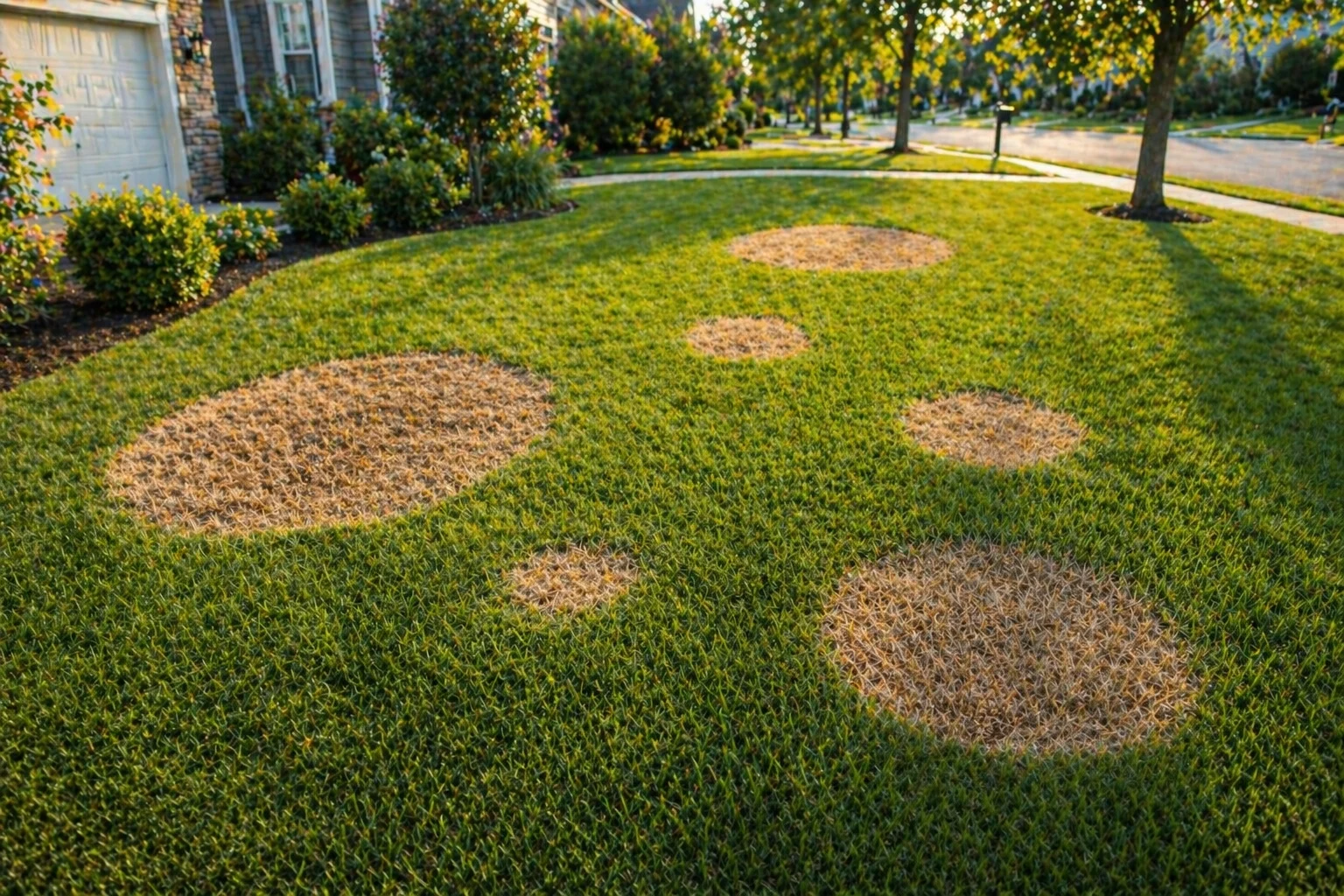
Diagnose by Pattern
| Pattern You See | Season | Most Likely Cause |
|---|---|---|
| Circular tan patches, 2–12 inches, darker edge | Summer, humid conditions | Brown Patch fungus |
| Straw-coloured irregular patches, spreading | Summer, hot South | Chinch bugs (South) or Sod Webworm |
| Brown patches that peel up like carpet | Late summer – early fall | White grub damage |
| Small silver-dollar-sized circular patches | Spring or fall, cool-season | Dollar Spot fungus |
| Brown centre with green outer ring | Any time | Dog urine burn |
| Brown strips after fertiliser application | Any time | Fertiliser or chemical burn |
| Brown only in shaded areas | Summer, humid | Shade + disease combination |
| Entire lawn brown, not patches | Summer (cool-season grass) | Heat dormancy, normal |
| Brown + water not absorbing | Summer, sandy soil | Hydrophobic soil (dry patch) |
| Brown patches after heavy mow | Any | Scalping or dull blade |
1. Brown Patch Fungus (Rhizoctonia solani)
The most common summer disease of American lawns. Brown Patch appears as circular tan-to-brown patches ranging from 2 inches to 6+ feet in diameter. A distinctive darker 'smoke ring' often surrounds actively spreading patches in the early morning when dew is still present.
Conditions: night temperatures above 65°F, leaf wetness exceeding 10 hours, high humidity. Tall Fescue is the most susceptible cool-season grass; St. Augustine is the most susceptible warm-season grass in Florida and the Gulf Coast. Excess nitrogen worsens outbreaks dramatically, an early-July fertiliser application on Tall Fescue is the classic trigger.
Fix: apply a propiconazole, azoxystrobin, or myclobutanil fungicide at label rate. Single application halts active spread in most cases; repeat in 14 days if new patches emerge. Improve air flow by trimming overhanging shrubs; water early in the day so blades dry by noon; avoid evening watering entirely during humid summer weather.
Prevention: maintain correct mowing height (3–4 inches on Tall Fescue), avoid summer nitrogen on cool-season grass, water deeply but infrequently before sunrise.
2. White Grub Damage
Beetle larvae, Japanese Beetle, June Beetle, European Chafer, feed on grass roots below the surface. Damage appears as irregular brown patches that spread outward, and the defining feature is that damaged grass lifts like a loose carpet when pulled because no roots are holding it in place.
Diagnostic test: pull a suspect patch. If it peels back easily and the soil beneath shows C-shaped white larvae, you have a grub infestation. Three or more grubs per square foot warrants treatment.
Fix: apply a granular insecticide containing imidacloprid or chlorantraniliprole at label rate. Time the application for early-to-mid summer when larvae are young and feeding near the surface. Water the product in with ½ inch of irrigation to move it into the root zone where grubs feed.
Prevention: preventive chlorantraniliprole application in June provides 3 months of protection. Milky spore powder (organic biological control) provides long-term Japanese Beetle control on permanently-sited lawns, though it takes 2–3 years to build populations to effective levels.
3. Dog Urine Spots
Concentrated nitrogen in dog urine, especially from females who squat and deliver full volume in one location, burns grass the same way over-applied fertiliser does. The signature pattern: a dead brown centre ring with a dark green outer ring. The outer green ring is where nitrogen concentration diluted to a fertilising (not burning) level.
Fix: flush the affected spot with 3–5 gallons of water immediately after the dog urinates, if you can catch it. After burn damage occurs, overseed the spot with matching grass type, seedlings establish faster than mature turf fills in from the edges.
Prevention: designate a gravel or mulched pee area and train the dog to use it. For large female dogs on Kentucky Bluegrass lawns, this may be the only practical solution. Urine-neutraliser dietary supplements have mixed evidence; don't rely on them as a sole strategy.
4. Chinch Bug Damage (Southeast / Florida)
Chinch bugs are the primary insect pest of St. Augustine lawns in Florida, the Gulf Coast, and the Carolinas. They suck plant juices from grass blades and inject a toxin that kills the tissue, producing spreading patches of straw-coloured dead grass, especially in sunny, hot, dry areas near driveways and sidewalks.
Diagnostic test: the 'coffee can' flotation test. Cut the bottom out of a large metal coffee can, push it into the ground at the edge of a damaged area, fill with water, and watch for 10 minutes. Chinch bugs float to the surface.
Fix: apply a bifenthrin or lambda-cyhalothrin insecticide targeting the edge of active damage. Treat twice, 10–14 days apart, to catch both adult bugs and newly hatched nymphs. Water the lawn deeply after application to drive the chemical into the thatch layer where chinch bugs live.
Prevention: maintain St. Augustine at 3.5–4 inches mowing height, water deeply but infrequently, avoid excess nitrogen, and treat preventively in May–June if your neighbourhood has a history of infestation.
5. Dollar Spot Fungus
Dollar Spot creates small (silver-dollar sized, 1–3 inch) circular patches with bleached straw-coloured leaves. Multiple spots can merge into larger irregular areas as infection spreads. Common on Kentucky Bluegrass, Tall Fescue, Perennial Ryegrass, Bermuda, and Zoysia.
Conditions: warm days (70–85°F) and cool, dewy nights. Nitrogen-deficient grass is especially vulnerable because low nitrogen slows leaf growth and keeps infected tissue in place longer.
Fix: first, apply a light nitrogen fertiliser (½ lb actual N per 1,000 sq ft). Many Dollar Spot outbreaks resolve with nitrogen alone. If spots continue spreading, apply a thiophanate-methyl or propiconazole fungicide. Avoid evening watering; water early in the morning.
Prevention: maintain adequate nitrogen during spring and fall, mow at the correct height, avoid dew retention by watering before dawn rather than late in the day.
6. Drought Stress
Prolonged drought produces uniform browning across the lawn or irregular patches on high-exposure areas (south-facing slopes, areas near pavement that reflects heat). The diagnostic signature is the screwdriver test, probe the soil; if the tool meets resistance in the top 2 inches, the soil is bone-dry.
Cool-season grasses (Kentucky bluegrass, perennial ryegrass) typically last 7 to 21 days without water before browning begins, and can survive 4 to 6 weeks of dormancy before crown damage starts. Tall fescue extends that survival window to 28+ days thanks to its deeper root system. Warm-season grasses (Bermuda, zoysia, St. Augustine) tolerate 30 to 60 days of drought once established.
If brown spots are spreading across most of the lawn rather than appearing in isolated patches, drought stress (rather than disease or insect damage) is the likely cause. The recovery technique is cycle-and-soak watering: 3 to 4 short cycles separated by 10 to 15 minute soak intervals deliver moisture deep to the root zone without runoff loss. See our complete watering protocol in the [water restrictions survival guide](/how-to-keep-lawn-alive-water-restrictions).
Fix: water deeply. Apply 1 inch in a single session early in the morning, then repeat in 3–4 days. For cool-season lawns, some drought dormancy is acceptable, don't over-water trying to force green during July heat. Warm-season lawns are more drought-tolerant but still recover faster with deep watering.
Distinguish drought from overwatering: both produce brown grass, but drought soil is hard and dry while overwatered soil is soft and waterlogged. The screwdriver test is definitive.
7. Fertiliser / Chemical Burn
Over-applied fertiliser or herbicide produces strip-shaped or patchy brown damage, usually appearing within 24–72 hours of application. Common causes: spreader overlap on the edges, paused application in one spot, liquid concentrate applied at too-strong dilution, spot-spray herbicide over-application.
Fix: flush the affected area with 3–4 inches of water spread over 3–4 days. Do not apply more fertiliser, over-application is usually the cause, not the solution. Severely burned grass may need overseeding once the soil has been leached.
Prevention: calibrate your spreader before each application, apply in perpendicular directions (two light passes beat one heavy pass), and water-in granular products within 24 hours of application.
8. Hydrophobic Soil (Dry Patch Disease)
Sandy or heavily thatched soils can develop a waxy organic coating on soil particles that repels water. Irrigation beads on the surface and runs off rather than penetrating the root zone, producing brown drought-stressed patches that don't respond to normal watering.
Diagnostic test: pour water from a watering can onto the suspect area; if water beads up or runs off, soil is hydrophobic.
Fix: apply a soil wetting agent (Wettasoil, SaturAid, Hydretain) at label rate, water in deeply, and repeat 30 days later if symptoms persist. For severe cases, hand-fork the affected area to break the crust and allow water to penetrate.
Prevention: maintain thatch below ½ inch through aeration and dethatching; apply a preventive wetting agent each spring in sandy-soil regions (Florida, Arizona, coastal Carolinas, Perth).
9. Shade Stress
Grass in shaded areas, under tree canopies, north-facing walls, dense hedges, receives insufficient sunlight for normal photosynthesis. Weak, thin grass in shade is more susceptible to disease and cannot recover from minor stress.
Fix: assess sunlight reality. Most lawn grasses need 4+ hours of direct sun daily; less than 4 hours and no conventional grass performs well. Options: prune overhanging trees to increase light penetration; overseed with shade-tolerant blends (Fine Fescue, Fine Fescue + KBG mix); or replace grass with shade-tolerant ground cover (pachysandra, vinca, English ivy).
St. Augustine is the most shade-tolerant warm-season lawn grass but still needs 4+ hours. Fine Fescue is the most shade-tolerant cool-season grass and can tolerate 3 hours in mild climates.
10. Thatch-Related Problems
Heavy thatch (over ½ inch) creates a spongy layer between soil and grass that blocks water, nutrients, and air from reaching the root zone. Symptoms: brown patches that don't respond to fertiliser or water, soft underfoot feel, visible straw-coloured layer when you pull a grass plug.
Fix: dethatch the lawn using a power dethatcher or verticutter rental ($75–$150/day). Time the work for active growth, spring for warm-season grass, fall for cool-season. Follow with overseeding if the lawn is thin after dethatching.
Prevention: avoid over-fertilisation (excess nitrogen drives thatch buildup), mulch-mow rather than bag clippings (healthy microbial activity breaks down thatch naturally), aerate annually on clay soils.
Diagnostic Tests
The soil screwdriver test: push a long screwdriver into the suspect area. If it goes in easily to 6 inches, soil is well-watered (possibly overwatered). If it meets resistance in the top 2 inches, soil is dry. This test distinguishes drought from overwatering in 10 seconds.
The pull test: grasp a handful of grass in a brown patch and tug firmly. If grass pulls up easily with no resistance (no roots), grubs or root rot. If grass resists pulling but individual blades break off (crowns still in ground), disease or drought. If nothing budges and the grass is firmly rooted, the issue is likely chemical burn, mower damage, or dormancy.
The coffee-can flotation test: cut both ends from a large metal can, push it 1 inch into the soil at the edge of damage, fill with water. Wait 10 minutes. Chinch bugs and sod webworm larvae float to the surface.
Frequently Asked Questions
Why do I have brown spots after fertilising?
Fertiliser burn from over-application, spreader overlap, or applying to wet grass. Flush the affected area with 3–4 inches of water over 3–4 days to leach excess nitrogen out of the root zone. Most fertiliser burn recovers in 2–4 weeks if the crowns weren't killed. Re-seed severely damaged patches.
How do I tell if brown spots are fungus or insects?
Fungus: circular patches, often with a darker edge ring, no visible insects, appears after humid weather. Insects: irregular patches that spread outward, grass pulls up easily (grubs) or bugs visible in coffee-can test (chinch bugs). Always rule out insects first, fungicide on an insect problem wastes money.
Will brown grass come back?
Yes in most cases. Dormant grass (drought, disease, heat stress) recovers with treatment of the root cause. Actually dead grass (crowns killed) doesn't come back, it needs overseeding or sodding. Use the pull test: if crowns are firm white tissue, recovery is possible; if crowns crumble, re-plant.
Should I fertilise brown spots to make them green again?
Only after you've identified the cause. Fertiliser worsens Brown Patch fungal disease, burn damage, and chemical injury. It helps Dollar Spot and nitrogen-deficiency yellowing. Diagnose first, treat second. Applying fertiliser as a universal fix often makes the problem worse.
When do brown spots need professional help?
Call a professional if: spots are spreading rapidly (doubling weekly), a lawn service application is suspected as the cause (liability matters), grub or chinch bug infestation exceeds 20% of the lawn area, or a fungicide spray is needed across more than 2,500 sq ft (equipment dosing is hard for homeowners). Small, slow-spreading brown spots are usually DIY-diagnosable.
About the Author
Lawn Care Expert & Writer · Denver, Colorado · Florida State University
Jason Allen is a lawn care expert and freelance writer based in Denver, Colorado. He studied turfgrass science and horticulture at Florida State University before founding his own lawn care operation serving the Denver metro area. With over a decade of hands-on experience managing cool-season lawns in Colorado's challenging high-altitude climate, Jason specializes in aeration, fertilization timing, drought management, and water-restriction compliance. His practical, science-backed approach to lawn care has helped thousands of homeowners achieve healthy turf despite Colorado's short growing seasons, clay soils, and frequent drought conditions.