When to Aerate Your Lawn (2026 Timing Guide)
Published:

Aerating at the wrong time isn't just a waste of money — it actively stresses your lawn by pulling soil cores during a period when the grass can't recover. Cool-season lawns (Kentucky Bluegrass, Fescue, Ryegrass) belong to the fall window; warm-season lawns (Bermuda, Zoysia, St. Augustine, Centipede) belong to late spring and early summer. This guide covers exact timing by grass type, region, and first-frost date, plus the reason wrong-season aeration kills otherwise healthy grass.
Aeration Timing by Grass Type
The right time to aerate is always when the lawn is in peak active growth. For cool-season grasses this is early fall; for warm-season grasses it is late spring and early summer. Aerating during dormancy or shoulder-season stress periods produces bare cores that don't fill in and invite weed colonisation.
| Grass Type | Best Time | States / Regions | Why |
|---|---|---|---|
| Kentucky Bluegrass | Late Aug – Oct | MN, ND, SD, MI, WI, IA, CO, WA, OR | Peak fall growth recovers holes fast |
| Tall Fescue | Early Sept – Oct | NC, VA, TN, KY, MO, KS, NE, North TX | Transition zone fall window |
| Perennial Ryegrass | Sept – Oct | Northeast, Pacific NW | Fall root establishment |
| Fine Fescue | Sept – Oct | Northeast, Midwest | Same window as KBG |
| Bermuda | Late May – June | TX, FL, GA, AL, MS, SC, LA, OK, AR | Active summer growth heals holes |
| Zoysia | Late May – July | Southeast, Transition | Slightly later than Bermuda |
| St. Augustine | May – July | FL, TX Gulf Coast, LA | Warm-season window |
| Centipede | May – June | GA, SC, coastal AL | Shorter active window |
| Bahia | May – July | Central / south FL | Warm-season |
| Buffalo Grass | Late May – June | TX, KS, CO (east) | Short window before summer heat |
Aeration Timing by Region
| Region | Best Month(s) | Grass Type | Notes |
|---|---|---|---|
| Pacific Northwest | Sept – Oct | Fescue, Ryegrass, KBG | Avoid waterlogged winter soils |
| Northeast | Sept – early Oct | KBG, Fescue, Ryegrass | Before first frost |
| Upper Midwest | Late Aug – Sept | KBG, Fescue | Earlier because of cold winters |
| Mid-Atlantic | Sept – Oct | Tall Fescue, KBG | Strong fall window |
| Southeast | May – June | Bermuda, Zoysia, St. Augustine | Not fall |
| Texas (warm-season) | May – June | Bermuda, St. Augustine, Centipede | Coastal and Central TX |
| Texas (cool-season zones) | Sept – Oct | Fescue | North Texas / Panhandle only |
| Mountain West | Late Aug – Sept | Fescue, KBG | Short growing season |
| Southwest (AZ, NM) | May – June | Bermuda, Zoysia | Deep watering essential after |
| Florida | March – May or Sept – Oct | St. Augustine, Bermuda, Bahia | Avoid summer peak heat |
Why Timing Matters More Than Technique
Every aeration conversation eventually circles back to the same point: timing beats technique. The goal of core aeration is to create open channels through compacted soil so water, air, and nutrients can reach the root zone. But pulled cores leave small bare circles across the lawn, and those circles only fill in when the grass is actively growing. Aerate during active growth and the holes close within two to three weeks; aerate during dormancy and they stay open for months, letting weeds colonise before the desired grass can recover.
Wrong-season aeration isn't merely ineffective — it's actively harmful. Aerating a dormant cool-season lawn in midsummer opens the crown of every plant to heat and drought stress at the worst possible time. Aerating a dormant warm-season lawn in fall leaves cores open throughout winter, where they compact again from rain and foot traffic before the grass wakes up. Either way the homeowner pays for compaction relief and loses the compaction relief plus healthy grass.
The single best piece of timing advice for any US lawn is: aerate when the grass is growing fastest. For KBG and Tall Fescue, that's early fall as soil temperatures drop from summer peaks but air remains mild. For Bermuda and Zoysia, that's late spring as soil crosses 65°F and day length climbs. The calendar is a guide; active growth is the trigger.
Cool-Season Lawn Aeration Timing (Fall Window)
Cool-season lawns — Kentucky Bluegrass, Tall Fescue, Perennial Ryegrass, Fine Fescue — have two peak growth periods each year: spring and fall. Fall is the better aeration window for two reasons. First, soil is still warm from summer, so roots grow aggressively into the open cores. Second, air temperatures are cooling, which reduces evaporation and heat stress on the exposed crowns. The sweet spot nationally is 1 September through 15 October, with later dates in the South and earlier dates in the Upper Midwest.
Do not aerate after the first frost in your region. A hard frost stops root activity completely, and cores pulled after the first frost remain open through winter. In Minnesota, Michigan, and the Dakotas the cutoff is often 1 October; in New York and Pennsylvania you can usually push to mid-October; in Tennessee and Virginia early November still works.
Spring aeration (March–April) is a legitimate secondary option if you missed the fall window. It pairs well with pre-emergent herbicide because aeration holes do not break the pre-emergent barrier if the pre-emergent is applied first and watered in before aeration. Apply pre-emergent, wait two weeks for the barrier to establish, then aerate — this sequence preserves crabgrass prevention while relieving compaction. Spring is less productive than fall because the grass has less time to recover before summer heat stress, but it beats skipping aeration for another year.
Warm-Season Lawn Aeration Timing (Spring / Summer Window)
Warm-season lawns — Bermuda, Zoysia, St. Augustine, Centipede, Bahia, Buffalo — green up from winter dormancy as soil temperatures rise. The aeration window opens when the lawn is fully green and actively producing new leaf blades and stolons. In most of the South, that's late May through early July depending on latitude and grass type.
Never aerate warm-season grass in fall. The grass is preparing for dormancy, not active recovery, and fall-aerated cores in the South will not fill in before the first frost. The damage shows up in spring green-up as thin, weed-invaded patches exactly where the aeration tines came down.
Bermuda is the forgiving warm-season choice — aerate any time between late May and mid-July. TifTuf and Tahoma 31 recover fastest because of aggressive stolon production. Zoysia is slower to heal and prefers June through mid-July; Empire Zoysia tolerates slightly earlier timing than Meyer or El Toro. St. Augustine is the most sensitive — keep aeration to May and early June before the peak July heat, and avoid aerating during a declared drought. Centipede should be aerated only if genuinely compacted; its shallow, slow growth habit makes aeration marginal in most suburban yards.
Signs Your Lawn Needs Aeration Now
If you see three or more of these signals, your lawn is overdue for aeration. Heavy clay soils (Texas Blackland, North Carolina Piedmont red clay, Washington DC silty clay) benefit from annual aeration on any suburban lot with kids, dogs, or regular foot traffic. Sandy soils (Florida coastal, Arizona, Long Island, Pacific Northwest glacial till) can go two to three years between aerations because they compact less readily.
- Water pools on the lawn after normal rainfall instead of soaking in — the #1 compaction signal
- Soil feels spongy underfoot because of thatch buildup over ½ inch
- Grass thins in high-traffic areas (walkways, play zones) despite adequate watering
- Soil cores removed with a probe or screwdriver feel like packed concrete
- Footprints stay visible in the lawn long after you walk across it
- Fertiliser applied at label rate produces minimal response — nutrients can't reach roots
How Often to Aerate
| Soil + Traffic | Frequency |
|---|---|
| Clay soil + high traffic (kids, dogs) | Annually — and consider spring + fall for cool-season |
| Loam soil + moderate traffic | Annually |
| Loam soil + low traffic | Every 2 years |
| Sandy soil + any traffic | Every 2–3 years |
| Sandy soil + low traffic (FL, coastal) | Every 3 years |
| New sod (first 12 months) | Do not aerate — roots still establishing |
What to Do Right After Aeration
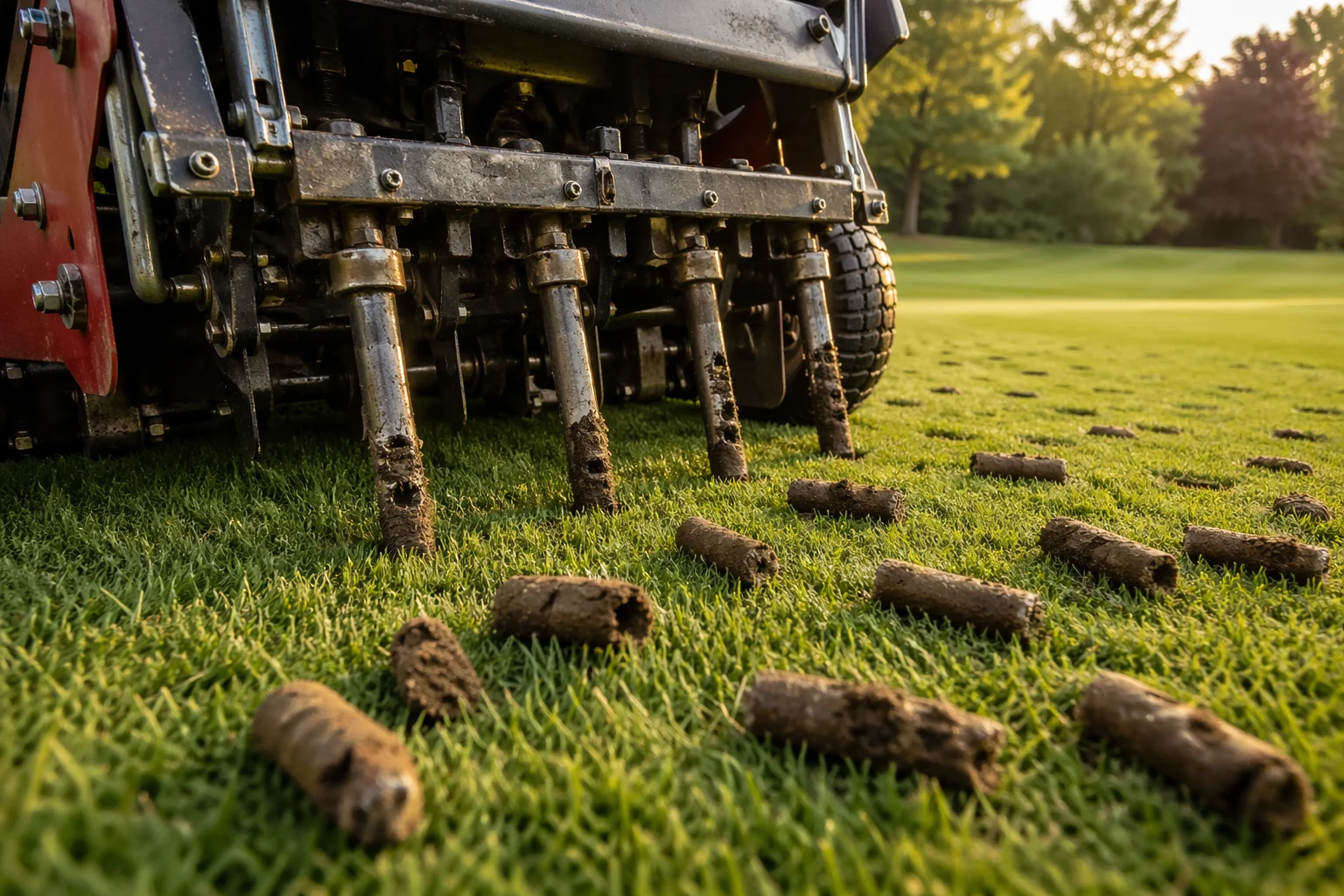
Leave the soil cores on the lawn surface. They look ugly for about a week but break down naturally in two to three weeks as rain and mowing grind them back into the canopy. Raking up cores defeats the purpose — you'd be removing the topdressing the aeration just created.
Overseed immediately after aeration if you have a cool-season lawn. The holes provide ideal seed-to-soil contact, and overseeding into fresh aeration cores is the single most effective stand-thickening technique available. Fall aeration + fall overseeding is the flagship combination for Kentucky Bluegrass, Tall Fescue, and Ryegrass lawns across the northern half of the country.
Apply a starter fertiliser within 48 hours of aeration. Nutrient uptake is maximised when roots are actively growing into fresh soil structure, and a phosphorus-rich starter formula (18-24-12 or similar) drives rapid root establishment if you overseeded. Water deeply for the next three days to keep the cores moist and accelerate fill-in.
Aeration + Overseeding: The Power Combination
The most effective and lowest-cost lawn renovation strategy available to homeowners is aerate + overseed + fertilise in a single visit during the ideal fall window. Aeration creates the channels; overseeding delivers fresh seed into those channels; starter fertiliser fuels the new seedlings and the recovering parent turf simultaneously. Professional services bundle the three tasks for $160–$425 on a 10,000 sq ft lot; the DIY equivalent using a rental slit-seeder ($100–$150/day) runs $60–$150 plus seed cost.
Timing the bundle: do not apply pre-emergent herbicide if you plan to overseed in the same season. Pre-emergents cannot distinguish between weed seed and desired grass seed — they prevent both from germinating. If you want both pre-emergent protection and overseeded turf, alternate years: overseed this fall, pre-emergent next fall. This is one of the most common timing mistakes in cool-season lawn care.
Frequently Asked Questions
Can I aerate in spring instead of fall?
Spring aeration is acceptable for cool-season grass as a secondary option if you miss the fall window. Apply any pre-emergent herbicide first, wait two weeks for the barrier to establish, then aerate. Spring aeration is less effective than fall because the grass has less recovery time before summer heat, but it beats skipping another year. For warm-season grass, spring (late May) is actually the primary window — not a secondary option.
Should I water before or after aeration?
Both. Water the lawn deeply the day before aeration so the soil is moist enough for tines to pull clean cores rather than shattering dry clay. Water immediately after aeration to help cores break down and close, and keep the lawn moist for the next three days. If you overseeded during aeration, water lightly two or three times a day for the first ten days to keep seeds from drying out.
Can I aerate a new lawn?
No. Sod laid within the last 12 months has not established a deep root system, and aeration will lift or shift the sod pieces. Newly seeded lawns are even more fragile — aeration kills seedlings. Wait a full growing season (ideally two) before the first aeration. After that, follow the grass-type timing in the table above.
Does aeration kill the grass?
No. Core aeration removes only small plugs of soil (typically 3 inches deep, ¾ inch wide), affecting a small fraction of the total lawn area. The grass around each core hole continues growing normally and fills the hole within two to three weeks during active growth. Aeration during dormancy is a different story — dormant grass cannot heal, and cores remain open until the next growth period. Timing is everything.
How long until the holes close up?
In cool-season grass during the fall window, aeration holes typically close in 10–21 days. In warm-season grass during the late-spring window, holes close in 7–14 days because of aggressive stolon growth. If holes are still visible after four weeks during the active-growth window, the lawn is under-watered or under-fed and needs follow-up care.
About the Author
Lawn Care Expert & Writer · Denver, Colorado · Florida State University
Jason Allen is a lawn care expert and freelance writer based in Denver, Colorado. He studied turfgrass science and horticulture at Florida State University before founding his own lawn care operation serving the Denver metro area. With over a decade of hands-on experience managing cool-season lawns in Colorado's challenging high-altitude climate, Jason specializes in aeration, fertilization timing, drought management, and water-restriction compliance. His practical, science-backed approach to lawn care has helped thousands of homeowners achieve healthy turf despite Colorado's short growing seasons, clay soils, and frequent drought conditions.