When to Overseed Your Lawn (2026 Guide)
Published:

Overseeding is the single best way to thicken a cool-season lawn, fight weed invasion, and introduce modern disease-resistant cultivars without tearing out the existing turf. But timing is everything. Overseed at the wrong time and the new seed either fails to germinate, gets outcompeted by summer weeds, or freezes in immature seedling form before its first winter. This guide covers the exact overseeding window by grass type and region, why the 45-day-before-first-frost rule drives everything, and why warm-season lawns generally should not be overseeded at all.
Overseeding Window by Grass Type
| Grass Type | Overseed Window | Region | Notes |
|---|---|---|---|
| Kentucky Bluegrass | Late Aug – Sept 15 | MN, MI, WI, ND, SD | 45+ days before frost; pairs with aeration |
| Tall Fescue | Aug 15 – Oct 1 | NC, VA, TN, KY, MO | Best: Aug 20–Sept 15 in most areas |
| Perennial Ryegrass | Sept – Oct | Northeast, PNW | Fast germinator; 7–10 day emergence |
| Fine Fescue | Sept – Oct | Northeast, shade areas | Slower; plant early in window |
| Bermuda | NOT RECOMMENDED | South | Spreads by stolons; seeding rarely works |
| Zoysia | NOT RECOMMENDED | Southeast | Primarily vegetative propagation |
| St. Augustine | NOT RECOMMENDED | FL, Gulf Coast | No viable seed; sod or plugs only |
| Bermuda + winter Rye overseed | Oct – Nov | FL, TX, AZ, GA | Temporary winter colour only |
First Frost Date vs Overseed Deadline
The standard rule is simple: grass seed needs 45 days (about six weeks) of active growth to establish a root system that will survive the first hard freeze. Work backwards from your average first frost date and you have your latest overseed day.
| City | Avg First Frost | Overseed By |
|---|---|---|
| Minneapolis, MN | Oct 7 | Aug 23 |
| Denver, CO | Oct 7 | Aug 23 |
| Boston, MA | Oct 17 | Sept 2 |
| Chicago, IL | Oct 26 | Sept 11 |
| Kansas City, MO | Nov 1 | Sept 16 |
| Nashville, TN | Nov 1 | Sept 16 |
| Charlotte, NC | Nov 12 | Sept 28 |
| Atlanta, GA | Nov 12 | Sept 28 |
| Seattle, WA | Nov 15 | Oct 1 |
| Philadelphia, PA | Oct 26 | Sept 11 |
| Pittsburgh, PA | Oct 21 | Sept 6 |
| Indianapolis, IN | Oct 24 | Sept 9 |
Why 45 Days Before First Frost Is the Rule
Grass seed germination is fast in warm soil. Perennial Ryegrass emerges in 7–10 days, Tall Fescue in 10–14 days, Kentucky Bluegrass in 14–28 days. But germination is only the first step — the seedling then needs to develop a root system deep enough to survive winter, produce enough top growth to photosynthesise through shorter fall days, and build carbohydrate reserves for spring green-up. That process takes roughly six weeks of active growth from emergence.
Overseed later than the 45-day mark and the seedlings enter dormancy with shallow roots and thin leaf blades. The first deep freeze kills them outright. Overseed earlier and the seedlings compete with summer weed pressure (crabgrass, spurge, prostrate spurge) that won't be present after the first frost. Early September is the sweet spot across most of the cool-season belt.
Dormant seeding (November through February) is a different strategy — broadcast seed into frozen ground so freeze-thaw cycles work it into the soil, then germination happens naturally in spring. It's a gamble and only viable in USDA zones 6 and warmer. Treat it as a last-resort option.
Spring Overseeding — When It's Worth It
Spring overseeding is always a second choice for cool-season lawns. Weed competition is fierce in April and May — crabgrass, foxtail, and annual weeds germinate faster than grass seedlings and choke out new growth before it establishes. The window is also short. Seed planted after mid-May rarely survives its first July heatwave because roots haven't reached depth.
Where spring overseeding does make sense: patchy winter damage repair on otherwise healthy lawns. Apply from the end of frost risk through early May. Choose fast-establishing species — Perennial Ryegrass or Turf-Type Tall Fescue blends — rather than slow KBG. And skip pre-emergent herbicide entirely if you spring-seed. Pre-emergent prevents all germination, including your new grass seed.
If your lawn needs a full overhaul (more than 40% bare or weedy), wait for fall. A well-executed fall renovation produces a better result than two mediocre spring attempts.
Warm-Season Lawns: Why Not to Overseed
Bermuda, Zoysia, St. Augustine, Centipede, and Bahia spread vegetatively through above-ground stolons and below-ground rhizomes. Their seed is either unreliable (Bermuda common seed produces inferior plants), not commercially available (St. Augustine, hybrid Bermuda), or slow and unsuitable for quick patching (Centipede, Bahia).
The right way to repair a warm-season lawn is plugs, sprigs, or sod. Cut plugs from a healthy section of the existing lawn, drop them into prepared holes in the bare area, and let the stolons connect up naturally over four to eight weeks during active growth. Sod is faster and more visually consistent — expect $0.90–$3.00 per sq ft installed for Bermuda or St. Augustine.
The one exception where overseeding warm-season lawn makes sense: winter ryegrass overseed for temporary green colour during Bermuda dormancy. Apply Annual Ryegrass or Perennial Ryegrass at 6–10 lb per 1,000 sq ft in October or November, once Bermuda has entered dormancy and is clearly brown. The rye grows all winter, then dies out naturally when Bermuda resumes in spring. Cost: $0.02–$0.05 per sq ft in seed.
Preparing for Overseeding
- Mow the existing lawn to 2 inches the day before — low enough that new seedlings get sunlight but high enough to shade the soil surface
- Dethatch if the thatch layer exceeds ½ inch — thatch blocks seed-to-soil contact and kills germination rate
- Aerate — the single most important pre-overseed step. Core aeration creates thousands of ideal micro-planting sites for new seed
- Rake or drag to break up soil cores and create surface texture that holds seed in place
- Check soil pH — lime to 6.0–7.0 if your test reads below 6.0 (common in Northeast and Pacific Northwest)
- Apply starter fertiliser (high phosphorus, e.g., 18-24-12) at the same time as seed — do not wait
Seed Rates and Application
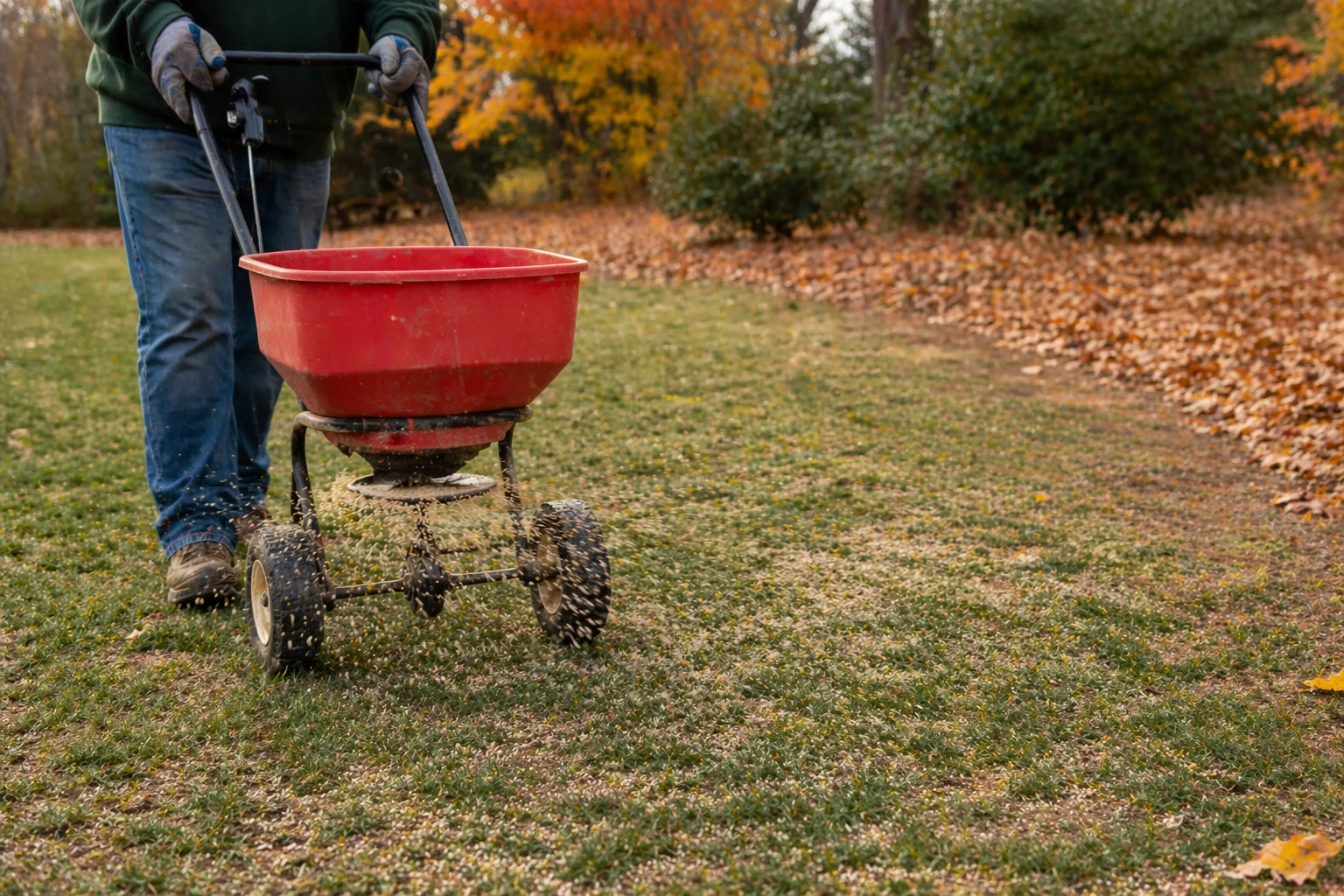
Use a broadcast spreader and make two perpendicular passes — each pass at half the calculated rate. This achieves even coverage without the streaks that single-direction spreading creates. Rake lightly after seeding to bury seed to about ¼ inch depth. Deeper burial prevents germination; surface seed dries out and fails.
| Grass Type | Overseed Rate | New Lawn Rate |
|---|---|---|
| Kentucky Bluegrass | 2–3 lb / 1,000 sq ft | 4–6 lb / 1,000 sq ft |
| Tall Fescue (Turf-Type) | 6–8 lb / 1,000 sq ft | 8–10 lb / 1,000 sq ft |
| Perennial Ryegrass | 7–9 lb / 1,000 sq ft | 10–12 lb / 1,000 sq ft |
| Fine Fescue blends | 4–5 lb / 1,000 sq ft | 6–8 lb / 1,000 sq ft |
| Transition mix (TTTF + KBG) | 5–6 lb / 1,000 sq ft | 7–9 lb / 1,000 sq ft |
After Overseeding — Care Calendar
Days 1–10: water lightly two to three times per day. The goal is to keep the top inch of soil moist without creating standing water. Morning and late-afternoon watering works best. Miss a day of irrigation during this period and germination rates can drop 40–60%.
Days 10–21: reduce to once-daily deep watering of roughly ½ inch. Seedlings now have emerging roots and can tolerate brief surface drying between waterings.
Day 21 and beyond: transition to normal deep, infrequent watering — roughly 1 inch per week in a single session. First mow when new grass reaches 3–4 inches, and use a sharp blade set at the recommended height for your grass type. Never remove more than ⅓ of the blade length in a single mow.
First post-overseed fertiliser: roughly six weeks after emergence, using a balanced 20-5-10 or similar. Do not apply post-emergent herbicide to newly overseeded lawn for at least 60 days — most broadleaf herbicides kill young grass seedlings.
Frequently Asked Questions
Can I overseed without aerating first?
You can, but results are dramatically worse. Seed broadcast onto undisturbed soil gets poor seed-to-soil contact and germination rates drop to 30–50%. Aeration plus overseeding routinely produces 80–90% germination. If you absolutely cannot aerate, at least dethatch and power rake before seeding to create surface disturbance.
Can I apply pre-emergent and overseed at the same time?
No. Pre-emergent herbicides cannot distinguish between crabgrass seed and your new lawn seed — they prevent all seed germination. Skip pre-emergent in any season when you plan to overseed. The one exception is Tenacity (mesotrione), which is labelled for use at seeding on specific grass types.
My Bermuda lawn is patchy — should I overseed?
No. Bermuda doesn't respond well to seeding, and available Bermuda seed produces inferior plants compared with hybrid cultivars. Patch Bermuda with plugs cut from the healthy section of your lawn, or with sod. Time the repair for late May or June during active growth.
What's the fastest-germinating grass seed?
Perennial Ryegrass emerges in 7–10 days from seed — the fastest of any cool-season lawn grass. Annual Ryegrass is even faster but dies out in summer heat. Turf-Type Tall Fescue emerges in 10–14 days. Kentucky Bluegrass is slowest at 14–28 days. Many modern sun/shade mixes blend Ryegrass with Fescue specifically for quick cover plus longer-term durability.
How long until an overseeded lawn looks full?
Visible thickening within three weeks. Full cover at about eight weeks. The lawn does not reach its mature appearance until the following growing season — roots deepen over winter and the seedlings tiller (produce side shoots) in spring. An overseeded lawn looks best a full year after planting.
About the Author
Lawn Care Expert & Writer · Denver, Colorado · Florida State University
Jason Allen is a lawn care expert and freelance writer based in Denver, Colorado. He studied turfgrass science and horticulture at Florida State University before founding his own lawn care operation serving the Denver metro area. With over a decade of hands-on experience managing cool-season lawns in Colorado's challenging high-altitude climate, Jason specializes in aeration, fertilization timing, drought management, and water-restriction compliance. His practical, science-backed approach to lawn care has helped thousands of homeowners achieve healthy turf despite Colorado's short growing seasons, clay soils, and frequent drought conditions.