Fall Lawn Care 2026 – Complete Guide by Grass Type
Published:

Fall is the single most important season in cool-season lawn care. Every task you complete between mid-August and late October — aerating, overseeding, fertilising, fall pre-emergent — pays dividends for a full calendar year. Skip fall and you start the following spring behind. Warm-season lawns in the South have the opposite priority: prepare for dormancy, stop fertilising early enough that late-season growth hardens off before frost, and consider winter ryegrass overseeding for temporary colour. This guide covers both programmes in detail.
Fall Checklist — Cool-Season Lawns
| Task | When | Notes |
|---|---|---|
| Aerate | Aug 15 – Oct 1 | First and most important fall task |
| Overseed | Immediately after aeration | 45+ days before first frost |
| Fertilise | Sept – Oct | Most important feed of the year |
| Winterizer | Late Oct – Nov | High-K formula for root storage |
| Pre-emergent (fall) | When soil drops to 70°F | Targets Poa annua, henbit, chickweed |
| Leaf removal | October – November | Avoid smothering grass |
| Final mow | Before ground freezes | ½ inch lower than normal |
| Winterize irrigation | Before first hard freeze | Blow out systems in Zone 5 and colder |
Fall Checklist — Warm-Season Lawns
| Task | When | Notes |
|---|---|---|
| Stop fertilising | 6–8 weeks before first frost | Bermuda: 4–5 weeks |
| Winter ryegrass overseed (optional) | Oct – Nov | For green colour through dormancy |
| Reduce irrigation | October | Taper off as grass goes dormant |
| Final mow | Before dormancy | At normal height |
| Soil test | October – November | Prep spring amendments |
Fall Is the Most Important Season for Cool-Season Lawns
Kentucky Bluegrass, Tall Fescue, Perennial Ryegrass, and Fine Fescue have two peak growth periods each year: spring and fall. Fall is the more important of the two. As day length shortens and soil temperatures drop from summer peaks, cool-season grasses shift energy from top growth into root development. Fall-applied fertiliser builds root carbohydrate reserves that drive the following spring's green-up — a well-fed lawn in October looks noticeably better in April than one that skipped fall fertilisation.
Fall overseeding is the single highest-success seeding window of the year. Warm soil drives fast germination, cooling air reduces heat stress on seedlings, and reduced weed competition (crabgrass is dying, not germinating) lets the new grass establish without fighting for light and nutrients. Expect 80–90% germination from fall overseeding, compared with 50–70% from spring.
Skip fall care entirely and you start the following season at a disadvantage. Thin winter lawns become weed-invaded spring lawns, and spring renovation produces marginal results compared with what fall would have delivered. The order of operations is: aerate → overseed → fertilise, ideally all within the same 2-week window in early September.
The Fall Power Move: Aerate + Overseed + Fertilise (Same Day)
The single most effective fall lawn programme is a same-day combination of core aeration, overseeding, and starter fertiliser application. It works because aeration creates ideal seed-to-soil contact for overseeding, and the starter fertiliser fuels both the new seedlings and the recovering existing turf. The three tasks reinforce each other — doing them separately across multiple weekends produces inferior results.
Schedule the aerate-overseed-fertilise combination in early September across most of the US. In Minnesota, Wisconsin, and the Dakotas push the window earlier to late August. In North Carolina, Virginia, and Tennessee you can stretch it to mid-September. Always target 45 or more days before your region's average first hard freeze date so the new seedlings have time to establish.
Professional service pricing for the bundled job: $160–$425 on a 10,000 sq ft lot, depending on region. DIY equivalent with a rental slit-seeder ($100–$150/day) runs $60–$150 plus seed cost. The professional premium buys scheduling reliability and typically better equipment, but DIY is more than viable for homeowners with one weekend of time and a broadcast spreader.
Do not apply pre-emergent herbicide in the same fall season as overseeding. Pre-emergent blocks all seed germination — weed seed and your grass seed alike. Alternate years: overseed this fall, pre-emergent next fall.
Fall Pre-Emergent — The Overlooked Application
Most American homeowners apply spring pre-emergent for crabgrass and stop there. They skip the fall application — and then complain about winter weeds the following spring. Annual bluegrass (Poa annua), henbit, chickweed, and hairy bittercress all germinate in fall as soil temperatures drop below 70°F, typically September across most of the country. Fall pre-emergent prevents these winter annuals from ever establishing.
Apply fall pre-emergent 1–2 weeks before expected germination — late August in the Upper Midwest, early to mid-September in the Mid-Atlantic, early October in the Deep South. Products are the same as spring: Prodiamine, Dithiopyr, or Pendimethalin. The residual carries through winter and doesn't need a second application.
Exception: skip fall pre-emergent entirely if you are overseeding this fall. You cannot do both. Choose one strategy per fall and plan the alternate year for the opposite task.
Leaf Management
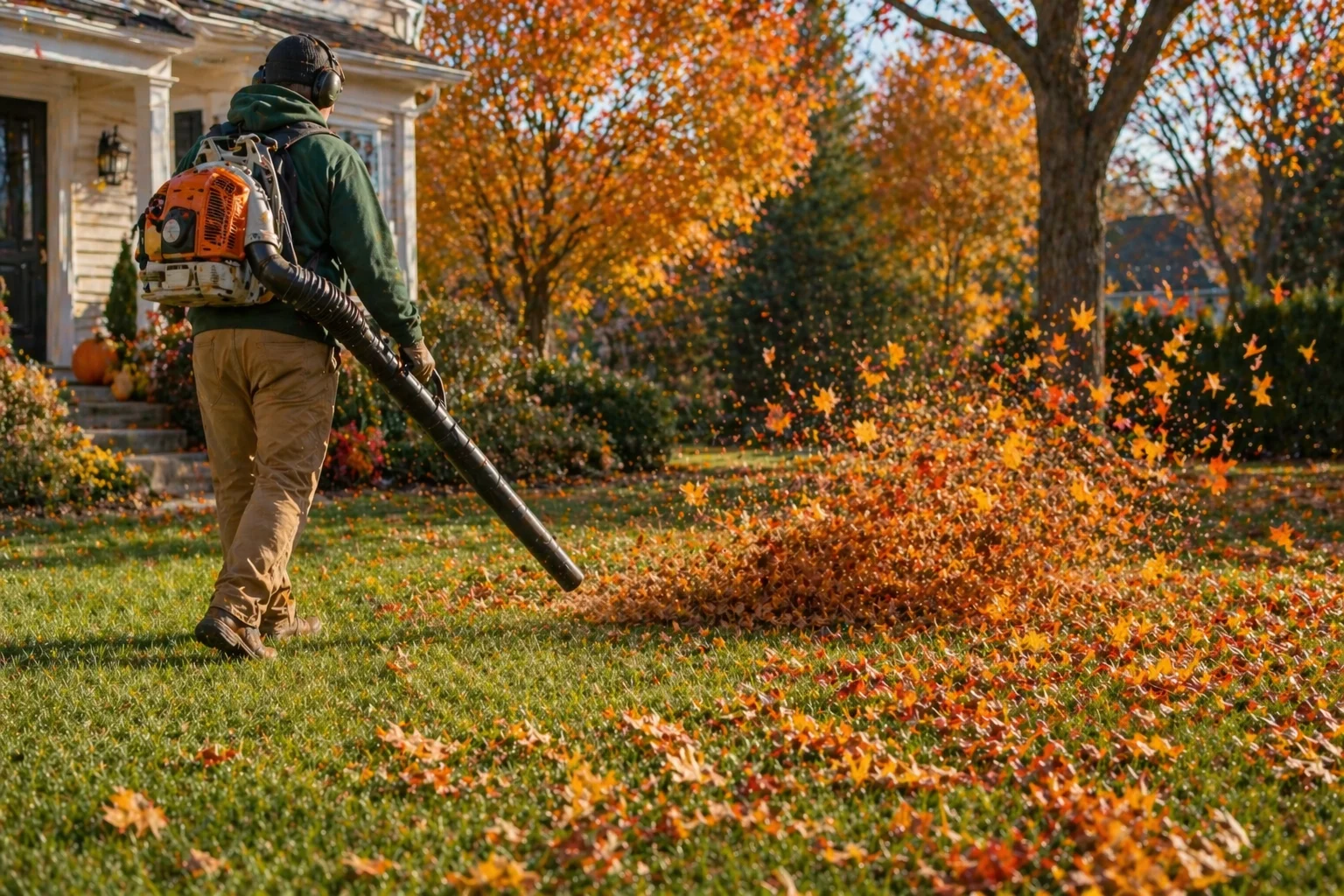
Thick leaf accumulation smothers grass, blocks sunlight, and creates ideal conditions for fungal disease (especially Pythium Blight and Brown Patch overlay). Thin layers of shredded leaves, however, are actually beneficial — they add organic matter and nutrients to the soil as they decompose.
The right strategy: mulch-mow thin layers of leaves weekly during peak leaf drop. A mulching mower chops leaves into pieces small enough to fall between grass blades and decompose naturally over winter. Research from Michigan State shows mulch-mowing delivers an estimated ¼ lb of nitrogen per 1,000 sq ft to the soil annually — free fertiliser.
Bag or compost heavier accumulations. Once leaves layer more than 2 inches deep, mulch mowing can't keep up and the layer starts smothering grass. Rake or blow thick layers into garden beds, compost piles, or municipal yard-waste collection.
Keep leaves completely off newly overseeded areas for the first 3 weeks. Young seedlings are especially vulnerable to smothering, and a single heavy leaf drop on a freshly overseeded area can wipe out 50%+ of germination.
Winterizer Fertiliser — The Late-Fall Feed
The winterizer application (late October through November, depending on region) is the second half of the fall fertilisation programme. Unlike the September feed that drives continued root growth, winterizer fertilisers are high-potassium formulas (e.g., 24-0-11) that harden the grass plant for winter. Potassium strengthens cell walls, improves cold tolerance, and reduces winter desiccation damage.
Apply winterizer after the lawn's top growth has stopped but before the ground freezes. The grass roots continue slowly absorbing nutrients into December in most of the country, and the stored potassium drives stronger spring recovery. Rate: 1 lb actual nitrogen per 1,000 sq ft.
For warm-season lawns, skip the winterizer application entirely. Bermuda and Zoysia should not receive fertiliser after early September in most areas — late-season feeding delays dormancy and leaves new growth vulnerable to frost damage.
Irrigation Winterisation
In USDA Zones 5 and colder (Minnesota, Wisconsin, Michigan, northern New York, northern New England, most of the Dakotas and Montana), blow out your irrigation system before the first hard freeze. Water left in buried PVC pipes freezes, expands, and cracks the pipes — an expensive spring surprise.
Compressor blowout: rent a 10-20 gpm air compressor ($50–100/day) or hire a professional service ($75–150 typical residential). Run compressed air through each zone until no more water emerges from the heads. Close manual drain valves on exposed backflow prevention devices.
In Zones 6 and warmer (Mid-Atlantic, most of the South, Pacific Northwest lowlands), pipe freeze is less likely but still possible during exceptional cold snaps. Minimum precaution: drain or insulate above-ground components (backflow preventers, exposed manifolds). Full blowout is optional but sensible if you had freeze damage in past years.
Frequently Asked Questions
Is it too late to overseed in October?
Depends on your region and first frost date. You need 45+ days of growing conditions before first hard freeze. In Minnesota and Wisconsin, October is too late. In North Carolina and Virginia, early October still works. In Georgia and the Carolinas coast, mid-October is fine. Check your average first frost date and count backwards.
Can I fertilise in fall and still plan spring pre-emergent?
Yes. Fall fertilisation and spring pre-emergent are independent — they don't conflict. The conflict is between fall overseeding and fall pre-emergent, or between spring overseeding and spring pre-emergent. Fertilise freely in fall; apply spring pre-emergent in March–April as normal.
Do warm-season lawns need fall care?
Less than cool-season lawns, but not zero. Stop fertilising 6–8 weeks before first frost, reduce irrigation as the grass goes dormant, do a final mow at normal height, and consider winter ryegrass overseeding for temporary green colour during dormancy. Do not aerate or dethatch warm-season grass in fall — it's preparing for dormancy and cannot recover.
Should I rake all the leaves off my lawn?
No. Mulch-mow thin layers weekly and you gain free organic matter and nitrogen. Bag or compost only when the accumulation exceeds 2 inches deep. For heavily-wooded lots, use a mulching mower with extra passes through the leaf layer to finely shred and redistribute them.
When should I stop mowing in fall?
Continue mowing until the grass stops growing — usually after the first hard freeze in the North, early December in the Mid-Atlantic, or when grass height stabilises below the target mowing height. Do one final mow ½ inch shorter than your normal height to reduce winter fungal disease (snow mold, pink snow mold) risk.
About the Author
Lawn Care Expert & Writer · Denver, Colorado · Florida State University
Jason Allen is a lawn care expert and freelance writer based in Denver, Colorado. He studied turfgrass science and horticulture at Florida State University before founding his own lawn care operation serving the Denver metro area. With over a decade of hands-on experience managing cool-season lawns in Colorado's challenging high-altitude climate, Jason specializes in aeration, fertilization timing, drought management, and water-restriction compliance. His practical, science-backed approach to lawn care has helped thousands of homeowners achieve healthy turf despite Colorado's short growing seasons, clay soils, and frequent drought conditions.