When to Fertilize Your Lawn (2026 Timing Guide)
Published:

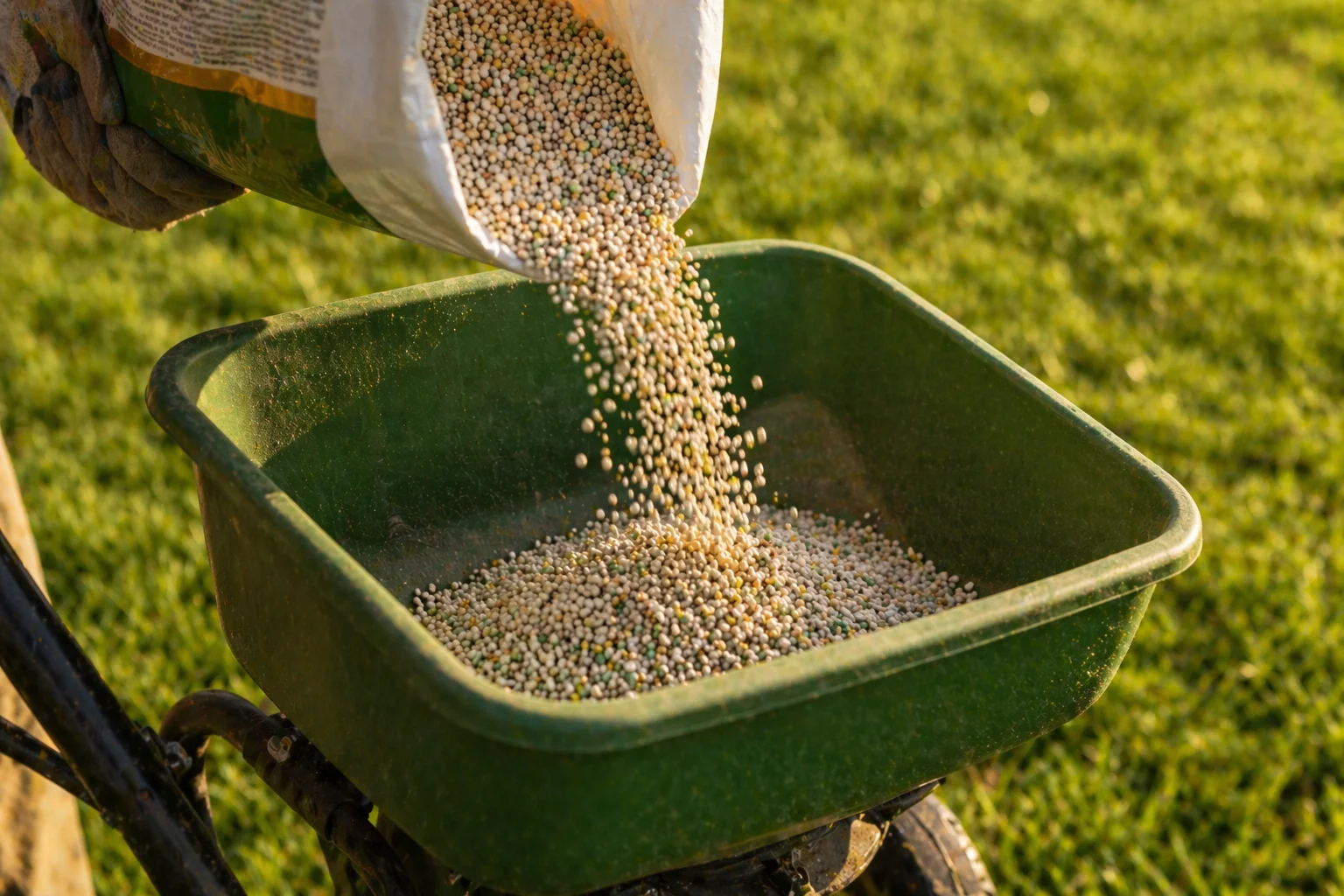
Wrong-season fertiliser is worse than no fertiliser at all. Feeding a cool-season lawn in July pushes lush top growth during the grass's heat-dormancy period, producing fungal disease and wasted nitrogen. Feeding a warm-season lawn in November wastes product on dormant turf that cannot absorb nutrients. This guide covers the right timing by grass type, why fall is the single most important application for cool-season lawns, and how to avoid the common mistakes that kill otherwise healthy turf.
Fertiliser Schedule by Grass Type
| Grass | Application 1 | Application 2 | Application 3 | Skip |
|---|---|---|---|---|
| Kentucky Bluegrass | Early Sept | Late Oct / Nov | Optional April | Never summer |
| Tall Fescue | Sept 1–15 | Nov (light) | April (optional) | Never July–Aug |
| Perennial Ryegrass | Sept | Nov | April | Never summer |
| Fine Fescue | Sept (light) | Skip or Nov (light) | — | Summer always |
| Bermuda | May (green-up) | June – July | August | Never after Sept 1 |
| Zoysia | May – June | August | — | Never after Sept 15 |
| St. Augustine | April – May | June – July | August | Never dormancy |
| Centipede | May (ONCE only) | — | — | Never over-fertilise |
| Bahia | April – June | August | — | — |
| Buffalo Grass | May (optional, light) | — | — | Rarely needs fertiliser |
Cool-Season Grass: Fall Is the Most Important Feed
The biggest myth in homeowner lawn care is that spring is the fertilising season. It isn't — fall is. Cool-season grasses (Kentucky Bluegrass, Tall Fescue, Perennial Ryegrass, Fine Fescue) enter their primary root-growth phase in September and October, storing carbohydrates in root tissue that drive spring green-up the following year. Fall-applied nitrogen builds these reserves directly; spring-applied nitrogen mostly pushes vulnerable top growth.
NEVER fertilise cool-season grass in summer (July–August). Nitrogen applied during heat stress pushes lush new growth at the exact moment the plant cannot support it, and the result is a predictable cascade of fungal disease — Brown Patch in Tall Fescue, Summer Patch in Kentucky Bluegrass, Pythium Blight in Ryegrass. Every lawn-care professional has stories of homeowners who ruined healthy summer lawns with a mid-July fertiliser application.
The fall programme: first application in early September once temperatures cool below 80°F consistently. Second application (winterizer) in late October or November, using a high-potassium formula that hardens the plant for winter. An optional light April application adds spring green-up. Three applications per year is plenty for most cool-season lawns; more fertiliser is not more growth, it's more disease.
Application rate: 1 lb of actual nitrogen per 1,000 sq ft per application. Read the label N-P-K percentage to calculate — for example, a 32-0-10 bag spread at 3 lb per 1,000 sq ft delivers roughly 1 lb of actual N.
Warm-Season Grass: Feed During Active Growth Only
Warm-season grasses (Bermuda, Zoysia, St. Augustine, Centipede, Bahia, Buffalo) follow the opposite schedule. Their active growth period is summer — fertilise only when the lawn is fully green and producing new leaf blades and stolons. Never fertilise dormant warm-season grass. A brown Bermuda lawn in January cannot use nitrogen; the product sits on the surface until the next rain carries it into storm drains.
The trigger for the first application is full green-up, not a calendar date. In Houston that's typically late April; in Atlanta mid-May; in Nashville early June; in Kansas City almost July. Wait until the lawn is 100% green with active leaf extension, then apply. Jumping the gun with a pre-green-up application wastes product and risks burning the dormant crowns.
Bermuda programme: May → July → August. Stop at least 6 weeks before first expected frost to prevent late-season growth that won't harden off. St. Augustine: April–May through August, often with a high-iron formula to prevent chlorosis on alkaline soils. Zoysia: May–June and August, skipping July to avoid fungal flush. Centipede: ONE application in May, and never more — Centipede Decline is a real disease caused by over-fertilisation.
How to Read a Fertiliser Label
Every bag of lawn fertiliser is labelled with three numbers representing the guaranteed percentages of nitrogen (N), phosphorus (P), and potassium (K). A bag marked 32-0-10 contains 32% N, 0% P, and 10% K by weight. A 50 lb bag of 32-0-10 therefore contains 16 lb of actual nitrogen.
Nitrogen drives leaf growth and colour. Too little = pale and thin; too much = disease and thatch. The standard application rate is 1 lb of actual N per 1,000 sq ft per application, and 3–4 lb per year total for cool-season lawns.
Phosphorus drives root development. Most established lawns don't need added phosphorus — soil reserves are usually sufficient, and several states restrict phosphorus use because of runoff pollution. New lawns and overseeded areas benefit from a starter fertiliser with higher P (e.g., 18-24-12).
Potassium drives stress tolerance and disease resistance. Fall winterizer products for cool-season grass (e.g., 24-0-11) lean heavily on K for this reason. Summer fertilisers for warm-season grass also include meaningful K to support heat and drought tolerance.
Slow-release vs quick-release: slow-release formulations (sulphur-coated urea, polymer-coated urea, methylene urea) release nitrogen over 6–12 weeks and reduce the risk of burn. Quick-release (ammonium nitrate, urea) acts within days but requires more careful application. For homeowners, slow-release is almost always the better choice.
Soil Testing Before Fertilising
Soil pH determines which nutrients the grass can actually absorb. Below pH 6.0, phosphorus and calcium become chemically locked up; above pH 7.5, iron and manganese become unavailable. Most homeowner fertiliser problems are actually soil pH problems that fertiliser cannot fix.
Local land-grant university extension offices run soil tests for $10–25 per sample. A full test covers pH, organic matter, N-P-K, calcium, magnesium, micronutrients, and recommended amendments. Do a soil test every three years; the information is valuable far longer than any bag of fertiliser.
For a quick screening, Amazon and hardware stores sell digital soil pH meters for $15–25. They aren't as precise as lab tests but give a useful reading of your baseline. Lime (calcium carbonate) raises pH; elemental sulphur lowers pH. Both are slow-acting — budget 6–12 months for applications to change soil chemistry.
Fertiliser Cost — DIY vs Professional
DIY granular fertiliser costs $25–45 for a bag that treats 5,000 sq ft. A broadcast spreader is a $40–80 one-time purchase. Annual DIY cost for a standard ¼-acre lawn on a three-application programme: roughly $75–$150 in product.
Professional lawn fertilisation runs $64–$385 per application, depending on lawn size, product, and region. A full-season four-application programme through TruGreen, Lawn Doctor, or a regional franchise typically costs $300–$800 per year for a standard suburban lot. The professional price premium buys scheduling reliability, adjusted application rates, and typically integrated weed control.
The DIY break-even is generally clear: lawns under 10,000 sq ft benefit from DIY fertiliser if you can commit to the schedule. Lawns over 15,000 sq ft, or homeowners who travel during key application windows, get better value from a professional programme.
Urea Price Surge Warning 2026
Urea fertiliser prices rose 46% in March 2026 following Middle East supply disruptions that tightened global ammonia availability. Homeowners should expect continued price pressure on quick-release urea products through the rest of 2026. Slow-release products based on Environmentally Smart Nitrogen (ESN), Polymer-Coated Sulphur-Coated Urea (PSCU), and methylene urea are less exposed to the urea spot market and show more stable pricing.
Practical advice: lock in fall fertiliser prices in August before the seasonal demand peak, and favour slow-release products if the price premium over urea is under 15%. Professional programmes have absorbed most of the 2026 price increase themselves so far, but mid-year contract adjustments are likely in the second half of the year.
Frequently Asked Questions
Can I fertilise in the rain?
Light rain is ideal for watering in granular fertiliser. Heavy rain within 2 hours of application can wash product off the surface into storm drains — a waste of product and a water-quality problem. Aim for application before forecast rain of ¼ to ½ inch, not a downpour.
What happens if I fertilise too early in spring?
For cool-season grass, an April application before the lawn is actively growing sits on the soil surface waiting for activity. Most of the nitrogen volatilises into the atmosphere within 2 weeks. Wait until consistent daytime highs above 55°F before the first spring feed, and keep the rate low (½ lb N / 1,000 sq ft) as a starter.
Is weed-and-feed the same as fertiliser?
Weed-and-feed combines fertiliser with pre-emergent or post-emergent herbicide in a single granular product. It's convenient but sacrifices flexibility — you can't tune the herbicide rate to your weed pressure or skip the herbicide over time. Most lawn-care professionals recommend buying fertiliser and herbicide separately for better control.
How long after fertilising can my kids and pets use the lawn?
Granular fertiliser: wait until granules dissolve completely after watering in, typically 24 hours. Liquid fertiliser: wait until surfaces are fully dry, typically 2–4 hours. Combination products with herbicide often specify 24 hours for pets; check the label for specific re-entry times.
Should I water in granular fertiliser?
Yes, within 24–48 hours of application. Watering dissolves the granules and moves nitrogen into the root zone where roots can absorb it. Without watering in, granular fertiliser releases volatilised ammonia into the atmosphere and you lose 20–40% of the applied nitrogen.
About the Author
Lawn Care Expert & Writer · Denver, Colorado · Florida State University
Jason Allen is a lawn care expert and freelance writer based in Denver, Colorado. He studied turfgrass science and horticulture at Florida State University before founding his own lawn care operation serving the Denver metro area. With over a decade of hands-on experience managing cool-season lawns in Colorado's challenging high-altitude climate, Jason specializes in aeration, fertilization timing, drought management, and water-restriction compliance. His practical, science-backed approach to lawn care has helped thousands of homeowners achieve healthy turf despite Colorado's short growing seasons, clay soils, and frequent drought conditions.