When to Dethatch Your Lawn (2026 Guide)
Published:

Dethatching is the single most overlooked — and most damaging when done wrong — maintenance task in residential lawn care. Done at the right time in a grass's active growth window, dethatching opens up the soil surface, improves water penetration, and dramatically accelerates response to fertiliser and seed. Done at the wrong time it shreds the crowns of stressed grass and produces a brown mess that takes a full growing season to recover. This guide covers exact timing by grass type and region, how to tell whether you actually need to dethatch, and how dethatching differs from aeration.
Dethatching Timing by Grass Type
| Grass Type | Best Window | Region | Notes |
|---|---|---|---|
| Kentucky Bluegrass | Sept – Oct | Midwest, Northeast, Mountain | Same window as aeration |
| Tall Fescue | Sept – Oct | Transition zone, Southeast | Pair with overseeding |
| Perennial / Fine Fescue | Sept | Northeast, PNW | Least thatch-prone; rarely needed |
| Bermuda | May – June | South, Southwest | Fast recovery in summer heat |
| Zoysia | May – July | Southeast | Most thatch-prone common grass |
| St. Augustine | May – June | FL, Gulf Coast | Never fall — too sensitive |
| Centipede | May – June | GA, SC, coastal AL | Minimal thatch normally |
| Bahia | May – July | Florida | Rarely needed |
What Is Thatch and When Is It a Problem?
Thatch is the layer of partially decomposed grass stems, runners, and roots that accumulates between the soil surface and the green leaf canopy. A thatch layer up to ½ inch thick is actually beneficial — it acts as insulation, holds moisture, and cushions foot traffic. The problem starts when thatch exceeds ½ inch.
Excess thatch blocks water, nutrients, and air from reaching the soil and root zone. Irrigation pools on top of the thatch layer and evaporates before it soaks into the soil. Fertiliser sits on the thatch and gets consumed by thatch-decomposing microbes rather than the grass. Worst of all, thatch harbours insects (chinch bugs, sod webworm larvae) and fungal pathogens that overwinter safely in its spongy structure.
Test your thatch depth with a screwdriver or a long flathead. Push it into the soil, then note the depth from the green leaf surface down to the firm soil. If the spongy brown layer exceeds ½ inch, dethatching is warranted. If it's under ½ inch, skip dethatching this year.
Zoysia and Bermuda produce the most thatch among common US grasses. Kentucky Bluegrass produces moderate thatch. Tall Fescue and Fine Fescue produce the least — Fescue lawns often go decades without needing dethatching. Fertilisation schedule is the biggest driver: over-fertilised lawns of any grass type thatch faster than appropriately fertilised lawns.
Dethatching Methods: Rake, Power Dethatcher, Verticutter
Manual dethatching rake: a heavy-tined rake that pulls up thatch when dragged across the lawn. Cost: $30–60 at any hardware store. Good for small lawns under 3,000 sq ft with light thatch under ¾ inch. Physically demanding work — budget 2–3 hours per 1,000 sq ft.
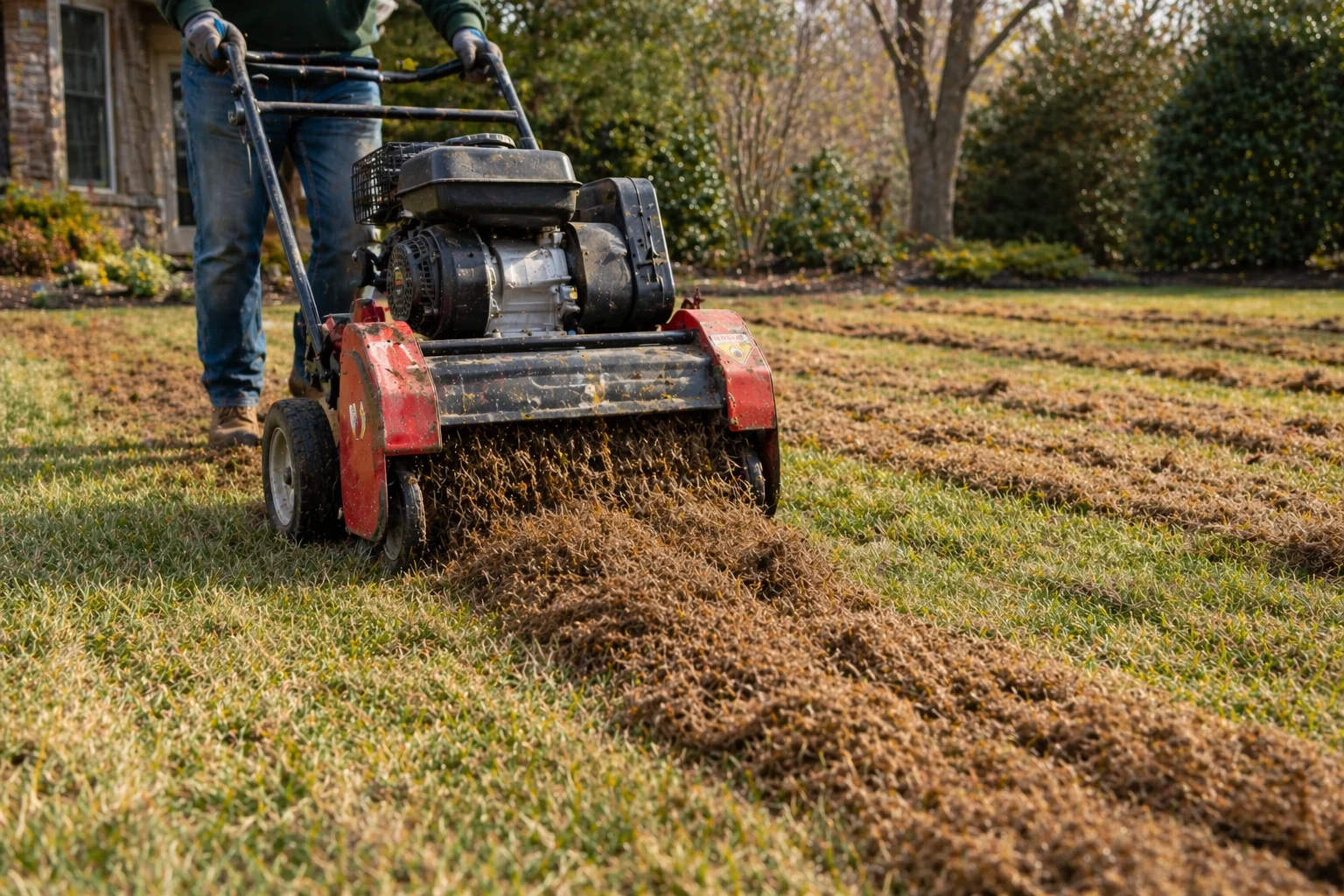
Power dethatcher (spring-tine dethatcher, scarifier): a motorised unit with flailing spring tines that tear through the thatch layer. Rental cost: $75–100 per day from Home Depot or United Rentals. Best for ½–1 inch thatch on lawns up to roughly 15,000 sq ft. Set the tine depth carefully — too deep and you'll shred the grass crowns; too shallow and you won't reach the thatch.
Verticutter / slit-seeder: a motorised unit with rotating vertical blades that cut through the thatch and into the top ½ inch of soil. Rental: $100–150 per day. The best option when combining dethatching with overseeding in the same visit — the slits become perfect seeding furrows. Also the most effective option on heavy thatch buildup exceeding 1 inch.
Professional service: $100–400 depending on lawn size and method. Pros usually bring walk-behind verticutters and can calibrate tine depth to avoid damaging the lawn. Pair with overseeding for the best value.
Dethatching vs Aeration — Which Do You Need?
The two tasks solve different problems and are often confused. Core aeration pulls soil cores to relieve compaction; dethatching removes the organic layer between the soil and the grass canopy. Compacted soil with minimal thatch → aerate. Heavy thatch on loose soil → dethatch. Both problems present → do both, in that order: dethatch first, then aerate, then overseed if planned.
Most suburban lawns need aeration annually but dethatching only every 2–3 years. If you can only do one, aeration delivers more value on most properties. The exceptions are Zoysia and over-fertilised Bermuda lawns, where thatch buildup can become a dominant problem within 2 years.
Cool-Season Dethatching: Fall Window
Cool-season grasses dethatch best in early fall (September for most of the country, late August in Minnesota and Wisconsin). This is the same window as aeration and overseeding for a reason — early fall is the peak recovery period for KBG, Tall Fescue, and Ryegrass. Thatch removal during peak growth means cores and blades recover within 2–3 weeks; thatch removal at any other time leaves the lawn looking shredded for months.
Do not dethatch cool-season lawn in summer. July and August dethatching removes insulating thatch at the worst moment and exposes stressed crowns to heat and drought damage.
Spring dethatching is a secondary option for cool-season lawns when fall is not possible. April works in the North, late March in the Mid-Atlantic. Avoid dethatching before pre-emergent is applied and settled — the mechanical action can break the chemical barrier that prevents crabgrass germination.
Warm-Season Dethatching: Late Spring / Early Summer Window
Warm-season grasses dethatch best in late spring once the lawn is fully green and actively producing new stolons. Bermuda: late May through June. Zoysia: June through early July. St. Augustine: May through early June. Centipede: May only.
Never dethatch warm-season grass in fall. The lawn is preparing for winter dormancy and cannot recover from mechanical damage before the first frost. Fall-dethatched warm-season lawns come out of winter thin and weed-invaded.
Zoysia deserves special attention: it is the most thatch-prone of the common American lawn grasses, and annual dethatching can become necessary on over-fertilised or heavily used Zoysia lawns. Verticutting rather than spring-tine dethatching works better on Zoysia because of its tough, dense canopy.
After Dethatching Care
Immediately after dethatching, the lawn looks terrible. Brown thatch debris covers the surface, grass blades are shredded, and bare soil shows through in patches. This is normal and expected — rake up the debris the same day, then water deeply.
If you combined dethatching with overseeding (highly recommended for cool-season grass in fall), apply seed immediately into the opened soil, then water lightly 2–3 times per day for the first ten days to keep the seedbed moist.
Apply fertiliser 2–3 weeks after dethatching — not the same day. Fresh wounds on grass crowns absorb nitrogen aggressively and can burn at full label rate. A half-rate starter fertiliser is safer the first 2 weeks; full-rate after that.
Expect the lawn to look recovered 3–4 weeks after dethatching when done in the right window. If recovery takes longer, the dethatching was done outside the grass's active growth period or too aggressively.
Frequently Asked Questions
How often should I dethatch my lawn?
Most lawns need dethatching every 2–3 years, not annually. Zoysia and heavily fertilised Bermuda may need it annually. Fescue lawns can go 5+ years between dethatchings. Test thatch depth with a screwdriver annually; dethatch only when the spongy brown layer exceeds ½ inch.
Can I dethatch and overseed on the same day?
Yes — in fact this is the ideal combination for cool-season lawns. Use a verticutter/slit-seeder and you can do both tasks in one pass. The slits created by the dethatching blades make perfect seed furrows. Water lightly several times a day for the first 10 days to establish the new grass.
Will dethatching damage my lawn?
Done at the right time in the grass's active growth window, dethatching causes temporary cosmetic damage that heals in 3–4 weeks. Done at the wrong time (summer for cool-season, fall for warm-season), dethatching can cause lasting damage that takes a full growing season to recover. Timing is everything.
Is a dethatching mower blade a good alternative?
Dethatching mower blades (replacement blades with vertical tines) do light surface scarification only. They work for removing surface debris on lightly thatched lawns but cannot reach thick thatch layers. For serious dethatching, rent a power dethatcher or verticutter — dethatching blades are a marginal tool.
Should I dethatch before or after mowing?
Mow first, at a setting roughly 1 inch shorter than your normal height. This makes the thatch more accessible and creates better seed-to-soil contact if you plan to overseed. Rake or bag the clippings from this low mow so they don't interfere with dethatching.
About the Author
Lawn Care Expert & Writer · Denver, Colorado · Florida State University
Jason Allen is a lawn care expert and freelance writer based in Denver, Colorado. He studied turfgrass science and horticulture at Florida State University before founding his own lawn care operation serving the Denver metro area. With over a decade of hands-on experience managing cool-season lawns in Colorado's challenging high-altitude climate, Jason specializes in aeration, fertilization timing, drought management, and water-restriction compliance. His practical, science-backed approach to lawn care has helped thousands of homeowners achieve healthy turf despite Colorado's short growing seasons, clay soils, and frequent drought conditions.