Why Is My Grass Yellow? Diagnose and Fix It
Published:

Yellowing grass has eight common causes, and the right fix depends entirely on the pattern, season, and grass type. Uniform pale yellow across the entire lawn usually means iron deficiency or nitrogen shortage. Yellow stripes following your mower path mean a dull blade. Yellow patches that lift like carpet are grub damage. This guide walks through each cause with a clear identification pattern, diagnostic tests, and a specific fix — so you're not guessing.
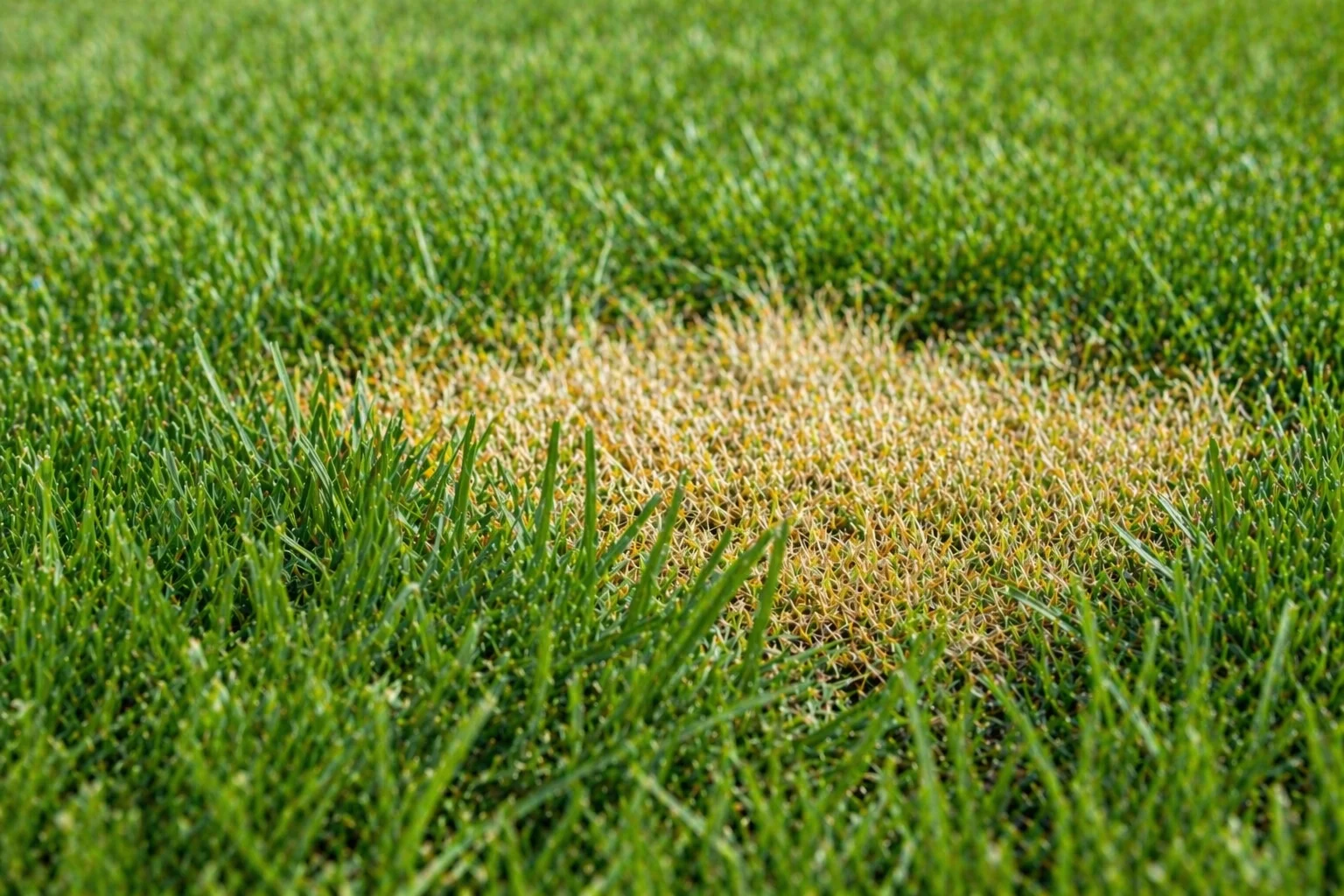
Diagnose by Pattern
| Pattern You See | Most Likely Cause | Action |
|---|---|---|
| Uniform yellow across entire lawn | Iron deficiency (alkaline soil) | Iron chelate (Fe-EDTA) application |
| Yellow stripes following mower lines | Dull mower blade scalping | Sharpen blade immediately |
| Yellow patches, irregular | Fungal disease (Dollar Spot / Brown Patch) | Fungicide; improve drainage |
| Yellow + thin patches, peel like carpet | Grub damage (beetle larvae) | Imidacloprid or chlorantraniliprole |
| Yellow at lawn edges | Fertiliser burn (spreader overlap) | Heavy water for 3 days |
| Yellow after heavy rain | Overwatering / root rot | Reduce irrigation; aerate |
| Yellow in hot summer (cool-season grass) | Heat dormancy — normal | Water lightly, don't panic |
| Yellow with purple tinge | Phosphorus deficiency (cold soil) | Starter fertiliser |
| Yellow spots where dog pees | Nitrogen burn (urea) | Flush with water; fence area |
| Yellow only in shaded areas | Inadequate sunlight | Shade-tolerant grass or pruning |
1. Iron Deficiency (Chlorosis) — Most Common Cause
Iron deficiency causes the most widespread yellowing of American lawns, particularly in alkaline-soil regions. Florida (pH 7.5–8.5 calcareous soils), Arizona (desert alkaline), Southern California coastal, West Texas, and most of Adelaide in Australia all have soils high enough in calcium carbonate to chemically lock up iron and manganese regardless of how much is present in the soil. The grass is not iron-deficient in the absolute sense — it's iron-starved because it cannot absorb what's there.
Identification: uniform pale yellow-green across the entire lawn, with interveinal yellowing (leaf veins stay green while tissue between turns yellow). St. Augustine lawns in Florida are the classic victim; Kentucky Bluegrass in Utah's Wasatch Front suburbs shows it commonly.
Fix: apply chelated iron (Fe-EDTA at 15–20 g per square metre, or Fe-DTPA for high-pH soils). Response is visible within 7–10 days. Do not apply regular ferrous sulphate on alkaline soils — it binds with calcium carbonate and becomes unavailable faster than the plant can absorb it. Do not add lime — your soil is already alkaline and adding lime makes the problem worse.
Long-term solution: soil acidification with elemental sulphur if your soil consistently tests above pH 7.5. The process is slow (6–12 months to see pH change) but produces lasting improvement in iron availability.
2. Nitrogen Deficiency
Uniform pale yellow with slow growth is often simple nitrogen shortage. The grass isn't producing chlorophyll at normal rates, and the pale colour reflects thin internal pigmentation. Differentiation from iron deficiency: nitrogen-deficient grass grows slowly and has thinner leaves; iron-deficient grass grows normally but the colour is wrong.
Fix: apply a nitrogen-rich fertiliser (21-0-0, 32-0-10, or similar) at 1 lb actual N per 1,000 sq ft. Water in within 24–48 hours. Response is visible in 7–14 days. Do not over-apply — two light applications spaced 4 weeks apart produce better results than one heavy dose, and avoid the disease flush that follows excessive nitrogen.
Warm-season lawns in mid-summer showing pale green are often nitrogen-deficient from leaching during heavy rain. Sandy soils lose nitrogen fastest. Budget an extra mid-season feed on sandy or heavy-rain coastal lawns.
3. Overwatering and Root Rot
Too much water is a surprisingly common cause of yellow grass. Saturated soil drives oxygen out of the root zone, and roots starved of oxygen cannot absorb nutrients. The grass yellows as if nutrient-starved, but no fertiliser fixes the problem — the roots literally can't function.
Identification: yellow grass plus soft, spongy soil underfoot; mushrooms appearing on the lawn; thatch building up rapidly; irrigation-heads running on automatic cycles. If you walked across the lawn this morning and saw water squeeze up around your footprints, you're overwatering.
Fix: reduce irrigation immediately. Most lawns need 1–1.5 inches per week total; check your controller. Aerate the lawn if it's been chronically overwatered — core aeration opens channels for air to return to the root zone. Smart irrigation controllers with soil moisture sensors prevent this problem permanently.
Severe cases with visible root rot need extended drying plus fungicide (propamocarb, mefenoxam) and may require replanting the worst sections.
4. Drought Stress
The opposite of overwatering, but harder to diagnose because the end state (brown/yellow grass) looks similar. Drought-stressed grass first turns blue-grey, then yellow-tan, then straw-coloured. Footprints stay visible in drought-stressed grass because the blades don't spring back.
Fix: water deeply — 1 inch delivered in a single session, early morning. Repeat in 3–4 days. Do not fertilise drought-stressed grass; nitrogen on dry soil burns roots. Raise mowing height to ½ inch above your normal setting during drought to shade the soil surface.
Cool-season grasses (Kentucky Bluegrass, Tall Fescue) have a drought-dormancy response — they go brown but recover when water returns. Allow this dormancy rather than fighting it; over-watering during summer heat causes more problems than it solves. Warm-season grasses are more drought-tolerant still and can survive 3–4 weeks with minimal water.
5. Lawn Disease (Dollar Spot, Brown Patch)
Fungal diseases produce distinctive yellow-to-tan patch patterns. Dollar Spot creates small (silver-dollar sized) circular patches with straw-coloured leaves — common on Kentucky Bluegrass, Tall Fescue, and Bermuda during cool, wet weather. Brown Patch creates larger (2–10 inch) circular tan patches with a darker edge ring — common on Tall Fescue during hot, humid weather, and on St. Augustine year-round in Florida.
Fix: improve air flow and reduce moisture on leaf blades. Avoid evening watering; mow early in the day so blades dry before night; trim overhanging shrubs to let air circulate. For active outbreaks, apply a propiconazole or azoxystrobin fungicide — one application usually halts spread; repeat in 14 days if patches are still expanding.
Nitrogen nudges: Dollar Spot is often nitrogen-deficient grass under stress, while Brown Patch is often nitrogen-excess grass with too-rapid top growth. Soil test and moderate fertilisation to the recommended rate, no more.
6. Grub Damage
Beetle larvae (white grubs) feed on grass roots below the soil surface, severing the roots that deliver water and nutrients to the leaf blades. The result: yellow-to-tan patches that spread outward, and grass that lifts like a loose carpet when pulled because there are no roots holding it in place.
Identification: pull a suspect patch; if it peels back with minimal resistance and the soil beneath shows C-shaped white larvae, you have grubs. Birds feeding intensely on one section of lawn are another early warning.
Fix: apply a granular insecticide containing imidacloprid or chlorantraniliprole. Timing matters — treat in early-to-mid summer when larvae are young and close to the surface. Water the product in with ½ inch of irrigation to move it into the root zone.
Prevention: milky spore powder (organic) provides long-term biological control of Japanese Beetle grubs specifically. Preventive chlorantraniliprole applications in June prevent grub damage in July–August.
7. Dog Urine Spots
Concentrated nitrogen in dog urine (especially from females, who squat and deliver the full volume in one spot) burns grass the same way over-applied fertiliser does. The classic signature is a yellow or dead centre ring with a dark green outer ring — the outer ring is where the nitrogen diluted to a fertilising rather than burning concentration.
Fix: flush the affected spot with 3–5 gallons of water immediately after the dog urinates, if you can. After burn has occurred, overseed the spot; grass seed grows faster than the surrounding mature turf fills in.
Prevention: designate a pee area (gravel or mulch), train the dog to use it. For large-breed female dogs on a Kentucky Bluegrass lawn, this may be the only practical solution — products sold as urine neutralisers have mixed reviews and limited evidence.
8. Scalping and Dull Blade Damage
Yellow stripes that match your mower pattern are caused by two things: scalping (cutting too low) or a dull blade (ripping rather than slicing the grass tips). Scalping removes more than ⅓ of the blade length at once; the cut area exposes white basal tissue that yellows immediately. Dull-blade damage leaves ragged, frayed tips that brown within days.
Fix: sharpen the mower blade ($10–20 at a hardware store, or DIY with a metal file). Raise mowing height to the recommended level for your grass type — Kentucky Bluegrass and Tall Fescue to 3–4 inches, Bermuda to 1–2 inches, Zoysia to 1.5–2.5 inches.
A sharp blade and correct height eliminate 90% of mower-caused yellowing. Sharpen the blade twice per season at minimum — once in spring before the first mow, and once mid-season.
When Yellow Grass Is Normal (Not a Problem)
Cool-season grass going yellow-tan across the entire lawn in July and August is normal heat dormancy. Kentucky Bluegrass, Tall Fescue, and Ryegrass reduce growth and colour during sustained heat, conserving energy until cooler September temperatures return. Do not fertilise; do not attempt to force green with heavy watering. Water lightly (½ inch per week) to keep crowns alive, and let the lawn recover naturally in fall.
Warm-season grass going yellow-brown in November-March is normal winter dormancy. Bermuda, Zoysia, St. Augustine, and Centipede all go dormant after the first frost and stay dormant until spring green-up. Do nothing — the lawn is not dead, it is resting. Winter ryegrass overseeding can provide green colour during dormancy if the appearance matters.
New sod or sprigs yellowing around the edges in the first 2–3 weeks after installation is usually transplant shock. Water deeply and patiently; the yellow fades as roots establish. If yellowing spreads beyond 3 weeks, investigate for disease or installation problems.
Frequently Asked Questions
Can yellow grass turn green again?
Almost always, yes — as long as the crown (growing point at the base of each grass plant) is still alive. Yellow leaf blades can re-green with the right treatment (water, nutrients, fungicide), or will be replaced by new green blades as the plant recovers. Pull a plug of grass: if the base is firm white/green tissue, the lawn is recoverable. If it crumbles or is black, the crown is dead.
Is yellow grass dead?
No. Yellow is a stress signal, not a death signal. Grass that looks yellow can be dormant, nutrient-deficient, diseased, or heat-stressed — all recoverable conditions. Actually dead grass is straw-coloured or grey-brown with crowns that crumble when you pull a plug. The distinction matters because treatment is very different for dormant vs dead lawn.
What fertiliser makes grass greener?
Iron supplements produce the fastest visible green-up, often within 7 days. Nitrogen fertilisers (urea, ammonium sulphate, slow-release blends) drive sustained green growth over 2–4 weeks. For fastest visible colour without the disease risk of heavy nitrogen, iron is the right pick. Ironite is a popular mainstream brand; LawnStar iron+ works well in high-pH soils.
My entire lawn is yellow after fertilising — what happened?
Over-application or fertiliser burn. Too much nitrogen on a lawn — especially quick-release urea — burns the leaf tissue and produces uniform yellowing. Water heavily for 3–4 days to flush the excess out of the root zone. Recovery usually takes 2–3 weeks. Check your spreader calibration before the next application.
Why is my grass yellow after rain?
Overwatering plus saturated soil. Heavy rain combined with already-wet soil drives oxygen out of the root zone, and roots starved of oxygen stop absorbing nutrients — producing a nutrient-starved yellow appearance. Aerate to improve drainage, and reduce irrigation frequency. The problem usually resolves within 1–2 weeks once soil dries out.
About the Author
Lawn Care Expert & Writer · Denver, Colorado · Florida State University
Jason Allen is a lawn care expert and freelance writer based in Denver, Colorado. He studied turfgrass science and horticulture at Florida State University before founding his own lawn care operation serving the Denver metro area. With over a decade of hands-on experience managing cool-season lawns in Colorado's challenging high-altitude climate, Jason specializes in aeration, fertilization timing, drought management, and water-restriction compliance. His practical, science-backed approach to lawn care has helped thousands of homeowners achieve healthy turf despite Colorado's short growing seasons, clay soils, and frequent drought conditions.