When to Water Your Lawn: Timing, Frequency and Amount
Published:

Lawn watering is the most common daily lawn task and also the one homeowners get most wrong. The right combination of time of day, frequency, and total amount depends on your grass type, your soil, and your climate — but a few universal principles apply everywhere. Water early in the morning, water deeply but infrequently, and never exceed 1.5 inches per week unless you have a specific reason. This guide covers exact watering amounts by grass type, how to measure irrigation output, and how to adjust for season and local restrictions.
Water Requirements by Grass Type
| Grass | Weekly Need | Best Frequency | Drought Tolerance |
|---|---|---|---|
| Kentucky Bluegrass | 1–1.5 inches | 1–2x per week deeply | Yes — ½ inch every 14 days when dormant |
| Tall Fescue | 1–1.25 inches | 1–2x per week | Yes — ½ inch every 14 days |
| Perennial Ryegrass | 1–1.25 inches | 2x per week | Moderate — shallow roots |
| Fine Fescue | 0.75–1 inch | 1x per week deeply | Excellent — most drought-tolerant cool-season |
| Bermuda | 1 inch | 2x per week | Very high — 4+ weeks without water |
| Zoysia | 0.75–1 inch | 1–2x per week | Very high — 3–4 weeks dry |
| St. Augustine | 1–1.5 inches | 2x per week | Moderate — less drought-tolerant |
| Centipede | 1 inch | 1x per week | Moderate — avoid overwatering |
| Buffalo Grass | 0.5 inch | 1x per week | Extreme — native prairie grass |
The Best Time to Water a Lawn
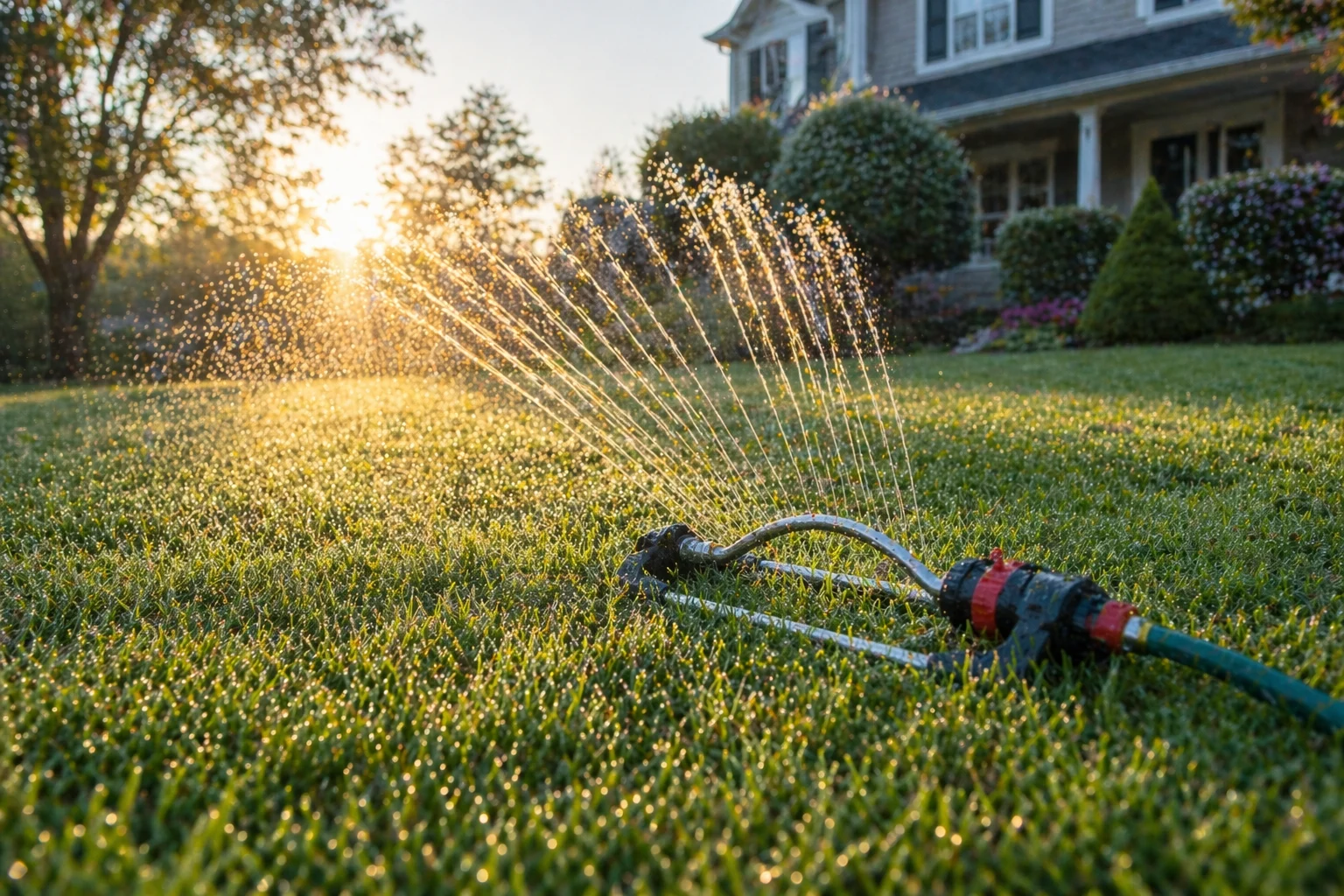
Between 6:00 a.m. and 10:00 a.m. is the optimal window for lawn watering anywhere in the United States. Three physical factors drive this: temperature, wind, and leaf wetness duration. Early-morning soil is cool, so less water evaporates before it penetrates. Wind is typically calm, so sprinkler pattern is consistent and less spray drifts away. And the sun will dry leaf blades by mid-morning, which is critical for fungal disease prevention.
Avoid evening watering at all costs. Watering after 6 p.m. leaves grass blades wet through the overnight period, and wet blades in warm summer air are the single most favourable condition for Brown Patch, Dollar Spot, and Pythium Blight. A lawn watered every evening in July will nearly always develop disease by early August.
Midday watering is also bad, though for a different reason: evaporation. On a hot summer day with air temperatures above 85°F, 40–50% of water from a sprinkler evaporates before it reaches the soil. Midday watering is also explicitly prohibited in many US cities during drought restrictions — Phoenix, Las Vegas, Los Angeles, Denver, Austin, and most of California enforce morning-or-evening rules year-round.
For homeowners with smart irrigation controllers, set the default start time to 5:30 a.m. or 6:00 a.m. This ensures the cycle completes before the sun is high enough to drive significant evaporation. For manual sprinkler operators, the most common time to forget to shut off a sprinkler is during weekend mornings — use a mechanical timer ($10–20) to avoid over-watering.
How Often to Water
Deep and infrequent beats shallow and frequent every time. A single deep watering session that delivers ½ inch forces roots to extend downward to access the moisture, building a deeper and more drought-tolerant root system. Daily shallow watering keeps moisture in the top 1–2 inches of soil, and roots stay shallow because they have no reason to extend deeper. The shallow-rooted lawn then wilts at the first hint of drought.
The general rule: most established lawns need 1–1.5 inches of water per week, delivered in 1 or 2 deep sessions. Soil type modulates this — sandy soils need more frequent (but not deeper) watering because water drains through sand faster; clay soils need less frequent watering because they hold water longer.
The can test: place 3–5 empty tuna cans around the lawn, turn the sprinkler on, and time how long it takes to collect ½ inch of water. That's your run time per session. Most home sprinkler systems put out ½ inch in 15–30 minutes depending on head type and pressure.
Signs of Overwatering vs Underwatering
Underwatering symptoms: footprints stay visible in the grass after you walk across, blades turn blue-grey before they turn brown, leaves curl lengthwise to reduce evaporation, and soil feels hard and dry when probed with a screwdriver.
Overwatering symptoms: mushrooms appear on the lawn, the surface feels spongy underfoot, thatch builds up rapidly, bare soil stays constantly wet, and fungal disease (Brown Patch, Pythium) shows up in humid weather. Severely overwatered lawns eventually turn yellow then brown as the root zone becomes anaerobic and roots rot.
The confusing overlap: both underwatering and overwatering can produce a brown lawn that looks dead. Use the screwdriver test to distinguish. Push a long screwdriver into the soil. If it goes in easily to 6 inches or more, the soil is well-watered (possibly over-watered — check for mushrooms and sponginess). If it meets resistance in the top 2 inches, the soil is dry and the lawn needs watering.
Seasonal Watering Adjustments
Spring (March–May): reduce irrigation until soil fully warms. Natural rainfall handles most cool-season lawn needs through May. Turn the irrigation controller off during spring rain and check for rain-delay compliance on smart systems.
Summer (June–August): peak demand. Cool-season lawns in the North need 1.25–1.5 inches per week in two deep sessions. Warm-season lawns in the South need 1 inch per week in 1–2 sessions. Reduce mowing frequency during drought stress and raise the mowing height by ½ inch to shade the soil.
Fall (September–November): reduce irrigation as air temperatures drop. Cool-season lawns benefit from continued deep watering into early October to fuel fall root growth. Stop irrigating 2–3 weeks before the first expected hard freeze to allow the lawn to harden off. Disconnect and drain outdoor irrigation lines in USDA zones 5 and colder before the first hard freeze.
Winter (December–February): warm-season lawns are dormant — stop watering entirely. Cool-season lawns in zones 7 and warmer may need occasional winter watering during extended dry spells (2+ weeks without precipitation) to prevent desiccation. In colder zones, snow cover and rain typically meet all winter water needs.
Smart Irrigation Tips
- Use a weather-based controller (Rachio, Hydrawise, RainBird ESP-TM2) that adjusts automatically to rainfall — typical savings: 20–40% of annual water use
- Avoid watering if rain is forecast within 72 hours — smart controllers do this automatically, manual systems need discipline
- Use cycle-and-soak programming on slopes and clay soils: 3 cycles of 5 minutes each beats 1 cycle of 15 minutes because water has time to soak in between runs
- Replace fixed-spray sprinkler heads with high-efficiency rotating nozzles (MP Rotator, Hunter MP3000) — 30% less water for the same coverage
- Install a rain sensor if your controller doesn't have one — a $25 sensor can save a $500 water bill during wet summers
- Check the system monthly for broken heads, leaks, and overspray onto paved surfaces — a single broken head can waste 100+ gallons per cycle
- Mulch mower clippings rather than bagging — returned clippings reduce water needs by 10–15% by returning moisture and nutrients to the soil
Water Restrictions — What Applies to You
Most Western US cities maintain year-round watering restrictions. Phoenix, Tucson, Las Vegas, and Denver all prohibit watering between 9 a.m. and 7 p.m. during summer. Los Angeles, San Diego, and most California cities enforce 2–3 days per week watering schedules. Austin, San Antonio, and much of Texas activate Stage 1 or higher restrictions during summer drought.
Eastern cities vary more. Atlanta, Charlotte, and Nashville declare restrictions during drought events but don't maintain permanent schedules. New York, Boston, and Philadelphia generally don't enforce lawn-watering restrictions except during declared drought emergencies. Miami and southern Florida have permanent 2-day-per-week schedules.
Check your specific city's rules before setting an irrigation schedule. Fines vary widely — from $50 in small municipalities to $500+ per violation in Denver and Southern California cities with active enforcement.
Frequently Asked Questions
Is it OK to water my lawn every day?
Daily watering keeps moisture shallow and produces weak, shallow-rooted grass that wilts at the first drought. Deep watering 1–2 times per week builds deeper roots and a more drought-tolerant lawn. The only exception is newly seeded or newly sodded lawns during the first 2–3 weeks of establishment, when daily light watering is correct.
Can I water too much in summer?
Yes. Overwatering during summer drives fungal disease, encourages thatch buildup, and wastes significant money and water. Most lawns need 1–1.5 inches per week even in peak summer heat. Water more frequently only during extreme heat waves above 100°F for 5+ consecutive days.
How do I know if my sprinkler is watering evenly?
Run the can test. Place 5 empty tuna cans or flat-bottomed containers at varied distances from the sprinkler head, run the system for 15 minutes, and measure water depth in each can. If readings vary by more than 25%, adjust sprinkler head arc, pattern, or pressure. Uniform coverage is the #1 predictor of lawn-watering efficiency.
Should I water after fertilising?
Yes, within 24–48 hours. Granular fertiliser needs water to dissolve the granules and move nitrogen into the root zone. Without watering in, you lose 20–40% of applied nitrogen to volatilisation. Liquid fertiliser needs less water but benefits from ½ inch within 48 hours.
How long does it take for a lawn to recover from drought?
Warm-season lawns (Bermuda, Zoysia) recover in 1–2 weeks with adequate watering after drought stress. Cool-season lawns (Kentucky Bluegrass, Tall Fescue) recover in 2–4 weeks. Severely drought-stressed lawns with dead crowns may need overseeding or sodding — the browning doesn't reverse.
About the Author
Lawn Care Expert & Writer · Denver, Colorado · Florida State University
Jason Allen is a lawn care expert and freelance writer based in Denver, Colorado. He studied turfgrass science and horticulture at Florida State University before founding his own lawn care operation serving the Denver metro area. With over a decade of hands-on experience managing cool-season lawns in Colorado's challenging high-altitude climate, Jason specializes in aeration, fertilization timing, drought management, and water-restriction compliance. His practical, science-backed approach to lawn care has helped thousands of homeowners achieve healthy turf despite Colorado's short growing seasons, clay soils, and frequent drought conditions.