Common Lawn Diseases: Identification, Treatment & Prevention
Published:

Ten fungal diseases account for nearly every lawn-disease problem American homeowners encounter. Brown Patch, Dollar Spot, Red Thread, and Snow Mold are the most common. Pythium Blight, Necrotic Ring Spot, Summer Patch, and Take-All Patch are more destructive but less frequent. Most fungal problems start with an environmental trigger (too much nitrogen, too much water, wrong watering time, poor air flow) — and cultural fixes prevent recurrence more reliably than repeated fungicide applications.
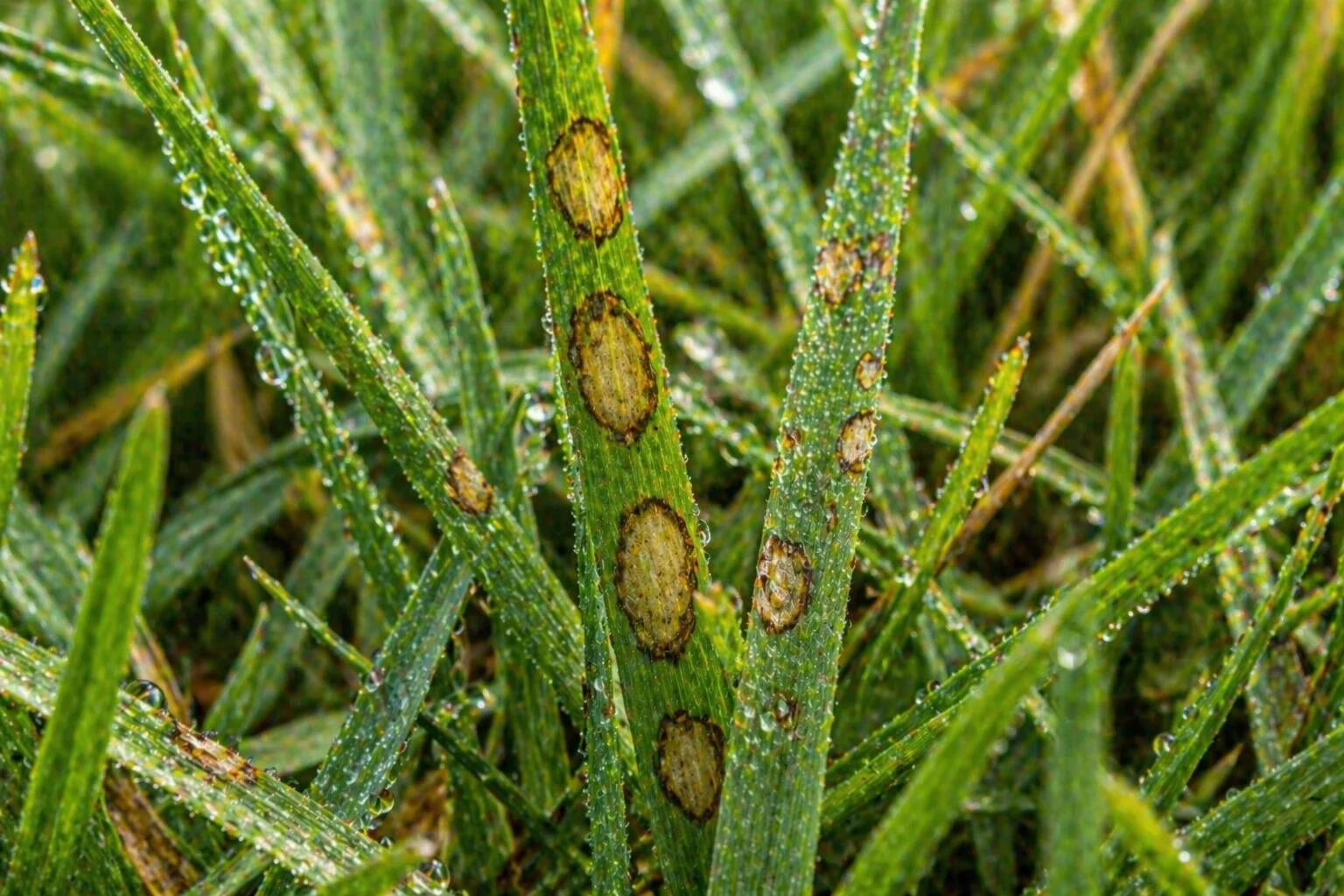
Master Disease Reference
| Disease | Grass Types | Season | Appearance | Treatment |
|---|---|---|---|---|
| Brown Patch | All; Tall Fescue worst | June – August, humid | Circular tan patches with dark ring | Myclobutanil, azoxystrobin, propiconazole |
| Dollar Spot | All cool-season; Bermuda | Spring / fall | Silver-dollar circles, bleached blades | Thiophanate-methyl; add nitrogen |
| Red Thread | Fescue, Rye, KBG | Spring, cool / wet | Pink-red threads in grass tips | Nitrogen first; fungicide if severe |
| Gray Snow Mold | KBG, Ryegrass, Fescue | Spring snowmelt | Circular straw-coloured rings | Rake vigorously; usually no spray |
| Pink Snow Mold | KBG, Fescue, Bent | Spring snowmelt | Salmon / pink patches with mycelium | Propiconazole before snow; rake |
| Pythium Blight | Ryegrass, Fescue | Hot / humid nights | Greasy dark patches, white fluff | Mefenoxam; improve drainage urgently |
| Necrotic Ring Spot | KBG | Summer stress | Rings of dead grass with green centre | Propiconazole; overseed resistant varieties |
| Summer Patch | KBG, Fine Fescue | July – August | Circular dead patches, straw colour | Propiconazole spring application |
| Leaf Spot / Melting Out | KBG, Fescue | Spring / fall | Purple-brown leaf lesions | Propiconazole; raise mowing height |
| Take-All Patch | Bermuda, St. Augustine | Variable | Irregular sunken patches, dying stolons | Azoxystrobin; manage soil pH |
Brown Patch (Rhizoctonia solani)
The #1 summer lawn disease across the Eastern and Central US. Brown Patch creates circular tan-to-brown patches ranging from 2 inches to 6+ feet in diameter. A characteristic darker 'smoke ring' edge is often visible in early morning when dew is still present.
Conditions that trigger outbreaks: night-time temperatures above 65°F, leaf wetness exceeding 10 hours, humidity above 80%, nitrogen applied within the previous 2–4 weeks. Tall Fescue is the most vulnerable cool-season grass in the Mid-Atlantic and Midwest; St. Augustine is the most vulnerable warm-season grass in Florida and the Gulf Coast.
Cultural fixes (apply first): water only early in the morning (before 9 a.m.); maintain correct mowing height (3–4 inches for Tall Fescue, 3.5–4 inches for St. Augustine); skip summer nitrogen fertilisation on cool-season grass entirely; trim overhanging shrubs to improve air flow.
Fungicide treatment: propiconazole (Banner Maxx, Infuse), azoxystrobin (Heritage G, Scotts DiseaseEx), or myclobutanil (Immunox) at label rate. Single application halts active spread in most cases; repeat in 14 days if new patches emerge. Azoxystrobin has the longest residual (21–28 days) and is the most cost-effective for prevention.
Dollar Spot (Clarireedia jacksonii)
Dollar Spot creates small (silver-dollar sized, 1–3 inch) circular patches with bleached straw-coloured leaves. Multiple spots can merge into larger irregular damage. Active on Kentucky Bluegrass, Tall Fescue, Perennial Ryegrass, Bermuda, and Zoysia — basically all common American lawn grasses.
Conditions: warm days (70–85°F), cool dewy nights, nitrogen-deficient grass. Dollar Spot is essentially a disease of stress and insufficient fertility — well-fed lawns rarely show significant damage.
First fix: apply ½ lb actual N per 1,000 sq ft. Many Dollar Spot outbreaks resolve with nitrogen alone within 2 weeks. If patches continue spreading after 2 weeks, move to fungicide.
Fungicide: thiophanate-methyl (Cleary's 3336, Fungicide III), propiconazole, or chlorothalonil. Dollar Spot has developed resistance to some older chemistries (DMI group) in heavily-treated areas — rotate chemistry classes year to year.
Red Thread (Laetisaria fuciformis)
Red Thread appears as pink-to-red thread-like structures extending from the tips of grass blades, most visible in early morning dew. Affected areas develop a reddish tinge when viewed from a distance. Common on Fescue, Perennial Ryegrass, and Kentucky Bluegrass.
Conditions: cool temperatures (60–75°F), high humidity, nitrogen-deficient grass. Red Thread is strongly associated with fertility deficiency — a nitrogen application usually eliminates the problem without fungicide.
First fix: apply nitrogen fertiliser at 1 lb actual N per 1,000 sq ft. Water in well. Response visible within 10–14 days.
Fungicide (if severe): propiconazole, azoxystrobin, or chlorothalonil. Rarely necessary if nitrogen deficiency is addressed.
Snow Mold (Gray and Pink)
Snow Mold appears after prolonged snow cover melts in spring. Gray Snow Mold (Typhula spp.) creates circular straw-coloured patches with a white to light-grey fungal mass at the edges. Pink Snow Mold or Microdochium Patch (Microdochium nivale) creates salmon-pink patches, often with more severe damage extending to the crown.
Gray Snow Mold is usually cosmetic — rake the affected area vigorously to break up the matted grass, and the lawn recovers in 3–4 weeks of active growth. No fungicide needed.
Pink Snow Mold is more damaging. Rake affected areas, and apply a propiconazole or chlorothalonil fungicide if patches exceed 4 inches in diameter or are merging. Pink Snow Mold can kill crowns, requiring overseeding the following fall.
Prevention: don't fertilise late in fall (after mid-October in most zones), mow the final cut of the season at normal height (not extra-low), and avoid leaving dense leaf layers on the lawn through winter.
Pythium Blight (Pythium aphanidermatum)
Pythium Blight is the most destructive fungal disease of cool-season lawns — it can kill grass in 24–48 hours during peak outbreaks. Symptoms: dark, water-soaked greasy patches spreading rapidly, often with visible cottony white fungal mycelium in early morning.
Conditions: night temperatures above 68°F, day temperatures above 85°F, humidity above 90%, saturated soil. Pythium thrives on poor drainage and recent heavy rain combined with high night-time humidity.
Fungicide (urgent): mefenoxam (Subdue MAXX) or fosetyl-Al (Signature) at highest label rate. Single-application cure is possible if caught early. Do not wait to see if the disease spreads — Pythium moves faster than almost any other lawn pathogen.
Cultural fixes: improve drainage immediately; aerate the affected area; stop all evening watering; hold off on fertilisation until the lawn recovers. Newly seeded lawns are especially vulnerable — Pythium on young seedlings (seedling damping-off) can wipe out a new lawn in 48 hours.
Necrotic Ring Spot (Ophiosphaerella korrae)
Primarily a Kentucky Bluegrass disease. Forms rings or arcs of dead grass — often 6 inches to 3 feet in diameter — with green grass remaining in the centre (the 'frog-eye' pattern). Damage is most visible in mid-to-late summer but infection begins months earlier.
Fungicide: propiconazole applied in spring (April–May) as a preventive treatment provides the best control. Treating after visible symptoms is less effective because the disease has already damaged root tissue.
Long-term management: overseed infected lawns with KBG varieties bred for NRS resistance (Ram I, Washington, NuGlade). Maintain balanced fertility — both deficiency and excess worsen NRS.
Summer Patch (Magnaporthiopsis poae)
Another Kentucky Bluegrass specialty. Summer Patch creates circular patches of dead grass, often 6–24 inches in diameter, with straw-coloured leaves and darker roots visible when a plug is pulled. Damage peaks July–August in the Mid-Atlantic and Midwest.
Fungicide: propiconazole, azoxystrobin, or myclobutanil applied in May or June as a preventive before symptom onset. Curative applications work less reliably.
Cultural management: avoid heavy irrigation, maintain soil pH 6.0–6.5 (Summer Patch is worse on alkaline soils), and use acidifying fertilisers (ammonium sulphate) on KBG lawns with history of the disease.
Leaf Spot / Melting Out (Drechslera spp.)
Brown-to-purple lesions on individual grass blades, visible when examined closely. Progresses to general thinning of the lawn canopy — the 'melting out' phase — if untreated. Common on Kentucky Bluegrass and Tall Fescue in cool, wet weather.
Cultural fix: raise the mowing height ½ to 1 inch, reduce nitrogen if over-fertilised, water early in the day only. The disease is strongly associated with stress — healthy, moderately-fertilised lawn resists infection.
Fungicide (if severe): propiconazole or chlorothalonil. Preventive application in late spring works better than curative applications on active infection.
Take-All Patch / Take-All Root Rot (Gaeumannomyces graminis)
Take-All Root Rot is the primary turf disease of Bermuda and St. Augustine lawns in the Gulf Coast and Florida. Symptoms: irregular sunken yellow-to-brown patches, dying stolons that lift easily, and characteristic black root lesions visible when a plug is pulled and cleaned.
Fungicide: azoxystrobin or propiconazole at label rate. Multiple applications usually required; Take-All is more persistent than most warm-season diseases.
Cultural management: maintain soil pH in the 5.5–6.5 range (alkaline soils worsen Take-All significantly), avoid excess nitrogen, improve drainage, and overseed heavily damaged areas with resistant Bermuda varieties (Tifway 419 shows moderate resistance).
Cultural Controls — Prevention Is Cheaper Than Cure
- Water in the morning only, never in evening. Wet grass blades overnight are the #1 disease trigger.
- Do not mow wet grass — blade damage from wet-mowing creates infection points for fungal spores.
- Maintain the correct mowing height for your grass type — 3–4 inches for cool-season, 1–2.5 inches for warm-season.
- Avoid excess nitrogen fertilisation, especially in summer on cool-season grass. Over-fertilisation is the single biggest driver of disease outbreaks.
- Aerate compacted soil to improve drainage — wet, anaerobic root zones drive root-rot diseases.
- Keep the thatch layer under ½ inch through periodic dethatching.
- Trim overhanging shrubs and trees to improve air flow across the lawn surface.
- Use disease-resistant grass varieties when overseeding — modern cultivars (RTF Tall Fescue, Ram I KBG, TifTuf Bermuda) have meaningful built-in resistance.
Frequently Asked Questions
How do I identify a lawn disease vs insect damage?
Disease: circular or irregular patches with blade-level symptoms (lesions, discoloration, mycelium), grass still rooted when pulled. Insects: patches that spread from a central point, grass lifts easily when pulled (grubs severed roots), visible insects in coffee-can test or when pulling a plug. Fungicide on insect damage wastes money — always rule out insects first.
Can I use one fungicide for all lawn diseases?
No — different active ingredients target different pathogen groups. Propiconazole and myclobutanil (DMI class) cover most common diseases including Brown Patch, Dollar Spot, Red Thread, Summer Patch. Azoxystrobin (strobilurin class) has broad activity and longer residual. Mefenoxam is essential for Pythium. Thiophanate-methyl is the workhorse for Dollar Spot. Keep two or three fungicides on hand for different problems.
How long do fungicides last?
Depends on the active ingredient. Chlorothalonil: 7–14 days. Propiconazole: 14–21 days. Azoxystrobin: 21–28 days. Mefenoxam: 10–14 days. Re-apply at label intervals if disease pressure is ongoing. Rotate chemistry classes year-to-year to prevent fungicide resistance.
Can I prevent lawn disease without fungicide?
Most cases, yes. Cultural practices — morning watering only, correct mowing height, moderate fertilisation, good air flow — prevent 80%+ of residential lawn disease problems. Fungicide is the right tool for active outbreaks on established lawns, not for routine prevention on well-maintained turf.
Is my lawn disease contagious to other yards?
Fungal spores spread by wind, water, foot traffic, and mowing equipment. Heavily infected lawns can spread spores to neighbouring properties, though most residential diseases don't move aggressively across property lines. Clean mower blades and shoes after mowing an infected lawn to avoid tracking spores to uninfected areas.
About the Author
Lawn Care Expert & Writer · Denver, Colorado · Florida State University
Jason Allen is a lawn care expert and freelance writer based in Denver, Colorado. He studied turfgrass science and horticulture at Florida State University before founding his own lawn care operation serving the Denver metro area. With over a decade of hands-on experience managing cool-season lawns in Colorado's challenging high-altitude climate, Jason specializes in aeration, fertilization timing, drought management, and water-restriction compliance. His practical, science-backed approach to lawn care has helped thousands of homeowners achieve healthy turf despite Colorado's short growing seasons, clay soils, and frequent drought conditions.