Brown Patch Lawn Disease: Identify, Treat, and Prevent
Published:

Brown Patch is the most common summer lawn disease in the US, affecting millions of Tall Fescue, Perennial Ryegrass, and Kentucky Bluegrass lawns from June through September. The fungus Rhizoctonia solani produces circular tan patches 15 cm to over 1 meter in diameter with a characteristic darker outer ring visible in morning dew. Left untreated on susceptible lawns, Brown Patch can damage 25% or more of total lawn area in a single summer. This guide covers how to identify Brown Patch versus the diseases and problems it's commonly confused with, the specific conditions that trigger outbreaks, fungicide selection and application timing, and the cultural controls that prevent Brown Patch from establishing in the first place.
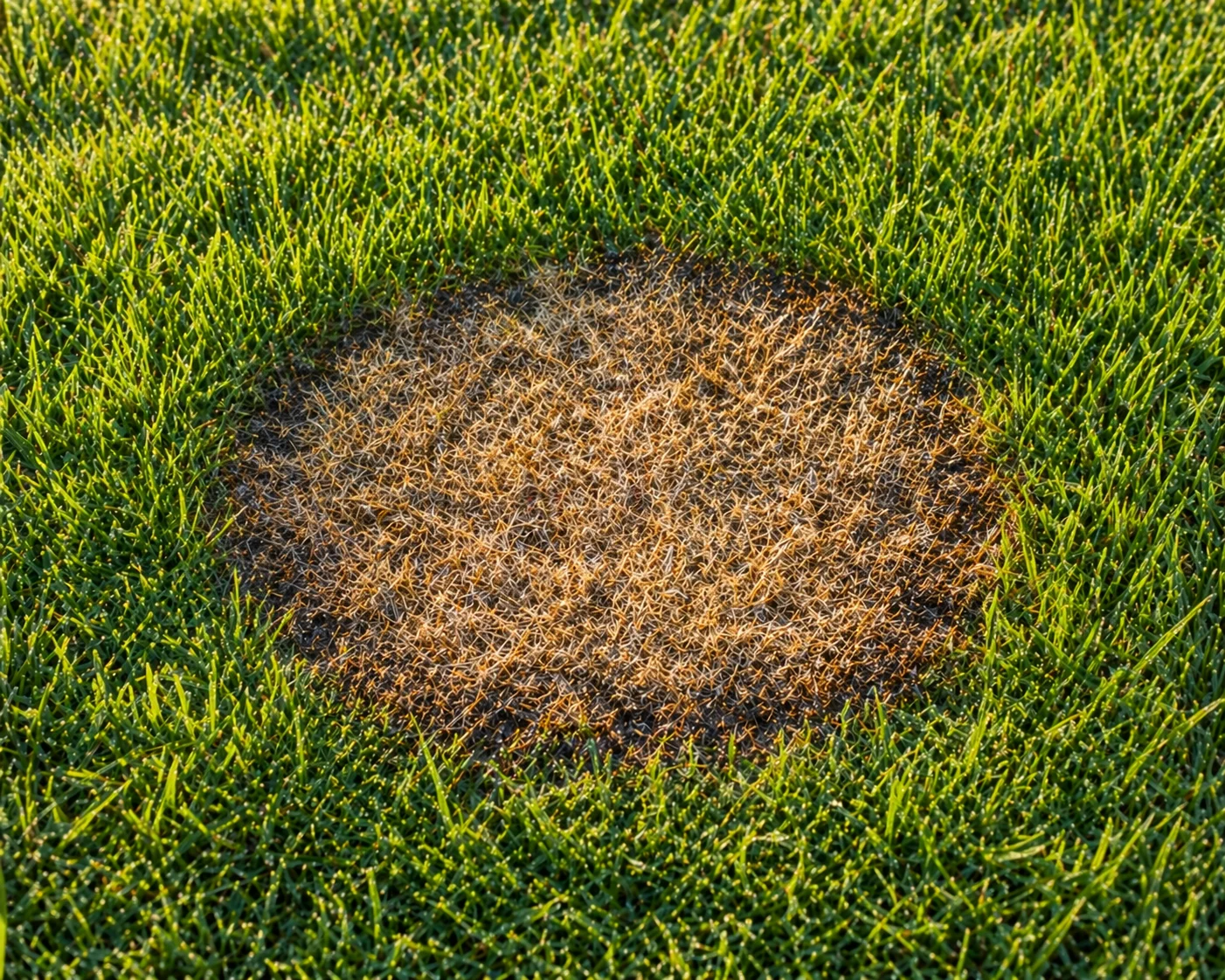
What Does Brown Patch Look Like?
Brown Patch produces roughly circular patches of tan, straw-colored, or light brown dead grass, ranging from 15 centimeters to over 1 meter in diameter on home lawns, with larger patches possible on golf courses and other close-mowed turf. The shape is typically circular or slightly irregular but consistently rounded — not random or elongated. Multiple patches often appear simultaneously across an affected lawn, sometimes merging into larger coalesced areas.
The most diagnostic feature is the smoke ring — a darker-colored border (usually gray or dark purple-brown) visible at the edge of active patches, most apparent in early morning dew. The smoke ring is the active front of the fungus advancing outward into healthy grass, and its presence definitively distinguishes Brown Patch from look-alike conditions. White cottony mycelium may also be visible at patch edges in heavy dew.
Individual blade inspection provides final confirmation. Pull grass blades from the edge of an active patch. Brown Patch blights blades from the sheath (base) upward, producing tan or straw-colored tissue with irregular dark borders where the lesion transitions to healthy green tissue. Drought-damaged blades brown from the tip downward — never from the base. Dollar Spot produces smaller distinctive hourglass-shaped lesions. Pythium Blight produces greasy, water-soaked tissue rather than the papery dry appearance of Brown Patch.
What Causes Brown Patch?
Brown Patch is caused by the fungus Rhizoctonia solani, which is soil-borne and present in most US lawn soils year-round but only becomes pathogenic under specific environmental conditions. The fungus persists in soil and thatch as sclerotia (resting structures) for years, waiting for favorable weather. Once conditions align, it grows rapidly across grass blades and into plant tissue, feeding on leaf cells and producing the characteristic dead patches.
The specific conditions required for Brown Patch development are: daytime temperatures 21–30°C, nighttime temperatures above 20°C (this is the critical trigger), relative humidity above 95% at the soil surface, and leaf wetness for 10 or more consecutive hours. These conditions describe most summer nights in the humid US from mid-June through September — particularly after evening irrigation or rain events that leave grass blades wet through the warm overnight period.
The disease is essentially a weather event on a susceptible host. Brown Patch won't develop in dry conditions no matter how much fungus is present in the soil, and won't develop on resistant grasses even under perfect conditions. The three-way interaction of pathogen, host, and environment (the disease triangle) all needs to align for an outbreak to occur. Interrupting any one leg of the triangle prevents disease.
Which Grasses Are Most Affected?
Susceptibility varies dramatically by species. Tall Fescue in the transition zone receives the most severe Brown Patch pressure of any US lawn situation.
Tall Fescue is the single most susceptible common lawn grass. Millions of Tall Fescue lawns in the transition zone (Virginia, North Carolina, Kentucky, Tennessee, Missouri, Kansas) and mid-Atlantic develop Brown Patch annually, with severe outbreaks occurring roughly every 3–5 years during particularly hot humid summers. Perennial Ryegrass shows similar susceptibility and is particularly vulnerable when used as winter overseed on Bermuda lawns in the South — the transition period when overseeded Rye is growing in warm spring weather produces severe Brown Patch pressure.
Warm-season grasses develop Large Patch — a closely related disease caused by Rhizoctonia solani AG2-2 rather than AG1-1A. Large Patch occurs in fall and spring rather than summer, with different environmental triggers. See section 11 below for Large Patch details. A Tall Fescue lawn that shows circular patches in July has Brown Patch; a Zoysia lawn that shows circular patches in November has Large Patch.
| Grass Type | Susceptibility | Peak Season | Notes |
|---|---|---|---|
| Tall Fescue | HIGH | June–September | Primary target in transition zone |
| Perennial Ryegrass | HIGH | June–September | Northern states, overseeded Bermuda |
| Kentucky Bluegrass | MODERATE | July–August | Especially in humid Northeast summers |
| Creeping Bentgrass | HIGH | June–September | Golf course primary target |
| Fine Fescue | MODERATE | July–August | Less susceptible than Tall Fescue |
| Bermuda | LOW | Different species | Different Rhizoctonia — rarely damaging |
| Zoysia | LOW–MODERATE | Large Patch (fall/spring) | Distinct disease, see section 11 |
| St. Augustine | MODERATE | Large Patch (fall/spring) | Rhizoctonia AG2-2 variant |
| Centipede | LOW–MODERATE | Spring transition | Large Patch primary concern |
Brown Patch Calendar — When to Expect It
Regional timing varies significantly. Peak risk periods depend on when overnight temperatures consistently exceed 20°C combined with humidity and leaf wetness conditions.
The transition zone receives the most consistent Brown Patch pressure because the region's summer conditions align perfectly with the fungus's requirements. Most transition zone Tall Fescue lawns see some Brown Patch activity every summer, with moderate to severe outbreaks in 2–3 years out of every 5. Preventive fungicide programs are common and often necessary for high-quality transition zone lawns.
Northern states have shorter Brown Patch windows because their cooler nights fall outside the 20°C+ nighttime trigger for most of the summer. Typical Northeast Brown Patch pressure is confined to 2–4 weeks in late July and early August during particularly humid stretches. This makes preventive fungicide less economically justified; curative treatment at first symptom is usually adequate.
| Region | Peak Season | Shoulder Seasons | Annual Risk |
|---|---|---|---|
| Transition zone (VA, NC, TN, KY) | June–September | May + October | HIGH annually |
| Northeast (NY, PA, NJ, MA) | July–August | Late June, Early Sept | MODERATE annually |
| Southeast (GA, SC, AL) | June–October | May + November | HIGH annually |
| Midwest (OH, IN, IL, MO) | July–August | Late June, Early Sept | MODERATE annually |
| Upper Midwest (MN, WI, MI) | July (brief) | Late June only | LOW annually |
| Pacific Northwest | August–September | July, October | LOW–MODERATE |
| California Central Valley | July–August | Hot nights only | LOW–MODERATE |
| Mountain West | July (rare) | None typical | LOW |
The #1 Cause: Evening Irrigation
Evening irrigation is the single most controllable factor affecting Brown Patch risk. Research data from multiple university trials consistently shows that lawns irrigated between 6 PM and 10 PM have 3–5 times higher Brown Patch incidence than lawns irrigated between 5 AM and 9 AM at the same total water volume. The mechanism is sustained leaf wetness — evening irrigation leaves grass blades wet through the entire warm overnight period, providing the 10+ hours of leaf wetness that Brown Patch requires for infection.
The fix is mechanical: set your irrigation controller to run between 5 and 9 AM, period. Every modern programmable controller supports this timing. If you have to water during a restricted morning-prohibited period, 4 AM is better than 8 PM — grass dries within a few hours of sunrise regardless of when water was applied. 2 AM is better than 6 PM. Anything that ends with grass blades drying before sustained warm overnight humidity sets in dramatically reduces Brown Patch risk.
Rain events are unavoidable, but the controllable irrigation factor alone can reduce Brown Patch pressure by 60–70% on susceptible lawns. Combined with other cultural controls (correct mowing height, moderate nitrogen), irrigation timing can often eliminate the need for fungicide entirely on moderately-susceptible lawns. For high-susceptibility lawns (Tall Fescue in the transition zone), irrigation timing plus preventive fungicide is the most effective combined program.
Mowing Height and Brown Patch Risk
Mowing height has a direct and measurable effect on Brown Patch severity. Research plots mowed at 65 mm show significantly higher Brown Patch incidence than identical plots mowed at 90 mm — typically 40–60% higher disease severity. The mechanism is microclimate at the soil surface: closely-mowed lawns have dense, humid microclimates at the soil/thatch interface that trap moisture and elevate humidity to levels favorable for fungal development. Taller canopies allow air circulation and faster drying.
Raising the summer mowing height is the second most effective cultural control after irrigation timing. For Tall Fescue lawns: raise from 65 mm winter/spring height to 90 mm summer height during June–September. For Kentucky Bluegrass: raise from 50 mm to 75–90 mm. For Perennial Ryegrass overseed on Bermuda: maintain 50 mm or above during transition periods. The cost is more frequent mowing (taller grass grows faster per week) but the disease reduction is substantial and fungicide savings often offset the added mowing.
Scalping — cutting more than one-third of the blade length in a single mow — is particularly damaging during Brown Patch pressure. The stress of scalping combined with the resulting dense humid canopy at the soil surface creates ideal conditions for fungal establishment. Never scalp a Tall Fescue lawn in summer; space mowings to remove at most one-third of blade length at each pass.
Nitrogen and Brown Patch
Excessive nitrogen is a major risk factor for Brown Patch. Summer nitrogen applications (June through August) on susceptible grasses produce lush, succulent new tissue that is significantly more vulnerable to fungal infection. Research data shows Brown Patch severity increasing 30–50% on plots receiving summer nitrogen versus plots fertilized only in spring and fall.
The correct approach for cool-season grasses is: no nitrogen applications from June 1 through September 1 in Brown Patch-susceptible regions. Schedule spring applications for April–May and fall applications for September–November. Summer fertilization should be limited to potassium and iron if additional color support is needed. Potassium strengthens cell walls and actually reduces disease susceptibility; iron provides color without the disease-promoting growth flush.
Warm-season grasses have the opposite pattern — summer is the correct growth season and nitrogen should be applied through the summer. Large Patch on warm-season grasses is driven by fall nitrogen applications, not summer, so avoid late-season nitrogen on Zoysia and St. Augustine lawns in October–November.
Brown Patch Treatment — Fungicides That Work
Fungicide selection depends on preventive vs curative application and the grass type. Preventive applications are significantly more effective than waiting for symptoms.
Preventive applications starting June 1 are standard practice on high-susceptibility lawns (Tall Fescue in transition zone). Apply azoxystrobin or propiconazole at label rate every 21–28 days through September 1. Each $80–$120 professional application covers roughly 5,000–10,000 sq ft and provides 3–4 weeks of protection. DIY equivalent using Scotts DiseaseEx or BioAdvanced runs $25–$40 per application covering 5,000 sq ft.
Curative applications after symptoms appear can stop disease spread within 3–5 days but cannot restore dead grass. The damage you see today will remain until natural tillering recovery fills in dead areas over 4–6 weeks. If more than 20% of the lawn is affected when treatment begins, overseeding in fall (after cooler weather breaks Brown Patch pressure) is the fastest path to full recovery.
Resistance management matters. Rotate between chemistry classes (strobilurins like azoxystrobin, triazoles like propiconazole, and contact fungicides like chlorothalonil) rather than using the same product repeatedly. Brown Patch resistance to strobilurins has been documented on golf courses and is emerging on home lawns. Rotation programs extend the useful life of available fungicides.
| Product | Active Ingredient | Application Type | Homeowner Access |
|---|---|---|---|
| Heritage G (Syngenta) | Azoxystrobin 0.31% | Preventive + Curative | Commercial; home similar: Scotts DiseaseEx |
| Banner MAXX (Syngenta) | Propiconazole 14.3% | Preventive + Curative | Commercial; home: Bayer Fungus Control |
| Armada (Bayer) | Trifloxystrobin + Propiconazole | Curative preferred | Commercial product |
| Scotts DiseaseEx | Azoxystrobin | Preventive + Curative | Consumer retail (Home Depot, Lowe's) |
| BioAdvanced Fungus Control | Propiconazole | Preventive + Curative | Consumer retail |
| Daconil Weather Stik | Chlorothalonil | Preventive only | Consumer retail (spray concentrate) |
| Cleary's 3336 | Thiophanate-methyl | Curative | Commercial product |
| Pillar SC | Triticonazole + Pyraclostrobin | Preventive + Curative | Commercial combination product |
How Long Does Recovery Take?
Fungicide stops active disease progression within 3–7 days of application. The smoke ring at patch edges stops advancing, new blade infections cease, and the disease is effectively contained. This is observable — walk the lawn daily after treatment and you should see patch edges stable by day 5. If patches continue expanding past day 7, the diagnosis may be wrong or resistance is present; consult a lawn care professional for alternative chemistry.
Dead grass in Brown Patch areas does not recover. The blades are dead, and they will remain tan or straw-colored until physically removed. Recovery happens through natural tillering — living crowns around patch edges produce new shoots that fill in dead zones over 4–6 weeks of favorable growing conditions. In cool-season grasses, tillering is most active in September and October, so Brown Patch damage from July typically doesn't show substantial recovery until early fall.
For large patches (more than 30% of lawn area affected), overseeding is the fastest path to full recovery. Wait until disease pressure breaks — typically early to mid-September when nights cool below 20°C consistently — before overseeding. Apply fungicide one final time to ensure no active disease, then overseed with Brown Patch-resistant Tall Fescue varieties (RTF, Turf Saver, Southern Tide) at 4–6 lbs per 1,000 sq ft. Expect full density restoration by late November.
Do not overseed during active Brown Patch conditions. Young seedlings are extremely susceptible to Brown Patch, and seedlings emerging into an active disease environment are typically killed before they establish. The window between Brown Patch season ending and winter hardening-off begins is narrow — plan overseeding carefully.
Preventing Brown Patch Long-Term
Long-term Brown Patch prevention combines cultural and chemical controls into an integrated program. For a high-susceptibility Tall Fescue lawn in the transition zone: morning-only irrigation (5–9 AM), summer mowing height at 90 mm, no nitrogen June through September, annual core aeration in fall, preventive fungicide program starting June 1 with applications every 21–28 days through early September.
Variety selection matters significantly. Newer disease-resistant Tall Fescue cultivars (Rhizomatous Tall Fescue — RTF — varieties like Barenbrug RTF, Turf Saver RTF) show substantially reduced Brown Patch susceptibility compared to older varieties. When overseeding, specify disease-resistant varieties rather than generic Tall Fescue seed mixes. The premium for resistant varieties ($20 per 25-lb bag vs $40–50) is recovered within 1–2 seasons through reduced fungicide needs.
Thatch management is critical. Thatch over 12 mm thick holds moisture and creates the humid microclimate Brown Patch thrives in. Core aerate annually in fall (September or October for cool-season grasses) with minimum 15 cm core depth and 3–4 inch spacing. Remove cores rather than leaving them on the surface to decompose — the process of removing cores physically reduces thatch faster than natural decomposition.
Drainage improvements in chronic wet areas. If specific sections of your lawn remain wet for 24+ hours after rain or irrigation, they will develop Brown Patch repeatedly regardless of other controls. Consider French drains, grading adjustments, or conversion to drought-tolerant alternatives (replacing lawn with native plantings or gravel) in chronically wet zones.
Large Patch: Brown Patch on Warm-Season Grasses
Large Patch is a distinct disease caused by Rhizoctonia solani anastomosis group AG2-2, related to but different from the AG1-1A that causes Brown Patch on cool-season grasses. Large Patch attacks warm-season grasses (St. Augustine, Zoysia, Centipede, occasionally Bermuda) in fall and spring rather than summer — when soil temperatures are 15–22°C combined with wet conditions. This corresponds to October–December and March–May in most of the warm-season growing region.
Symptoms are similar to cool-season Brown Patch — circular patches of tan or orange-brown dead grass, typically 30 cm to 3 meters in diameter, with a diffuse darker edge (the smoke ring is less pronounced than on cool-season Brown Patch). Affected patches often appear as Bermuda begins spring green-up or Zoysia enters fall dormancy. St. Augustine lawns in Florida develop Large Patch primarily in October–December following the fall rainy season.
Cultural controls: reduce fall nitrogen applications on warm-season grasses (opposite advice from cool-season Brown Patch). Avoid irrigation after October 1 in most of the warm-season zone. Maintain fall mowing height at the grass's recommended height (25 mm for Bermuda, 40 mm for Zoysia, 75 mm for St. Augustine). Aerate in spring rather than fall to avoid creating wounds that favor Large Patch establishment.
Fungicide treatment: azoxystrobin, propiconazole, and flutolanil all provide good control. Apply preventively in October for fall Large Patch and in March for spring Large Patch in historically affected lawns. Curative applications after symptoms appear reduce spread but damage is already done. St. Augustine lawns in Florida often warrant preventive programs; Zoysia lawns in cooler climates can usually skip preventive programs with good cultural controls.
Frequently Asked Questions
Will brown patch kill my lawn permanently?
No — Brown Patch damages leaf tissue but does not typically kill grass crowns or roots. Individual patches appear dead but the crown remains viable, and natural tillering recovery fills in dead areas over 4–6 weeks. In severe cases where more than 30% of the lawn is affected, overseeding in fall accelerates full recovery. Permanent damage only occurs in extreme cases with severe repeated outbreaks combined with poor cultural practices.
Can I overseed brown patch patches in summer?
No — do not overseed during active Brown Patch conditions. Young seedlings are extremely susceptible to Brown Patch and will be killed before establishing. Wait until fall when night temperatures consistently drop below 20°C (typically September in the transition zone, late August in the Northeast). Apply a final fungicide to ensure no active disease, then overseed with disease-resistant Tall Fescue varieties.
Does brown patch come back every year?
On susceptible lawns without good cultural practices, yes — Brown Patch is likely to recur annually during summer conditions. On lawns with morning-only irrigation, correct mowing height, appropriate nitrogen timing, and good drainage, Brown Patch may skip years entirely even in the transition zone. Preventive fungicide programs essentially eliminate active outbreaks on high-susceptibility lawns.
How do I know if it's brown patch or drought damage?
The smoke ring test is definitive. Brown Patch produces a darker-colored border (smoke ring) at the edge of active patches, visible in morning dew. Drought damage produces uniform browning without any ring pattern. Pull a blade: Brown Patch blades are blighted from the sheath upward with distinct lesion borders; drought blades brown from the tip downward. The timing also differs — Brown Patch appears suddenly and expands, while drought damage develops gradually.
Is the brown patch fungicide safe for pets and children?
When used per label, yes. Consumer fungicide products (Scotts DiseaseEx, BioAdvanced Fungus Control) are registered for residential use and considered safe after application dries (liquid) or is watered in (granular). Typical re-entry period is 2–24 hours depending on product. Keep pets and children off treated areas during the re-entry period, and store products locked and out of reach. Never allow dogs to eat treated grass.
About the Author
Lawn Care Expert & Writer · Denver, Colorado · Florida State University
Jason Allen is a lawn care expert and freelance writer based in Denver, Colorado. He studied turfgrass science and horticulture at Florida State University before founding his own lawn care operation serving the Denver metro area. With over a decade of hands-on experience managing cool-season lawns in Colorado's challenging high-altitude climate, Jason specializes in aeration, fertilization timing, drought management, and water-restriction compliance. His practical, science-backed approach to lawn care has helped thousands of homeowners achieve healthy turf despite Colorado's short growing seasons, clay soils, and frequent drought conditions.