Lawn Fungus: How to Identify, Treat, and Prevent It
Published:

Lawn fungus isn't one disease, it's a category of eight distinct fungal pathogens that produce very different symptoms, attack different grass types, and require different treatments. Brown Patch creates large circular tan patches. Dollar Spot creates small silver-dollar-sized bleached circles. Red Thread leaves pink-red needle-like mycelium on blades. Pythium Blight kills lawns in 48 hours. Identifying the specific fungus is the first and most important step, the wrong treatment on the wrong disease wastes money and lets the actual disease spread. This guide covers how to tell fungus from other lawn problems, the eight fungi you're most likely to encounter, cultural controls that prevent most diseases, and fungicide selection when prevention fails.
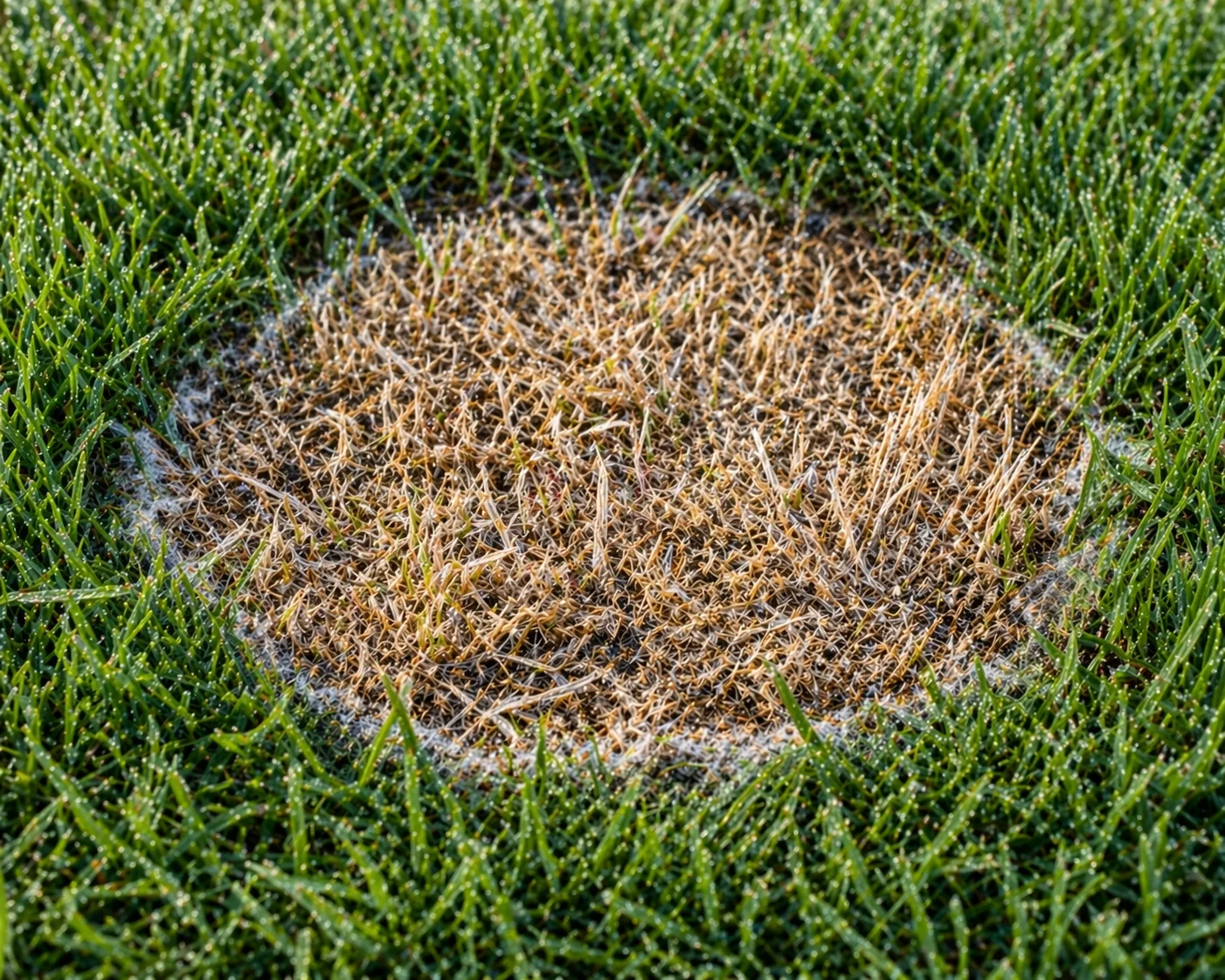
How to Tell If Your Lawn Has Fungus
Lawn fungus produces distinctive patterns that differ from drought, insect damage, and dog urine. Circular or irregular patches with bleached, tan, or discolored grass are the primary visual cue. White, gray, pink, or tan fuzzy growth visible on blades in morning dew is diagnostic, that's the fungal mycelium actively feeding on the grass. Ring patterns, either with a darker outer edge (smoke ring) or a full ring of darker green (stimulated growth), also indicate fungal activity.
The single most diagnostic test is the blade pull test. Gently pull a few grass blades from the edge of a suspect patch and examine them. Fungal disease produces discoloration starting at the base or in bands across the blade, with lesions that have distinct edges and sometimes a darker or lighter colored border. Drought stress produces blade-tip browning that works its way down from the tip, never from the base. Insect damage leaves mechanical chewing or cutting marks. Dog urine leaves a distinctive dark green outer ring around a dead center spot.
When to suspect fungus: humid weather, consistent leaf wetness, circular patterns, white or colored mycelium visible in morning. When to suspect something else: single dead patches with no circular pattern (usually dog urine or chemical spill), dead patches with peeled-up turf (grubs, see our grubs-in-lawn guide), uniform browning across the entire lawn (drought or dormancy).
The 8 Most Common Lawn Fungi
These eight fungal diseases account for roughly 95% of diagnosed lawn fungus cases in the US. Use this table to narrow down candidates based on appearance and season, then read the detailed section below for confirmation.
Most home lawns will see Brown Patch or Dollar Spot as the primary fungal problem, with occasional outbreaks of the others under specific conditions. The key data points for identification are the size of the affected area, the color of the grass blades, whether mycelium is visible, and the season in which symptoms appeared. Get those four pieces of information right and the disease identification becomes straightforward.
| Disease | Appearance | Season | Grass Types | Conditions |
|---|---|---|---|---|
| Brown Patch | Circular 15–100cm tan patches, darker outer ring | Summer (Jun–Sep) | Tall Fescue, Ryegrass, KBG | Night >20°C, wet leaves 10+ hrs |
| Dollar Spot | Silver-dollar-sized (5–7cm) bleached circles | Spring + Fall | All grasses | Dewy nights 10–25°C, low nitrogen |
| Red Thread | Pink-red needle-like mycelium on blades | Spring + Fall | Fine Fescue, Ryegrass | Cool wet weather, low nitrogen |
| Pythium Blight | Greasy water-soaked patches, rapid spread | Hot humid nights | Ryegrass, Bentgrass | Night >20°C, saturated soil |
| Necrotic Ring Spot | Rings of dead grass 15–60cm diameter | Summer stress | Kentucky Bluegrass | Soil compaction, thatch |
| Fairy Ring | Circular rings, mushrooms, stimulated green | Year-round | All grasses | Buried organic matter decomposing |
| Snow Mold | Matted patches at snowmelt, gray or pink | Late winter/spring | All cool-season | Under snow cover on green grass |
| Leaf Spot / Melting Out | Brown spots on blades, thinning stands | Spring + Fall | KBG, Fescue | Cool wet weather, close mowing |
Brown Patch Fungus (Most Common)
Brown Patch is caused by Rhizoctonia solani, a soil-borne fungus present in most US lawn soils but only actively pathogenic when specific environmental conditions align. The disease produces circular patches ranging from 15 cm to over 1 meter in diameter, with tan or straw-colored dead grass in the center and often a distinct darker-colored outer ring (the smoke ring) visible in morning dew. The smoke ring is the active edge of the disease, the fungus advancing outward into healthy grass.
Cool-season grasses are the primary target. Tall Fescue is the most susceptible, followed by Perennial Ryegrass and Kentucky Bluegrass. The disease is most active when daytime temperatures are 21–30°C and nighttime temperatures remain above 20°C, essentially describing most summer nights in the humid US from June through September. Leaf wetness for 10 or more hours is required for infection to establish, which is why evening irrigation is the single biggest preventable risk factor.
Treatment: apply a fungicide containing azoxystrobin (Heritage, Scotts DiseaseEx), propiconazole (Banner MAXX, Bayer Fungus Control), or a combination product. Fungicides are most effective applied preventively in June in historically affected lawns. Curative applications after symptoms appear will stop the disease from spreading but cannot restore dead grass, recovery happens through natural tillering in 4–6 weeks. Cultural controls are critical: morning-only irrigation, summer mowing height raised to 90mm for Tall Fescue, no summer nitrogen applications.
Dollar Spot (Most Widespread)
Dollar Spot is caused by Clarireedia jacksonii (formerly Sclerotinia homoeocarpa). It's the most widespread fungal disease in the US because it affects virtually every common grass species, Bentgrass, Bermuda, Kentucky Bluegrass, Tall Fescue, Perennial Ryegrass, and Zoysia all develop Dollar Spot under appropriate conditions. The characteristic symptom is distinctive: silver-dollar-sized circular patches (5–7cm) with bleached, tan, or straw-colored centers. On close-mowed turf the patches stay small and discrete; on home lawns mowed at normal heights they can merge into larger irregular areas.
Individual blade lesions are diagnostic. Pull a grass blade from the edge of a suspect patch and look for hourglass-shaped lesions, tan or bleached center bands with reddish-brown margins, spanning across the blade. White cottony mycelium visible on grass blades in morning dew is also highly diagnostic, and distinguishes Dollar Spot from the similar-sized patches caused by drought or fertilizer burn.
Dollar Spot is uniquely linked to low nitrogen. Unlike Brown Patch which thrives on excessive nitrogen, Dollar Spot is worst on nutrient-stressed, slow-growing turf. Applying a light nitrogen application during active infection can actually help suppress the disease, the opposite response from any other fungal disease. Treatment options include propiconazole, thiophanate-methyl (Cleary's 3336), iprodione (resistance issues documented), and SDHI fungicides (boscalid, penthiopyrad). Apply on 14–21 day intervals for preventive control.
Red Thread and Pink Patch
Red Thread is caused by Laetisaria fuciformis. The diagnostic feature is unmistakable: thin pink-red fungal strands (mycelium threads) that bind dead grass blades together, visible in morning dew as faint pink fuzz on grass tips. Affected areas are typically 5–25 cm in diameter, with tan or bleached grass interspersed with healthy green blades. The pink threads and small patch size together are diagnostic, no other common lawn fungus produces pink-red mycelium.
Primary hosts are Fine Fescue and Perennial Ryegrass, with occasional damage to Kentucky Bluegrass in cool wet conditions. Red Thread is primarily a cool-season, cool-weather disease active in spring (April–June) and fall (September–November) when daytime temps are 15–24°C and nights are cool and damp. The Pacific Northwest, New England, and upper Midwest see the most Red Thread pressure; the humid Southeast less so because conditions rarely stay cool enough for sustained development.
Red Thread rarely kills grass. The disease feeds on dead and dying leaf tissue but doesn't attack crowns or roots, meaning affected lawns recover completely when conditions change. The most effective management is adequate nitrogen fertilization, Red Thread is often a sign that the lawn is nutrient-stressed. A light urea application (15–20 g/m² actual N) during active disease suppresses Red Thread within 10–14 days. Fungicides are rarely warranted for home lawn Red Thread.
Pythium Blight (The Fastest Spreader)
Pythium Blight (Pythium aphanidermatum and related species) is the most destructive lawn disease in North America. It can kill large areas of lawn within 24–48 hours of establishment, faster than any other disease. The characteristic symptom is greasy, dark, water-soaked patches that enlarge rapidly. Cottony white mycelium is visible on grass blades at dawn during active outbreaks, so distinctive that experienced lawn care professionals can diagnose Pythium from across a yard.
Pythium requires extreme conditions to propagate: daytime temperatures above 30°C, nighttime temperatures above 20°C, relative humidity above 90%, and saturated soil. These conditions typically occur in the Southeast and transition zone in July and August following heavy rain events combined with poor drainage. Perennial Ryegrass and Bentgrass are most susceptible; Kentucky Bluegrass and Tall Fescue are moderately susceptible; Bermuda and Zoysia are resistant.
Pythium is the one lawn disease where treatment cannot wait. If you see the characteristic greasy patches and cottony mycelium, apply a Pythium-specific fungicide (mefenoxam-based products like Subdue MAXX, or propamocarb) within 24 hours. Broad-spectrum fungicides (azoxystrobin, propiconazole) do NOT control Pythium because Pythium is an oomycete (water mold), not a true fungus. Improve drainage immediately, aerate, reduce irrigation, correct any low spots where water pools. Prevention is morning-only watering, not overwatering, and resistant varieties.
Fairy Ring
Fairy Ring is caused by soil-dwelling fungi (more than 60 species can produce the symptom) feeding on buried organic matter, old tree stumps, construction debris, or simply thick thatch layers. The disease produces distinctive circular rings ranging from 30 cm to 3 meters across, with three possible patterns. Type 1 Fairy Ring is a ring of dead or severely wilted grass caused by hydrophobic soil conditions in the fungal mat. Type 2 Fairy Ring is a ring of stimulated green growth from nitrogen released by fungal decomposition. Type 3 is a ring of mushrooms only, with no visible effect on the grass.
No effective fungicide treatment exists for Fairy Ring, the pathogen is established in soil, not on grass. Management focuses on cultural controls. Type 1 (dead ring) is treated with aggressive core aeration in the affected ring plus application of a soil wetting agent (Revolution, Hydraway) to break down the hydrophobic fungal mat and allow water to penetrate. Type 2 (green ring) usually doesn't require treatment, it's cosmetic rather than damaging. Type 3 (mushroom ring) can be managed by mowing off mushrooms as they appear.
If Fairy Ring is caused by a specific buried organic source (old tree stump, construction debris), excavation and removal is the only permanent fix. For Fairy Ring in lawns without identifiable buried debris, expect the ring to slowly expand over years and eventually fade. Overseeding dead zones with high-quality seed and rehabilitating the soil with compost topdressing supports recovery.
Snow Mold (Gray and Pink)
Snow Mold develops under persistent snow cover on cool-season grass that remained green when the snow fell. Two species produce the symptom. Gray Snow Mold (Typhula spp.) produces matted circular patches of gray or bleached grass 15 cm to 1 meter in diameter, visible immediately after snowmelt. Pink Snow Mold (Microdochium nivale) produces similar patches but with a distinctive pink or salmon tint, and can also develop in cool wet conditions without snow cover in coastal and Pacific Northwest regions.
Prevention is more effective than treatment. Stop fall nitrogen fertilization by October 15 in the Northern US, late nitrogen produces lush succulent growth that cannot harden off before snow and is highly susceptible to Snow Mold. The final mow of the season should bring the lawn to 50–65mm height (rather than the summer 75–90mm) so grass doesn't mat down under snow. Leaves and debris should be fully cleared before first snow.
Treatment after snowmelt: rake affected areas lightly to separate matted grass blades and allow air circulation. Most Snow Mold damage is cosmetic, the crowns survive and new growth emerges as soil warms. If dead areas persist past mid-May, apply a fungicide (propiconazole, PCNB) and overseed affected zones. Severe, annually-recurring Snow Mold problems may warrant a preventive late-fall fungicide application in the weeks before first snow.
Cultural Controls, The Best Prevention
The three most effective cultural controls for lawn fungus are morning-only irrigation, correct mowing height, and moderate nitrogen fertilization. Each addresses a different mechanism by which fungal diseases establish. Morning irrigation (5–9 AM) allows grass blades to dry during the day, preventing the 10+ hours of leaf wetness required by Brown Patch, Dollar Spot, and Pythium Blight. Evening irrigation is the single largest preventable fungal disease risk factor in US lawns.
Correct mowing height protects the microclimate at the soil surface. Closely mowed lawns have dense, humid microclimates at the soil/thatch interface that favor fungal development. Raising Tall Fescue from 65mm to 90mm summer height reduces Brown Patch incidence by approximately 50% in university research trials. Bermuda at 25mm versus 40mm shows similar reductions in Dollar Spot. The cost of higher mowing is minimal (more frequent mowing because of accelerated growth response); the disease benefits are substantial.
Nitrogen management is complex because different diseases respond differently. Brown Patch and Pythium are worsened by excessive summer nitrogen. Dollar Spot and Red Thread are worsened by insufficient nitrogen. The balanced approach: moderate nitrogen (1–2 lbs/1000 sq ft per year on cool-season, 3–4 lbs on warm-season), split across 3–4 applications, with fall applications favored over summer for cool-season grasses.
Supporting cultural controls: aerate annually to reduce thatch below 12mm, improve drainage in chronic wet areas, prune overhanging trees to improve air circulation, use disease-resistant grass varieties when overseeding (RTF Tall Fescue, Blueberry Kentucky Bluegrass, Fiesta Ryegrass are known resistant lines). Together these practices reduce fungicide need significantly, a well-managed lawn with good cultural practices typically needs preventive fungicide only during peak-risk weather events.
Grass type matters more than you think. Drought-tolerant grass species (tall fescue, fine fescue, Bermuda, zoysia) develop fungal issues less frequently than thirstier species like Kentucky bluegrass or perennial ryegrass. Their deeper root systems produce healthier crown tissue and survive 28+ days without water versus 7 to 14 for shallow-rooted species. If you are rebuilding a lawn that has had recurring fungus problems, transitioning to a more drought-tolerant grass type addresses the underlying vulnerability rather than just fighting the symptom.
Fungicide Guide: What Works on What
Fungicide selection depends on target disease, preventive vs curative application, and grass type. No single product controls all diseases, match the fungicide to the diagnosed disease.
Preventive applications are more effective than curative. Apply fungicides before symptoms appear in historically affected lawns, for Brown Patch on Tall Fescue, that means starting applications in early June. Curative applications stop disease spread but cannot restore dead tissue. Application timing matters: most systemic fungicides need to be watered in within 24 hours to move into the root zone where they can be absorbed and distributed through the plant.
Resistance management is important. Rotate fungicide chemistry classes (strobilurin, triazole, carboxamide) rather than reapplying the same product repeatedly. Resistance has been documented for iprodione on Dollar Spot, thiophanate-methyl on several diseases, and emerging SDHI resistance on Dollar Spot. Follow label directions for maximum applications per year.
Organic options have a place. Neem oil (azadirachtin) provides modest preventive activity against several foliar fungi. Copper fungicides work well on some diseases (Dollar Spot, Leaf Spot) but can be phytotoxic in hot weather. Bacillus subtilis biofungicides (Serenade, Rhapsody) show modest efficacy particularly on Dollar Spot. Compost topdressing provides broad disease suppression (20–40% reduction in several studies) through microbial competition.
| Active Ingredient | Controls | Type | Homeowner Products |
|---|---|---|---|
| Azoxystrobin | Broad spectrum (most diseases) | Preventive + Curative | Heritage G, Scotts DiseaseEx |
| Propiconazole | Brown Patch, Dollar Spot, Red Thread | Preventive + Curative | Banner MAXX, Bayer Fungus Control |
| Thiophanate-methyl | Dollar Spot, Brown Patch, Fusarium | Curative | Cleary's 3336, Scotts Systemic Fungicide |
| Iprodione | Brown Patch, Dollar Spot, Melting Out | Curative | Chipco 26GT (resistance issues) |
| Chlorothalonil | Broad spectrum contact fungicide | Preventive only | Daconil Weather Stik |
| Mefenoxam | Pythium Blight, Downy Mildew | Curative (Pythium only) | Subdue MAXX |
| Triticonazole | Brown Patch, Dollar Spot | Preventive + Curative | Armada (combo product) |
| Boscalid + Pyraclostrobin | Broad spectrum | Preventive + Curative | Insignia SC |
When to Call a Lawn Professional
Pythium Blight spreading rapidly. Pythium is the one lawn disease where DIY delay can result in 50% or greater lawn loss within a weekend. If you see greasy dark patches expanding during a hot humid spell, call a professional immediately, they have access to restricted-use Pythium-specific fungicides that are significantly more effective than consumer products.
Repeated annual recurrence of the same disease. If your lawn develops Brown Patch every summer or Dollar Spot every spring despite good cultural practices, professional diagnosis of underlying soil conditions, irrigation patterns, or microclimate issues can identify root causes that homeowner-level intervention misses. Many persistent fungus problems trace to compacted soil, chronic over-irrigation from misaligned heads, or drainage issues that require professional assessment.
Large area (more than 30% of lawn) affected. Widespread disease may indicate a mismatch between grass variety and local conditions rather than a treatable disease outbreak. Professional diagnosis can determine whether fungicide treatment makes sense or whether a partial renovation with disease-resistant grass varieties is the better long-term investment.
Disease persisting after 2 fungicide applications. If consumer fungicides at label rates haven't controlled the disease after two applications 14 days apart, either (1) the disease is misidentified, (2) resistance has developed to the chosen chemistry, or (3) the application technique isn't delivering product effectively. Professional diagnosis and access to alternative chemistries can resolve cases that homeowner products cannot.
Frequently Asked Questions
Can lawn fungus spread to garden plants or trees?
Most lawn fungi are grass-specific or limited to turf-related species. Brown Patch (Rhizoctonia) can affect some garden plants but typically not in the forms that attack grass. Pythium can affect garden vegetables like cucumbers and squash. Dollar Spot and Red Thread are grass-specific. The practical risk is low, good lawn fungicide hygiene (cleaning mower blades, boots) prevents most cross-contamination.
Does mowing spread lawn fungus?
Yes, mowing during active disease can spread fungal spores across the lawn via blades and wheels. Best practices during active outbreaks: mow affected areas last, clean the mower deck after mowing, and avoid mowing wet grass during disease pressure. If the lawn has a major active infection (Pythium spreading rapidly), delay mowing entirely until after fungicide treatment takes effect, typically 3–5 days.
How long does lawn fungus treatment take to work?
Fungicides stop active disease spread within 3–7 days of application. The disease's active edge stops expanding, and new blade infections cease. However, already-dead grass does not recover, the grass you see today that is brown or bleached will remain so. Recovery through natural tillering and regrowth takes 4–6 weeks in favorable conditions. Severe cases may require overseeding to restore full density.
Is lawn fungus dangerous to humans or pets?
The fungi themselves are not directly harmful to humans or pets, they are grass pathogens. However, fungicide products have safety considerations. Keep pets and children off treated areas until the product has dried (liquid) or been watered in (granular). Never let dogs eat treated grass. Fairy Ring mushrooms may be poisonous if consumed and should be removed or fenced off if children or pets have lawn access.
Does lawn fungus go away on its own?
Some fungi resolve without treatment when conditions change. Red Thread often fades when cool wet weather ends. Snow Mold usually heals naturally as spring warms. Dollar Spot and Brown Patch, however, can expand aggressively under favorable conditions and may destroy substantial lawn area if untreated. Pythium never resolves on its own, it spreads until conditions change dramatically or the host is exhausted. When in doubt, treat.
About the Author
Lawn Care Expert & Writer · Denver, Colorado · Florida State University
Jason Allen is a lawn care expert and freelance writer based in Denver, Colorado. He studied turfgrass science and horticulture at Florida State University before founding his own lawn care operation serving the Denver metro area. With over a decade of hands-on experience managing cool-season lawns in Colorado's challenging high-altitude climate, Jason specializes in aeration, fertilization timing, drought management, and water-restriction compliance. His practical, science-backed approach to lawn care has helped thousands of homeowners achieve healthy turf despite Colorado's short growing seasons, clay soils, and frequent drought conditions.