Grubs in Your Lawn: How to Find, Identify, and Kill Them
Published:

White grubs are the larval stage of several beetle species — Japanese Beetles, European Chafers, June Bugs, and Oriental Beetles most commonly — that hatch in mid-to-late summer and feed on grass roots from August through October. A moderate grub infestation (10+ grubs per square foot) severs enough roots that large areas of lawn die and peel back like loose carpet. Damage is often blamed on drought or disease initially; the correct diagnosis requires physically pulling back suspect turf and counting grubs in the soil below. This guide covers definitive identification, the grub life cycle that dictates treatment timing, preventive and curative insecticide options, organic controls, lawn repair after damage, and region-specific grub species information.
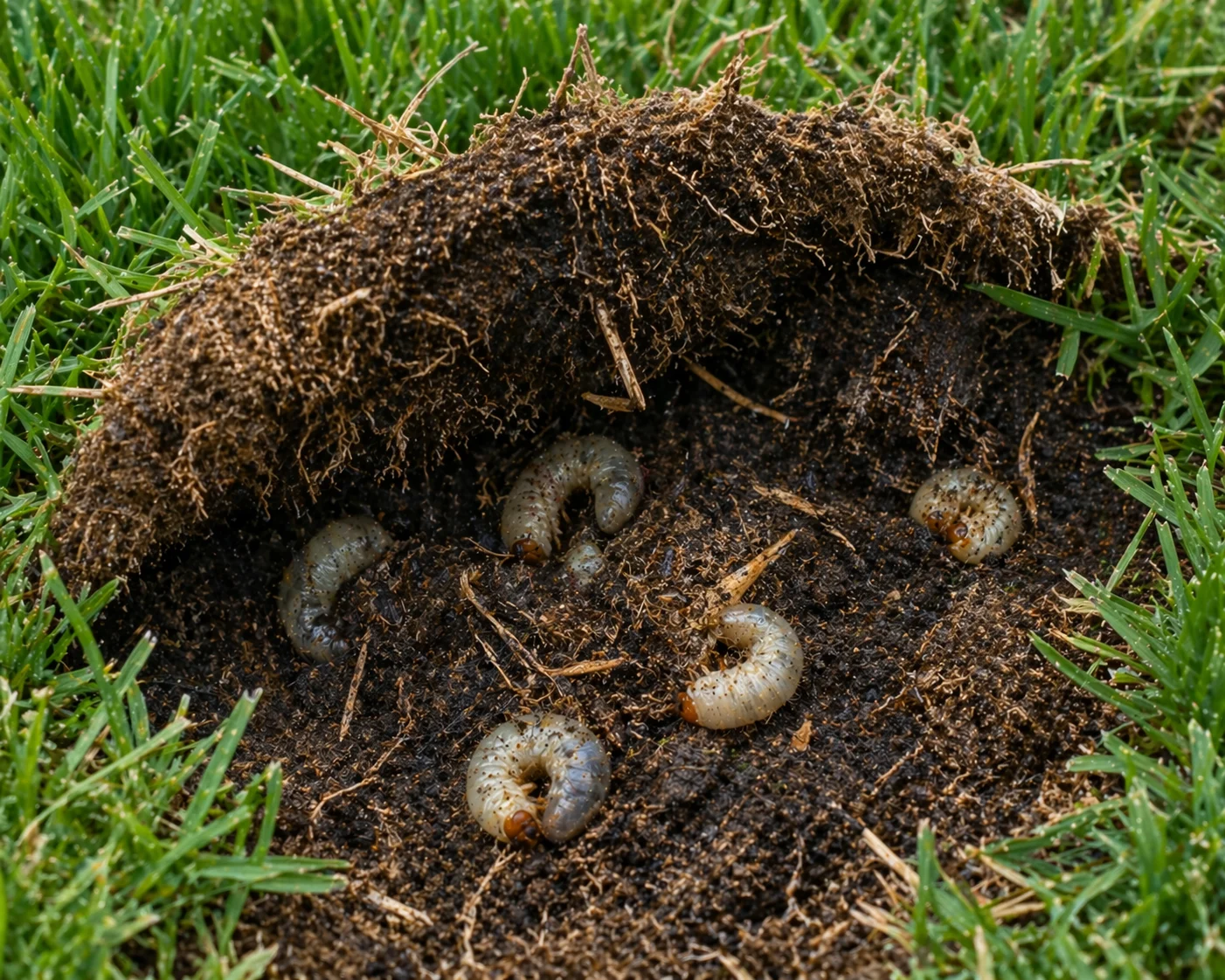
Signs of Grubs in Your Lawn
The primary diagnostic symptom is dead or dying grass in irregular patches — typically 30 cm to several meters in diameter — that doesn't respond to irrigation. Grub-damaged grass cannot take up water because the roots are eaten; adding water does nothing. Drought-damaged lawns recover within 48 hours of heavy irrigation, while grub-damaged lawns show no response.
The definitive test is the peel-back test. Grab the edge of a brown patch with both hands and pull upward. Grub-damaged turf lifts easily like loose carpet — the root system is gone and only the top layer of grass and thatch remains. Healthy turf resists pulling. Disease-damaged turf pulls up only in small pieces as dead blades separate from the soil. If a 30 cm x 30 cm section pulls up intact with bare soil beneath, you have grubs.
Secondary signs include dramatically increased bird activity (robins, starlings, crows) feeding intensely in affected areas — birds are eating the grubs. Skunks, raccoons, armadillos, and opossums all dig for grubs at night, leaving distinctive conical pits 5–10 cm deep scattered across affected lawn areas. Mole tunnels appearing in previously mole-free lawns also indicate grub populations; moles follow grub populations as a food source.
Confirmation: Pull back the edge of a suspect patch and examine the top 5–8 cm of soil. Grubs are white C-shaped larvae, 15–40 mm long depending on species and age, with visible brown head capsules and three pairs of legs near the head. They curl into a C-shape when disturbed — this is the most diagnostic identifier. Count grubs per 30 cm² (roughly a foot square) in at least three different spots across the affected area to assess infestation severity.
What Are Lawn Grubs?
Grubs are the larval stage of scarab beetles. Multiple species affect US lawns with varying geographic distributions and susceptibility to different treatments.
Species identification matters because different species have different geographic distributions, different life cycles (annual vs multi-year), and different susceptibilities to specific treatments. The Japanese Beetle is the most widespread US grub species and is the target species for most commercial grub control products. Milky Spore (Paenibacillus popilliae) is Japanese Beetle-specific and won't control June Bugs or European Chafers. Nematode species selection also varies by target — Heterorhabditis bacteriophora works well on Japanese Beetle and European Chafer; Steinernema glaseri is preferred for masked chafers.
The Black Turfgrass Ataenius is a notable exception — it's much smaller (5–8 mm rather than 20+ mm), produces very high population densities (100+ per square foot on golf courses), and has a shorter life cycle. Ataenius damage concentrates on golf course fairways and home lawns in the Southwest. Identification requires close inspection because the small size makes individual grubs easy to miss; treatment relies on preventive rather than curative approaches because populations are too dense for curative control to catch up.
| Species | Size | Distribution | Distinguishing Features |
|---|---|---|---|
| Japanese Beetle (Popillia japonica) | 20–30 mm | Nationwide, worst in NE+MW | Classic C-shape; metallic green adult; most widespread species |
| European Chafer (Amphimallon majale) | 20–30 mm | Northeast, upper Midwest | Round stocky body; rapid damage; cool-climate preferred |
| Oriental Beetle (Anomala orientalis) | 20–25 mm | Northeast Coast | Similar to Japanese Beetle; coastal bias |
| June Bug / June Beetle (Phyllophaga spp.) | 25–40 mm | South, Midwest | Larger than Japanese Beetle; 2–3 year life cycle |
| Green June Bug (Cotinis nitida) | 25–40 mm | Southeast, Gulf Coast | Very large; adult feeds on fruits |
| Masked Chafers (Cyclocephala spp.) | 20–25 mm | South, Southwest | Warm-climate; nocturnal adults |
| Black Turfgrass Ataenius | 5–8 mm | Southwest, golf courses | Much smaller; high-density damage |
| Asiatic Garden Beetle (Maladera castanea) | 15–20 mm | East Coast | Prefers night feeding on ornamentals |
Grub Life Cycle — Why Timing Matters
The grub life cycle dictates everything about treatment timing. Most North American grub species (excluding June Bugs which have a 2–3 year cycle) follow an annual cycle: Adult beetles emerge from pupation in late June through July. Adults mate and females lay eggs in lawns, preferring irrigated or moist lawns with short thatch over dry or heavily-thatched lawns. Eggs hatch in August into tiny first-instar larvae.
First and second instar larvae (August–September) feed actively in the top 5 cm of soil eating grass roots. This is the peak damage window and the critical curative treatment period — grubs at this stage are small, close to the surface, and susceptible to most insecticide chemistries. As soil temperatures drop in October, third-instar larvae move deeper (10–20 cm) and reduce feeding. By late November across most of the US, grubs are fully burrowed and dormant for winter.
Spring feeding (March–May) is a secondary damage window as grubs return to the surface for brief pre-pupation feeding. Spring feeding damage is usually less severe than fall damage because grubs are preparing to pupate and aren't feeding aggressively. However, spring feeding can finish off lawns that were weakened in fall. Late spring: larvae pupate in soil, adults emerge in June–July, cycle repeats.
Treatment timing implications: Preventive insecticides (chlorantraniliprole, imidacloprid, thiamethoxam) should be applied in late May through July, before egg hatch, to place residual insecticide in the root zone where first-instar larvae will encounter it. Curative insecticides (trichlorfon, carbaryl) should be applied in August through September when grubs are in the top 5 cm and susceptible. Spring applications are less effective because grubs are larger, deeper, and less susceptible.
How Many Grubs Is Too Many?
Not every grub causes damage. Healthy turf can tolerate low grub populations. Threshold counts determine when treatment is economically justified.
To count grubs accurately, use a sharp spade to cut three sides of a 30 cm x 30 cm square of turf in a suspect area. Lift the turf flap carefully, exposing the soil below. Count every grub visible in the soil and in the bottom of the turf flap (they often cling to the root zone). Repeat in two more spots in the affected area and average the counts. If the average exceeds the threshold for your grass type, treatment is justified.
Healthy lawns with deep root systems and adequate irrigation can tolerate up to 2x the threshold counts without visible damage — the grass simply produces new roots faster than the grubs can eat them. Stressed lawns (drought-stressed, nutrient-deficient, compacted soil) show damage at half the threshold because they cannot replace eaten roots. Good lawn health is itself a form of grub tolerance.
| Grass Type | Economic Threshold | Inspection Depth | Notes |
|---|---|---|---|
| Kentucky Bluegrass | 5–8 grubs / 30 cm² | 5–8 cm | Shallow-rooted; moderate tolerance |
| Tall Fescue | 10–12 grubs / 30 cm² | 5–10 cm | Deep roots; most tolerant cool-season |
| Perennial Ryegrass | 6–8 grubs / 30 cm² | 5–8 cm | Shallow-rooted; limited tolerance |
| Fine Fescue | 8–10 grubs / 30 cm² | 5–8 cm | Moderate tolerance |
| Bermuda Grass | 5–6 grubs / 30 cm² | 3–6 cm | Shallow-rooted warm-season; sensitive |
| Zoysia | 8–10 grubs / 30 cm² | 5–8 cm | Moderate tolerance |
| St. Augustine | 5–7 grubs / 30 cm² | 5–8 cm | Shallow-rooted; visible damage quickly |
| Centipede | 6–8 grubs / 30 cm² | 5–8 cm | Shallow-rooted; limited recovery |
Grub Treatment — Preventive Insecticides (June–July)
Chlorantraniliprole (brand names: Acelepryn, GrubEx Mach 2 — although Scott's GrubEx 1 uses different active ingredients; read labels carefully) is the best preventive insecticide available. Applied in May–June before egg hatch, chlorantraniliprole provides season-long grub control with exceptional safety for bees, earthworms, and beneficial insects. The product is more expensive than older alternatives ($35–50 per 5,000 sq ft vs $18–25 for imidacloprid) but the bee safety profile and long residual make it the current professional standard.
Imidacloprid (Bayer Grub Killer Plus, Scott's GrubEx 1, Spectracide Triazicide) is the most widely-used preventive insecticide. Apply in June–July; the product must be watered in with 3/4 to 1 inch of irrigation within 24 hours to move to the root zone where grubs will encounter it. Season-long control is generally effective. Concerns about bee exposure have led some states to restrict imidacloprid for commercial landscape use; homeowner applications remain legal in most states.
Thiamethoxam (Meridian, similar chemistry to imidacloprid) is another preventive option with similar efficacy and similar bee-exposure concerns. Application timing and watering-in requirements are the same as imidacloprid. Available in commercial-grade products; consumer retail is limited.
The key rule for preventive applications: water in within 24 hours with 3/4 to 1 inch of irrigation. Without adequate water to move the insecticide into the root zone, preventive applications sit on the surface and provide minimal grub control. Plan preventive applications before expected rain events or immediately before your normal irrigation cycle. This single step is the difference between effective and ineffective preventive grub control.
Grub Treatment — Curative Insecticides (August–September)
Trichlorfon (Bayer 24 Hour Grub Killer Plus, Dylox) is the fast-acting curative insecticide for active grub infestations. Apply in August–September when grubs are feeding actively in the top 5 cm of soil. Trichlorfon has high acute toxicity (caution handling required) but is fast-acting — grub mortality is 70–90% within 3 days of application. Products must be watered in immediately (1/2 inch irrigation) for effectiveness. Trichlorfon is restricted in some states; check local regulations.
Carbaryl (Sevin, Bayer Advanced GrubEx Kill II) is an older broad-spectrum insecticide that provides effective curative grub control when applied at correct rates. Slower than trichlorfon (5–10 days to full mortality) but broader spectrum and somewhat lower acute toxicity. Concerns about pollinator safety have led to application restrictions in some states. Water in with 1/2 inch irrigation.
The timing window is critical. Curative insecticides only work on grubs in the top 5 cm of soil — once grubs burrow deeper (typically mid-to-late October in most of the US), curative applications become ineffective because the product cannot reach the target. August through mid-September is the consistent treatment window across most of the country. In southern states, the window extends into October because soil stays warm longer.
Do not apply preventive and curative insecticides in the same year without consulting label requirements. Most products specify maximum annual application rates, and double-dosing risks both exceeded label rates and unnecessary environmental exposure. Choose either a preventive program (apply May–July, expect season-long control) or a curative response (scout in August, apply if threshold exceeded) rather than both.
Organic Grub Control
Heterorhabditis bacteriophora nematodes are the most effective organic grub control. These microscopic beneficial roundworms actively seek out and kill grubs by entering through body openings and releasing pathogenic bacteria. In favorable conditions (soil temperature 15–25°C, adequate moisture, good soil contact), nematodes provide 40–70% grub reduction — approaching but not matching chemical insecticide efficacy.
Application timing and conditions are critical for nematode success. Apply in August when soil temperature is 15–25°C. Water in thoroughly immediately after application, then maintain soil moisture for 2 weeks through regular irrigation. Nematodes require direct contact with grubs and will die within hours in dry soil. Apply in early morning or evening to avoid UV damage. Nematodes must be fresh — refrigerate and use within 4 weeks of purchase.
Milky Spore (Paenibacillus popilliae) is a bacterial control specific to Japanese Beetle grubs only. It will not control June Bugs, European Chafers, or other species. Milky Spore establishes slowly (2–4 years to reach effective soil population levels) but provides very long-term control once established — often 10+ years in favorable conditions. Apply in fall or spring to established lawn by sprinkling powder or granules at label rates. Milky Spore is not effective in cold climates because soil temperatures don't reach the activation threshold consistently.
Combined strategy works best: nematodes for immediate control of current-year populations, Milky Spore for long-term suppression of Japanese Beetle populations over years. Combined programs provide roughly 60–75% grub reduction at ongoing cost comparable to chemical preventive programs, without the ecological concerns of neonicotinoid insecticides.
Limitations: organic controls are less effective than chemical insecticides. If grub populations are high (2x threshold or greater) and turf damage is severe, chemical intervention may be necessary in the first year while establishing organic populations for subsequent years. Organic controls also have geographic limitations — nematodes need consistent soil moisture and cannot establish in arid climates without supplemental irrigation.
Lawn Repair After Grub Damage
After grub treatment resolves the active infestation, dead areas need rehabilitation. September is the ideal window for cool-season grasses (Kentucky Bluegrass, Tall Fescue, Ryegrass) because soil is still warm, nighttime temperatures moderate, and fall rainfall supports establishment. Warm-season grass repair is best in late spring (April–May) when the grass is entering active growth.
Step 1: Remove dead grass. Rake vigorously or scalp-mow affected areas to remove dead blades and expose soil. For severely damaged areas, physical removal of the dead turf mat (which rolls up easily due to the missing roots) and disposal is often more efficient than trying to rehabilitate through overseeding alone.
Step 2: Address soil. Aerate affected areas with a core aerator to break up any compaction and create channels for seed-to-soil contact. If animals (skunks, raccoons, armadillos) have dug extensively, rake the disturbed soil smooth and lightly compact before seeding. Add 6–10 mm of compost topdressing across affected areas to restore organic matter and soil biology that may have been disrupted.
Step 3: Overseed at double the normal rate. Typical Tall Fescue overseeding rate is 4–6 lbs per 1,000 sq ft; use 8–12 lbs on grub-damaged areas. The high seed rate ensures full density restoration even with some germination loss. Use high-quality seed of your existing grass type — matching the existing lawn is essential for a uniform appearance.
Step 4: Water consistently until establishment. Keep soil moist (not saturated) with 2–3 light daily irrigations for the first 10 days, then taper to daily irrigation through Week 2, then 2–3 times per week as seedlings establish. Full establishment typically takes 4–6 weeks; complete lawn uniformity (color and density matching surrounding undamaged areas) takes 6–10 weeks.
For severely damaged lawns (more than 30% affected) consider replacing sod rather than overseeding in damaged zones. Professional sod installation runs $1–2.50 per square foot installed and provides instant visible recovery, versus 6–10 weeks for seed-based recovery. The cost premium is often justified for front yards and high-visibility landscapes.
Preventing Grubs Long-Term
Annual preventive insecticide application in historically affected areas is the most reliable long-term grub control. Chlorantraniliprole (Acelepryn equivalent) applied in May–June provides season-long control with favorable environmental profile. Plan for annual preventive applications in areas that have experienced grub damage in the past 2–3 years — grub populations tend to establish in the same geographic neighborhoods year after year.
Maintain healthy, deep-rooted turf. Grass with 10+ cm deep root systems tolerates grub pressure significantly better than shallow-rooted lawns. Proper mowing height (top of recommended range for grass type), deep-and-infrequent watering (1 inch once per week rather than 0.25 inch daily), annual core aeration, and adequate potassium fertilization all support deeper root systems. Healthy turf can tolerate up to 2x the economic threshold grub counts without visible damage.
Reduce thatch. Thick thatch (over 12 mm) creates ideal egg-laying habitat for adult beetles — moist organic material that holds eggs through the hatch period. Annual core aeration plus overseeding reduces thatch accumulation over 2–3 years. Dethatching with a vertical mower or power rake in spring can address existing thatch; apply compost topdressing after dethatching to support soil biology recovery.
Irrigation timing: avoid evening irrigation in late June through July, when adult beetles are seeking egg-laying sites. Moist, soft soil in the evening is particularly attractive to female beetles searching for egg-laying sites. Morning irrigation provides the same lawn moisture without concentrating the attractiveness during peak egg-laying activity. This is a subtle but measurable reduction in grub pressure documented in some research trials.
Encourage beneficial wildlife. Birds (particularly robins, starlings, and crows) consume significant numbers of grubs. Install bird feeders to encourage continued bird presence through spring and summer. Maintain mature trees near the lawn to support starling and crow habitat. Bat houses support bat populations that consume adult beetles before they lay eggs. These are marginal but real contributors to long-term grub population management.
Japanese Beetle traps are controversial. Research indicates traps attract more beetles than they capture — potentially increasing local beetle populations and egg-laying near the trap. If you use traps, place them at property boundaries far from valuable lawn areas rather than near the lawn. Many entomologists recommend skipping traps entirely in favor of healthy turf and preventive insecticides.
Grub Damage vs. Other Brown Patch Causes
Accurate diagnosis prevents wasted treatment. The peel-back test is the definitive grub test.
The peel-back test is the single most reliable grub diagnostic. Grab the edge of a suspect dead patch with both hands and pull upward with moderate force. If the patch lifts up like a loose roll of carpet — revealing bare soil beneath with no visible root mat — you have grubs. If the patch resists pulling or only comes up in small pieces with dead blades separating from intact soil, the problem is something other than grubs.
| Cause | Peel-Back Test | Season | Root System | Key Diagnostic |
|---|---|---|---|---|
| Grubs | Peels easily like carpet | August–October | Destroyed | White C-shaped larvae visible in soil |
| Brown Patch Fungus | Resists peeling | June–September | Intact | Smoke ring border in dew |
| Chinch Bugs | Resists peeling | July–September | Intact | Tiny insects visible with float test |
| Drought Stress | Resists peeling | Hot dry periods | Intact but dry | Responds to irrigation within 48 hrs |
| Necrotic Ring Spot | Resists peeling | Summer stress | Partial damage | Dead rings with green centers |
| Dog Urine | Resists peeling | Any season | Intact | Dark green outer ring around dead center |
| Dull Mower Blade | Resists peeling | After mowing | Intact | Yellow stripes following mower path |
Grubs by Region — What Species to Expect
Species distribution varies by region. This affects treatment selection and organic control options.
The Japanese Beetle is expanding its range in the US, particularly into the Pacific Northwest and upper Midwest. Areas that historically had low Japanese Beetle pressure (Oregon, Washington, Idaho, Colorado) are seeing establishment over the past 10–15 years. Monitoring programs in Western states use traps to track range expansion.
Milky Spore's Japanese Beetle specificity means it's effective in the Northeast and Midwest where Japanese Beetle dominates but less useful in the Southeast, Southwest, and West where other species prevail. For regions with June Bugs, European Chafers, or masked chafers as dominant species, nematodes or conventional insecticides are the better organic/chemical options.
| Region | Dominant Species | Secondary Species | Best Organic Control |
|---|---|---|---|
| Northeast (NY, NJ, PA, MA, CT) | Japanese Beetle, European Chafer | Oriental Beetle, Asiatic Garden Beetle | H. bacteriophora nematodes |
| Mid-Atlantic (MD, VA, DE, WV) | Japanese Beetle | June Bugs, European Chafer | H. bacteriophora + Milky Spore |
| Midwest (OH, IN, IL, MI, WI) | Japanese Beetle, June Bugs | European Chafer (upper MW) | H. bacteriophora + Milky Spore |
| Southeast (NC, SC, GA, FL) | Green June Bug, Southern Masked Chafer | June Bugs | S. glaseri nematodes (for masked chafers) |
| Texas + Oklahoma | Southern Masked Chafer, June Bugs | Japanese Beetle (expanding) | S. glaseri nematodes |
| Southwest (AZ, NM, CA) | Black Turfgrass Ataenius, masked chafers | Japanese Beetle (rare) | S. glaseri nematodes; cultural focus |
| Pacific NW (WA, OR) | European Chafer | June Bugs, Japanese Beetle (expanding) | H. bacteriophora nematodes |
| Upper Midwest (MN, IA, SD, ND) | June Bugs | Japanese Beetle (expanding) | Cultural + nematodes |
| Mountain West (CO, UT, ID, MT) | June Bugs | Masked chafers (limited) | Cultural focus; limited pressure |
Frequently Asked Questions
When is the best time to treat for grubs?
For preventive control: May through July, before eggs hatch. For curative control: August through September, when young grubs are in the top 5 cm of soil and most susceptible to insecticides. Spring applications (March–May) are less effective because grubs are larger, deeper, and preparing to pupate. Timing matters more than product selection — even the best insecticide applied at the wrong time won't control grubs.
How do I know if I have grubs or a lawn disease?
The peel-back test is definitive. Grab a patch of dead grass and pull upward. Grub damage lifts like loose carpet because the roots are eaten; disease-damaged turf resists pulling because roots remain intact. Additionally, grub damage shows white C-shaped larvae in the soil below affected areas — turn back the turf and count. Disease damage shows discolored blades with specific lesion patterns but intact soil below.
Will grubs come back next year if I treat this year?
Usually yes — grub populations establish in specific geographic neighborhoods and return year after year in moderate to severe numbers. Adult beetles fly and lay eggs in suitable habitat, and once a neighborhood has established grub populations, the presence continues. This is why preventive programs in historically affected areas typically run annually for 3+ years. Long-term control through Milky Spore or habitat modification (thatch reduction, irrigation timing) can reduce recurrence but rarely eliminates it.
Can grubs damage a lawn in winter?
No active damage in winter — grubs burrow 10–20 cm deep as soil cools in October/November and remain dormant until spring. You may see delayed symptoms of fall damage (dead areas becoming more visible as winter dormancy exposes them) but grubs themselves are not actively feeding. Spring provides a brief secondary feeding window in March–May before pupation, but damage is typically less severe than fall.
How many grubs is normal in a healthy lawn?
Up to 3–5 grubs per square foot is generally tolerable for healthy, deep-rooted cool-season grass. Warm-season grasses and shallow-rooted varieties tolerate less — 2–3 grubs per square foot is the damage threshold for Bermuda. Most lawns have some grub population; treatment is warranted only when counts exceed the threshold for your grass type. A few grubs per square foot doesn't require treatment.
About the Author
Lawn Care Expert & Writer · Denver, Colorado · Florida State University
Jason Allen is a lawn care expert and freelance writer based in Denver, Colorado. He studied turfgrass science and horticulture at Florida State University before founding his own lawn care operation serving the Denver metro area. With over a decade of hands-on experience managing cool-season lawns in Colorado's challenging high-altitude climate, Jason specializes in aeration, fertilization timing, drought management, and water-restriction compliance. His practical, science-backed approach to lawn care has helped thousands of homeowners achieve healthy turf despite Colorado's short growing seasons, clay soils, and frequent drought conditions.