Overwatered Lawn: Signs, Damage, and How to Fix It
Published:

Overwatering is responsible for more lawn damage than drought in most US residential landscapes. The signs — yellow grass, fungus, soft soil, thatch, and pest invasion — mimic drought stress so closely that homeowners often respond by adding more water, accelerating the damage. This guide walks through the specific signs of overwatering, how to distinguish overwatering from actual drought, the diseases caused by excess soil moisture, and a step-by-step recovery plan. The fastest fix for most 'struggling' lawns in suburban America is not more water — it's less.
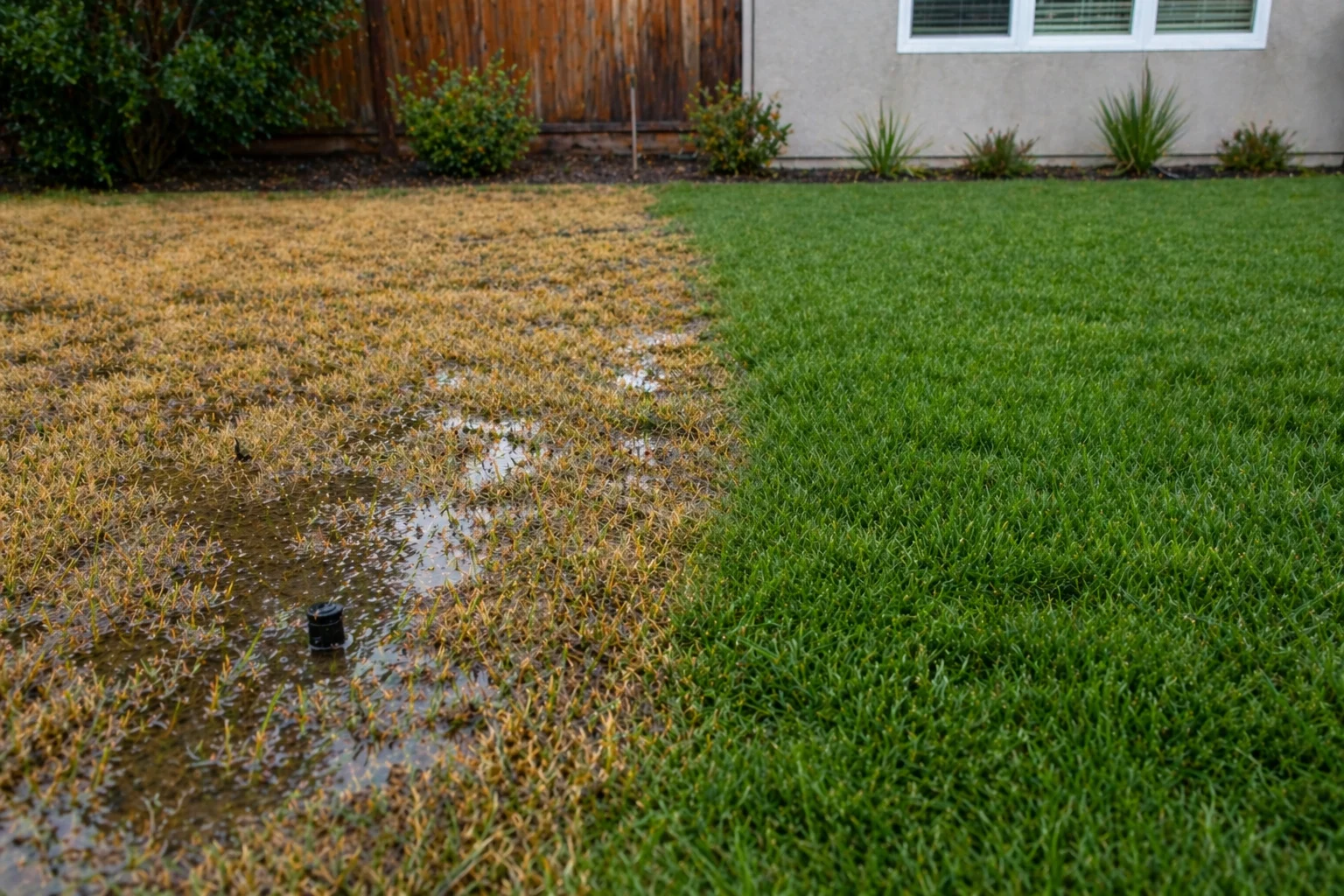
Signs Your Lawn Is Overwatered (Not Under-Watered)
The most diagnostic single sign is the combination of yellow-green color with soft, spongy soil. Yellow with hard, dry soil = drought. Yellow with soft, wet soil = overwatering. Walk the lawn with a long screwdriver and probe to 6 inches in random spots. If the screwdriver slides in easily with no resistance and comes out with mud on the tip, the soil is saturated — too much water.
Fungal diseases (brown patch, dollar spot, pythium) are almost always diagnostic of overwatering. These fungi require sustained leaf wetness and warm soil to propagate. Properly watered lawns (deep irrigation early morning, dry canopy by evening) rarely develop these diseases. Chronic fungal pressure is the lawn telling you the watering schedule is wrong.
- Yellow or pale green color across broad patches, not just dry edges
- Fungal rings (brown patch, dollar spot, pythium blight) appearing in humid conditions
- Mushroom growth appearing after rainfall or watering events
- Soft or spongy feel underfoot, even in mid-afternoon
- Algae or moss growth on soil surface in shaded areas
- Standing water or visible runoff 20+ minutes after irrigation
- Footprint retention — footprints stay visible 10+ minutes after walking
- Thatch buildup over 1/2 inch (spongy mat between grass and soil)
- Shallow root system visible when you pull a plug
- Weed invasion by moisture-loving species: nutsedge, creeping charlie, clover
- Grub and insect damage (overwatered lawns attract moisture-dependent pests)
Overwatering vs. Drought Stress: How to Tell the Difference
The critical test is a 6-inch soil probe. Push a long screwdriver or soil probe into the lawn at midday, between irrigation cycles. Wet, muddy soil at 6 inches after normal irrigation schedule = overwatering. Hard, cracked soil that resists the probe = drought. Moist at 2 to 4 inches but dry at 6 inches = properly watered. This single test answers the overwatering question 90% of the time.
Color analysis at close range is the second-best diagnostic. Overwatered grass leaves are yellow at the tip with green at the base — the yellow represents chlorosis (chlorophyll breakdown) caused by nutrient leaching from saturated soil. Drought-stressed grass leaves curl inward, develop a blue-gray cast before browning, and show consistent color change from tip to base — the stress is systemic, not localized to the blade tips.
| Symptom | Overwatered Lawn | Drought-Stressed Lawn |
|---|---|---|
| Color | Yellow-green, pale | Blue-gray, then tan-brown |
| Soil probe (6" depth) | Slides in easily, comes out muddy | Resists penetration, comes out dry |
| Soil feel underfoot | Soft, spongy, possibly wet | Hard, crunchy, dry |
| Footprint test | Footprints remain 10+ minutes | Blades spring back within 1 minute |
| Leaf color close-up | Yellow at tip, green at base | Blue-gray curling blades |
| Fungal disease | Common (brown patch, pythium) | Rare |
| Mushrooms | Appear after watering/rain | Absent |
| Weed species | Nutsedge, clover, creeping charlie | Crabgrass, spurge, prostrate weeds |
| Root system | Shallow (less than 2") | Shallow but soil-anchored |
| Recovery after rainfall | Slow or no improvement | Green-up within 48 hours |
What Overwatering Does to Your Lawn
Overwatered lawns develop shallow root systems because roots don't need to extend in search of water — water is always available at the surface. Shallow roots (under 2 inches) make the lawn vulnerable to every subsequent stress: brief drought, heat waves, foot traffic, and disease pressure. A properly watered lawn develops roots 4 to 6 inches deep and can tolerate a week without irrigation before showing stress. An overwatered lawn can show stress within 2 days of missing a scheduled irrigation cycle.
Saturated soil drives out oxygen. Grass roots require oxygen for cellular respiration, and waterlogged soil (with pore spaces filled by water instead of air) creates anaerobic conditions. Anaerobic bacteria produce hydrogen sulfide and other toxins that damage root tissue directly. The lawn turns yellow not because of drought but because of suffocating root systems — a completely different root problem requiring a completely different fix.
Thatch accumulates in overwatered lawns faster than decomposition can clear it. The spongy brown layer between the green canopy and the soil surface is dead plant tissue (stolons, clippings, crown material) that normally decomposes within weeks. In saturated soil, the microbial decomposition process slows dramatically while the lawn continues producing new plant material — the result is 1 to 3 inch thatch layers that prevent water, fertilizer, and air from reaching the root zone. Thatch over 1/2 inch is a major sign of overwatering and requires dethatching or core aeration to resolve.
Weed invasion shifts toward moisture-loving species. Nutsedge, creeping charlie (ground ivy), and white clover all thrive in saturated soil and outcompete stressed turf grass. A lawn that suddenly develops heavy nutsedge pressure is often an overwatered lawn, not a weed-infected lawn — reducing irrigation is the primary fix, herbicide application is secondary.
Lawn Diseases Caused by Overwatering
Brown Patch (Rhizoctonia solani) is the most common overwatering disease in the US. It appears as circular patches of brown, dead grass, typically 2 to 3 feet in diameter, with a darker 'smoke ring' border visible in early morning dew. Brown Patch thrives at 80 to 90°F soil temperature with sustained leaf wetness — exactly the conditions created by evening irrigation in warm weather. Tall Fescue, Perennial Ryegrass, and Bentgrass are most susceptible. Prevention is watering early morning only, reducing frequency, and improving airflow through the canopy.
Pythium Blight (water mold disease) is the most destructive overwatering disease. It appears as irregular greasy-looking patches that expand rapidly in hot humid weather. Pythium can kill entire lawns within 48 to 72 hours of establishment. Active Pythium appears as a cottony white fungal mass on dewy grass blades in early morning. Pythium requires saturated soil to propagate — control is immediately stopping irrigation, improving drainage, and applying a Pythium-specific fungicide (mefenoxam-based products) if the outbreak is active.
Dollar Spot appears as silver-dollar-sized round bleached patches that can coalesce into larger irregular areas. It thrives on nutrient-stressed lawns (particularly nitrogen-deficient) with sustained leaf wetness. Dollar Spot is less destructive than Brown Patch or Pythium but indicates the same root cause: too much water on leaves overnight. Addressing nitrogen deficiency and reducing overnight irrigation typically resolves Dollar Spot without fungicide.
Red Thread appears as pink-red threadlike fungal growth on grass blades, visible in cool wet weather. Red Thread is common on Fescue lawns in the Pacific Northwest and Mid-Atlantic during cool wet spring periods. The disease looks alarming but rarely kills grass — it feeds on dead leaf tissue. Control through nitrogen fertilization and reduced irrigation; fungicide is rarely warranted.
How to Fix an Overwatered Lawn (Step-by-Step Recovery)
Step 1: Stop watering immediately. Turn off your irrigation controller or disconnect the hose for the next 48 to 72 hours. This sounds counterintuitive given the yellow color, but adding more water during saturation deepens the problem. Let the soil dry to appropriate moisture before restarting any watering.
Step 2: Probe the soil at 48 hours. Push a screwdriver into the lawn at 6 inches depth. If it still comes out muddy, extend the no-water period another 24 hours. If it comes out moist but not wet, the soil has reached appropriate moisture and you can begin the recovery watering schedule. If it comes out dry, the lawn was only temporarily saturated and you've already reached recovery moisture — proceed to Step 4.
Step 3: Core aerate if soil is compacted. Saturated soils are often compacted, and core aeration (pulling 3-inch soil cores) dramatically improves drainage and oxygen availability. Rent a core aerator ($80/day) or hire a service ($120 to $250 for an average lawn). Aerate when the soil is moist but not saturated — too wet and the tines smear the soil; too dry and they can't penetrate.
Step 4: Apply a fungicide if disease is present. If Brown Patch, Pythium, or Dollar Spot is actively expanding, apply a broad-spectrum lawn fungicide (chlorothalonil or azoxystrobin) at label rates. For active Pythium outbreaks, use mefenoxam-based products specifically. Follow label directions carefully — some fungicides require 12 to 24 hours before rewatering.
Step 5: Reset the irrigation schedule. Begin with deep, infrequent watering: 1 inch per week total, applied in 1 to 2 sessions per week rather than daily. For spray head systems, that's typically 30 to 40 minutes per zone, once or twice per week. For rotor systems, 45 to 60 minutes per zone. Water in early morning (5 to 9 AM) only. No evening or midday watering.
Step 6: Monitor recovery over 2 to 6 weeks. Grass should begin regaining green color within 10 to 14 days as nutrient uptake resumes in newly-aerated soil. Full recovery to normal color and density typically takes 4 to 6 weeks. If the lawn doesn't improve after 3 weeks despite correct watering, the soil may have permanent damage (compaction, structure breakdown) requiring more aggressive renovation.
How to Set the Right Irrigation Schedule
The 1-inch-per-week rule is the foundation of correct lawn watering. Most US lawns need approximately 1 inch of water per week — including rainfall — for healthy growth. The rule varies slightly by grass type and climate (Bermuda in Phoenix needs slightly less; Kentucky Bluegrass in New England might need slightly more in July), but 1 inch is the correct starting point for 95% of US residential lawns.
Deep-and-infrequent is the correct delivery method. Apply the weekly 1 inch in 1 to 2 sessions per week rather than spreading across 5 or 7 sessions. Deep watering drives roots deep into the soil as they seek moisture; frequent shallow watering creates surface-rooted lawns that wilt at the first heat wave. A typical schedule is 2 sessions of 30 to 40 minutes per zone, Monday and Thursday, early morning.
Calibrate your specific system with the tuna can test. Place 4 to 6 empty tuna cans across a single zone's coverage area. Run that zone for 15 minutes. Measure the water depth in each can. Average the depths — if the average is 0.25 inch in 15 minutes, your zone delivers 1 inch per hour. Adjust runtime to deliver the target weekly amount split across your sessions.
Install a rain sensor if you don't have one. Rain sensors (Hunter Mini-Clik, Rain Bird CPRSDBEX) cost $20 to $60 and wire into any automatic controller. They prevent the irrigation from running when natural rainfall has already provided adequate moisture. Many US municipalities require rain sensors by code; California's MWELO regulation mandates smart controllers with weather-based adjustments on all systems installed after 2015.
Smart controllers (Rachio 3, Hunter Hydrawise, Rain Bird ST8) provide automatic schedule adjustments based on local weather data. The premium over a basic controller ($150 to $350) typically pays back within 1 to 2 seasons through water savings of 20% to 40%. Every overwatering problem described in this article is preventable with a correctly-configured smart controller.
Overwatering Signs by Grass Type
St. Augustine is especially vulnerable to overwatering-induced diseases. Take-All Root Rot is a permanent condition that spreads through saturated soil, and entire lawns can be lost within a single overwatered summer. Centipede grass is similarly sensitive — Ground Pearls (small scale insects) thrive in overwatered Centipede and cause damage that can be impossible to reverse without complete lawn renovation.
Pythium Blight on Perennial Ryegrass is the fastest-moving overwatering disease in US lawns. Active outbreaks can kill 1,000+ square feet of lawn in 72 hours. Ryegrass lawns in hot humid climates (Southeast, Mid-Atlantic summer) require particularly careful water management — reduce to once per week at most, water before 7 AM only, and apply preventative fungicide during the July and August peak-risk period.
| Grass Type | Common Overwatering Sign | Recovery Time |
|---|---|---|
| Kentucky Bluegrass | Yellow patches, Brown Patch fungus | 4–6 weeks |
| Tall Fescue | Brown Patch, thatch buildup | 3–5 weeks |
| Perennial Ryegrass | Pythium Blight, rapid dieback | 2–8 weeks if treated |
| Fine Fescue | Red Thread, pink-red fungal mats | 2–4 weeks |
| Bermuda | Thatch, Dollar Spot | 3–5 weeks |
| Zoysia | Large Patch disease, yellow rings | 4–8 weeks |
| St. Augustine | Take-All Root Rot, yellowing from drains | 8–12 weeks if treated |
| Centipede | Ground Pearl damage, nematode issues | Often permanent damage |
When to Call a Lawn Professional
Call a lawn care professional if: (1) more than 25% of the lawn shows active disease with spreading patches, (2) disease continues expanding despite 2 weeks of reduced irrigation, (3) you've identified Pythium Blight (requires specific mefenoxam-based fungicide and proper application technique), (4) the lawn isn't responding to corrective watering after 3 weeks, or (5) you suspect Take-All Root Rot on St. Augustine (specialized diagnosis and treatment required).
Licensed lawn care operators (LCOs) have access to restricted-use fungicides that are significantly more effective than consumer products, particularly for Pythium and Take-All. A typical professional fungicide application runs $150 to $300 for an average residential lawn and often resolves outbreaks that consumer products cannot. Budget accordingly — advanced disease is more expensive to fix than initial disease.
Long-term overwatering damage (compaction, soil structure breakdown, thatch over 1 inch) may require professional renovation. Core aeration plus top-dressing with sand and compost, or full lawn renovation with fresh sod on amended soil, can run $0.80 to $2.50 per square foot depending on scope. The cost of fixing overwatering damage typically exceeds the cost of preventing it — budget for smart irrigation and professional diagnosis upfront.
Frequently Asked Questions
How do I know if my lawn is overwatered or underwatered?
The soil probe test is definitive. Push a long screwdriver into the lawn at 6 inches depth during midday. If it slides in easily and comes out muddy, you're overwatering. If it resists penetration and comes out dry, you're underwatering. Color cues are secondary: yellow with soft soil = overwatering; blue-gray to tan with hard soil = drought. Fungal diseases and mushroom growth are almost always overwatering signs.
Can I fix an overwatered lawn?
Yes, most overwatered lawns recover in 4 to 6 weeks with correct care. Stop watering for 48 to 72 hours, core aerate if soil is compacted, apply fungicide if active disease is present, and restart irrigation on a deep-and-infrequent schedule (1 inch per week in 1 to 2 sessions, early morning only). Severe long-term overwatering damage (thatch over 1 inch, compaction, Take-All Root Rot on St. Augustine) may require professional renovation.
How much water does a lawn actually need?
Most US lawns need 1 inch of water per week total, including rainfall. Apply the 1 inch in 1 to 2 deep sessions per week rather than daily shallow sessions — deep watering drives roots deeper and makes lawns more drought-resistant. Specific requirements vary by grass type and climate: Bermuda in Phoenix might need 0.75 inch/week; Kentucky Bluegrass in New England might need 1.25 inches in July. Use the tuna can test to calibrate your specific system's output.
What time of day should I water to prevent overwatering?
Early morning, 5 to 9 AM. Morning irrigation allows the lawn to dry before evening, preventing the sustained leaf wetness that invites fungal disease. Evening watering (after 6 PM) is the single biggest cause of overwatering-related fungus because the lawn stays wet overnight. Midday watering is wasteful (25 to 40% evaporation loss) but not disease-inducing. If you can only water in the evening, accept that you'll need fungicide during humid summer months.
Will overwatering kill my lawn permanently?
Short-term overwatering (a few weeks of excessive irrigation) rarely causes permanent damage — the lawn recovers with corrective care. Long-term overwatering (years of daily irrigation) can cause permanent damage through soil structure breakdown, extreme compaction, chronic thatch, and persistent disease pressure. St. Augustine lawns with active Take-All Root Rot may require complete renovation. Centipede lawns with Ground Pearls may be unrecoverable without full replacement.
About the Author
Lawn Care Expert & Writer · Denver, Colorado · Florida State University
Jason Allen is a lawn care expert and freelance writer based in Denver, Colorado. He studied turfgrass science and horticulture at Florida State University before founding his own lawn care operation serving the Denver metro area. With over a decade of hands-on experience managing cool-season lawns in Colorado's challenging high-altitude climate, Jason specializes in aeration, fertilization timing, drought management, and water-restriction compliance. His practical, science-backed approach to lawn care has helped thousands of homeowners achieve healthy turf despite Colorado's short growing seasons, clay soils, and frequent drought conditions.