Best Time of Day to Water Your Lawn (And Why It Matters)
Published: April 23, 2026 · Updated:

The best time to water your lawn is 5 to 9 AM. This window minimizes evaporation loss, delivers water when wind is typically calm for even coverage, and allows grass blades to dry before evening — preventing the sustained leaf wetness that invites Brown Patch, Pythium, and Dollar Spot fungal diseases. Watering at night is the worst choice, directly responsible for most residential lawn fungus problems. Midday watering wastes 25 to 40% to evaporation but does not cause disease. This guide covers the science behind the morning window, explains why evening watering causes disease, debunks the midday-burning myth, and provides specific timing adjustments for different grass types and climate zones.
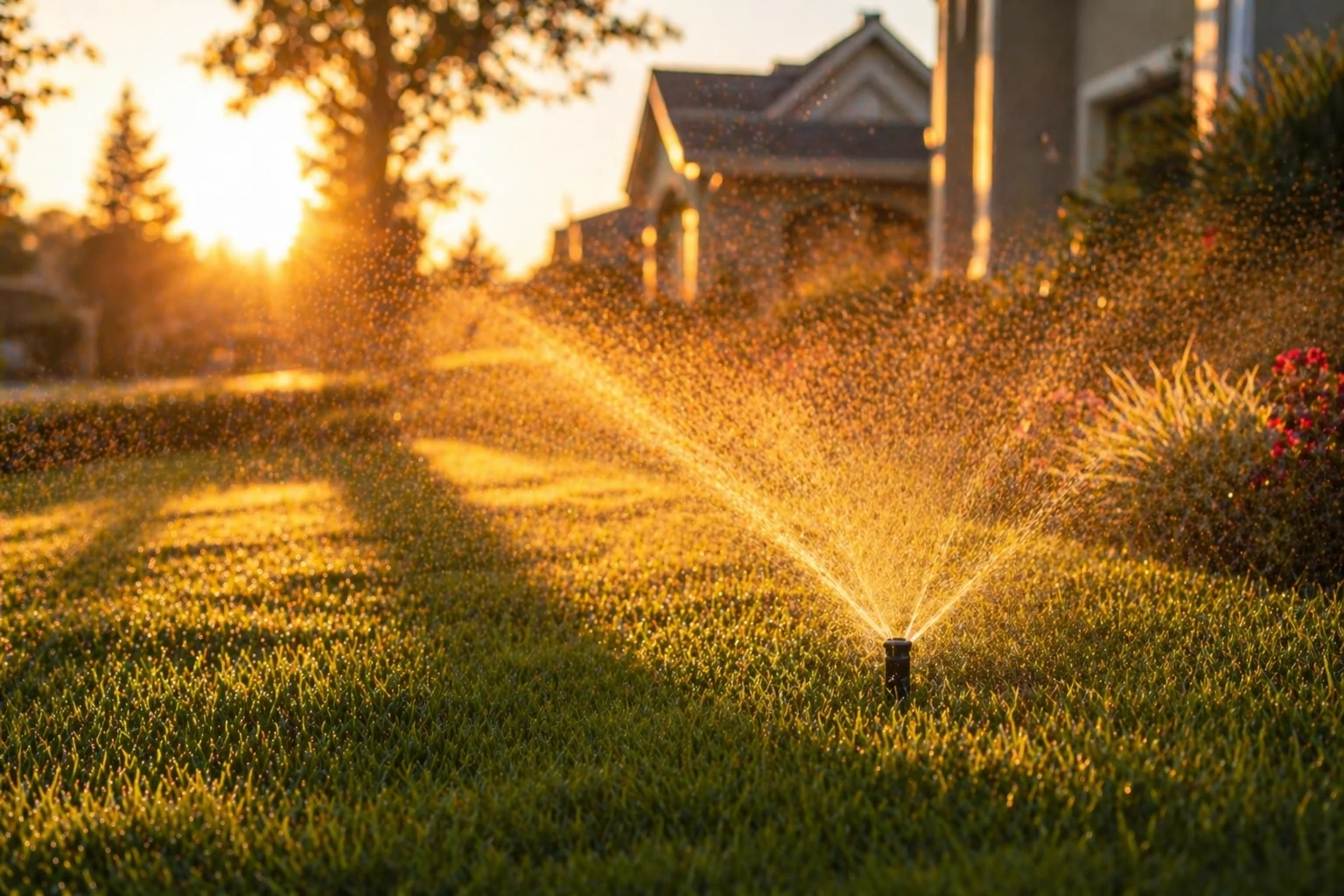
The Best Time to Water: 5-9 AM (And the Science Behind It)
Early morning — 5 to 9 AM — is universally the correct window for lawn irrigation. Every major university extension service (Texas A&M AgriLife, University of California ANR, Penn State Extension, University of Minnesota Extension, Michigan State University) recommends early morning as the first-choice schedule. The consensus is based on three specific agronomic principles, each measurable and well-documented.
Principle 1: Low evaporation loss. Air temperature and solar radiation are both at their daily minimum in early morning. Evaporation from irrigation is typically 5 to 10% of applied water during morning sessions, versus 25 to 40% during midday sessions. A 30-minute spray zone applying 0.5 inch at midday actually delivers only 0.30 to 0.38 inch to the soil after evaporation losses. The same 30-minute session at 6 AM delivers 0.45 to 0.48 inch. Morning irrigation is 20% to 30% more efficient per gallon.
Principle 2: Calm wind conditions. Average wind speeds are typically 40% to 60% lower between 5 and 9 AM than between noon and 4 PM. Lower wind produces better sprinkler head coverage uniformity — water lands where it was designed to land rather than drifting off-pattern. Wind drift on a 10-knot breeze can push spray head coverage 3 to 5 feet off-target, creating dry spots on one side of the zone and runoff on the other.
Principle 3: Adequate drying time. Grass blades that get wet in early morning dry completely by mid-morning as temperatures rise and sunlight hits the canopy. Evening-irrigated blades stay wet through the warm overnight period — ideal conditions for fungal disease propagation. The difference between a lawn watered at 6 AM and the same lawn watered at 7 PM is roughly a 10x difference in fungal disease risk over a summer season.
Why Evening Watering Causes Lawn Disease
Brown Patch (Rhizoctonia solani) propagates specifically in warm, humid, wet-canopy conditions. Soil temperatures of 80 to 90°F combined with leaf wetness for 10+ hours per night create the ideal environment for Brown Patch to establish and spread. Evening irrigation at 7 PM in July means grass blades stay wet from 7 PM until roughly 9 AM the next morning — 14 hours of leaf wetness, every night. Morning irrigation at 6 AM means blades are dry by 10 AM — 4 hours of leaf wetness instead of 14.
Pythium Blight is the most destructive evening-irrigation disease. Pythium is a water mold (oomycete) rather than a true fungus, and it requires saturated conditions to propagate. A single warm humid night on evening-irrigated Perennial Ryegrass can trigger a Pythium outbreak that kills 1,000+ square feet of lawn within 48 hours. Pythium Blight is 90% preventable through morning-only watering.
Dollar Spot (Clarireedia jacksonii) causes silver-dollar-sized bleached patches that coalesce into larger damaged areas. It thrives on nutrient-stressed lawns with sustained leaf wetness. Evening-irrigated lawns routinely develop Dollar Spot even at moderate nutrient levels because the sustained leaf wetness overrides the nutrient resilience of healthy grass. Morning-irrigated lawns with proper fertility rarely develop Dollar Spot.
Red Thread (Laetisaria fuciformis) produces distinctive pink-red fungal growth on grass blades in cool wet conditions. Common on Fescue lawns in the Pacific Northwest and Mid-Atlantic spring. Red Thread rarely kills grass but looks alarming and indicates chronic leaf wetness. Morning irrigation plus nitrogen fertilization typically clears Red Thread without fungicide.
Data from university research plots consistently shows 3x to 10x higher disease incidence on evening-irrigated plots versus morning-irrigated plots, all other factors equal. If you can change one thing about your lawn care schedule, changing evening watering to morning watering has the single largest positive impact on lawn health.
Why Midday Watering Is Wasteful (But Not as Bad as Evening)
Midday watering (10 AM to 4 PM) loses 25% to 40% of applied water to evaporation. Peak solar radiation heats both the water and the surrounding air, accelerating evaporative loss from both the spray pattern (water droplets evaporating mid-air before reaching the lawn) and the wetted soil surface. A 30-minute session at 1 PM on a 90°F day effectively delivers 18 to 22 minutes of water — the rest vanishes.
Wind at midday compounds the problem. Typical afternoon wind (10 to 15 mph) disrupts sprinkler head patterns, causing uneven coverage with dry spots and over-watered spots. Drift can push spray 5 to 10 feet off-target in strong winds, producing visible wet strips on driveways and sidewalks while the intended lawn area stays dry.
The hydraulic stress myth: a persistent misconception claims that water droplets on grass blades at midday act as magnifying lenses, focusing sunlight and 'burning' the grass. This is false. The physics don't work — water droplets are too small and too short-lived to focus enough solar energy to damage plant tissue. Dozens of agricultural experiment stations have specifically tested and debunked this claim. Midday watering is wasteful but does not damage grass through 'burning.'
Practical midday guidance: if drought restrictions or work schedules force midday irrigation, run sessions 25% to 35% longer to compensate for evaporation loss. A zone calibrated to 20 minutes of morning runtime needs 25 to 27 minutes at midday to deliver equivalent soil moisture. Expect higher water bills when irrigating at midday; expect dry spots from wind drift; but don't worry about 'burning' the grass.
Midday does not cause disease. If your only option is midday watering (common during drought restrictions that prohibit morning watering), midday is strictly better than evening. Wasted water is less harmful than lawn disease.
Best Time to Water by Grass Type
Warm-season grasses (Bermuda, Zoysia, St. Augustine, Centipede, Bahia, Buffalo) are generally more disease-resistant than cool-season grasses, giving a slightly wider acceptable watering window. Bermuda handles 5 to 10 AM irrigation well; Centipede and Bahia tolerate even midmorning watering in dry climates. That said, early morning remains optimal — the flexibility just means brief schedule deviations don't cause disease outbreaks.
Cool-season grasses (Kentucky Bluegrass, Tall Fescue, Perennial Ryegrass, Fine Fescue) have stricter morning-only requirements in humid summers. Perennial Ryegrass is the highest-risk grass for Pythium Blight under evening irrigation — if you have a Ryegrass-heavy lawn in a humid summer climate, morning irrigation is not optional. Tall Fescue's Brown Patch susceptibility is well-documented in the Mid-Atlantic and Southeast transition zone.
Zoysia has a specific vulnerability to Large Patch disease (Rhizoctonia solani — same fungus as Brown Patch) during the spring green-up and fall dormancy transition periods. Cool wet conditions during these transitions combined with evening irrigation can trigger Large Patch outbreaks that cause 3 to 6 foot diameter dead patches that take years to fully recover. Zoysia lawns should irrigate morning-only always, and minimize irrigation entirely during spring and fall transitions.
St. Augustine has unique vulnerability to Take-All Root Rot in humid climates (Florida, Texas Gulf Coast, Louisiana, coastal Southeast). Take-All is a soil-borne disease that spreads through saturated soil and can cause permanent lawn damage that requires complete renovation. Morning irrigation plus careful schedule management (not overwatering) is the only reliable Take-All prevention.
| Grass Type | Ideal Window | Absolute Worst | Special Notes |
|---|---|---|---|
| Kentucky Bluegrass | 5–9 AM | Evening (Pythium risk) | Strict morning in humid summers |
| Tall Fescue | 5–9 AM | Evening (Brown Patch) | Most Brown-Patch prone grass |
| Perennial Ryegrass | 5–9 AM | Evening (Pythium Blight) | Highest disease risk of any common grass |
| Fine Fescue | 5–10 AM | Evening (Red Thread) | Shade-tolerant; cooler soils extend window |
| Bermuda | 5–10 AM | Evening (Dollar Spot) | More flexible; less disease-prone |
| Zoysia | 5–9 AM | Evening (Large Patch) | Large Patch devastating in spring/fall |
| St. Augustine | 5–9 AM | Evening (Take-All Root Rot) | Morning critical in humid climates |
| Centipede | 5–10 AM | Evening (nematode issues) | Less susceptible to foliar disease |
| Bahia | 5–10 AM | Evening | Most disease-resistant common grass |
| Buffalo Grass | 5–10 AM | Evening | Rarely needs irrigation if native climate |
Best Time to Water by Climate Zone
Arid and desert climates (Phoenix, Tucson, Las Vegas, Albuquerque, El Paso, Palm Springs): Morning irrigation remains best, but the disease risk of off-schedule timing is dramatically lower than in humid climates because of the low overnight humidity. Evening irrigation at 8 PM in Phoenix on a July night — humidity typically under 20% — has very low disease risk because grass blades dry quickly despite the warm overnight temperatures. 5 to 10 AM is still preferred for evaporation efficiency, but evening is more acceptable in arid climates than in humid ones.
Humid Southeast (Atlanta, Charlotte, Nashville, Memphis, Orlando, New Orleans, Houston): Strictly morning only. Overnight humidity at 85 to 95% combined with 75 to 80°F overnight temperatures creates ideal disease propagation conditions for any wet grass. Brown Patch and Pythium outbreaks in the Southeast are largely preventable through strict morning-only watering discipline. Evening irrigation in the Southeast summer is almost guaranteed to produce disease over a full season.
Pacific Northwest (Seattle, Portland, Eugene, Spokane): Morning preferred but evening less risky than in other regions due to lower overnight humidity and cooler overnight temperatures. Red Thread and pink snow mold are the primary PNW evening-watering diseases but both are less destructive than Southeast brown patch/pythium. 6 to 10 AM is the ideal window; 8 to 10 AM is acceptable given the region's later sunrise during summer.
Mid-Atlantic and Northeast (Washington DC, Philadelphia, New York, Boston, Baltimore): Strict morning only during humid summers. The Mid-Atlantic and Northeast have Southeast-level humidity in July and August, with 14+ hours of nighttime leaf wetness from evening irrigation. Disease risk is high and preventable.
Great Plains (Denver, Kansas City, Minneapolis, Omaha): Morning preferred, but the region's lower overnight humidity reduces disease risk slightly. 5 to 9 AM ideal; evening watering produces moderate disease risk.
California and Pacific Coast: Morning strongly preferred. California's Mediterranean climate has dry summer days but cool marine-layer nights with high humidity — the combination produces Brown Patch and Dollar Spot pressure on Fescue and Bluegrass lawns if evening-irrigated. San Francisco Bay Area fog belt makes morning-only mandatory for any Fescue-based lawn.
Adjusting Watering Time for Water Restrictions
Many drought restrictions specify allowed hours that conflict with optimal morning timing. For example, Phoenix Stage 2 restrictions prohibit irrigation between 10 AM and 6 PM — the 5 to 10 AM window aligns with the morning irrigation recommendation. But other restriction frameworks prohibit morning watering entirely during peak hours (some Texas restrictions ban 4 to 10 AM watering to preserve municipal pressure during peak demand).
When restrictions conflict with agronomic ideal, prioritize early morning and late evening over midday. If restrictions force you to choose between 4 AM (pre-sunrise) and 8 PM (post-sunset), 4 AM is strictly better — the grass blades will dry as the sun rises, preventing sustained leaf wetness. 8 PM watering invites disease because blades stay wet through the overnight warm humid period.
Hand watering and drip irrigation are typically exempt from day-of-week and hour-of-day restrictions. For small targeted watering (foundation plantings, vegetable beds, high-priority ornamentals), hand watering during optimal morning hours avoids restrictions entirely. This doesn't scale to full-lawn irrigation but saves high-value landscape elements during restriction periods.
See our water restrictions guide at lawnbyseason.com/water-restrictions for state-specific allowed hours, day-of-week rules, and exemptions for each major utility. Plan your irrigation schedule to align both with restriction requirements and with agronomic ideal timing whenever possible.
How to Program Your Sprinkler Controller for Morning Watering
Rachio: Open app, select schedule, set start time to 5:00 AM (or earlier if you have multiple zones requiring long total runtime). Rachio's zone sequencing automatically runs zones back-to-back, so a 6-zone system with 30-minute zones takes 3 hours total. Starting at 5:00 AM, the last zone finishes at 8:00 AM. Enable 'Weather Intelligence Plus' to skip sessions after measurable rainfall.
Hunter Pro-C: Rotate dial to 'Set Current Time/Day' to confirm controller clock is accurate. Rotate to 'Set Program Start Times' and set Program A to 5:00 AM. Set up to 4 start times per program if needed. Note: multiple start times run the full program from scratch each time — use them only if you're intentionally scheduling multiple cycles per day.
Hunter Hydrawise: Log into app, select controller, tap 'Programs,' set start time. Hydrawise's 'Time of Day Watering Triggers' feature lets you set different morning start times for different days of the week — useful if restrictions allow only specific days. Enable 'Predictive Watering' to adjust runtime based on local weather.
Rain Bird ESP-Me: Rotate dial to 'Set Watering Start Times.' Select Program A and set start time 1 to 5:00 AM. Confirm by pressing right arrow. Rain Bird's 'Seasonal Adjust' dial setting lets you scale all runtimes by percentage (50% to 200%) for seasonal adjustments.
Orbit B-hyve: Open app, select controller, tap 'Programs.' Set 'Start Time' to 5:00 AM. Enable 'Smart Watering' for ET-based adjustment. Note: B-hyve's Smart Watering may override your fixed start time for optimization — if you need a specific hard start time, disable Smart Watering and use fixed scheduling.
All modern controllers support 'Water Days' programming — setting which days of the week the schedule runs. Use this to match your utility's odd/even restriction schedule. Most controllers also support rain sensor override (skipping scheduled irrigation after measurable rainfall) — enable this on every controller to prevent running during or after rain events.
Watering During a Heat Wave
Extreme heat (95F+ air, 85F+ soil) changes the calculus but not the answer: 5 to 9 AM morning watering is even more important in a heat wave than in a normal week. The disease pressure is worse (warm humid nights concentrate Pythium and brown patch), the evaporation penalty is worse (midday losses climb to 40 to 50 percent), and the crown-protection stakes are higher (a mistimed session can push a survivable dormancy into stand loss).
Water deeper, not more often. During a heat wave, target 0.75 to 1 inch per session on cool-season lawns and 1 to 1.5 inches per week (in one or two sessions) on warm-season lawns. Split into cycles if runoff starts before you hit the target: 20 minutes on, 30 minutes off, 20 minutes on. Cycle-and-soak lets water infiltrate on slopes and clay, and reaches the 4 to 6 inch depth where soil stays cooler and roots can survive.
Do not water daily. Frequent shallow watering during a heat wave is the single most common way homeowners kill lawns. It wets only the top inch (which evaporates by afternoon), encourages shallow roots, and cannot cool the crown. One or two deep morning sessions per week protects the crown; five shallow sessions per week fails to.
Never water in the evening during a heat wave. Sustained overnight leaf wetness at 78 to 82F is the ideal environment for Pythium blight, which can kill a lawn in a single warm humid night. If your only choice is 4 AM or 8 PM because of restrictions, 4 AM is strictly better even if it feels earlier than you would prefer.
For the full heat-wave survival playbook including crown protection, mowing rules, and what to stop doing entirely, see our <a href='/keep-lawn-alive-heat-wave'>keep your lawn alive in a heat wave</a> guide.
What to Do When You Can't Water in the Morning
Situation 1: Work schedule requires evening watering. If you're reliant on manual hose watering and can only water in evenings, accept the elevated disease risk and plan for fungicide applications during humid summer months. Chlorothalonil or azoxystrobin at label rates applied every 3 to 4 weeks during July and August can offset the disease risk of evening watering. Budget $40 to $80 per month for fungicide during peak season.
Situation 2: Water restrictions prohibit early morning watering. Check whether your restriction's allowed hours include any pre-sunrise window (some ordinances allow 12 AM to 4 AM watering). If pre-sunrise watering is allowed, schedule for 3 or 4 AM — the grass will still dry as the sun rises a few hours later. If only afternoon/evening windows are allowed, follow Situation 1 mitigation.
Situation 3: Low water pressure in your area makes morning watering ineffective. Some municipalities experience peak residential demand between 6 and 8 AM, causing pressure drops that reduce sprinkler head effectiveness. If your system noticeably underperforms during peak morning hours, schedule for 4 to 5 AM (before peak demand) or 9 to 10 AM (after peak). A pressure gauge at an outdoor faucet during morning hours confirms the problem.
Situation 4: Smart controller isn't compatible with your system. Upgrade. Smart controllers with WiFi and weather-based adjustment ($150 to $350 installed) are the single highest-ROI irrigation upgrade. Water savings of 15 to 30% plus disease reduction typically pays for the upgrade within one summer season. Rebates from most Southwest and California utilities offset $75 to $150 of the purchase price.
Frequently Asked Questions
Is it OK to water my lawn at night if I have a timer?
No. Night watering causes fungal disease regardless of whether you use a manual hose or an automatic timer — the problem is sustained leaf wetness, not the timer itself. Program your timer for 5 to 9 AM. If you cannot water in that window for any reason, plan for preventative fungicide applications during humid summer months to offset the elevated disease risk.
Can I water at noon if that's when my restrictions allow?
Yes, midday watering is acceptable when restrictions require it. Midday is strictly better than evening — it wastes water to evaporation (25 to 40%) but does not cause disease. Run sessions 25 to 35% longer than morning schedules to compensate for evaporation loss. The 'water droplets burn grass at noon' myth is false; don't worry about burning.
Does morning watering really make a difference for disease?
Yes — research data consistently shows 3x to 10x higher disease incidence on evening-irrigated plots versus morning-irrigated plots, all other factors equal. Brown Patch, Pythium Blight, and Dollar Spot all require sustained leaf wetness to propagate. Evening irrigation leaves grass wet 14+ hours overnight; morning irrigation leaves grass wet 4 hours. The difference is dramatic.
How early is too early to water in the morning?
Very early morning (2 to 4 AM) is still fine and actually preferred in some scenarios. The grass will dry as the sun rises a few hours later, so disease risk is still low. The only downside to extremely early watering is that evaporation recovery is slower — by 8 AM, water that went on at 2 AM has been sitting on leaves for 6 hours. Stick with 5 to 9 AM for the optimal balance.
What's the best time to water in hot, dry climates like Arizona?
5 to 9 AM remains optimal in Arizona and similar arid climates for evaporation efficiency. However, the disease risk of off-schedule watering is dramatically lower in arid climates because of low overnight humidity — evening watering in Phoenix produces far less disease than evening watering in Atlanta. If your restriction requires off-morning watering in Arizona, you have more flexibility than a comparable schedule in the humid Southeast.
About the Author
Lawn Care Expert & Writer · Denver, Colorado · Florida State University
Jason Allen is a lawn care expert and freelance writer based in Denver, Colorado. He studied turfgrass science and horticulture at Florida State University before founding his own lawn care operation serving the Denver metro area. With over a decade of hands-on experience managing cool-season lawns in Colorado's challenging high-altitude climate, Jason specializes in aeration, fertilization timing, drought management, and water-restriction compliance. His practical, science-backed approach to lawn care has helped thousands of homeowners achieve healthy turf despite Colorado's short growing seasons, clay soils, and frequent drought conditions.