Lawn Watering Schedule: How Much, How Often, What Time
Published:

Most US lawns need 1 to 1.5 inches of water per week for healthy growth, delivered in 1 to 2 deep sessions rather than daily shallow watering. The right schedule balances three variables: the weekly volume (1 to 1.5 inches), the session count (fewer deeper sessions beat daily), and the time of day (early morning 5 to 9 AM is optimal). This guide lays out the complete schedule by grass type, season, and soil — spring, summer, fall, and winter — plus how to calibrate runtime for your specific sprinkler system and adjust for water restrictions and drought response.
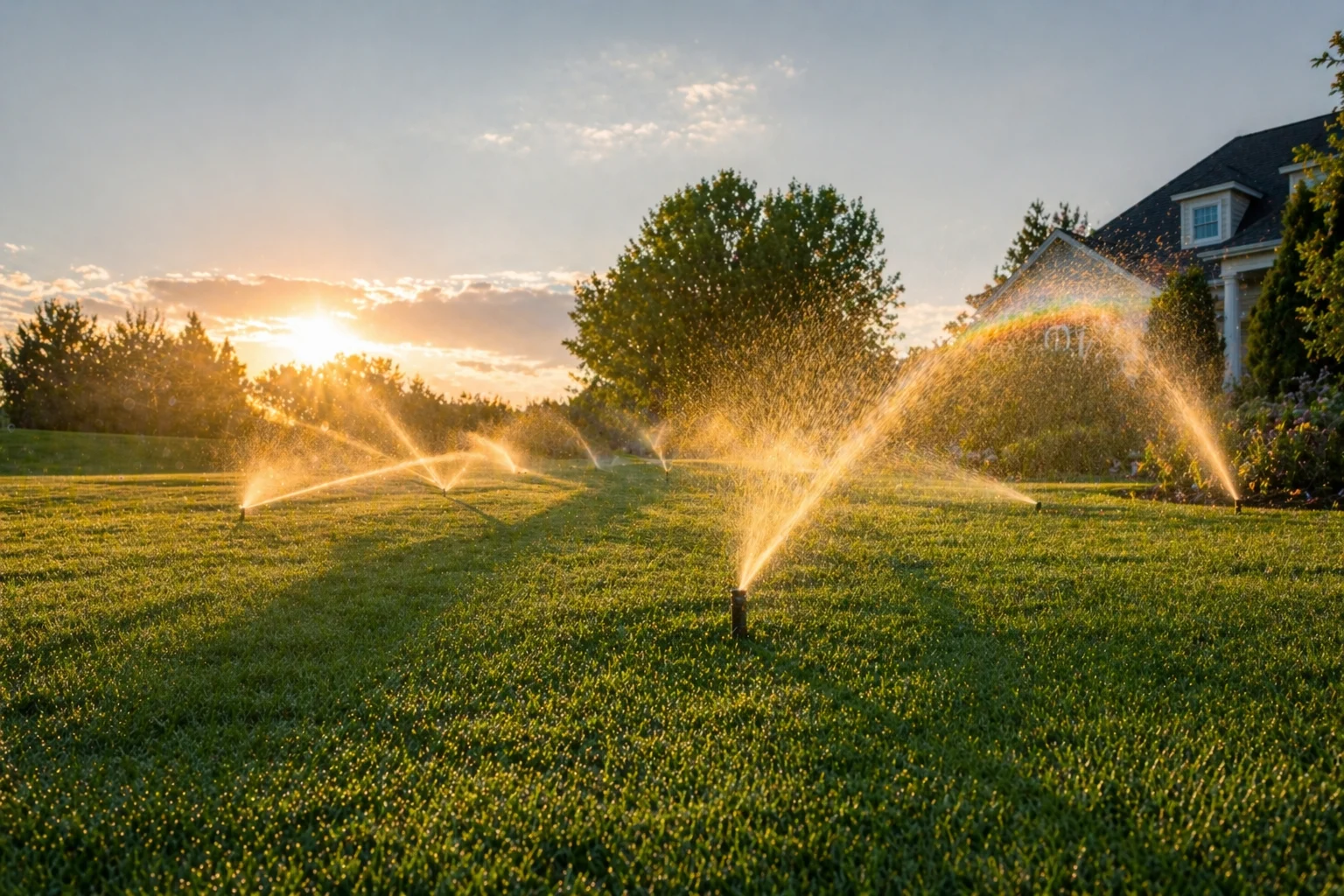
The 1-Inch Per Week Rule (And When to Break It)
The 1-inch-per-week rule is the correct starting point for almost every US residential lawn: apply approximately 1 inch of water to your lawn per week, including rainfall. This volume supports healthy root development, avoids waste from over-irrigation, and matches what most grass species evolved to receive in their native climates. Record rainfall with a simple rain gauge ($8 at any hardware store) and subtract rainfall from your irrigation target each week.
The rule flexes slightly by grass type and climate. Bermuda grass in Phoenix can survive on 0.75 inch per week during active growth — its deep root system and drought-adapted physiology use water efficiently. Kentucky Bluegrass in Boston in July may need 1.25 to 1.5 inches because cool-season grass in humid Northeast heat loses more water to transpiration than a simple climate comparison suggests. Tall Fescue sits in the middle at approximately 1 inch per week across most of its growing range.
Break the 1-inch rule in three specific situations. First, newly installed sod or seed needs 2 to 3 times daily light watering during establishment (separate establishment schedule — see our guides on watering new sod and watering new grass seed). Second, active heat waves over 95°F justify temporarily increasing to 1.25 to 1.5 inches per week if your restrictions allow. Third, dormancy periods (winter for warm-season grasses, summer dormancy for cool-season in extreme heat) drop to a minimal 0.25 inch per week crown irrigation to keep plants alive without triggering active growth.
Watering Schedule by Grass Type
Runtime depends on your sprinkler head type and local water pressure. Typical spray heads deliver 1 to 2 inches per hour, rotor heads deliver 0.4 to 0.8 inch per hour, and drip systems deliver 0.5 to 1 gallon per hour per emitter. The runtime column above assumes typical residential pressure (50 to 60 psi) and head spacing. Calibrate your specific system with the tuna can test (see the 'How to Check If Your Lawn Got Enough Water' section).
Cool-season grasses (Kentucky Bluegrass, Tall Fescue, Ryegrass, Fine Fescue) have two peak growth periods — spring and fall — with a summer slowdown or dormancy. Their watering schedule should reflect this rhythm: heavier watering during active growth (April, May, September, October) and reduced watering during summer heat stress (July, August) to avoid forcing growth the grass cannot sustain.
Warm-season grasses (Bermuda, Zoysia, St. Augustine, Centipede, Bahia, Buffalo) have a single peak growth period (May through September) with complete winter dormancy in most US climates. Their schedule mirrors this: heavy active-season watering and essentially zero winter irrigation as the lawn enters dormancy. Do not water dormant warm-season grass — water triggers premature green-up that cold weather will then kill.
| Grass Type | Water Needs | Best Frequency | Runtime per Session |
|---|---|---|---|
| Kentucky Bluegrass | 1–1.25 in/week | 2x/week deep | 30–40 min spray, 45–60 min rotor |
| Tall Fescue | 1 in/week | 1–2x/week deep | 35–45 min spray, 45–60 min rotor |
| Perennial Ryegrass | 1–1.25 in/week | 2x/week | 30–40 min spray, 45 min rotor |
| Fine Fescue | 0.75 in/week | 1x/week deep | 30 min spray, 40 min rotor |
| Bermuda | 0.75–1 in/week | 2x/week | 25–35 min spray, 35–45 min rotor |
| Zoysia | 0.75–1 in/week | 1–2x/week deep | 30–40 min spray, 45 min rotor |
| St. Augustine | 1 in/week | 1–2x/week deep | 35–45 min spray, 45–60 min rotor |
| Centipede | 0.75 in/week | 1x/week | 25–35 min spray, 35–45 min rotor |
| Bahia | 0.5–0.75 in/week | 1x/week or rainfall only | 20–30 min spray |
| Buffalo Grass | 0.5 in/week or less | Rainfall only (ideal) | Minimal supplemental |
Seasonal Watering Schedule
Spring (March to May): Increase gradually as temperatures rise. Early spring (March-early April) typically requires 0.5 inch per week or less, with natural rainfall often sufficient. By mid-May, most US lawns are at the full 1 inch per week schedule. Watch soil moisture carefully during spring — cool-season lawns benefit from deep early-spring watering that drives roots deeper before summer heat.
Summer (June to August): The 1 to 1.5 inch per week schedule is critical. This is when water management most affects lawn health. Deep-and-infrequent watering (one or two sessions per week of 30 to 45 minutes) beats daily shallow watering at keeping lawns healthy through summer stress. Avoid midday watering (25 to 40% evaporation loss) and evening watering (invites fungal disease). Early morning 5 to 9 AM is the only correct window for summer irrigation.
Fall (September to November): Reduce as grass growth slows. Early fall (September) often still requires 1 inch per week for cool-season lawns in active growth. Mid-fall (October) can usually reduce to 0.75 inch per week. Late fall (November) typically requires only 0.5 inch per week or less as grass prepares for dormancy. For warm-season grasses, reduce faster — by mid-October most warm-season lawns are ready to taper to 0.25 inch per week through early winter.
Winter (December to February): Dormant lawns need minimal or no irrigation. Warm-season grasses (Bermuda, Zoysia, St. Augustine) are fully dormant in most US climates and should receive no irrigation — water triggers premature green-up. Cool-season grasses in the Southern US (Tall Fescue in Atlanta) may benefit from a once-monthly 30-minute session during extended dry periods to keep crowns hydrated. Northern US cool-season lawns are typically under snow cover or frozen — no irrigation needed. Detach hoses and drain your system before first freeze.
Best Time of Day to Water Your Lawn
Early morning (5 to 9 AM) is the optimal watering window for three reasons. First, temperatures are cool, minimizing evaporation loss (typically under 10% of applied water). Second, wind is typically calm in early morning, producing better coverage from sprinkler heads. Third, the lawn has the full day to dry, minimizing the overnight leaf wetness that invites fungal disease. Every lawn care extension service in the US recommends early morning irrigation as the first-choice schedule.
Evening watering (after 6 PM) is the single biggest cause of lawn disease in residential settings. Brown Patch, Pythium Blight, and Dollar Spot all require sustained leaf wetness to propagate. Evening irrigation leaves grass blades wet through the warm overnight period — ideal fungal growing conditions. If you must water in the evening because of your schedule or work constraints, plan to apply fungicide during humid summer months to offset the disease risk.
Midday watering (10 AM to 4 PM) is wasteful but not disease-inducing. The 25 to 40% evaporation loss at midday means you must apply more water to achieve the same soil saturation as a morning session. If your only available irrigation window is midday (common during drought restrictions), plan to run sessions 25% to 35% longer to compensate for evaporation loss. The long-standing myth that midday watering 'burns' grass is false — water droplets don't act as lenses on grass blades.
How Long to Run Sprinklers
Runtime depends primarily on sprinkler head type. Spray heads (fixed pop-ups) deliver 1.5 to 2 inches per hour — runtime for 1 inch per session is 30 to 40 minutes. Rotor heads (slow-rotating streams) deliver 0.4 to 0.6 inch per hour — runtime for 1 inch per session is 45 to 60 minutes. Rotary nozzles (modern high-efficiency spray) deliver 0.8 to 1.2 inches per hour — runtime is 50 to 75 minutes. Drip irrigation varies dramatically by emitter flow rate but typically runs 45 to 90 minutes per session.
Soil type modifies runtime significantly. Clay soils accept water slowly (0.1 to 0.2 inch per hour absorption rate) and generate runoff if irrigation exceeds absorption. On clay, use cycle-and-soak programming: run each zone for 10 minutes, wait 30 to 45 minutes, run again for 10 minutes, repeat. This three-cycle approach delivers the target 1 inch without runoff. Sandy soils absorb quickly (0.8 to 1 inch per hour) and don't require cycle-and-soak but may need shorter, more frequent sessions to prevent deep drainage below the root zone.
Calculate your specific runtime with the tuna can test. Place 4 to 6 empty tuna cans across a single zone's coverage area. Run the zone for 15 minutes. Measure the average water depth collected. Multiply by 4 to get your zone's hourly output rate. Divide the target 1 inch weekly volume by the hourly rate to calculate total runtime. Split across your scheduled sessions. Repeat for each zone — runtime varies significantly between zones because of head type, head count, and pipe pressure.
How to Check If Your Lawn Got Enough Water
The screwdriver test is the fastest moisture check. Push a long screwdriver (6+ inches) into the lawn 1 hour after irrigation. If the screwdriver slides in easily to 4 to 6 inches, the soil is adequately moist. If it resists at 2 to 3 inches, the water didn't penetrate deep enough — increase runtime. If it slides in to 6+ inches with almost no resistance and comes out muddy, the soil is saturated — reduce runtime.
The tuna can test measures actual water delivery. Place empty tuna cans (or any straight-sided cylindrical container) across a zone and run a typical irrigation session. Measure the water depth in each can after the session completes. The average across cans is your per-session application depth. The variance across cans tells you about coverage uniformity — large differences indicate poor head-to-head spacing or obstruction issues.
Soil probes are the most precise check. A standard lawn soil probe ($15 to $30) pulls a 6 to 8 inch soil core that you can examine directly. Moist soil in the top 4 to 6 inches with slightly drier soil below that depth indicates correct watering. Wet-at-6-inches or drier-than-expected in the root zone identify the specific watering problem and its solution.
Root depth is the long-term indicator. Dig a small test hole 12 inches deep once per season. Examine the root depth — properly watered lawns develop roots 4 to 6 inches deep. Shallow roots (under 2 inches) indicate overwatering or frequent shallow watering. No roots below the sod line after a full season indicate severe overwatering or compacted soil.
Adjusting Your Schedule for Drought and Water Restrictions
Drought-restricted watering schedules typically limit you to specific days of the week and specific hours of the day. The restriction framework varies by state and utility, but common patterns are odd/even address scheduling (odd addresses water Monday/Thursday, even addresses water Tuesday/Friday) and time-of-day blackouts (no irrigation between 10 AM and 6 PM). Your normal 1 inch per week goal doesn't change — you just need to deliver it in the allowed windows.
Consolidate watering when restrictions limit frequency. If your restriction allows 2 days per week, apply the full weekly 1 inch in those 2 sessions (30 to 40 minutes per spray zone, 45 to 60 minutes per rotor zone). If restrictions reduce to 1 day per week, consolidate to a single deep session — some zones may need cycle-and-soak programming to deliver 1 inch without runoff on clay soils.
Hand watering and drip irrigation are exempt from day-of-week restrictions in virtually every US restriction ordinance. Use hand watering for trees, shrubs, and foundation plantings on off-restriction days to keep high-value landscape elements healthy while complying with restrictions on turf irrigation. Drip systems delivering less than 30 GPH total are also exempt in most ordinances and can be scheduled for best agronomic timing rather than fitting into restriction windows.
See our state-by-state water restrictions guide at lawnbyseason.com/water-restrictions for specific schedule requirements, day-of-week rules, allowed hours, and fine structures for each major US city's active water restrictions.
Smart Watering Controllers and Automation
Smart irrigation controllers with weather-based scheduling (ET-based controllers) reduce water consumption by 15% to 30% versus fixed-schedule controllers while maintaining equal or better lawn quality. Rachio 3, Hunter Hydrawise, Rain Bird ESP-TM2 with ET module, and Orbit B-hyve are the leading residential options in 2026. Prices range from $150 to $350 installed.
The ET (evapotranspiration) calculation is the key technology. ET controllers receive daily weather data (temperature, humidity, wind, solar radiation) and calculate actual plant water needs for the specific day. A hot dry windy day triggers a longer irrigation runtime; a cool humid day triggers a shorter runtime or skips irrigation entirely. Over a season, the math produces significantly lower water use than fixed schedules that run the same amount regardless of conditions.
Rebate programs support smart controller purchases in drought-sensitive markets. California SoCal Water$mart, Arizona Water Use It Wisely, Denver Water, and most Southern California utilities offer $75 to $150 rebates on WaterSense-labeled smart controllers. Check your local utility's rebate portal before purchasing — the rebate can effectively pay for the controller upgrade entirely in many markets.
Basic features to look for in a smart controller: weather-based ET adjustment, smartphone app control, zone-specific scheduling, rain sensor integration, and WaterSense certification. Advanced features worth paying for: soil type recognition, slope adjustment, shade vs sun zone differentiation, and integration with voice assistants (Google Home, Amazon Alexa). Avoid controllers that require monthly subscription fees for basic functionality.
Frequently Asked Questions
How often should I water my lawn?
Most US lawns need 1 to 1.5 inches of water per week, delivered in 1 to 2 deep sessions rather than daily shallow watering. For cool-season grasses (Kentucky Bluegrass, Fescue), 2 sessions per week during active growth works well. For warm-season grasses (Bermuda, Zoysia), 1 to 2 deep sessions per week is ideal. Deep-and-infrequent watering drives roots deeper and makes your lawn more drought-resistant than frequent shallow watering.
How many minutes should I run my sprinklers?
Depends on head type. Spray heads: 30 to 40 minutes per zone for 1 inch of water. Rotor heads: 45 to 60 minutes per zone. Rotary nozzles: 50 to 75 minutes. Calibrate your specific system with the tuna can test: place tuna cans across a zone, run for 15 minutes, measure water depth, and calculate runtime to reach 1 inch per session. Soil type matters too — clay soils may require cycle-and-soak programming.
What's the best time of day to water the lawn?
Early morning, 5 to 9 AM. Morning watering minimizes evaporation loss, takes advantage of typically calm winds for better coverage, and allows the lawn to dry before evening to prevent fungal disease. Evening watering is the worst choice — sustained leaf wetness overnight invites Brown Patch, Pythium, and Dollar Spot. Midday watering wastes 25 to 40% to evaporation but doesn't cause disease problems.
How do I know if my lawn is getting enough water?
Screwdriver test: push a screwdriver 6 inches into the soil 1 hour after irrigation. Easy penetration to 4 to 6 inches = correctly watered. Resistance at 2 to 3 inches = more water needed. Slides to 6+ inches into mud = overwatering. Root depth is the long-term indicator — dig a 12-inch test hole and check root depth once per season. Roots at 4 to 6 inches = healthy schedule; roots at 2 inches or less = overwatering problem.
Should I change my schedule during different seasons?
Yes. Spring (increase gradually to 1 inch per week by May). Summer (hold at 1 to 1.5 inches per week with strict early-morning timing). Fall (decrease to 0.75 inch by October, 0.5 inch by November). Winter (minimal or no irrigation — warm-season grasses in dormancy need zero water; northern cool-season lawns are frozen or snow-covered). Match the schedule to active growth periods of your specific grass type.
About the Author
Lawn Care Expert & Writer · Denver, Colorado · Florida State University
Jason Allen is a lawn care expert and freelance writer based in Denver, Colorado. He studied turfgrass science and horticulture at Florida State University before founding his own lawn care operation serving the Denver metro area. With over a decade of hands-on experience managing cool-season lawns in Colorado's challenging high-altitude climate, Jason specializes in aeration, fertilization timing, drought management, and water-restriction compliance. His practical, science-backed approach to lawn care has helped thousands of homeowners achieve healthy turf despite Colorado's short growing seasons, clay soils, and frequent drought conditions.