How to Water New Grass Seed (Until Germination & Beyond)
Published:

New grass seed needs light, frequent watering — 2 to 3 times per day — to keep the seed zone consistently moist until germination. The seed zone is only the top 1/4 inch of soil, so it dries out within hours on warm, sunny days. Miss a single watering during the germination window and a significant percentage of seeds desiccate and fail. This guide covers the pre-germination schedule (the critical first 7 to 21 days), germination times by grass type, the post-germination transition to a normal watering schedule, and the common mistakes that cause sparse stands of new grass.
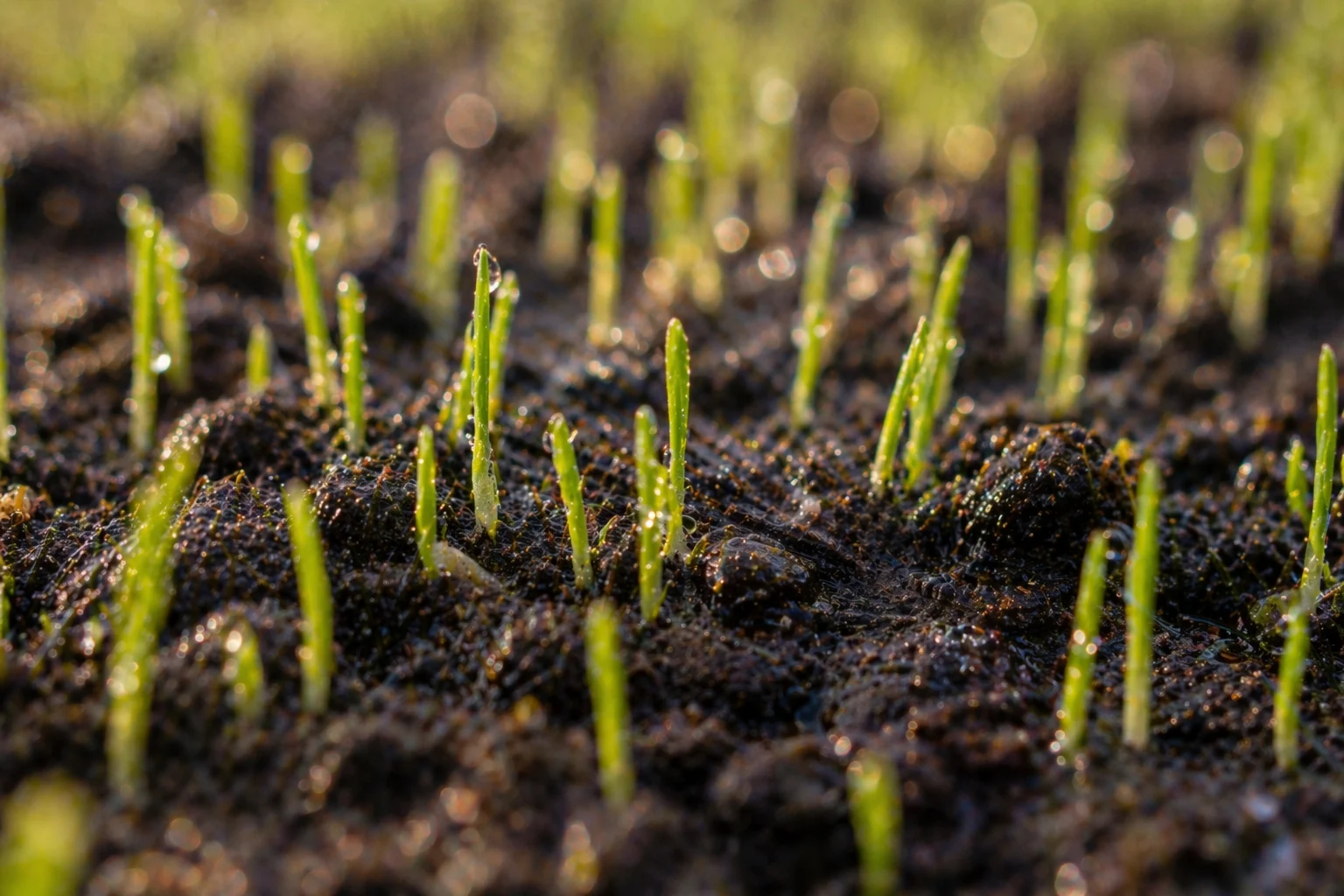
The Critical Rule: Keep the Seed Zone Consistently Moist
The single most important rule for new grass seed is keeping the top 1/4 inch of soil consistently moist from seeding through germination. Grass seed begins absorbing water within minutes of first contact and starts cellular activity that cannot be interrupted without killing the seed. A seed that absorbs water, begins germination, then dries out will not restart — it is dead.
The seed zone is extraordinarily vulnerable to drying because it is so shallow. The top 1/4 inch of soil dries in 2 to 4 hours on a sunny 75°F day, or 1 to 2 hours on a 90°F day with wind. The watering strategy is therefore based on frequency, not volume — many light sessions throughout the day rather than fewer heavy sessions. Each session should wet the top 1/4 inch without creating runoff or standing water.
Do not rely on rainfall during germination. A brief shower may moisten the surface but leaves gaps between rain events that extend beyond the seed zone's ability to hold moisture. Plan to irrigate on schedule regardless of forecast rainfall, and skip scheduled irrigation only if the prior 24 hours delivered 0.25 inch or more of measurable precipitation verified by a rain gauge at the seeding site.
How Often to Water New Grass Seed (Pre-Germination Schedule)
The target is 3 to 5 minutes of runtime per zone per session for spray heads, or 8 to 12 minutes for rotor heads — enough to visibly dampen the soil surface without creating puddles or runoff. Longer sessions waste water (soaks below the seed zone where it does no good) and can wash seed out of position.
Early morning (6 to 7 AM) is the first session and most important. Morning irrigation replenishes moisture lost overnight and sets up the seeds for the day's solar load. Mid-day session (11 AM to 1 PM) fights peak evaporation. Late afternoon session (3 to 5 PM) — if temperatures exceed 75°F — keeps the seed zone moist through the hottest part of the day. Avoid evening watering even for new seed, as overnight moisture invites fungal disease in the seed zone.
| Temperature Range | Frequency | Duration per Session | Notes |
|---|---|---|---|
| Below 60°F (cool fall) | 2×/day (morning + mid-afternoon) | 5–8 min/zone | Lower evaporation |
| 60–75°F (ideal spring/fall) | 2–3×/day | 5–8 min/zone | Standard schedule |
| 75–85°F (late spring) | 3×/day | 5–8 min/zone | Add afternoon session |
| 85–95°F (summer) | 3–4×/day | 4–6 min/zone | Summer seeding risky |
| High wind 15+ mph | Add 1 session | +2–3 min | Wind doubles evaporation |
| Overcast/humid | Reduce by 1 session | Same | Lower evaporation |
Germination Times by Grass Type
Kentucky Bluegrass has the longest germination window of any common cool-season grass (up to 21 days) and is the most vulnerable to missed watering sessions. A 3-week watering schedule of 3x daily without interruption is a significant commitment — many KBG seeding failures trace to a single weekend where watering was skipped or reduced.
Perennial Ryegrass is often mixed with Kentucky Bluegrass specifically because it germinates in 5 to 10 days, providing quick visible green cover while the slower KBG catches up. A 70% KBG / 30% Ryegrass blend establishes faster than pure KBG and is the standard cool-season seeding mix for that reason.
Bermuda seed requires soil temperatures of 65°F+ consistently for reliable germination. Seeding Bermuda in April in most of the South is too early — the soil is still too cool. Wait until daytime highs are consistently 75°F+ and overnight lows above 60°F. Seeding in mid-May through mid-June is ideal for Southeast; late April through early June for Texas and Southwest.
| Grass Type | Germination Time | Pre-Germination Schedule | Notes |
|---|---|---|---|
| Perennial Ryegrass | 5–10 days | 2–3×/day | Fastest common grass; good nurse crop |
| Tall Fescue | 7–14 days | 2–3×/day | Reliable germinator in cool weather |
| Kentucky Bluegrass | 14–21 days | 3×/day minimum | Slowest cool-season; most vulnerable |
| Fine Fescue | 7–14 days | 2–3×/day | Shade-tolerant, cool-weather preferred |
| Bermuda (seed) | 10–30 days | 3–4×/day | Needs soil 65°F+; late spring only |
| Zoysia (seed) | 14–21 days | 3×/day | Slow and finicky; sod preferred |
| Buffalo Grass (seed) | 14–30 days | 2×/day | Drought-tolerant once established |
| Centipede (seed) | 14–28 days | 3×/day | Sandy acidic soil required |
Post-Germination: Transitioning to Normal Watering
Once seedlings emerge (typically visible at the expected germination time for the grass type), the watering strategy shifts from frequency-focused to depth-focused. The goal becomes encouraging deep root growth rather than just surface moisture. Transition gradually over 2 to 3 weeks to avoid drought-stressing young seedlings.
Week 1 post-germination: reduce from 3x daily to 2x daily, but extend each session from 5 to 10 minutes. The soil should be moist to 1 inch deep rather than just 1/4 inch. Seedlings will begin putting down roots to reach the deeper moisture.
Week 2 post-germination: reduce to 1x daily or every other day, with each session running 15 to 20 minutes to reach 2 inches of soil depth. Check moisture with a screwdriver or soil probe before each scheduled session — the top inch should be slightly dry, the 1 to 2 inch depth should be moist.
Week 3 and beyond: transition to 2 to 3 times per week at 30 to 45 minutes per zone. This matches a normal established-lawn schedule. The grass should have a 2 to 3 inch root system by this point and be ready for standard care. First mow at this stage if the lawn has reached 4 inches height — never cut more than 1/3 of blade height on new seedlings.
Seasonal Watering Adjustments for New Seed
Spring seeding (March to May in Northern US, February to April in Southern US) benefits from reliably cool temperatures and typically higher soil moisture from winter precipitation. The 2 to 3x daily schedule is usually sufficient, and germination rates are high. The risk is late frost damage to emerged seedlings — seed at least 6 weeks before the average last frost date for your region to give seedlings time to harden off before cold snaps.
Fall seeding (late August to early October in Northern US) is the ideal window for cool-season grasses. Cooler temperatures reduce evaporation, and dew formation provides supplemental moisture overnight. Many fall seedings can reduce to 2x daily by Week 1 without germination failure. Plan fall seeding 6 to 8 weeks before the average first frost to allow seedlings to establish root systems before cold weather.
Summer seeding (June to August) is the hardest season to seed successfully anywhere in the US. High temperatures accelerate evaporation, and heat-stressed seedlings fail easily. If you must seed in summer, irrigate 4x daily and use shade cloth on the seeded area during peak afternoon heat. Consider slit-seeding into existing turf to reduce evaporation loss, or postpone until fall.
Winter dormant seeding (December to February in Northern US) is a specialty technique that works for Kentucky Bluegrass and Fescue on frozen ground. The seed remains dormant until spring soil warming triggers germination. No irrigation is needed during dormancy, but beginning in March the emerging seedlings need the standard germination schedule. This technique suits large properties where spring irrigation would be impractical.
How to Tell If Your Seed is Getting Enough Water
Underwatering signs: uneven germination across the seeded area (patches of bare spots), seedlings emerging with yellow or bronze cast, visible seed on the soil surface that hasn't swelled or sprouted after 2x the expected germination time, and soil that is visibly dry 2 hours after an irrigation session. These symptoms indicate the water isn't reaching or staying in the seed zone.
Overwatering signs: standing water or runoff after irrigation, slimy or mossy growth on the soil surface, seed visibly floating or displaced from original position, damping-off disease in emerged seedlings (thin rotting stems at soil line causing seedlings to collapse), and soil that remains saturated more than 2 hours after irrigation. Overwatering causes more seeding failures than underwatering because it rots seeds before germination and encourages fungal disease.
The screwdriver test is the easiest field check: push a screwdriver into the soil where you seeded. It should slide in easily through the first 1 to 2 inches (moist soil), then resist (indicating the soil below seed zone is still slightly dry). If the screwdriver goes in 4+ inches with no resistance, you're overwatering. If it won't penetrate the first inch without force, you're underwatering.
- Soil visibly damp in the seed zone before each scheduled irrigation session
- Seedlings emerging consistently across the seeded area at expected germination time
- Seed not visible on soil surface (hasn't been washed away)
- No cracking or curling of young seedling blades
- Germination rate matching the grass type's expected rate (80%+ for quality seed)
Common Overseeding Watering Mistakes
The most common failure mode is inconsistent watering. Seed that starts germination, then dries out mid-process is dead seed. This happens most often over weekends when homeowners are away from home, or during mid-week commuting days when no one is home to verify irrigation ran correctly. A smart irrigation controller (Rachio, Rain Bird WiFi models) with automatic daily schedules and weather-based adjustments is worth the investment for any significant overseeding project.
The second most common failure is applying pre-emergent herbicide before or during seeding. Pre-emergents like prodiamine and dithiopyr prevent seed germination for all grasses, including desired grass seed. If you applied pre-emergent in spring, do not overseed in the same season — the pre-emergent barrier remains effective for 3 to 6 months. Alternate years: pre-emergent this year, overseed next year.
- Relying on hose watering without consistency — missing sessions defeats the entire strategy
- Watering so heavily that seed washes out of position
- Applying pre-emergent herbicide before or during seeding (kills grass seed too)
- Skipping weekend watering when you're away from home
- Watering at night, inviting damping-off fungal disease
- Seeding during high winds — seed distribution becomes uneven
- Assuming rain will take care of watering (it rarely does reliably)
- Seeding too deeply (more than 1/4 inch covering — seeds can't emerge)
- Using unscreened topsoil that introduces weed seeds competing with grass
Watering New Seed During Water Restrictions
New seed establishment under active water restrictions is challenging. Most utilities grant establishment variances for new sod but not consistently for new seed — the logic is that sod is a higher-value investment with visible immediate landscaping, while seed can be delayed to a non-restriction period. Check your utility's specific variance policy before seeding during an active restriction.
Where seed variances are available, they typically allow 3 to 4 weeks of enhanced watering beyond normal restriction hours, but may still cap total water use. Hand watering with a shut-off nozzle and drip irrigation are exempt from day-of-week schedules in almost every US restriction ordinance — these techniques can supplement or substitute for sprinkler irrigation during restrictions.
For small seeding projects under restrictions (repairing bare patches, overseeding a few hundred square feet), hand watering 2x daily with a handheld hose is an effective low-water alternative to sprinkler irrigation. Apply water as a fine mist from a shut-off nozzle for 30 to 60 seconds per square yard, morning and mid-afternoon. This approach uses about 60% of the water that a sprinkler cycle would use for the same coverage.
See our water restrictions guide at lawnbyseason.com/water-restrictions for state-specific variance requirements, seeding timing recommendations during active restrictions, and the specific watering allowances for each major utility.
Frequently Asked Questions
How often should I water new grass seed per day?
2 to 3 times per day during typical spring/fall temperatures (60 to 75°F). Increase to 3 to 4 times per day in summer heat (above 85°F) or high winds. Each session should run 5 to 8 minutes per zone for spray heads — enough to dampen the top 1/4 inch of soil without creating runoff. The seed zone dries out within hours, so consistent frequency is more important than session duration.
How long does it take for grass seed to germinate?
Perennial Ryegrass: 5 to 10 days. Tall Fescue and Fine Fescue: 7 to 14 days. Kentucky Bluegrass: 14 to 21 days. Bermuda seed: 10 to 30 days (requires soil temperatures above 65°F consistently). Zoysia seed: 14 to 21 days. The slower the germination, the more critical consistent watering becomes — missed watering sessions during a 3-week germination window are devastating to KBG seedings.
Can I overwater new grass seed?
Yes. Overwatering is actually a more common cause of seeding failure than underwatering. Excessive water washes seeds out of position, creates anaerobic soil conditions that rot seeds before germination, and invites damping-off fungal disease in emerged seedlings. The goal is consistent moisture in the top 1/4 inch — not saturated soil. Standing water or visible runoff means you're overwatering.
What happens if I forget to water for a day?
Depends on when in the germination cycle. A single missed day before seeds have absorbed water is usually recoverable. A missed day after seeds have begun germination can kill a significant percentage of the seed bank — grass seeds that begin cellular activity and then dry out cannot restart the process. The further along in germination (emerged seedlings, visible growth), the more damaging a dry day becomes. Install a smart controller with automatic schedules to prevent missed sessions.
Can I seed during water restrictions?
Check your utility's new-lawn establishment variance policy first. Some utilities grant seeding variances of 3 to 4 weeks; others restrict seeding to non-drought periods entirely. Hand watering and drip irrigation are exempt from day-of-week restrictions in most ordinances and can substitute for sprinkler irrigation on small seeding projects. For large-scale seeding, consider delaying until the restriction period ends.
About the Author
Lawn Care Expert & Writer · Denver, Colorado · Florida State University
Jason Allen is a lawn care expert and freelance writer based in Denver, Colorado. He studied turfgrass science and horticulture at Florida State University before founding his own lawn care operation serving the Denver metro area. With over a decade of hands-on experience managing cool-season lawns in Colorado's challenging high-altitude climate, Jason specializes in aeration, fertilization timing, drought management, and water-restriction compliance. His practical, science-backed approach to lawn care has helped thousands of homeowners achieve healthy turf despite Colorado's short growing seasons, clay soils, and frequent drought conditions.