How to Water New Sod (Week-by-Week Schedule)
Published:

New sod needs watering 2 to 3 times daily for the first 7 to 14 days after installation. The critical rule during establishment is keeping the top 2 inches of soil consistently moist — not saturated, but never dry. Underwater a new sod installation and the roots desiccate before they reach the underlying soil; overwater and the roots stay shallow in the sod layer and never anchor into the ground below. This guide gives a week-by-week schedule that adjusts for grass type, season, and regional climate, plus the signs that tell you when new sod has rooted successfully and is ready for normal watering.
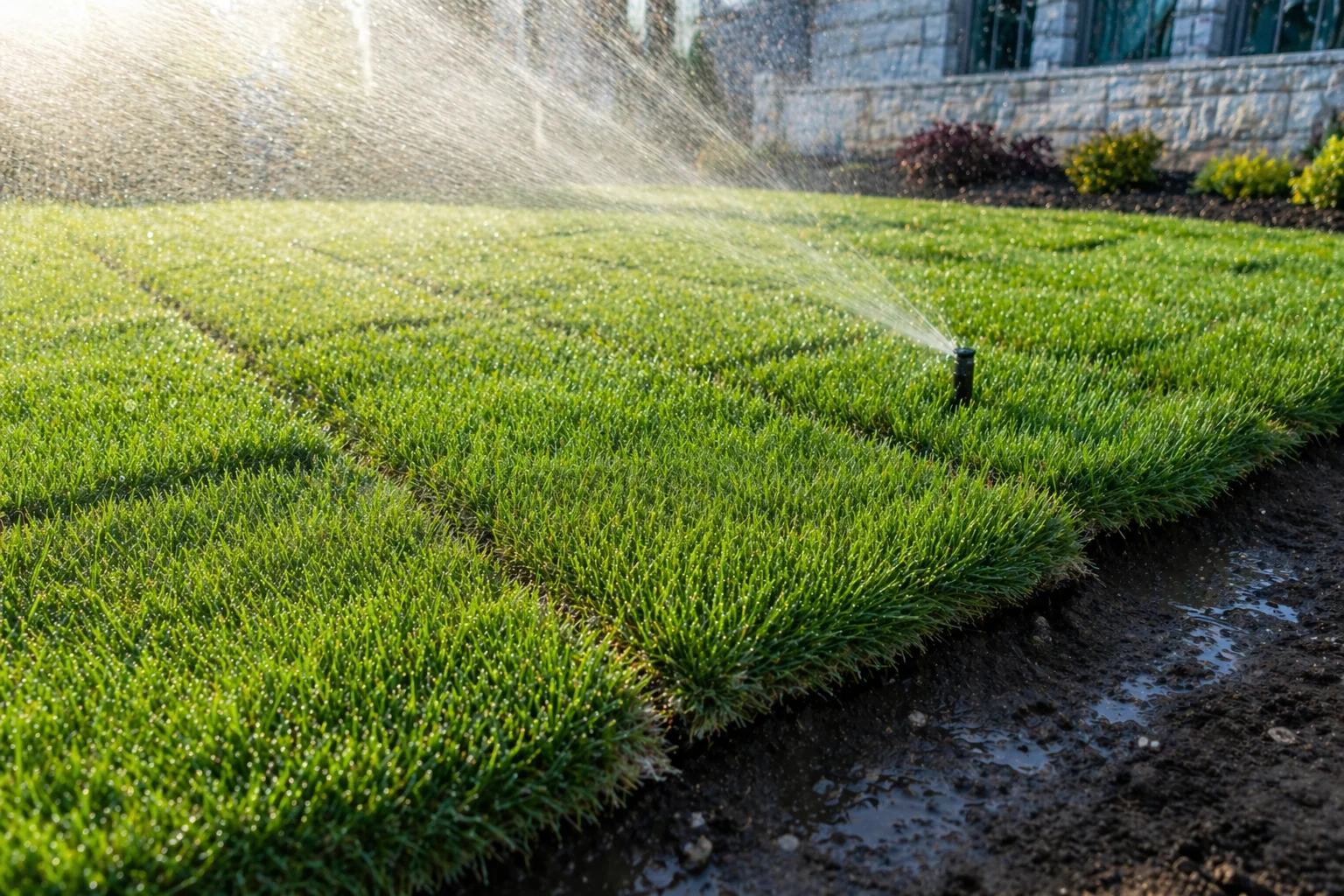
How Often to Water New Sod: The First 14 Days
The first 14 days after sod installation are the critical establishment window. During this period, the sod's root system is still in the original pad and has not yet grown into the underlying soil. The sod pad is only about 1 inch thick, so the roots have very limited water reserves — a single dry afternoon can kill an entire section of newly-installed sod.
Target for Days 1 to 7: keep the top 2 inches of soil consistently moist. This typically means 2 to 3 watering sessions per day of 10 to 15 minutes per zone on spray heads, or 20 to 30 minutes on rotor heads. Water enough to reach the bottom of the sod pad plus 1 inch into the underlying soil, but not so much that water pools or runs off. Lift a corner of the sod gently on Day 3 — the underlying soil should be dark and moist, not wet or dry.
Days 8 to 14: reduce to 2 watering sessions per day as the root system begins extending into the subsoil. You'll see white root fibers extending below the sod pad when you lift a corner — this is the goal, and it signals that the sod is beginning to establish. Do not reduce watering frequency until you see these roots.
Week-by-Week Watering Schedule
The schedule above assumes typical weather conditions — mid-70s to mid-80s Fahrenheit with partial sun. High-heat installation (90°F+) requires adding one watering session per day during Week 1. Cool-weather installation (below 65°F) can reduce Week 1 to 2 sessions per day because evaporation is lower.
The goal through the 4-week schedule is progressive root depth. Week 1 keeps the sod pad alive. Week 2 drives roots into the soil surface. Week 3 encourages deeper roots. Week 4 encourages the lawn to reach for water during dry periods between irrigation. Rushing to reduce frequency too quickly (skipping from Week 1 to Week 3) creates shallow-rooted sod that will fail in the first heat wave. Staying at Week 1 frequency too long (4+ weeks of 3x daily watering) creates the opposite problem — roots never reach down because water is always available at the surface.
| Week | Frequency | Cool-Season Runtime | Warm-Season Runtime | Goal |
|---|---|---|---|---|
| Week 1 (Days 1–7) | 3×/day | 10–15 min/zone | 10–12 min/zone | Keep sod pad + top 2" soil moist |
| Week 2 (Days 8–14) | 2×/day | 15 min/zone | 12–15 min/zone | Roots extending into subsoil |
| Week 3 (Days 15–21) | 1×/day | 20–25 min/zone | 15–20 min/zone | Roots anchoring 2–3" deep |
| Week 4 (Days 22–28) | Every other day | 25–30 min/zone | 20–25 min/zone | Tug test resistance |
| Week 5–6 | 2–3×/week | 30 min/zone deep | 25 min/zone deep | Transition to normal schedule |
| Week 7+ | Normal schedule | Per normal rotation | Per normal rotation | Fully established |
Watering New Sod by Grass Type
Bermuda sod is the most drought-tolerant warm-season sod once established but is sensitive during the first 3 weeks. Bermuda's aggressive stolon production means it roots into the subsoil quickly (typically Day 10 to 14) if watered correctly. Run 10 to 12 minutes per zone 3x daily during Week 1 in warm weather. Bermuda tolerates brief afternoon heat stress if watered in the morning and again in late afternoon, making it more forgiving than St. Augustine on hot-weather installations.
St. Augustine sod has the highest water demand during establishment and is the least forgiving of any common residential sod. St. Augustine's dense runner growth creates heavy water consumption, and drought stress during establishment often kills entire patches permanently. Run 12 to 15 minutes per zone 3x daily minimum during Week 1. St. Augustine installed in Texas or Florida summer heat may need 4x daily watering for the first 5 days. This is the grass where overhead misting (a quick 5-minute misting at 1 PM to cool the blades) can be the difference between success and failure.
Fescue sod (tall fescue, Kentucky 31) has moderate water demand during establishment. Fall installation is ideal — cooler temperatures and typically higher humidity reduce water stress significantly. Spring installation works in the cooler March to early May window. Summer installation is risky and should be avoided if possible. Run 10 to 15 minutes per zone 3x daily during Week 1; reduce quickly to 2x daily as temperatures drop in fall installations.
Zoysia sod is slow to establish but forgiving once rooted. Zoysia's dense growth pattern means initial root extension is slower than Bermuda (typically Day 14 to 21 for visible subsoil rooting), but the grass tolerates brief water stress well once any rooting is established. Run 10 to 12 minutes per zone 3x daily during Week 1 and be patient — Zoysia may not fully anchor until Week 4 or 5. Avoid reducing frequency too quickly.
Kentucky Bluegrass sod is the northern US standard and has moderate water demand. KBG sod handles cool-weather installation (fall or early spring) beautifully but struggles with summer installation because the grass enters partial dormancy in heat above 85°F. Run 10 to 15 minutes per zone 3x daily during Week 1 in spring/fall; summer installations may need 4x daily and still risk patchy failure.
Seasonal Adjustments
Summer installation (June to August) requires significantly more aggressive watering than spring or fall installation. In temperatures above 85°F, add one watering session to the base schedule — 4x daily instead of 3x during Week 1, 3x daily instead of 2x during Week 2. Early afternoon misting (2 to 3 minutes per zone at 1 to 2 PM) helps cool the sod blades without adding meaningful moisture. On extreme heat days (95°F+), run the irrigation cycle more frequently and for shorter durations to prevent heat damage.
Fall installation is the ideal window for cool-season sod and offers the easiest establishment schedule. September through early November installation in the Northern US benefits from cooler temperatures, higher humidity, and reliable rainfall — many fall installations can drop to 2x daily after Week 1 rather than maintaining 3x. Watch for early frost after Week 2 — if a hard frost is forecast within 2 weeks of installation, irrigation should be stopped 48 hours before the frost to allow the lawn to harden off.
Rain events during establishment: skip the next scheduled irrigation if the sod received 0.5 inch or more of natural rainfall in the prior 24 hours. Soil saturation can be as damaging as drought during establishment — waterlogged soil prevents oxygen from reaching the roots and encourages fungal disease. A rain gauge near the sod installation lets you calibrate accurately.
Hot dry winds accelerate evaporation dramatically. Texas Panhandle and Oklahoma installations in spring commonly face 25+ mph wind days that can dry out new sod in hours. Add one irrigation session on wind days, particularly during Week 1. Windbreak plantings or snow fencing can reduce wind exposure on exposed installations.
How to Tell If New Sod Is Rooting
The tug test is the most reliable single indicator of rooting progress. On Day 7, gently pull up a corner of a sod piece at the edge of the installation. If the piece lifts easily with no resistance, the sod has not yet rooted — continue the Week 1 schedule. If the piece resists and feels anchored, roots have begun extending into the subsoil — transition to Week 2 schedule. By Day 21, pulling up a piece should require significant force, indicating roots have extended 2 to 3 inches deep.
Edge lifting and brown strips at sod seams are the most common early-installation problems. They indicate either (1) irrigation not reaching the seam (poor head-to-head spacing or head obstruction) or (2) sod pieces butted too tightly and drying at the contact edges. Seam drying can be addressed with targeted hand watering — a 5-gallon bucket of water poured slowly along the dry seam each morning until the sod beside the seam is visibly anchored.
- Tug test: gently lift a corner of a sod piece. Resistance = rooting. Easy lift = not yet rooted.
- Root extension: roots visible extending 1"+ below the sod pad edge = successful establishment
- Color: consistent green with no yellow or blue-gray patches = adequate water
- Edge lifting: sod edges curling up = insufficient water penetration at seams
- Brown edges or strips: dry spots = coverage gap in irrigation pattern
- Blue-gray color throughout: drought stress, even if soil feels moist at surface
- Mushroom growth: excessive water, reduce frequency
- Soft/spongy feel underfoot: overwatering — reduce immediately
First Mow After New Sod
Wait a minimum of 2 to 3 weeks after installation before the first mow. The lawn should pass a firm tug test — pieces should resist lifting — before any mowing is attempted. Mowing before rooting is complete will rip up pieces, particularly on Zoysia and St. Augustine where mower wheels can grip the edges of unrooted sod.
First cut: no more than 1/3 of blade height. If the sod has grown to 4.5 inches, cut to no shorter than 3 inches. Cutting shorter than 1/3 of blade height shocks the lawn during a critical establishment period and causes visible yellowing that takes weeks to recover.
Mow when the soil is slightly dry to prevent rut damage. Mowing on saturated soil the day after irrigation or a rain event creates tire ruts in the softened soil that persist for months. Time your first mow for 24 to 36 hours after the last irrigation so the soil has firmed up but the grass is not drought-stressed.
Use a sharp blade for the first mow. Dull blades tear leaf tissue and create entry points for fungal disease during a period when the sod is already stressed. Sharpen or replace your mower blade before the first cut on new sod.
Collect clippings for the first 3 mows only. After 3 mows, switch to mulch mowing (leaving clippings on the lawn) to recycle nutrients and organic matter back into the new lawn. The early clipping collection helps prevent thatch buildup at the base of new grass while the root system is still establishing.
Common Watering Mistakes with New Sod
The single most common mistake is inadequate coverage at edges and seams. Irrigation designed for an established lawn leaves dry strips at the edges where spray heads don't quite reach. For new sod, these dry strips become brown strips within a week. Walk the installation with a tuna can or rain gauge during irrigation runtime; any area receiving less than 0.25 inch per irrigation session needs supplemental hand watering until rooting is complete.
The second most common mistake is watering on rainy days. Sod saturation from irrigation plus 1+ inch of rain creates anaerobic soil conditions that kill roots. Install a rain sensor on your irrigation controller (most smart controllers have built-in rain sensor compatibility) or manually skip irrigation when significant rain has fallen. A simple rain gauge at the installation site provides the data you need.
- Watering too deeply too early — saturating roots before they've extended
- Reducing frequency too quickly from Week 1 to Week 3 schedule
- Ignoring edge seams where irrigation spray doesn't reach
- Watering on rainy days (skip if 0.5"+ received)
- Relying on hose watering without measuring actual application
- Running irrigation during high winds (50%+ evaporation loss)
- Watering at night, inviting fungal disease
- Skipping midday misting during 90°F+ heat waves on new installations
- Installing sod in summer heat with inadequate irrigation capacity
Water Restrictions and New Sod Installation
Most US municipal water utilities allow new sod installation watering above and beyond drought restrictions. The typical framework grants a 14 to 30 day establishment variance for new sod, during which the standard day-of-week and hour-of-day restrictions are waived. The variance almost always requires pre-notification to the utility before sod installation — request the variance form through your utility's website or customer service line.
New sod variances are particularly important in active-restriction states. Texas (San Antonio, Austin), Arizona (Phoenix, Tucson), Nevada (Las Vegas), and California (Los Angeles, San Diego) all grant establishment variances of 21 to 30 days for properly-installed sod. The variance typically requires documentation of the installation date, quantity installed, and contractor information. Failure to obtain the variance before installation can result in citations even for legitimate establishment watering.
After the variance period expires, the new lawn returns to the standard restriction schedule. Plan to taper to the restricted schedule during the final week of the variance — if your post-variance schedule is 2 days per week, water 4 days in Week 3 and 3 days in Week 4 to transition smoothly. Abrupt transitions from 3x daily to 2x weekly cause visible shock in new lawns.
See our complete water restrictions guide at lawnbyseason.com/water-restrictions for state-by-state variance requirements and restriction schedules by city.
Frequently Asked Questions
How often should I water new sod in the first week?
Water 2 to 3 times per day during Week 1. Each session should last 10 to 15 minutes per zone to keep the top 2 inches of soil consistently moist. In temperatures above 85°F, increase to 4 sessions per day. The sod pad is only 1 inch thick, so the root system has minimal water reserves — a single dry afternoon can damage new sod permanently.
When can I stop watering new sod daily?
After roots anchor into the subsoil, typically Day 14 to 21. The tug test confirms rooting: gently lift a sod corner — if it resists and feels anchored, the lawn is ready to transition to every-other-day watering (Week 3 schedule). By Week 4, successful establishments transition to 2 to 3 times weekly, and by Week 6 to 7 the lawn is on a normal watering schedule.
Can I walk on new sod while it's establishing?
Minimize foot traffic for the first 14 days. Light foot traffic for essential reasons (hand watering seams, mower setup) is acceptable after Day 7 if the soil has firmed up. Avoid heavy traffic, pets, and play activities until after the first mow (typically Week 3) when the sod has anchored enough to resist lifting.
What if it rains during the first week after sod installation?
Skip the next scheduled irrigation if natural rainfall exceeds 0.5 inch in 24 hours. Saturated soil can be as harmful as drought during establishment — waterlogged soil prevents oxygen from reaching roots and invites fungal disease. Install a rain gauge at the installation site to track natural rainfall accurately.
How do I water new sod during water restrictions?
Request a new-lawn establishment variance from your water utility before installing sod. Most utilities grant 14 to 30 day variances that waive day-of-week and hour-of-day restrictions during establishment. The variance requires pre-notification with the installation date and square footage. Without the variance, you risk citations even for legitimate establishment watering.
About the Author
Lawn Care Expert & Writer · Denver, Colorado · Florida State University
Jason Allen is a lawn care expert and freelance writer based in Denver, Colorado. He studied turfgrass science and horticulture at Florida State University before founding his own lawn care operation serving the Denver metro area. With over a decade of hands-on experience managing cool-season lawns in Colorado's challenging high-altitude climate, Jason specializes in aeration, fertilization timing, drought management, and water-restriction compliance. His practical, science-backed approach to lawn care has helped thousands of homeowners achieve healthy turf despite Colorado's short growing seasons, clay soils, and frequent drought conditions.