How Long to Run Sprinklers (By Zone Type & Soil)
Published:

Fixed spray heads need 15 to 20 minutes per zone to deliver 1/2 inch of water. Rotor heads need 30 to 45 minutes per zone for the same depth. Rotary nozzles need 25 to 35 minutes. These are the base numbers — your actual runtime depends on your specific sprinkler head model, water pressure, soil type, and grass type. This guide walks through the precipitation rate calculations, the tuna-can calibration method, soil-type adjustments (cycle-and-soak for clay soils), seasonal adjustments, and the controller programming steps for each major brand. Correct runtime is the single highest-ROI adjustment most homeowners can make to their sprinkler system.
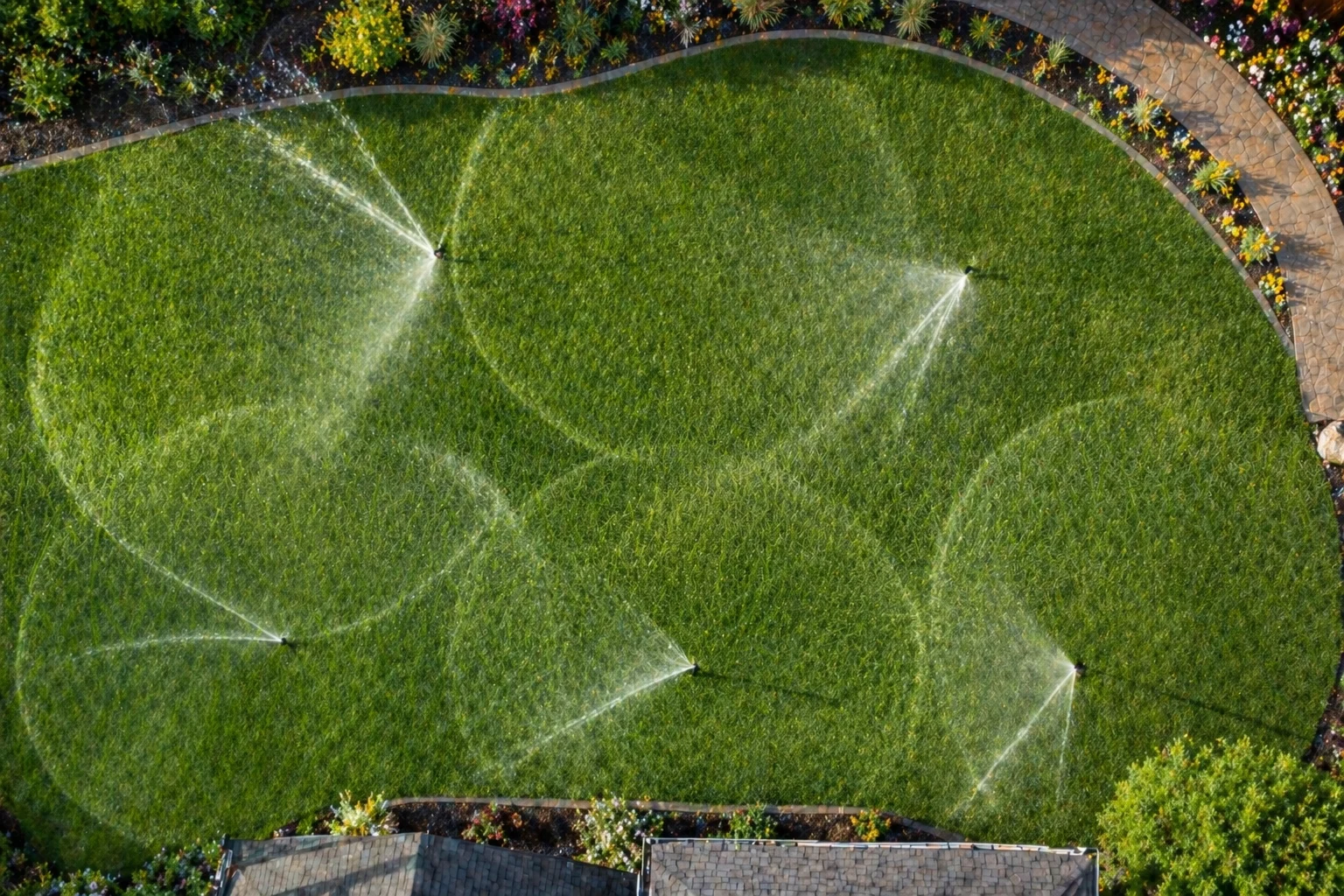
Recommended Run Times by Sprinkler Head Type
The first variable in runtime calculation is head type. Each head type has a different precipitation rate (PR) — the inches per hour the head delivers across its coverage area.
Fixed spray heads deliver the highest precipitation rate and the shortest runtime. A Hunter Pro-Spray or Rain Bird 1800 series spray head with 12-foot radius produces approximately 1.8 inches per hour across its wetted circle — 17 minutes runtime delivers 1/2 inch depth. Spray heads are ideal for small, irregular areas (10 to 15 foot coverage zones) where longer rotor throws would overshoot the area.
Rotor heads deliver the lowest precipitation rate of common residential heads — typically 0.5 inch per hour. The lower rate sounds like a weakness but is actually a strength for larger lawns: rotors apply water slowly enough that it all absorbs into the soil without runoff, while spray heads on clay soils can apply faster than absorption rate, creating runoff. Runtime of 60 to 75 minutes to deliver 1/2 inch is normal — if you're running rotors for only 20 minutes, the grass is getting 0.15 inch per session, which is nowhere near the target weekly volume.
Rotary nozzles (MP Rotator, Hunter MP, Rain Bird R-VAN) are modern high-efficiency spray alternatives. They deliver 0.6 to 0.8 inch per hour with better uniformity than traditional spray heads. Runtime for 1/2 inch is 40 to 50 minutes. These are the best choice for new installations and upgrades — they apply water at a rate matching clay soil absorption, which prevents runoff on slopes that traditional spray heads would saturate.
| Head Type | Precipitation Rate | Runtime for 1/2 inch | Runtime for 1 inch |
|---|---|---|---|
| Fixed spray (pop-up) | 1.5–2 in/hr | 15–20 min | 30–40 min |
| Rotor (PGP, 5000 series) | 0.4–0.6 in/hr | 50–75 min | 100–150 min (split) |
| Impact/impulse | 0.3–0.5 in/hr | 60–100 min (split) | 120–200 min (split) |
| Rotary nozzle (MP Rotator) | 0.4–0.8 in/hr | 40–75 min | 75–150 min (split) |
| Drip emitter (1 GPH) | Varies by spacing | 60–90 min | 120–180 min |
| Soaker hose | 1–2 in/hr at line | 15–30 min | 30–60 min |
How Soil Type Affects Run Time
Clay soils are the most common runtime problem in US lawns. Clay absorbs water at 0.1 to 0.2 inches per hour — slower than any sprinkler head can deliver. Running a spray head zone for 30 minutes on clay typically generates visible runoff after 8 to 10 minutes, with the remaining runtime wasting water and eroding soil. The solution is cycle-and-soak programming: run the zone for the maximum period before runoff begins (typically 8 to 12 minutes), wait 30 to 45 minutes for the applied water to soak in, then repeat. Most modern controllers (Rachio, Hunter Pro-C, Rain Bird ESP-Me) have built-in cycle-and-soak features.
Sandy soils have the opposite problem — water absorbs so quickly that it drains below the root zone before the grass can use it. Sandy soil requires shorter sessions (15 to 20 minutes) delivered more frequently (3 times per week instead of 2) to keep moisture available in the root zone. This is why coastal Florida and Carolina lawns often run on more frequent but shorter schedules than inland clay-soil lawns.
Caliche is a specialized desert soil condition common in Arizona, New Mexico, and parts of Texas. A calcium-carbonate hardpan layer forms under thin topsoil and is effectively impermeable. Cycle-and-soak with 5 short cycles of 6 minutes each, separated by 45-minute soak intervals, is often required to achieve any meaningful water penetration. Severely caliche-affected properties may require breaking the hardpan layer during initial soil prep to create a functional irrigation zone.
| Soil Type | Absorption Rate | Best Strategy | Session Duration |
|---|---|---|---|
| Sandy | 0.8–1 in/hr | Short, frequent sessions | 15–20 min full delivery |
| Sandy loam | 0.5–0.8 in/hr | Normal deep-and-infrequent | 30–40 min full delivery |
| Loam | 0.3–0.5 in/hr | Normal deep-and-infrequent | 40–50 min full delivery |
| Clay loam | 0.2–0.3 in/hr | Cycle-and-soak required | 3 cycles of 10 min each |
| Clay | 0.1–0.2 in/hr | Cycle-and-soak mandatory | 4 cycles of 8 min each |
| Caliche (AZ/NM/TX) | 0.05–0.15 in/hr | Multiple short cycles + time gaps | 5 cycles of 6 min each |
How to Calculate the Right Run Time for Your System
Step 1: Gather 4 to 6 identical straight-sided cans (tuna cans work perfectly). Empty cans — remove all product, clean them, and dry them.
Step 2: Place the cans across a single zone's coverage area. Spread them in a rough grid pattern — one near each corner of the zone and one or two in the middle. Avoid placing cans directly under a sprinkler head; place them in the middle of the wetted pattern.
Step 3: Run that zone for exactly 15 minutes (most controllers have a manual zone-start function that runs a set duration). Use a phone timer or stopwatch for accuracy.
Step 4: After the zone shuts off, wait 5 minutes for water to settle in the cans. Measure the water depth in each can with a ruler.
Step 5: Average the depths across cans. For example, if you measured 0.15, 0.20, 0.18, 0.22, 0.19 inches, your average depth is 0.188 inch in 15 minutes — that's an hourly rate of 0.75 inch per hour for that zone.
Step 6: Calculate runtime for target depth. For the target 1/2 inch per session (1 inch weekly delivered in 2 sessions), runtime = 0.5 / 0.75 * 60 = 40 minutes. For 1 inch in a single session, runtime = 80 minutes — but that might exceed your soil's absorption rate, requiring cycle-and-soak.
Step 7: Repeat for every zone in your system. Runtime varies significantly between zones because of head type, head count, pressure drops, and coverage area. A well-calibrated 8-zone residential system might have runtime settings of 18, 35, 42, 45, 32, 28, 40, and 22 minutes — no two zones identical.
Adjusting Run Times by Season
Seasonal adjustments reflect changing evapotranspiration (ET) rates. Summer peak ET in Phoenix is 0.30 inch per day; in Seattle it's 0.15 inch per day. Winter ET is a fraction of these. ET-based smart controllers (Rachio, Hunter Hydrawise) adjust runtime automatically based on weather; manual controllers require seasonal adjustment by the homeowner. Check your utility's ET tables (most California and Arizona utilities publish daily ET rates) for precise local numbers.
The month-by-month seasonal adjustments shown above reflect typical US conditions. Arid Southwest climates (Phoenix, Tucson, Las Vegas, Albuquerque) maintain near-peak ET from May through October — seasonal reductions are smaller and shifted later. Pacific Northwest and Northeast climates have more pronounced seasonal variation, with early spring and late fall ET sometimes under 30% of summer peak.
Do not rely on the calendar alone. A cool cloudy July week may require zero irrigation if rainfall has exceeded ET for the week. A hot dry September week may require full peak-season irrigation despite the calendar suggesting fall reductions. A rain sensor and smart controller handle these automatic adjustments; manual systems require weekly homeowner attention.
| Season | Adjustment | Runtime Example (1/2 inch target) |
|---|---|---|
| Early spring (March) | 50% of peak | Spray 10 min, Rotor 25 min |
| Late spring (May) | 80% of peak | Spray 15 min, Rotor 45 min |
| Summer peak (July) | 100% of peak | Spray 18 min, Rotor 55 min |
| Late summer (August) | 100%, increase frequency | Same runtime, add 1 session |
| Early fall (Sept) | 70% of peak | Spray 12 min, Rotor 40 min |
| Late fall (Oct) | 40–50% of peak | Spray 8 min, Rotor 25 min |
| Winter (Dec–Feb) | 0% or minimal crown | System off entirely in most regions |
Signs Your Sprinklers Are Running Too Long
Runoff during irrigation is the most immediate sign of overrunning. Water hitting sidewalks, driveways, or storm drains represents complete loss — that water does the lawn no good and in many jurisdictions violates runoff ordinances. Every minute of runtime after runoff begins is wasted. If you see runoff at the 8-minute mark of a scheduled 20-minute session, you need to switch to cycle-and-soak programming or significantly reduce runtime.
Soggy-soil symptoms develop over weeks of repeated overrunning. If soil probe tests return mud from 6-inch depth, if you see chronic fungal pressure, or if the lawn has a spongy feel underfoot — reduce runtime by 25% and reassess after 2 weeks. Chronic over-runtime creates compaction, thatch, and disease that take months to reverse.
- Visible runoff on driveways, sidewalks, or gutters during or after irrigation
- Puddles or standing water persisting 30+ minutes after cycle end
- Soggy soil 24+ hours after irrigation with no rainfall
- Fungal disease patterns (brown patch, dollar spot) appearing on lawn
- Mushroom growth after irrigation sessions
- Yellow-green color with soft spongy feel underfoot
- Pushing a screwdriver 6+ inches into soil with no resistance
- Weed invasion by moisture-loving species (nutsedge, creeping charlie)
Signs Your Sprinklers Are Not Running Long Enough
Under-runtime produces shallow roots and drought stress. The test is a 6-inch soil probe 1 hour after a scheduled irrigation session — soil should be moist to 4 to 6 inches. Dry below 3 inches means the water isn't penetrating deep enough. Either increase runtime per session (if cycle-and-soak isn't already required by soil type) or address the underlying problem: compacted soil (aerate), hydrophobic soil (wetting agent application), or inadequate head coverage (head adjustment or addition).
Under-runtime is often mistaken for overwatering because the lawn symptoms can look similar (yellowing, thinning). The diagnostic is the probe test — wet soil with yellow lawn = overwatering; dry soil with yellow lawn = underwatering. Don't respond to yellow color by reducing water before verifying with the probe test.
- Dry spots in zones despite scheduled irrigation
- Blue-gray color or footprint retention in localized areas
- Shallow root system (less than 3 inches deep) when you dig a test plug
- Hard soil underfoot that resists screwdriver penetration
- Grass wilting by mid-afternoon on hot days
- Weed pressure by drought-tolerant species (crabgrass, spurge, prostrate weeds)
- Lawn browning in the zone that should have been watered
How to Program Your Controller for Correct Zone Runtime
Rachio (all models): Open the Rachio app, select the zone, tap 'Runtime' and enter your calculated minutes. Rachio's built-in cycle-and-soak feature automatically splits long runtimes on clay soils — enable 'Smart Cycle' in zone settings. For a 40-minute runtime on clay, Smart Cycle will automatically split into 2 cycles of 20 minutes with a 30-minute soak interval.
Hunter Pro-C and X-Core: Press 'Set Station Run Times' on the main dial. Use +/- buttons to select zone 1, enter runtime with +/-, repeat for each zone. For cycle-and-soak, press 'Cycle Soak' button (Pro-C only) to set cycle time and soak time per zone. For example, Cycle 10 min / Soak 30 min for 3 cycles = 30 minutes effective runtime with 90-minute total span.
Hunter Hydrawise: Log into app, navigate to 'Zones,' select each zone individually. Enter runtime in minutes. Hydrawise's 'Predictive Watering' feature uses local weather data to adjust runtime automatically; enable this in zone settings for each residential zone. Hydrawise defaults to aggressive ET-based reductions — review seasonal adjustments at least twice per year to verify the algorithm is producing reasonable runtimes for your specific lawn.
Rain Bird ESP-Me and ESP-TM2: Rotate dial to 'Set Zone Run Times.' Use +/- to select zone number, arrow keys to adjust time in 1-minute increments. For cycle-and-soak, the ESP-TM2 supports 'Soak Cycle' programming via the app or dial. ESP-Me users can manually create cycle-and-soak using 'Delay Between Stations' feature.
Orbit B-hyve: Open app, select controller, tap 'Zones,' select zone, enter runtime. B-hyve's 'Smart Watering' feature enables ET-based adjustment — worth enabling for most residential customers. Manual runtime override is always available if Smart Watering produces unexpected schedules.
Cycle-and-Soak: The Right Approach for Clay Soils
Cycle-and-soak is a programming technique that splits a single irrigation session into multiple shorter cycles separated by soak intervals. Instead of running a zone for 40 minutes straight, cycle-and-soak runs it for 10 minutes, waits 30 minutes, runs for 10 minutes again, waits 30 minutes, runs for 10 minutes — total of 30 minutes active runtime delivered as 3 cycles over 90 minutes clock time.
The physics justify the approach. Clay soils have extremely slow water infiltration rates — typically 0.1 to 0.2 inches per hour. A spray head delivering 1.8 inches per hour is applying water 9 to 18 times faster than the clay can absorb it. After 8 to 12 minutes of continuous runtime, the topsoil reaches saturation and additional water runs off rather than penetrating. The 30-minute soak interval allows the water already applied to infiltrate deeper, freeing up surface absorption capacity for the next cycle.
Cycle-and-soak eliminates runoff and deepens water penetration. A 40-minute straight session on clay generates runoff at minute 10 and wastes 75% of the applied water after that point. A cycle-and-soak program delivering the same 40 minutes of runtime spread across 4 cycles produces zero runoff and achieves actual 1-inch soil penetration. The technique is mandatory for clay soils on any slope; it's beneficial even on flat clay.
Program cycle-and-soak on sloped areas regardless of soil type. A 5% or greater slope generates runoff faster than flat terrain because water moves laterally before soaking in. Even sandy loam slopes benefit from cycle-and-soak programming. On steep slopes (10%+), consider converting to low-precipitation heads (rotary nozzles or drip) rather than trying to force high-precipitation spray heads into working without excessive runoff.
Frequently Asked Questions
How long should I run my sprinklers per zone?
Depends on head type and target water depth. For 1/2 inch per session (1 inch weekly in 2 sessions): spray heads 15 to 20 minutes, rotor heads 50 to 75 minutes, rotary nozzles 40 to 50 minutes. Calibrate your specific system with the tuna can test: place cans across a zone, run 15 minutes, measure depth, calculate runtime from your zone's actual output rate. Soil type modifies runtime — clay soils require cycle-and-soak programming.
Why does my lawn have runoff when I water?
Your application rate exceeds your soil's absorption rate. Clay soils absorb 0.1 to 0.2 inches per hour; spray heads deliver 1.5 to 2 inches per hour — 10x too fast. The fix is cycle-and-soak programming: run the zone for the maximum period before runoff (typically 8 to 12 minutes on clay), wait 30 to 45 minutes for soaking, then repeat. Most modern controllers have built-in cycle-and-soak features.
Should I water longer in summer?
No — increase frequency instead of session length. Peak summer typically requires 2 to 3 sessions per week of the same session length, not longer sessions. Running 60 minutes instead of 30 often creates runoff without proportionally increasing soil moisture. Better to run 30 minutes on Monday and Thursday than 60 minutes on Monday alone. Smart controllers with ET-based adjustment handle these calculations automatically.
How do I calibrate my sprinkler runtime?
Use the tuna can test. Place 4 to 6 empty cans across a zone's coverage area, run the zone for exactly 15 minutes, measure the water depth in each can, and average the results. Multiply by 4 to get your zone's hourly output rate. Divide target depth (0.5 inch per session) by hourly rate to get runtime. Repeat for every zone — runtime varies between zones because of head type, head count, and pressure differences.
What's cycle-and-soak programming?
Cycle-and-soak splits a single irrigation session into multiple shorter cycles separated by soak intervals. Instead of running 40 minutes straight, it runs 10 minutes, waits 30, runs 10, waits 30, runs 10 — 3 cycles totaling 30 active minutes over 90-minute clock time. It's mandatory for clay soils and strongly recommended for slopes of 5% or greater. Modern controllers (Rachio, Hunter Pro-C, Rain Bird ESP-TM2) have built-in cycle-and-soak features that automatically split long runtimes.
About the Author
Lawn Care Expert & Writer · Denver, Colorado · Florida State University
Jason Allen is a lawn care expert and freelance writer based in Denver, Colorado. He studied turfgrass science and horticulture at Florida State University before founding his own lawn care operation serving the Denver metro area. With over a decade of hands-on experience managing cool-season lawns in Colorado's challenging high-altitude climate, Jason specializes in aeration, fertilization timing, drought management, and water-restriction compliance. His practical, science-backed approach to lawn care has helped thousands of homeowners achieve healthy turf despite Colorado's short growing seasons, clay soils, and frequent drought conditions.