Sprinkler System Installation Cost 2026
Published:

Professional sprinkler system installation costs $2,200 to $4,800 for an average single-family home in 2026, with labor accounting for 40% to 55% of the total project cost. The labor portion alone typically runs $1,200 to $2,800 for a 6 to 10 zone residential install, depending on local hourly rates ($50 to $100/hr), soil conditions, and contractor overhead. This guide focuses on the contractor pricing side of the decision: how installers price jobs, what a legitimate quote should include, how to compare multiple quotes without getting misled, and the red flags that separate professional irrigation contractors from operators who cut corners on code compliance and head spacing.
What Does Sprinkler Installation Labor Cost?
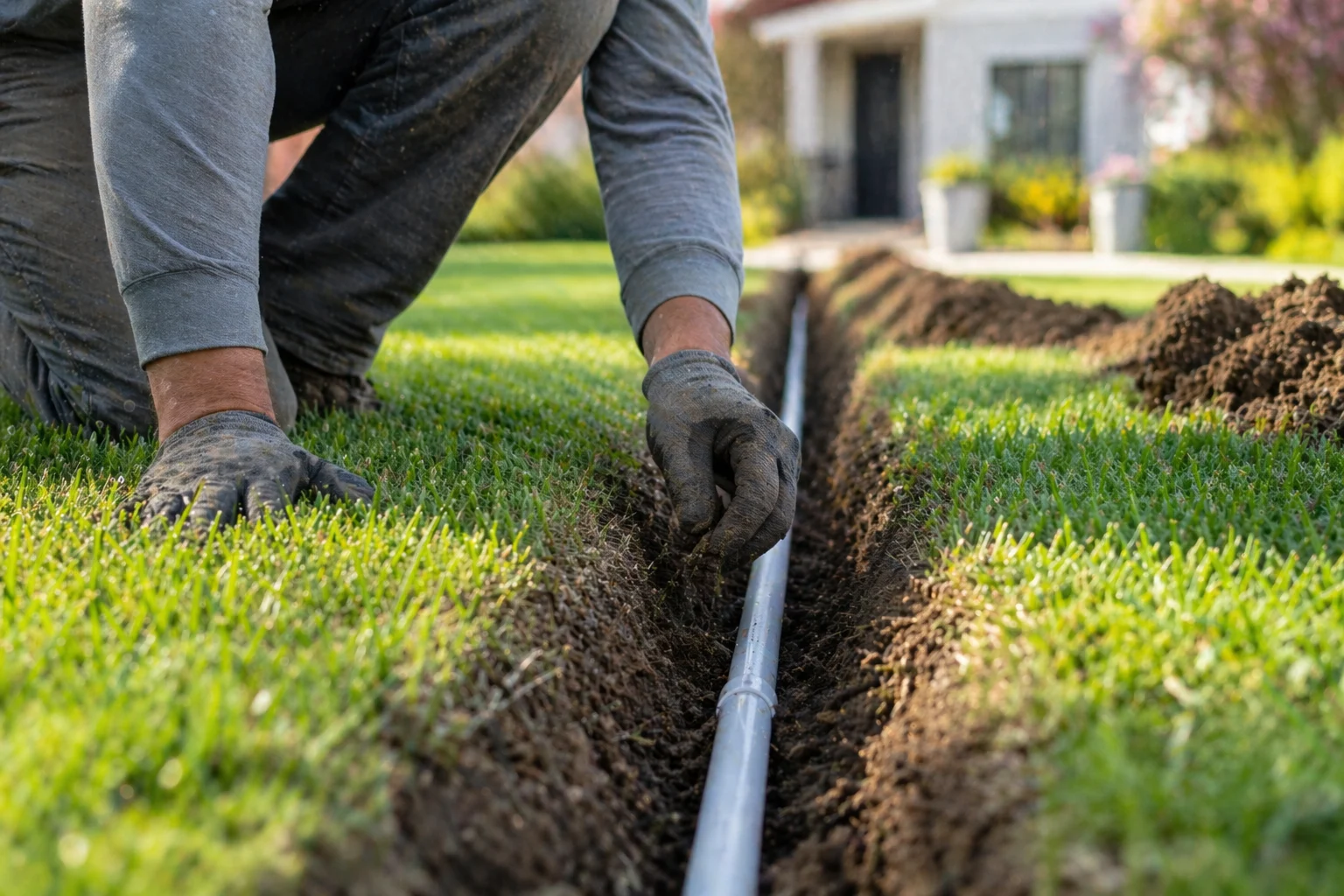
Labor is the single biggest cost driver on any residential sprinkler installation. Regional labor rates and soil conditions move the total by 30% to 50% between markets.
Labor rates track local cost-of-living and licensing requirements. California and Northeast metros carry the highest rates because of licensing, insurance, and prevailing-wage norms. Southeast labor runs 30% to 40% below West Coast rates for identical installations, which is why professional install pricing can differ dramatically for similar project scopes across regions.
Soil conditions affect labor hours more than homeowners expect. Sandy Florida lawn takes 20% less time to trench than Texas caliche or New England glacial till. A quote from a contractor who has not walked your property and probed the soil is unreliable — any significant excavation project must begin with an on-site assessment, not just a lot-size calculation.
| Region | Labor Rate | Labor Hours (1/2 acre) | Labor Subtotal |
|---|---|---|---|
| Northeast metros | $75–$110/hr | 22–28 | $1,650–$3,080 |
| Mid-Atlantic | $65–$95/hr | 20–26 | $1,300–$2,470 |
| Southeast | $55–$80/hr | 18–24 | $990–$1,920 |
| Midwest | $60–$90/hr | 20–26 | $1,200–$2,340 |
| Texas + OK | $55–$80/hr | 22–30 | Rocky soils add hours |
| Mountain West | $65–$95/hr | 20–26 | $1,300–$2,470 |
| Pacific NW | $70–$100/hr | 20–26 | $1,400–$2,600 |
| California | $85–$120/hr | 22–28 | $1,870–$3,360 |
How Contractors Price the Job
Irrigation contractors typically price residential installs one of two ways: per-zone pricing or per-square-footage pricing. Per-zone pricing dominates in the industry — contractors quote $350 to $600 per fully-installed zone, then multiply by the zone count needed to cover the property. This method is transparent and easy to compare between quotes, which is why professional contractors use it.
Per-square-footage pricing runs $0.30 to $0.60 per square foot of irrigated area and is more common with lower-end operators competing on price. The problem with square-footage pricing is that it does not account for irregular property shapes, slope, obstructions (driveways, patios, outbuildings), or pressure/flow constraints — all of which significantly affect zone count and material use. A half-acre flat rectangular lot and a half-acre lot with a swimming pool, deck, and driveway require very different zone configurations.
The third pricing approach, used mostly by hobbyist installers, is 'time and materials' with no upfront fixed price. Avoid this pricing model for residential installs — without a fixed price, the project scope tends to expand during installation with additional charges that were not disclosed upfront. A legitimate contractor provides a fixed-price quote based on a defined scope of work, with change orders requiring written approval before additional work begins.
What's Included in a Professional Install Quote
Any quote missing these elements is not a complete quote. Contractors who resist providing this level of detail upfront are either inexperienced or deliberately vague to preserve the ability to upcharge during installation. Ask every contractor for a complete written proposal including all of the above. The time spent reviewing a thorough quote saves thousands of dollars in post-installation surprises and future repair costs from improperly-spec'd components.
The site plan is the single most important document. A professional irrigation contractor walks the property with a measuring wheel and soil probe before quoting, sketches out head locations with head-to-head spacing that matches the selected head pattern radius, and verifies static water pressure at an existing outdoor faucet. The output is a scale drawing showing exactly how many zones are required, where pipes will run, and where heads will be positioned.
- Site plan showing head locations, zone boundaries, and pipe routing
- Specific head model numbers and counts (Hunter PGP, Rain Bird 5000, etc.)
- Specific controller model (with WiFi capability if included)
- Backflow preventer specification (PVB or RPZ, brand + model)
- Pipe specification (Class 200 main line, Class 160 lateral)
- Wire specification (18-AWG minimum, number of conductors)
- Trenching depth (8–12 inches typical)
- Permit acquisition and fee responsibility (contractor vs homeowner)
- Inspection scheduling and coordination
- Warranty terms in writing (typically 1–2 years parts and labor)
- Total fixed price with itemized breakdown
Questions to Ask Your Contractor Before Signing
Your contractor should answer every one of these questions without hesitation or evasion. If they cannot provide references, or if multiple references report post-installation problems that took weeks to resolve, walk away. The sprinkler system installation industry has significant variation in quality — a well-designed system from a competent installer runs reliably for 15 to 20 years; a poorly-designed system from a marginal installer will have coverage problems in Year 1 and repair costs in Year 3. The upfront diligence matters.
- What is your state irrigation contractor license number? (verify online before signing)
- How long have you been installing residential irrigation in my local area?
- Can you provide three references from installs completed in the past 24 months?
- Who performs the actual installation — your employees or subcontracted crews?
- What is your response time for warranty service calls?
- Do you handle the backflow preventer permit and certification, or do I?
- What happens if we hit rock or tree roots during trenching?
- How will you restore the lawn after trenching?
- Do you provide a written maintenance schedule for the first year?
- What is your payment schedule? (Avoid >50% deposits)
Red Flags in Irrigation Contractor Quotes
Hourly labor rates under $35/hr: Legitimate licensed contractors with insurance and overhead cannot operate at these rates in any US market. Quotes with sub-$35/hr implied labor typically indicate unlicensed operators or contractors who plan to cut corners on code compliance and component quality.
No mention of backflow preventer or permit: Every US municipality requires backflow prevention for residential irrigation tied to potable water service. A quote that does not specify a backflow device brand/model and does not include permit acquisition is either code-non-compliant or intentionally vague. Either problem falls on the homeowner when the utility requires backflow certification.
Generic 'premium parts' language: Real quotes list brand names and model numbers. 'Premium heads' and 'commercial-grade controllers' without specifics typically mean the contractor plans to install the cheapest acceptable option and bill at a premium. Request Hunter, Rain Bird, or Toro brand components by model number — those are the industry standards.
More than 50% deposit requested: Industry standard residential deposits are 25% to 40% upfront, with progress payments at install start and final payment on completion and inspection. Large upfront deposits (60% or more) are a warning sign that the contractor has cash flow problems — in the worst cases, deposits disappear entirely and projects are never completed.
Completion timeline under 24 hours: A proper 8-zone residential install requires 18 to 28 hours of labor across 2 to 3 days. Contractors promising completion in a single day are either understaffing the job (leading to rushed trenching and poor head placement) or overpromising to win the deposit. Legitimate residential installs take 2 to 3 days.
No written warranty document: Every professional installer provides a written warranty covering parts and labor for at least 1 year (2 years is the better industry standard). Verbal warranties are worthless. Request the warranty document before signing the contract; review what is covered, what is excluded, and what the claim process looks like.
How to Compare Multiple Contractor Quotes
Get three quotes minimum. Each should be reviewed on four dimensions: (1) total fixed price, (2) specific components and zone count, (3) warranty terms, and (4) contractor credentials and references. Do not pick the lowest quote by default — the lowest quote often reflects component substitutions or missing scope items that surface as problems later.
Create a side-by-side comparison spreadsheet. Put each contractor's price, zone count, controller brand, head brand, backflow preventer model, pipe class, wire gauge, warranty length, and timeline in columns. This exercise immediately reveals that quotes which looked comparable are actually quite different. A $2,800 quote with 6 zones and mid-grade components may offer less value than a $3,400 quote with 8 zones and premium components.
Zone count is the most important number to match between quotes. A contractor quoting 6 zones when competitors quote 9 zones for the same property is either reducing head density (creating dry spots) or ignoring the pressure constraints of your water service. Ask the low-zone-count contractor specifically how they plan to cover the full property with fewer zones — the answer reveals whether they're cutting corners or using higher-precipitation heads.
Reference checks are not optional. Call at least two references from each contractor. Ask: Was the project completed on time? Did you have any coverage problems in Year 1? How quickly did they respond to warranty service calls? Would you use them again? The answers sort legitimate contractors from marginal ones faster than any other diligence step.
Permit and Inspection Costs
Most US municipalities require a plumbing permit for residential irrigation installation. Permit costs run $50 to $200 in most jurisdictions, with California and Arizona commonly at $200 to $400 including design review. The permit includes a post-installation inspection by a licensed plumbing inspector to verify backflow preventer installation and code compliance before backfill.
Reputable contractors handle the permit process as part of the project scope. The quote should specifically state whether permit acquisition is the contractor's responsibility or the homeowner's, and who pays the permit fees. Most professional contractors include permit acquisition in the project price — budget $100 to $350 in the project total for permit and inspection costs.
Backflow preventer annual testing is an ongoing cost that begins after installation. Most municipalities require a certified tester to verify the backflow device's operation annually and file results with the utility. This costs $50 to $100 per year. Failure to submit annual test results can result in water service shutoff in strict enforcement jurisdictions, so factor this into ongoing operating costs.
Warranty, Insurance, and Licensing
Require a written warranty covering parts and labor for minimum 1 year (2 years is the industry standard for professional residential installations). The warranty should cover head replacement, valve failures, controller malfunctions, and pipe leaks — effectively any component failure that is not caused by homeowner misuse. Exclusions should be explicit: mower damage, vandalism, lightning damage, and freeze damage from failure to winterize are common exclusions.
Verify that your contractor carries general liability insurance (minimum $1 million) and workers' compensation insurance. Legitimate contractors provide certificates of insurance on request. If a worker is injured on your property and the contractor lacks workers' comp, you can become liable for medical costs. The insurance check takes five minutes and is worth the effort.
License verification is state-specific. California (C-27 Landscaping or C-36 Plumbing), Arizona (C-37 Landscaping or C-37L Landscape Lighting), Texas (licensed irrigator), and Florida (licensed plumbing contractor) all require specific licensing for in-ground irrigation installation. Verify the contractor's license number on the state licensing board website — the check is free and confirms current standing, insurance, and any complaint history.
Frequently Asked Questions
How long does professional sprinkler installation take?
A typical residential installation takes 2 to 3 days. Day 1: layout, trenching, pipe installation. Day 2: head installation, valve assembly, wiring. Day 3: testing, programming, cleanup. Larger 1-acre properties can take 3 to 5 days. Weather delays for rain or freeze extend timelines. Your contract should specify a projected timeline with daily milestones.
Can I install my own sprinkler system to save money?
DIY installation saves 40% to 60% on labor but carries real risk of code non-compliance, poor head spacing (dry and wet spots), and pipe sizing errors. DIY kit systems work well on simple 1/4-acre properties with friable soil. Properties larger than 1/3 acre, or with rocky soil, or with unusual shapes typically justify professional installation through better design and warranty coverage.
What's a fair deposit amount for a sprinkler install contract?
Industry standard deposits are 25% to 40% of total project cost at contract signing. An additional 30% is typically due at project start, with final 30% to 40% paid on completion and successful inspection. Deposit requests above 50% are a warning sign — legitimate contractors have cash flow to fund their own materials and labor without relying on homeowner deposits.
How do I verify a contractor's license?
Every US state with irrigation licensing requirements maintains an online license lookup on the state licensing board website. Search for your contractor by company name or license number. Verify (1) the license is current and not suspended, (2) the license class covers irrigation installation, (3) there are no recent disciplinary actions or complaints. The check takes five minutes and reveals license problems quickly.
What should I do if my contractor doesn't show up as scheduled?
Document the scheduled date and time, attempted contact, and contractor response in writing. If the contractor is 72 hours late without communication, send a certified letter demanding performance per the contract timeline. If the contractor remains non-responsive, file a complaint with the state licensing board and consider small claims court for deposit recovery. Paying contractors in escrow through a third-party service (some states support this) reduces deposit risk.
About the Author
Lawn Care Expert & Writer · Denver, Colorado · Florida State University
Jason Allen is a lawn care expert and freelance writer based in Denver, Colorado. He studied turfgrass science and horticulture at Florida State University before founding his own lawn care operation serving the Denver metro area. With over a decade of hands-on experience managing cool-season lawns in Colorado's challenging high-altitude climate, Jason specializes in aeration, fertilization timing, drought management, and water-restriction compliance. His practical, science-backed approach to lawn care has helped thousands of homeowners achieve healthy turf despite Colorado's short growing seasons, clay soils, and frequent drought conditions.