How to Kill Clover in Your Lawn (2026 Guide)
Published:

Clover in a lawn is almost always a fertility problem — clover fixes its own nitrogen from the atmosphere and outcompetes nitrogen-starved lawn grass. Fix the underlying nitrogen deficiency and clover fades on its own within 1–2 seasons. For faster chemical removal, selective herbicides containing dicamba, triclopyr, or clopyralid kill clover while leaving lawn grass unharmed. This guide covers both paths — and also the case for keeping clover in the lawn, which has become increasingly popular as a low-input sustainability choice.
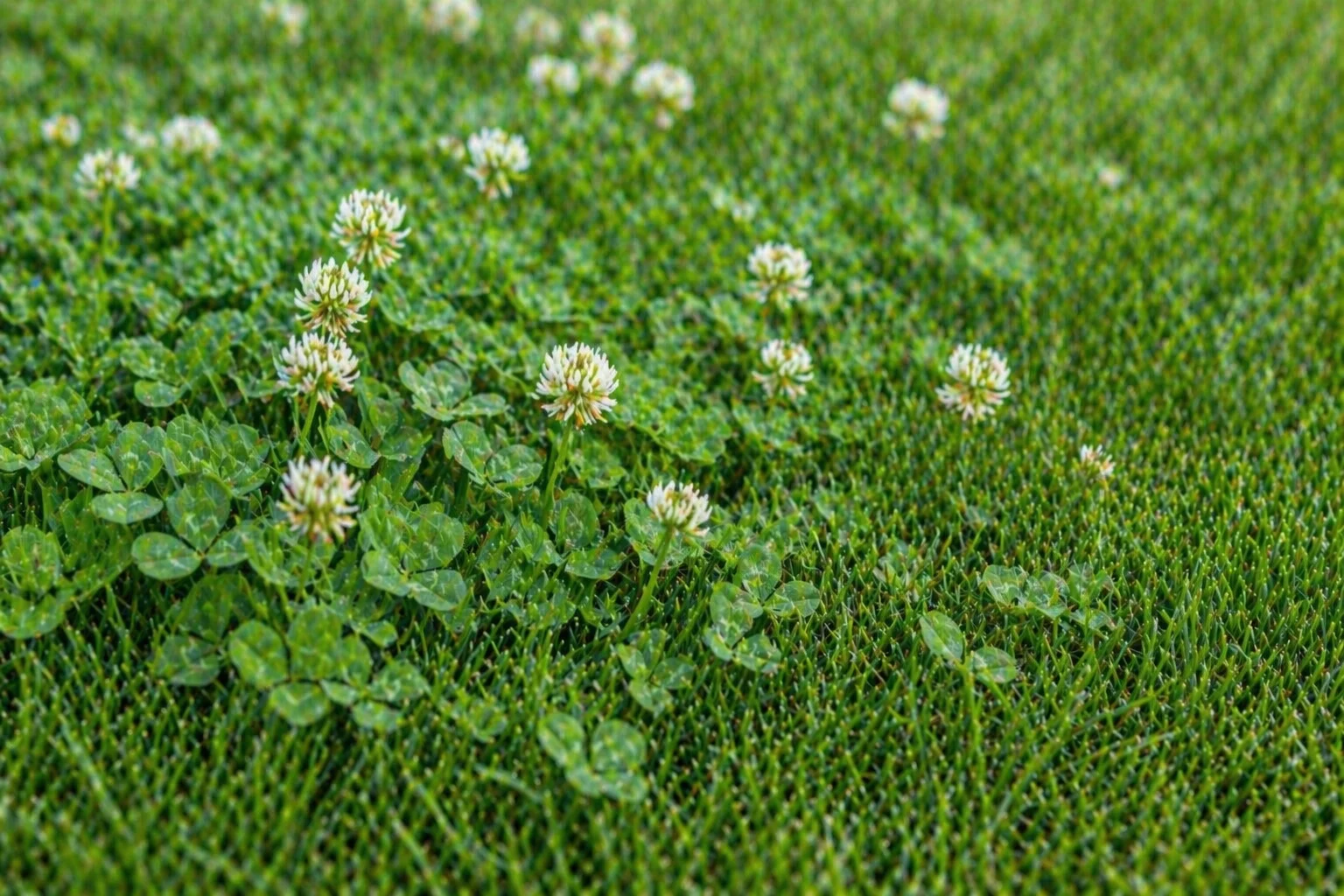
Identify the Clover
Three clover species appear in American lawns. White Clover (Trifolium repens) is by far the most common — low-growing, with the classic three-leaflet leaves, round white flower heads with a hint of pink. Yellow Clover or Black Medic (Medicago lupulina) has smaller yellow flower clusters and tends to grow in drier, compacted areas. Strawberry Clover (Trifolium fragiferum) appears in wet areas with pink flower heads.
All three are perennial, spreading via stolons (above-ground runners) and forming mats in nitrogen-deficient lawns. The three-leaflet leaf pattern is diagnostic — lawn grass has single linear leaves, clover has three oval leaflets per leaf stem.
White clover flowers May through October in most of the US, providing nectar for bees — one of the reasons some homeowners choose to tolerate or encourage clover rather than eliminate it.
The Root Cause: Nitrogen Deficiency
Clover is a legume — it hosts Rhizobium bacteria in root nodules that convert atmospheric nitrogen to plant-available form. In nitrogen-deficient soil, clover essentially makes its own fertiliser while lawn grass starves. The result: clover thrives, grass thins, and the clover patch expands.
The single most effective long-term clover control is adequate lawn fertilisation. Apply nitrogen at 3–4 lb of actual N per 1,000 sq ft per year (cool-season lawns; 4–5 lb for warm-season), split across 3–4 applications. Properly fertilised lawn grass outcompetes clover within 1–2 growing seasons without any herbicide application.
Diagnostic test: pull a plug of lawn that includes both grass and clover. If the grass is pale green with thin leaves while the clover is dark green and vigorous, you have nitrogen deficiency. Fix the fertility and clover fades on its own.
Counterintuitive: clover is often a symptom of low-nitrogen fertilisation programmes that homeowners adopted for environmental reasons. If you're trying to minimise fertiliser use and seeing clover expansion, you've traded one problem for another. Moderate nitrogen application is sustainable if managed correctly.
Chemical Control: Selective Broadleaf Herbicides
Clover is harder to kill chemically than many broadleaf weeds because of its waxy leaf surface. Standard 2,4-D + MCPP combinations provide partial control; dicamba, triclopyr, and clopyralid are more effective.
Best products for clover-specific control: Ortho Weed B Gon Plus Crabgrass Control (contains both broadleaf and grassy weed killers), Trimec Classic (2,4-D + MCPP + dicamba), Gordon's Triplet Lo-V (aggressive dicamba combination), Tenacity (mesotrione — kills clover post-emergent and works on Kentucky Bluegrass, Tall Fescue, Fine Fescue).
Application: timing matters enormously. Clover is most vulnerable to herbicide in early fall (September–October) when it's actively translocating carbohydrates to the roots for winter. Spring application (April–May) works but requires 2–3 treatments to match fall efficacy.
Spray on a calm, dry day with air temperature 60–85°F. Avoid rain within 6–8 hours of application. Add a non-ionic surfactant (Spreader-Sticker) to improve herbicide adhesion to waxy clover leaves. Expect visible browning within 5–10 days and complete kill at 21–28 days.
The Case for Keeping Clover
Clover is increasingly marketed as a legitimate lawn cover rather than a weed to eliminate. Seed retailers now sell 'Microclover' blends (Dutch white clover cultivars with smaller leaves) specifically for overseeding into existing lawns. The pitch: clover fixes atmospheric nitrogen, reducing fertiliser needs; stays green longer than lawn grass in drought; and provides pollinator habitat.
Genuine advantages: no fertiliser required, drought-tolerant once established, bees love it. Disadvantages: flowers attract bees which some homeowners want to avoid around play areas; pure clover isn't as durable as grass under heavy foot traffic; HOAs may object to non-traditional lawn cover.
Hybrid approach: intentionally overseed clover into a standard lawn at 0.5–1 lb per 1,000 sq ft. The resulting 10–20% clover cover provides nitrogen-fixing benefit without overwhelming the grass. This is the modern sustainable-lawn approach gaining traction on the East Coast and Pacific Northwest.
If you're converting an existing clover problem into a feature rather than fighting it, the key move is to stop trying to kill it. Fertilise lightly (half the normal rate), mow at 3.5–4 inches, and accept the mixed look. A clover-tolerant lawn costs less to maintain long-term than a pure grass lawn.
Physical Removal
Physical removal of clover is impractical on most lawns. Clover spreads via low-growing stolons (above-ground runners) and forms interconnected mats — pulling one plant leaves dozens of attached runners behind. Digging the entire mat creates large bare patches that require reseeding.
Where physical removal makes sense: isolated clover patches (under 2 sq ft) in otherwise clean lawn. Grasp the mat at the edge, pull firmly to extract as much stolon as possible, then overseed the bare spot with matched lawn grass.
For large infestations, chemical control combined with fertility correction is far more practical. Physical removal returns you to square one because you haven't addressed the underlying fertility deficiency that favoured clover in the first place.
Long-Term Prevention
- Maintain adequate nitrogen fertilisation — 3–4 lb actual N per 1,000 sq ft per year for cool-season grass, 4–5 lb for warm-season
- Mow at the upper end of your grass type's recommended range to shade out clover seedlings
- Overseed thin lawn areas annually — dense turf crowds out clover before it can establish
- Maintain soil pH in the 6.0–7.0 range; clover tolerates alkaline soils better than many lawn grasses
- Water deeply and infrequently; shallow watering favours shallow-rooted clover over deeper lawn grass roots
- Apply pre-emergent herbicide in spring — some products (Scotts Turf Builder Weed Prevent, Sta-Green Crab-Ex) include broadleaf weed-seed prevention that reduces new clover germination
Clover Control by Grass Type
Kentucky Bluegrass and Tall Fescue: all standard broadleaf herbicides (2,4-D + dicamba combinations, triclopyr) work safely at label rates. Fall application preferred.
Perennial Ryegrass and Fine Fescue: same products; Fine Fescue is slightly more sensitive, so use label rate only and avoid high temperatures.
Bermuda: triclopyr-based products (Turflon Ester, Ortho Weed B Gon Plus Crabgrass Control) are highly effective. Avoid 2,4-D combinations at high rates on newly established Bermuda.
Zoysia: most standard broadleaf herbicides work; Tenacity (mesotrione) is not safe on Zoysia — read the label.
St. Augustine: the most chemical-sensitive common lawn grass. Atrazine (labelled for St. Augustine) provides clover control; avoid 2,4-D + dicamba combinations at high rates. Read labels carefully.
Centipede: Atrazine or Image (imazaquin) are the standard selective choices. Most 2,4-D combinations damage Centipede.
Frequently Asked Questions
Will clover kill my grass?
No — clover doesn't kill grass; it outcompetes grass in nitrogen-deficient soil. Thin, pale lawn with expanding clover patches is almost always a nitrogen deficiency problem, not direct competition. Fertilise correctly and the grass recovers while clover declines.
Is clover good or bad for a lawn?
Depends on your priorities. Traditional lawn aesthetic: clover is a weed to eliminate. Sustainability focus: clover is a feature — no fertiliser needed, drought tolerant, pollinator habitat. Mixed lawns with 10–20% clover are increasingly popular and genuinely lower-input.
How long does it take to kill clover?
Chemical control: 14–28 days for visible kill. Fertility-based control: 1–2 growing seasons as the nitrogen-corrected lawn outcompetes clover gradually. For fastest results, combine both: apply appropriate herbicide plus fix the underlying nitrogen deficiency.
Can I overseed clover into my lawn on purpose?
Yes — Microclover and standard Dutch White Clover are sold as lawn overseed specifically for this purpose. Apply 0.5–1 lb per 1,000 sq ft in spring or fall, rake in lightly, water for 14 days. Fits into standard lawn maintenance without major changes. Expect 10–20% clover cover within 1 year.
Why does clover come back after I kill it?
Three reasons: (1) seed bank in the soil germinating new plants, (2) missed stolons regrowing into new plants, (3) the underlying nitrogen deficiency hasn't been corrected. Any one of these alone produces regrowth; all three together guarantee it. Herbicide plus fertility correction plus pre-emergent for 1–2 seasons eliminates clover reliably.
About the Author
Lawn Care Expert & Writer · Denver, Colorado · Florida State University
Jason Allen is a lawn care expert and freelance writer based in Denver, Colorado. He studied turfgrass science and horticulture at Florida State University before founding his own lawn care operation serving the Denver metro area. With over a decade of hands-on experience managing cool-season lawns in Colorado's challenging high-altitude climate, Jason specializes in aeration, fertilization timing, drought management, and water-restriction compliance. His practical, science-backed approach to lawn care has helped thousands of homeowners achieve healthy turf despite Colorado's short growing seasons, clay soils, and frequent drought conditions.