How to Kill Crabgrass (2026 Complete Guide)
Published:

Crabgrass is the most frustrating weed in American lawn care because the treatment window is narrow and unforgiving. Once a crabgrass plant has more than 3–4 tillers (branching stems from the central crown), no herbicide kills it reliably — your only options are hand-pulling or waiting for frost. Pre-emergent herbicide applied at the right soil temperature prevents crabgrass before it germinates and is by far the most cost-effective control. This guide walks through the full decision tree: prevention, seedling control, mature plant options, and the long-term cultural fixes that eliminate crabgrass from a lawn permanently.
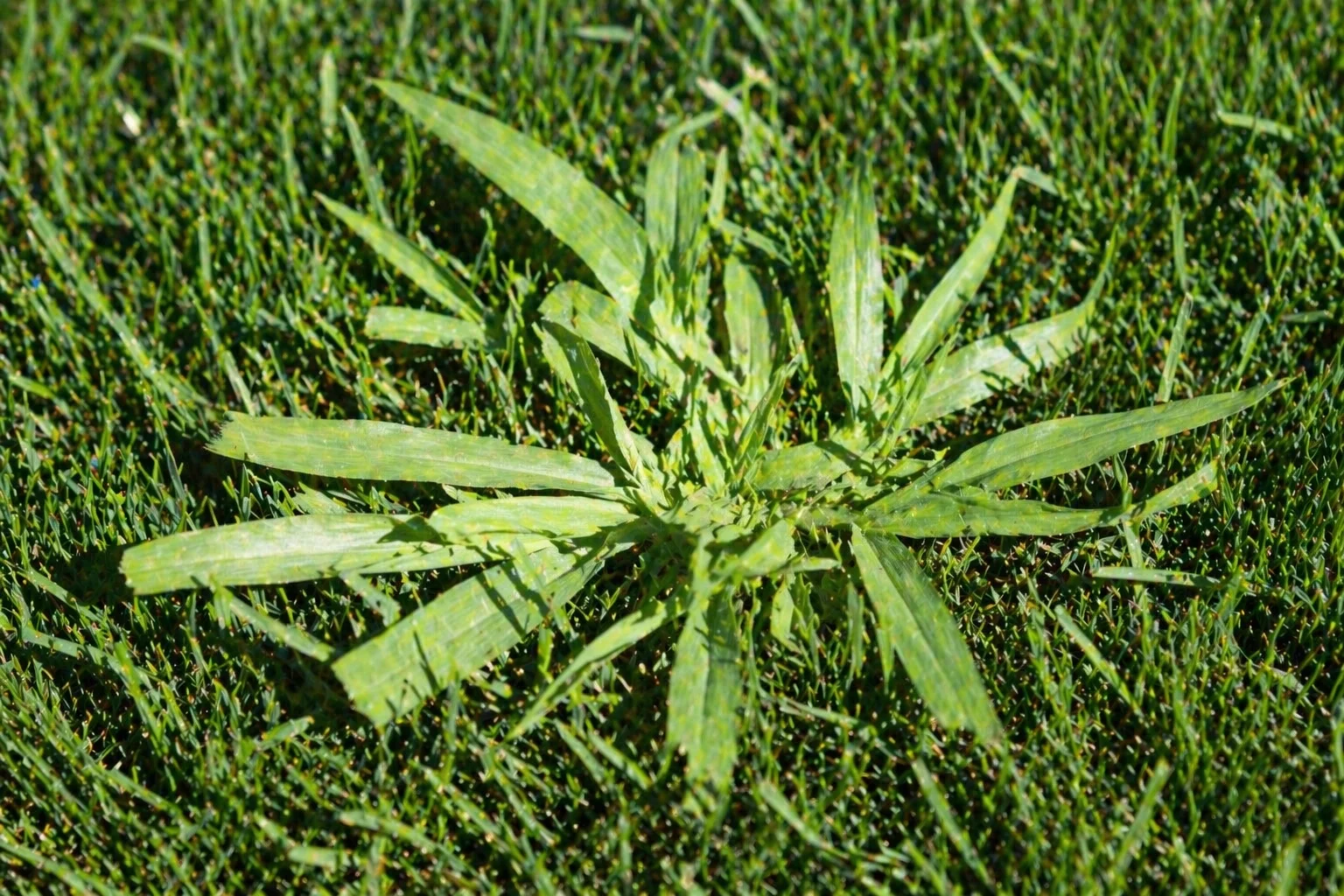
Decision Tree: What Stage Is Your Crabgrass?
Can you see crabgrass in your lawn yet this year? NO: apply pre-emergent herbicide (spring or late summer). YES: count the tillers — the branching stems from the central crown. 1–3 tillers: Dithiopyr (Dimension) or quinclorac (Drive XLR8) will still work. 4+ tillers: quinclorac plus fenoxaprop may work with multiple applications; hand-pulling is more reliable. Mature flowering plant: hand-pull and wait for frost.
The reason post-emergent control fails on mature crabgrass is simple plant biology. Crabgrass forms an increasingly robust central crown as it tillers, and the crown continues producing new shoots faster than herbicide can translocate. By the time the plant shows 5+ tillers and has started flowering, it's producing 50+ seeds per day that will germinate next spring.
How to Identify Crabgrass
Common misidentifications: tall fescue clumps are sometimes mistaken for crabgrass but fescue has narrow blades and grows vertically rather than in a flat spreading pattern. Dallisgrass looks similar but has a thicker central stem and larger seed heads. Goosegrass is related and requires similar treatment but has a distinctively flat, ground-hugging growth pattern with a white crown.
- Wide, flat blades — noticeably wider than the surrounding lawn grass
- Light green colour, lighter than Kentucky Bluegrass, Tall Fescue, or Ryegrass
- Grows in a star or crab pattern from a central crown, with stems fanning outward
- Found in bare or thin areas — sidewalks edges, heavily trafficked paths, sunny spots where lawn grass is weak
- Most visible July through September as summer heat stresses lawn grass but crabgrass thrives
- Seed heads appear mid-summer — 4–6 branched 'fingers' at the stem tips resembling chicken feet
Prevention: Pre-Emergent Herbicide (Before It Grows)
Pre-emergent herbicide is the single most effective crabgrass control available. Applied when soil temperature at a 4-inch depth reaches 50–53°F — a few degrees ahead of the 55°F crabgrass germination threshold — it forms a chemical barrier in the top ½ inch of soil that prevents seeds from establishing.
Best products: Prodiamine (Barricade) provides the longest residual (10–12 weeks) at competitive cost. Dithiopyr (Dimension) offers both pre-emergent prevention and early post-emergent control on 1–3 leaf crabgrass — useful if you apply a bit late. Pendimethalin (Pendulum, Halts) is economy choice with 8–10 weeks of residual.
Timing: apply at soil temperature 50–53°F. In the Deep South that's January; in Texas late February; in the Midwest mid-March; in the Upper Midwest mid-April. Use a soil thermometer ($10 at any hardware store) or check your state extension service's soil-temperature map online.
The Forsythia bloom rule works as a visual indicator in most of the Northeast and Midwest: apply pre-emergent when the forsythia in your neighbourhood is in full yellow bloom. The timing aligns with 55°F soil temperature in most temperate zones.
Corn Gluten Meal is the organic option — provides 70–80% crabgrass control (vs 90–95% for synthetic pre-emergents) plus modest nitrogen fertilisation. Good fit for homeowners committed to organic programmes; less reliable for heavy crabgrass pressure.
Post-Emergent Control on Seedling Crabgrass (1–3 Leaf Stage)
The window for post-emergent control is short — roughly 3–4 weeks from germination through the 3-leaf stage. After that, mature crabgrass becomes progressively harder to kill.
Products that work on young crabgrass: quinclorac (Drive XLR8, Quinclorac 75 DF) is the most effective single-product option. Dithiopyr (Dimension) has post-emergent activity on 1–3 leaf crabgrass in addition to its pre-emergent role. Fenoxaprop (Acclaim Extra) kills grassy weeds in cool-season turf but is expensive and requires careful timing.
Application: spray on a calm, dry, warm day (60°F+ ambient). Use a tank sprayer rather than a hose-end sprayer for accurate dilution. Avoid application within 2 hours of expected rain. A non-ionic surfactant (Spreader-Sticker) improves uptake — don't skip it.
Timing: treat when crabgrass is actively growing but still young. Early-morning or late-afternoon application avoids midday heat stress on the treated lawn. Most products require 14–21 days to complete kill; don't retreat before that.
Mature Crabgrass: Hand-Pulling and Patience
Crabgrass with 4 or more tillers is essentially impossible to kill reliably with herbicide. Multiple applications of quinclorac plus fenoxaprop may work but damage the surrounding lawn grass and cost more than hand-pulling.
Hand-pulling technique: water the area to soften soil, grasp the central crown near the soil line, and pull with a steady upward motion. A weed-pulling tool (Fiskars Uproot, Grampa's Weeder) makes the job easier on large plants. Pull early morning or after rain — dry crabgrass is firmly anchored and roots break off.
After pulling, overseed the bare spot with matching grass type. Crabgrass thrives in thin lawns, and the best long-term control is a thick, dense, well-maintained lawn that shades out new crabgrass seedlings before they can establish.
First frost is the ultimate control for mature crabgrass — the plant is an annual that dies completely with the first hard freeze. The challenge is preventing the seeds from germinating next spring, which brings you back to pre-emergent as the core strategy.
Long-Term Crabgrass Elimination: Cultural Fixes
Crabgrass invades thin, stressed, or short-mowed lawns. The best long-term control strategy is a dense lawn that simply outcompetes new crabgrass seedlings for light, water, and nutrients.
Raise mowing height to the top of your grass type's recommended range: 3.5–4 inches for Kentucky Bluegrass and Tall Fescue, 2–2.5 inches for Bermuda, 1.5–2.5 for Zoysia. Taller grass shades the soil surface, keeping soil temperatures below the 55°F crabgrass germination threshold for weeks longer than short-mowed lawn.
Overseed annually in fall with a matched-species blend. Dense turf from overseeding crowds out crabgrass before it can establish. The combination of tall mowing height + annual overseeding + pre-emergent herbicide reduces crabgrass pressure by 90%+ over 2–3 seasons.
Water deeply and infrequently. Shallow, frequent watering favours shallow-rooted crabgrass over deeper-rooted cool-season grass. Apply 1–1.5 inches of water per week in 1–2 sessions rather than short daily watering.
Test soil pH. Crabgrass tolerates a wider pH range than most lawn grasses (5.5–8.0) while desirable lawn grass prefers 6.0–7.0. Lime acidic soil into the 6.0–7.0 range to tip the advantage back to your desired grass.
Crabgrass Control by Grass Type
| Grass Type | Pre-Emergent Choice | Post-Emergent Safe |
|---|---|---|
| Kentucky Bluegrass | Prodiamine, Dithiopyr, Pendimethalin | Quinclorac, Fenoxaprop |
| Tall Fescue | Prodiamine, Dithiopyr | Quinclorac, Fenoxaprop |
| Perennial Ryegrass | Dithiopyr (preferred), Prodiamine | Quinclorac, Fenoxaprop |
| Fine Fescue | Pendimethalin (gentler) | Quinclorac (use caution) |
| Bermuda | Prodiamine, Pendimethalin | Quinclorac, MSMA (where labelled) |
| Zoysia | Dithiopyr (preferred) | Quinclorac, Fenoxaprop |
| St. Augustine | Dithiopyr, Pendimethalin (label rate only) | Quinclorac only at low rate |
| Centipede | Pendimethalin (gentle) | Quinclorac at low rate |
Split Application: Double Your Control
A single pre-emergent application at label rate provides 10–12 weeks of crabgrass protection. A split application — half the label rate at 50°F soil, the remaining half 6–8 weeks later — provides 16–20 weeks of combined protection and catches late-germinating crabgrass biotypes.
Split application is particularly valuable in regions with extended germination windows (April through July in the Mid-Atlantic) or lawns with heavy historic crabgrass pressure. The additional labour is minimal (one extra application), and the total chemical cost is the same.
Do not exceed total annual label rate — most products cap cumulative annual application at 2x the single-application rate. Split applications must add up to the label rate, not exceed it.
Frequently Asked Questions
Can I kill crabgrass without killing my lawn?
Yes with the right herbicide. Quinclorac kills crabgrass and most broadleaf weeds while being safe on Kentucky Bluegrass, Tall Fescue, Perennial Ryegrass, Bermuda, and Zoysia (check label). Dithiopyr is safe on most lawn grasses and has both pre-emergent and early post-emergent activity. Avoid glyphosate (Roundup) on active lawn — it kills everything.
Is it too late for pre-emergent if I already see crabgrass?
Yes — pre-emergent doesn't kill established plants, only prevents new germination. Switch to a post-emergent product (quinclorac, Dithiopyr, fenoxaprop) targeted at young seedlings, and plan for pre-emergent at the correct timing next spring.
How many applications of herbicide does it take?
Pre-emergent: one application at label rate, or split into two half-rate applications 6–8 weeks apart. Post-emergent on seedling crabgrass: usually 1 application with 14–21 day response. Mature crabgrass: 2–3 applications spaced 14 days apart, with reduced effectiveness at each subsequent treatment.
Does corn gluten meal really kill crabgrass?
Corn gluten meal provides 70–80% pre-emergent control of crabgrass — less than synthetic products (90–95%) but significantly better than nothing. Apply at 20 lb per 1,000 sq ft at the same timing as synthetic pre-emergents (50–53°F soil). Also adds ~1 lb of actual nitrogen per 1,000 sq ft. Good fit for organic programmes.
Will crabgrass come back next year?
If you don't apply pre-emergent next spring, yes. Each mature crabgrass plant produces 150–200 seeds before frost, and seeds remain viable in soil for 3+ years. One year of missed pre-emergent typically means 2–3 years of elevated crabgrass pressure. Consistent annual pre-emergent is the only long-term fix.
About the Author
Lawn Care Expert & Writer · Denver, Colorado · Florida State University
Jason Allen is a lawn care expert and freelance writer based in Denver, Colorado. He studied turfgrass science and horticulture at Florida State University before founding his own lawn care operation serving the Denver metro area. With over a decade of hands-on experience managing cool-season lawns in Colorado's challenging high-altitude climate, Jason specializes in aeration, fertilization timing, drought management, and water-restriction compliance. His practical, science-backed approach to lawn care has helped thousands of homeowners achieve healthy turf despite Colorado's short growing seasons, clay soils, and frequent drought conditions.