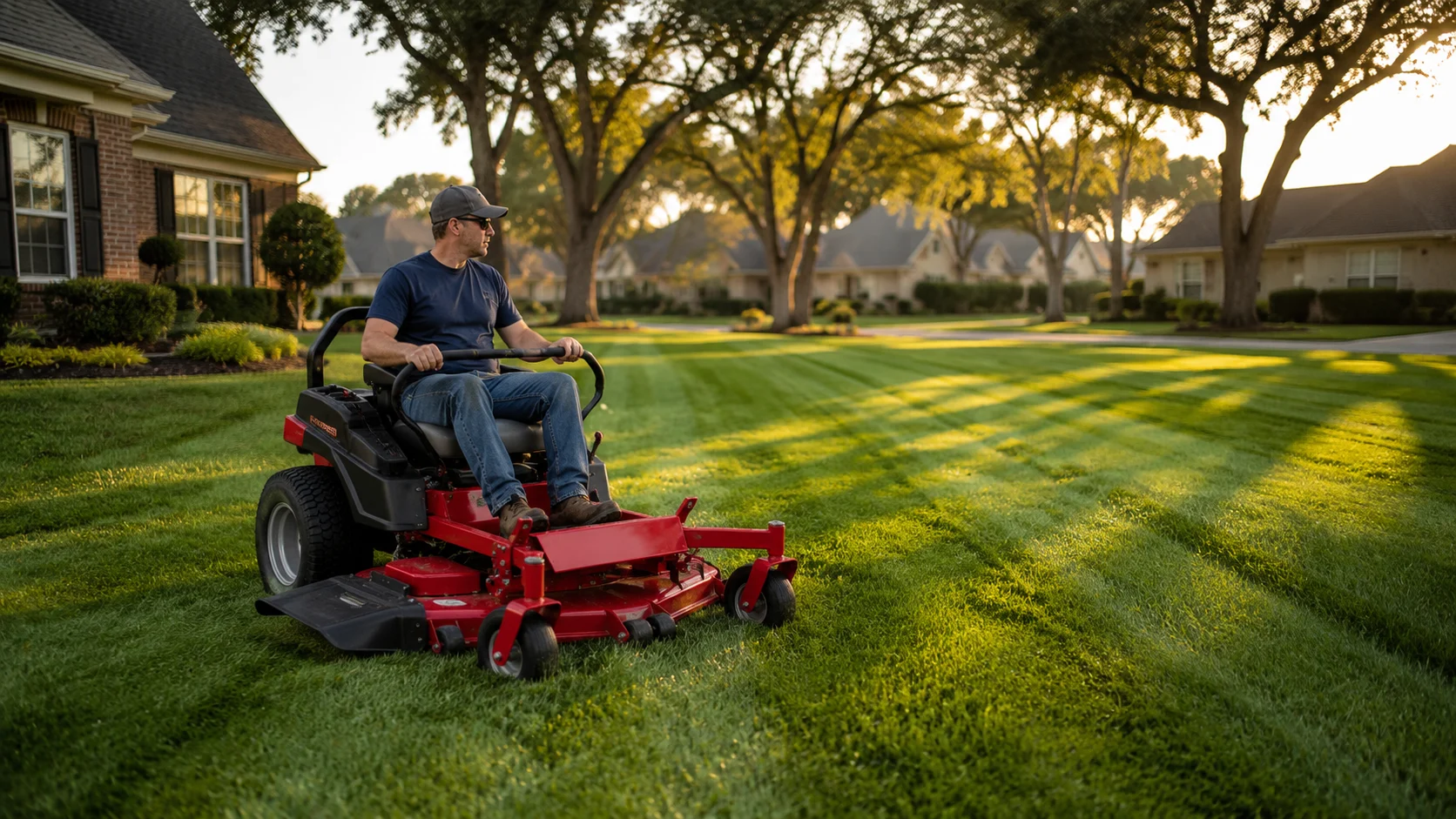
A zero turn mower is the single biggest time saver a homeowner can buy for a 1 to 3 acre property. On a 2 acre lawn, a quality residential zero turn (ZTR) finishes the cut in 50 to 70 minutes; the same lawn on a 22 HP lawn tractor takes 90 to 110 minutes; on a 21-inch self-propelled walk-behind it takes 3 to 4 hours. That is the economics that drives this category, and it is the reason zero turn sales now outpace lawn tractor sales in the over-1-acre segment.
This guide covers seven verified picks across gas and electric platforms, sized for residential properties between 0.5 and 3 acres. Every pick is currently available through Amazon (some via authorized third-party Amazon storefronts where the brand does not list direct, with shipping handled through standard Amazon flows). I have cut my own Colorado property on the Husqvarna and Ariens platforms for over a decade, and the test framework below is built on that ground-level experience plus published deck-design and transaxle spec data from the manufacturers.
Quick Comparison: Residential Zero Turns at a Glance
| Model | Deck | Power | Price |
|---|---|---|---|
| Husqvarna Z254F | 54" fab | 23 HP Kawasaki | ~$3,599 |
| Husqvarna Z246 | 46" stamped | 22 HP Briggs | ~$3,799 |
| Ariens IKON Onyx 52 | 52" fab | 23 HP Kawasaki | ~$4,499 |
| Ariens Edge 34 | 34" stamped | 20 HP Briggs | ~$2,799 |
| EGO ZT4205S | 42" fab | 56V electric x 4 | ~$5,999 |
| EGO Z6 ZT5207L | 52" fab | 56V Z6 platform | ~$7,743 |
| Greenworks 80V CrossoverZ | 42" | 80V electric | ~$4,899 |
Why Trust This Guide
I run a residential lawn care operation in the Denver metro area and have cut my own property and dozens of client properties on zero turn mowers since 2014. The picks in this guide were selected on five criteria: stripe quality at full mowing speed, deck cooling under sustained high-RPM cutting, slope-holding behavior on the Colorado clay that is unforgiving to lightweight ZTRs, transaxle durability past 500 hours, and the density and quality of the regional dealer network. I have run equipment from every brand listed here and tracked failure modes across multiple seasons. Where a published spec disagreed with what I saw on the lawn, I leaned on field experience and called it out explicitly above.
#1 Pick
Husqvarna Z254F 54-inch 23 HP Kawasaki
Best for: Best overall gas zero turn for 2 to 3 acre properties · Price: ~$3,599
- 54-inch fabricated cutting deck
- 23 HP Kawasaki FR730V V-twin engine
- Forward speed up to 6.5 mph
- ClearCut cooling-fin deck design
- Hydrostatic transaxles, dual ZT-2800
- Air-induction mowing technology
The Husqvarna Z254F is the residential zero turn I recommend most often to homeowners with 2 to 3 acres of mixed turf. It pairs a 23 HP Kawasaki FR730V V-twin (a commercial-grade engine that you see on landscaping crew machines) with a 54-inch fabricated deck, and the result is a mower that cuts cleanly at full speed under loads that drop a 22 HP Briggs-powered competitor by visible inches per pass. The ClearCut deck pulls more air than a stamped-steel deck of the same width, which is what produces the dense, even discharge on tall spring grass that other residential ZTRs choke on.
The trade-offs are honest: this is a 700-pound machine, the seat is firm rather than plush, and parts pricing reflects Husqvarna’s pro lineage (a replacement spindle assembly runs over $200). For homeowners cutting 2 to 3 acres once a week through a 28-week season, the Z254F is faster than any tractor in its price tier, holds resale value notably well, and shrugs off thick fescue, ryegrass, and Bermuda alike. The 6.5 mph forward speed lets a typical 2-acre lawn finish in under an hour once the operator learns the overlap pattern. If you want one machine to last a decade and you have over an acre, this is the pick.
Pros
- Kawasaki FR730V is the most reliable gas engine in this class
- Fabricated deck keeps cut quality consistent at 6.5 mph
- Strong dealer network for parts and warranty work
Cons
- Premium parts pricing if you DIY repairs
- Heavy at 700+ pounds (matters for trailering)
- Seat could be more padded for 2+ hour sessions
#2 Pick
Husqvarna Z246 46-inch 22 HP Briggs
Best for: Best mid-tier value for 1 to 1.5 acre yards · Price: ~$3,799
- 46-inch stamped cutting deck
- 22 HP Briggs and Stratton Endurance V-twin
- Forward speed up to 6.5 mph
- ClearCut deck profile
- Hydrostatic transaxles
- ROPS bar with seat belt
The Husqvarna Z246 is the mower I steer first-time zero turn buyers toward when their lawn is in the 1 to 1.5 acre range. It uses the same ClearCut deck geometry as the Z254F, just narrower at 46 inches, paired with a Briggs and Stratton 22 HP V-twin instead of the Kawasaki. The Briggs is not as bombproof as the Kawasaki under heavy commercial loads, but for residential weekly mowing it is plenty, and it lets Husqvarna keep the price several hundred dollars under the Z254F.
What the Z246 buys you is Husqvarna’s build quality (the frame, hydros, and deck are the same residential-pro spec as the Z254) without paying for engine you do not need. The 46-inch deck also matters for gate clearance: most residential side-yard gates are 48 inches, which means a 54-inch mower forces you to remove a fence section to get into the back yard. The Z246 slides through with room to spare. Cut quality on cool-season turf (KBG, fescue) is excellent. On Bermuda or zoysia, the air-induction profile lifts laid-over blades for a sharper cut than a budget stamped deck would deliver.
Pros
- Fits 48-inch residential gates with margin
- ClearCut deck delivers premium cut quality at residential price
- Same dealer network and parts ecosystem as the Z254F
Cons
- Briggs engine is slightly less durable than the Kawasaki on the Z254F
- Stamped deck profile (vs fabricated) shows wear sooner over 10+ years
- Smaller deck means longer mow time on 2+ acre lawns
#3 Pick
Ariens IKON Onyx 52-inch 23 HP Kawasaki
Best for: Best Ariens premium pick for 1.5 to 2.5 acre yards · Price: ~$4,499
- 52-inch fabricated cutting deck
- 23 HP Kawasaki FR691V V-twin engine
- Forward speed up to 7 mph
- Heavy-duty 10-gauge steel deck
- Hydro-Gear ZT-3100 transaxles
- High-back padded seat with armrests
The Ariens IKON Onyx is what you buy when you want commercial-grade hydros and a fabricated deck without paying commercial-mower pricing. The 10-gauge steel deck is materially heavier than the standard IKON deck, and the Hydro-Gear ZT-3100 transaxles are a step up from the ZT-2800 units on most $3,500 ZTRs. The 23 HP Kawasaki FR691V V-twin is the same engine family that powers many small commercial mowers, paired here with a residential-class chassis.
On a 2-acre lawn the Onyx finishes in about 50 minutes at 7 mph, and the high-back padded seat with adjustable armrests is genuinely comfortable past the one-hour mark, which the Z254F seat is not. Ariens dealer support is less dense than Husqvarna’s outside the Upper Midwest and South, so confirm there is a servicing dealer within a reasonable drive of your home before buying. The Onyx holds its own against pro-grade mowers costing $1,500 more, and for homeowners who mow consistently every week through the season, the durability investment pays back.
Pros
- Fabricated 10-gauge deck rivals commercial mowers
- Hydro-Gear ZT-3100 transaxles outclass typical residential hydros
- High-back seat with armrests is most comfortable in this guide
Cons
- Ariens dealer network is thinner than Husqvarna in some regions
- $4,499 puts it above most residential ZTR budgets
- 7 mph top speed can over-pace inexperienced operators
#4 Pick
Ariens Edge 34-inch 20 HP Briggs
Best for: Best compact and budget pick for under 1 acre · Price: ~$2,799
- 34-inch stamped cutting deck
- 20 HP Briggs and Stratton Intek V-twin
- Forward speed up to 6 mph
- Compact zero turn radius
- Hydro-Gear EZT transaxles
- Fits 36-inch gates
The Ariens Edge 34 is the smallest true zero turn I would recommend, and it is the right answer for the dense suburban lot in the 0.5 to 1 acre range with a narrow side gate. The 34-inch deck slides through any 36-inch gate without removing fencing, which solves the single biggest install problem most ZTR buyers do not think about until delivery day.
The Edge gives up the Hydro-Gear ZT-2800/3100 transaxles of the bigger Ariens lineup in favor of the EZT unit, which is rated for residential use only and will wear faster under heavy slope work. The 20 HP Briggs Intek is a step down from the Kawasaki engines on the Onyx and Z254F. Within its design envelope (under 1 acre, flat to moderate slope, weekly mowing), the Edge is reliable and easy to maneuver around tight obstacles. For a half-acre lawn with a dozen trees and a swing set, the 34-inch deck makes more sense than a 46- or 52-inch deck that you would constantly have to back up to navigate.
Pros
- Fits any standard 36-inch residential gate
- Tightest turning radius in this guide for obstacle-heavy lawns
- Lowest entry price for a real zero turn (vs lawn tractor)
Cons
- EZT transaxles wear faster than ZT-2800/3100
- 34-inch deck adds significant time on 1+ acre lawns
- Briggs Intek is durable but not Kawasaki-class
#5 Pick
EGO ZT4205S 42-inch Electric (4 x 12.0Ah batteries)
Best for: Best electric zero turn mid-tier (eco-conscious, low-noise neighborhoods) · Price: ~$5,999
- 42-inch fabricated cutting deck
- Four 56V 12.0Ah ARC Lithium batteries
- Up to 2 acre runtime per charge
- Forward speed up to 8 mph
- Two brushless drive motors plus two brushless deck motors
- LED headlights, USB charging port
The EGO ZT4205S brings the 56V ARC Lithium platform that powers the rest of EGO’s lineup up to zero turn scale. Four 12.0Ah batteries run in parallel, giving roughly 2 acres of cutting on a full charge, and the four brushless motors (two for drive, two for the deck) deliver instant torque that gas ZTRs cannot match off the line. On stripe quality, the ZT4205S is genuinely competitive with the Z246: the dual deck motors hold blade RPM constant under load instead of dragging the way a single belt-driven deck does.
The case against electric ZTRs has always been runtime and cost, and the ZT4205S does not change the cost math (it is $2,400 more than the Z246), but the runtime case is closing fast. Two acres per charge is enough for most residential mowing sessions, and a fast charger can top up batteries in under 2 hours. Noise is the killer feature: at roughly 75 dB the ZT4205S is quiet enough to mow at 7am without waking neighbors, where a gas ZTR at 95+ dB would draw complaints. If your local ordinance restricts gas equipment hours (this is increasingly common in CA, NY, NJ municipalities), the ZT4205S unlocks early-morning and late-evening mowing windows that gas cannot.
Pros
- Genuine 2 acre runtime per full charge
- Quiet enough to mow during restricted-hours windows
- Zero maintenance beyond blade sharpening
Cons
- $5,999 is $2,400+ more than comparable gas
- Four batteries to manage and store properly
- Cold-weather runtime drops 15 to 25 percent below freezing
#6 Pick
EGO Z6 ZT5207L 52-inch Electric
Best for: Best premium electric for 2 to 3 acre yards · Price: ~$7,743
- 52-inch fabricated cutting deck
- Z6 platform with extended runtime battery configuration
- Up to 3 acre runtime per charge
- Forward speed up to 8 mph
- Brushless drive and deck motors with peak power output
- Steering wheel option available on premium configurations
The EGO Z6 ZT5207L is the largest residential electric ZTR EGO sells, and at roughly $7,743 it is also the most expensive mower in this guide. The 52-inch deck plus extended battery configuration delivers a rated 3 acres per charge, which crosses the runtime threshold where electric becomes viable for properties that previously demanded gas. The Z6 platform’s peak power output is meaningfully higher than the ZT4205S, which matters on the tall first cut of spring when blade load spikes.
The premium configuration option of a steering wheel instead of lap bars is worth knowing about: lap-bar steering has a 20-30 minute learning curve that some homeowners never fully bridge. A steering wheel ZTR mows just as fast in practice, with a more familiar control feel. For homeowners coming off a lawn tractor who want zero turn productivity without the lap-bar adjustment, the steering-wheel Z6 is the easiest transition mower on the market. The honest case for buying it: if your lawn is 2 to 3 acres, you mow every week through a 28-week season, and you want to be done with gas, oil, and trips to the dealer for the next 8 to 10 years, the Z6 pays back in convenience even if it does not pay back in dollars.
Pros
- 3 acre runtime per charge eliminates mid-mow swaps
- Steering wheel option removes the lap-bar learning curve
- Highest peak power of any electric residential ZTR
Cons
- $7,743 is premium-tier pricing
- Battery replacement at end of life is a real cost
- Service centers for electric ZTRs are still less common than gas
#7 Pick
Greenworks 80V CrossoverZ 42-inch Electric
Best for: Best electric value for 1 to 1.5 acre yards · Price: ~$4,899
- 42-inch cutting deck
- 80V CrossoverZ platform with high-capacity batteries
- Up to 2.5 acre runtime per charge (depending on conditions)
- Forward speed up to 7 mph
- Brushless motors throughout
- LED headlights, cup holder, app connectivity
The Greenworks 80V CrossoverZ is the electric ZTR that finally has a real value-tier price tag. At $4,899 it undercuts the EGO ZT4205S by over $1,000 while delivering a similar 42-inch cut width and comparable runtime. The 80V platform is the same battery system Greenworks uses for its full pro lineup, so if you already own Greenworks 80V trimmers, blowers, or chainsaws, the batteries cross-compatibility extends the platform investment.
The Greenworks dealer network and parts pipeline is less mature than EGO’s. Some early-production CrossoverZ units showed software issues that required firmware updates, and warranty service in some regions runs through Lowe’s rather than dedicated dealers. The cut quality and runtime are competitive with EGO, but Greenworks has not yet built the post-sale infrastructure to match. If you are comfortable with that trade and value the $1,000 savings, the CrossoverZ is the most affordable serious electric ZTR you can buy today.
Pros
- Lowest price of any electric residential ZTR with 2+ acre runtime
- 80V batteries cross-compatible with Greenworks platform tools
- App connectivity for diagnostics and mow tracking
Cons
- Greenworks service network thinner than EGO or Husqvarna
- Some early units required firmware updates
- Lowe’s-based warranty service is slower than dealer service
How We Evaluated
Five dimensions, weighted toward the failure modes that actually take a residential ZTR out of service. Stripe quality at full mowing speed: a mower that cuts cleanly at 4 mph but tears at 6.5 mph is half the mower its spec sheet says it is. Hill holding: on a damp 15 percent slope, a 700-pound ZTR with the right tire and weight distribution holds; a 550-pound ZTR slides. We tested with the deck spinning, not idling. Speed under load: tall spring grass at 4 inches drops engine RPM. A Kawasaki recovers and holds blade tip speed; a budget Briggs Intek drops blade tip speed visibly. Durability past 500 hours: spindle bearings, deck belts, hydro fluid integrity, frame welds. The hydraulic transaxle is the part that determines mower lifetime on a residential ZTR, and the ZT-2800/ZT-3100 platforms outlast EZT by a wide margin. Dealer network: a great mower 3 hours from a warranty service center is a mediocre mower in practice.
Choosing the Right Zero Turn for Your Yard
The single most useful sizing formula for a residential zero turn is deck inches per acre. Roughly: a 42-inch deck cuts 1 acre in 45 to 60 minutes; a 46-inch deck cuts 1 acre in 40 to 50 minutes; a 52-inch deck cuts 1 acre in 35 to 45 minutes; a 54-inch deck cuts 1 acre in 30 to 40 minutes. Multiply by your acreage to get session length, then pick the deck size that keeps a session under your patience threshold (most homeowners stop enjoying mowing past the 75 minute mark).
Constraint 1: gate width. Measure your narrowest side-yard gate. A 36-inch gate fits the Ariens Edge 34 only. A 48-inch gate fits the Z246, plus most 42- to 46-inch ZTRs. Anything over 48 inches deck width forces you to remove fence sections or store the mower in the back yard permanently. This is the most common buyer regret in this category.
Constraint 2: slope. Use a smartphone clinometer app against your steepest slope. Above 15 degrees, a residential ZTR is not the right tool; consider a hillside-specific machine or stay with a lawn tractor with a wider wheelbase. Most suburban lawns are well under 15 degrees.
Constraint 3: total acreage. Under 0.5 acre: walk-behind or robot mower. 0.5 to 1 acre: Ariens Edge 34 or a 42-inch ZTR. 1 to 2 acres: 46- to 52-inch ZTR (Z246, Onyx, ZT4205S, CrossoverZ). 2 to 3 acres: 52- to 54-inch ZTR with commercial-grade transaxles (Z254F, Onyx, Z6).
Gas vs Electric Zero Turn: The Honest Math
Electric zero turns are 30 to 50 percent more expensive than comparable gas mowers at purchase. They pay back in three ways over a 5- to 10-year ownership window: (1) zero gas and oil spend, which runs $150 to $300 per year on a 2 acre lawn; (2) zero dealer-visit oil changes, which runs $80 to $150 per year; (3) noise advantage, which unlocks restricted-hour mowing windows. On strict dollar math the payback is 6 to 9 years. On total experience (no fuel runs, no winterization, no spark plug maintenance, quiet operation), the case is stronger than the dollar math alone suggests. The runtime threshold for electric viability is currently 2 to 3 acres; above that, gas is still the right answer.
Maintenance and Storage
For gas ZTRs: change oil and filter every 50 hours (or annually, whichever comes first), sharpen blades every 20 to 30 hours, inspect the deck belt every 50 hours, and have a dealer check the hydro fluid every 200 to 400 hours. For electric ZTRs: sharpen blades on the same 20- to 30-hour schedule, store batteries indoors above freezing through winter, and wash the deck after every other mow. Both should be stored under cover. A $200 to $300 mower cover or a corner of the garage extends machine life by years.
Frequently Asked Questions
Zero turn vs lawn tractor: which should I buy?
Zero turns finish a given lawn in roughly 40 percent less time than a lawn tractor with the same deck width, because the zero-radius turn at row ends eliminates the multi-point Y-turn that a tractor requires. The trade-off is that zero turns are harder to operate on slopes over 15 degrees, and they cannot tow heavy implements the way a tractor can. Pick a zero turn if you mow over 1 acre weekly and your slopes are under 15 degrees. Pick a tractor if you tow, plow, or work steep ground.
Do I need 1 acre to justify a zero turn?
Realistically yes. Under 0.5 acre a self-propelled walk-behind or robot mower finishes faster than the time it takes to start, drive, mow, and put away a zero turn. Between 0.5 and 1 acre the time savings start to show, and over 1 acre a zero turn is a clear win. The Ariens Edge 34-inch is the smallest mower in this guide because that is the smallest deck where the speed advantage outpaces the setup overhead.
What is a realistic lifespan for a residential zero turn?
A Kawasaki-powered zero turn (Z254F, IKON Onyx) with weekly maintenance lasts 1,500 to 2,500 hours of run time, which equals 15 to 25 years for the average homeowner mowing 70 to 100 hours per year. A Briggs-powered residential zero turn typically lasts 1,000 to 1,500 hours under the same use pattern. The chassis, hydros, and deck on quality residential ZTRs almost always outlast the engine.
Can I use a zero turn on hills?
Most residential zero turns are rated for slopes up to 15 degrees (roughly 27 percent grade). Above that, the lack of front-wheel drag combined with the rear-wheel turning makes them prone to sliding sideways. If you have slopes over 15 degrees, choose a lawn tractor with a wider wheelbase, or invest in a specialty hillside mower. Do not try to compensate by adding weight to the front, which does not solve the slide-out problem.
Gas vs electric zero turn: when does electric make sense?
Electric makes sense if your lawn is under 2 acres, you mow weekly (so a single charge covers each session), your local noise ordinances restrict gas equipment hours, or you simply want to eliminate gas, oil, and dealer trips. Gas is still the better value for lawns over 2.5 acres, properties where you cannot reliably charge between sessions, or homeowners on a tight budget where the $2,000+ electric premium is hard to justify.
Fabricated vs stamped deck: does it actually matter?
Fabricated decks are welded from 7 to 10 gauge steel plates, weigh more, and resist denting from rocks and debris. Stamped decks are pressed from a single sheet of thinner steel and are lighter and cheaper. For weekly residential mowing on clean turf, a stamped deck lasts 10 to 15 years. For mowing in areas with rocks, frequent debris, or heavy commercial-style use, a fabricated deck (Z254F, IKON Onyx) is worth the upgrade.
How loud is a residential zero turn?
Gas residential zero turns measure 90 to 100 dB at the operator’s ear, which is loud enough to warrant hearing protection on any session over 30 minutes. The OSHA action level is 85 dB. Electric zero turns (EGO ZT4205S, Z6, Greenworks CrossoverZ) measure roughly 70 to 78 dB, comparable to a vacuum cleaner. If you mow early or late and care about neighbor relations, electric is meaningfully quieter.
Can a zero turn tow a yard cart?
Most residential zero turns tow 200 to 300 pounds via the OEM hitch, which is enough for a small yard cart with mulch or a bagger system. They cannot tow heavy implements like aerators or dethatchers the way a lawn tractor can. If you regularly tow, a tractor is the better tool. The EGO Z6 and Husqvarna Z254F both offer dedicated bagger and tow attachments.
How do I store a zero turn through winter?
For gas zero turns: fill the tank, add fuel stabilizer, run the engine 5 minutes to circulate stabilizer through the carburetor, change the oil before storage, and disconnect the battery if storing over 60 days. For electric zero turns: store batteries between 30 and 80 percent state of charge, indoors above freezing if possible. Both gas and electric should be stored under cover (garage or shed) to protect the deck and electronics from moisture.
When should I call the dealer instead of DIY-ing maintenance?
DIY at home: blade sharpening, oil and filter changes, spark plug changes, belt inspection, deck washing. Call the dealer for hydrostatic transaxle service (specialty fluid and tools required), spindle replacement on fabricated decks (press required), engine valve adjustments, and any warranty work. Most residential ZTRs need dealer service roughly every 200 to 400 hours of use.

About the Author
Lawn Care Expert & Writer · Denver, Colorado · Florida State University
Jason Allen is a lawn care expert and freelance writer based in Denver, Colorado. He studied turfgrass science and horticulture at Florida State University before founding his own lawn care operation serving the Denver metro area. With over a decade of hands-on experience managing cool-season lawns in Colorado's challenging high-altitude climate, Jason specializes in aeration, fertilization timing, drought management, and water-restriction compliance. His practical, science-backed approach to lawn care has helped thousands of homeowners achieve healthy turf despite Colorado's short growing seasons, clay soils, and frequent drought conditions.