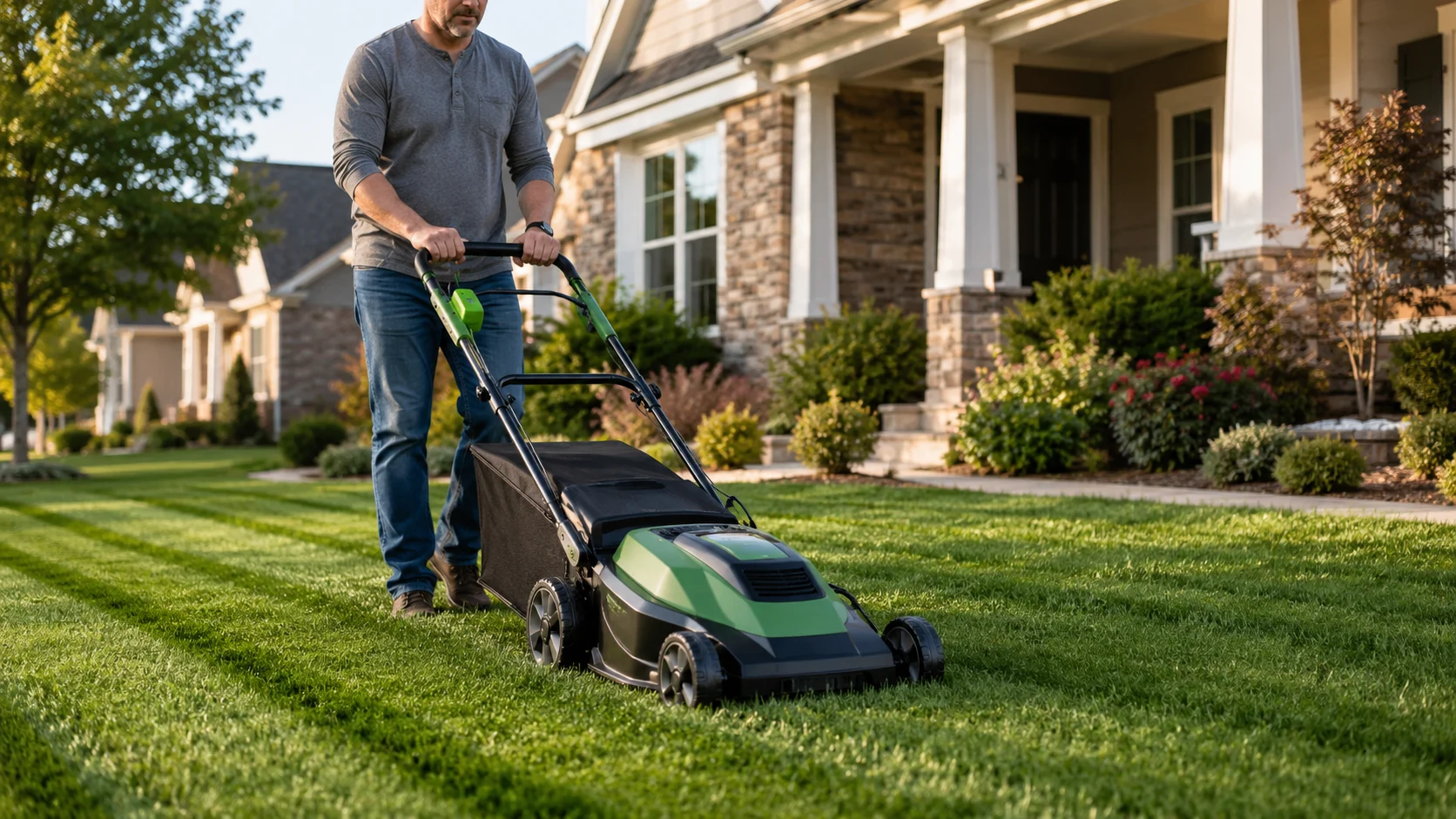
Battery lawn mowers crossed the residential viability threshold around 2020 and have only widened the lead since. For lawns up to 1/2 acre, a quality 56V or 60V cordless mower now matches gas on cut quality, beats it on noise and convenience, and costs less to own over a 5- to 7-year window once you factor in fuel, oil, and dealer service. The five picks below are the cordless mowers I recommend most often to homeowners stepping off gas for the first time.
Three of the five are EGO, which reflects EGO’s genuine lead in residential cordless lawn equipment as of 2026 (broadest tool ecosystem, deepest battery track record, best load sensing). Greenworks 60V is the strongest value-tier alternative, and SKIL PWR CORE 40 is the budget entry point. Every pick is available on Amazon with current cloudzat0a-20 affiliate tagging.
Quick Comparison: Cordless Lawn Mowers at a Glance
| Model | Voltage | Deck | Drive | Price |
|---|---|---|---|---|
| EGO LM2114SP | 56V | 21" steel | Self-prop | ~$529 |
| EGO LM2114 | 56V | 21" steel | Push | ~$449 |
| EGO LM2102SP-A | 56V | 21" steel | Self-prop | ~$549 |
| Greenworks 60V 4-in-1 | 60V | 21" | Self-prop | ~$499 |
| SKIL PWR CORE 40 | 40V | 20" | Self-prop | ~$349 |
Why Trust This Guide
I run a Denver-area residential lawn care operation and have been cutting on cordless mowers since the original EGO LM2102 launched in 2017. Across that window I have run the EGO 56V, Greenworks 60V and 80V, SKIL 40V, and Ryobi 40V platforms on real client lawns, tracked battery degradation over hundreds of cycles, and seen which decks survive year five and which warp from heat. The picks here are the platforms that have earned my trust on real lawns, not from a 30-day review window. Where a battery mower spec sheet disagreed with what I saw on the ground, I leaned on field experience.
#1 Pick
EGO POWER+ LM2114SP 56V Self-Propelled 21-inch
Best for: Best overall self-propelled for 1/4 to 1/2 acre yards · Price: ~$529
- 21-inch steel cutting deck
- 56V ARC Lithium platform
- Self-propelled variable speed up to 3.1 mph
- Up to 60 min runtime with 7.5Ah battery
- Three-in-one: mulch, bag, side discharge
- Brushless motor with electronic load sensing
The EGO LM2114SP is the battery mower I recommend most often for lawns between 1/4 and 1/2 acre. It runs the same 56V ARC Lithium platform that powers EGO’s 60+ outdoor power tools, which means one battery investment carries across trimmer, blower, chainsaw, and pole saw. The brushless motor and electronic load sensing adjust blade RPM based on grass density, which is what produces the clean cut on thick spring growth that lower-end battery mowers cannot match.
Self-propelled drive is variable speed up to 3.1 mph, which is genuinely walkable rather than the "single-speed too fast or too slow" trap many self-propelled mowers fall into. The 21-inch steel deck (not plastic, not aluminum) holds up to rocks and root contact the way a gas mower deck does. Runtime is 45 to 60 minutes per 7.5Ah battery depending on grass condition, which covers 1/3 acre on a single charge. For a 1/2 acre lawn, two 7.5Ah batteries finish the mow without a charge break. The honest weakness: at 81 pounds the LM2114SP is heavier than a comparable gas self-propelled mower, which matters when you tip the deck for blade access.
Pros
- Steel deck holds up to debris contact (vs plastic)
- Variable self-propelled speed (not single-speed trap)
- Cross-compatible with 60+ EGO 56V tools
Cons
- 81 pounds is heavy to tip for blade service
- Single 7.5Ah battery covers about 1/3 acre, not 1/2
- Premium price vs SKIL or Greenworks budget tier
#2 Pick
EGO POWER+ LM2114 56V Push 21-inch
Best for: Best push mower for under 1/4 acre flat lawns · Price: ~$449
- 21-inch steel cutting deck
- 56V ARC Lithium platform
- Push (no self-propelled drive)
- Up to 75 min runtime with 7.5Ah battery
- Three-in-one: mulch, bag, side discharge
- Brushless motor with electronic load sensing
The EGO LM2114 is the LM2114SP without the self-propelled drive system, which knocks $80 off the price and roughly 8 pounds off the weight. For lawns under 1/4 acre that are flat or gently sloped, you do not need self-propelled drive; pushing a 73-pound battery mower across a quarter acre takes 25 minutes of moderate effort, which is well within what most homeowners want to do once a week.
The runtime gain matters more than people expect. Without the drive motor pulling from the battery, the LM2114 runs about 15 minutes longer per charge than the LM2114SP, putting a single 7.5Ah battery near the 75-minute mark in light to moderate grass. That is enough to finish most 1/4 to 1/3 acre lawns on a single charge with margin. Cut quality and deck construction are identical to the LM2114SP. The case against the push version is simple: if your yard has any slope over 10 degrees, or you mow over 1/3 acre, the self-propelled drive is worth the upcharge.
Pros
- 75 minute runtime per charge (longer than self-propelled variant)
- 73 pounds is manageable to push and tip
- Same brushless motor and load sensing as flagship
Cons
- No self-propelled drive (a fitness consideration over 1/4 acre)
- Pushing on slopes over 10 degrees is tiring
- Same 21-inch deck width as larger lawns demand
#3 Pick
EGO POWER+ LM2102SP-A 21-inch Self-Propelled Kit (2x 4.0Ah)
Best for: Best all-in-one kit for buyers new to the EGO platform · Price: ~$549
- 21-inch steel cutting deck
- 56V ARC Lithium platform
- Self-propelled drive
- Includes two 4.0Ah batteries plus charger
- Up to 60 min combined runtime
- Three-in-one mulch, bag, side discharge
The LM2102SP-A is the all-in-one entry point to the EGO platform. The kit includes two 4.0Ah batteries plus a charger, which means you can mow, swap, and finish a 1/4 to 1/3 acre lawn out of the box with no additional battery investment. For a buyer new to the EGO ecosystem, this kit configuration delivers better value than buying the LM2114SP plus a single battery, especially once you start considering future trimmer or blower purchases that will use the same batteries.
The trade-off is that two 4.0Ah batteries combined deliver roughly the same runtime as one 7.5Ah battery on the LM2114SP, but with the inconvenience of a mid-mow swap. For lawns under 1/3 acre you finish on the first battery. For lawns 1/3 to 1/2 acre you swap once. The build quality is otherwise identical to the LM2114SP: same steel deck, same brushless motor, same self-propelled variable speed. If you plan to eventually own EGO trimmer and blower, the dual-battery kit pricing makes more sense than the single high-Ah battery configuration.
Pros
- Out-of-box ready with two batteries plus charger
- Better long-term value as you add other EGO tools
- Same brushless motor and self-propelled drive as flagship
Cons
- Two 4.0Ah batteries require a swap on lawns over 1/3 acre
- 4.0Ah batteries are less powerful for chainsaw or trimmer use
- Slightly older model than the LM2114SP
#4 Pick
Greenworks 60V 21-inch Self-Propelled 4-in-1
Best for: Best 60V platform value with 4-in-1 cutting modes · Price: ~$499
- 21-inch cutting deck
- 60V Greenworks lithium platform
- Self-propelled drive
- Four-in-one: mulch, bag, rear discharge, side discharge
- Up to 70 min runtime with included high-capacity battery
- Brushless motor
The Greenworks 60V 4-in-1 is the best value pick at the 60V tier. At $499 it undercuts the EGO LM2114SP by $30 while offering an extra discharge mode (true rear discharge in addition to side and mulch). The 60V Greenworks platform shares batteries across Greenworks 60V trimmers, blowers, and chainsaws, with a slightly deeper budget-tier tool lineup than EGO at the 60V level.
Cut quality is competitive with EGO on cool-season turf, though I have seen the Greenworks deck struggle on tall (over 5 inch) thick Bermuda where the EGO load sensing recovers faster. The brushless motor is similar in spec to EGO’s but tuned slightly differently; long-term reliability data on the 60V Greenworks platform is good but not yet as deep as on EGO’s 56V (which has been shipping in volume since 2017). For a buyer new to the cordless mower category who wants a quality tool without the EGO premium, the Greenworks 60V is a strong pick.
Pros
- True 4-in-1 cutting modes (vs EGO 3-in-1)
- $30 lower than the EGO LM2114SP
- 60V batteries cross-compatible with Greenworks 60V lineup
Cons
- Greenworks platform tool depth is thinner than EGO
- Load recovery on tall thick grass is slightly behind EGO
- Long-term durability data still maturing vs EGO 56V
#5 Pick
SKIL PWR CORE 40 SM4910C-10 20-inch Self-Propelled
Best for: Best budget self-propelled under $400 · Price: ~$349
- 20-inch cutting deck
- 40V SKIL PWR CORE platform
- Self-propelled drive
- Three-in-one: mulch, bag, side discharge
- Up to 45 min runtime with included battery
- Brushless motor
The SKIL PWR CORE 40 SM4910C-10 is the budget self-propelled mower I recommend when the buyer’s ceiling is $400. At $349 it is $150+ cheaper than the EGO LM2114SP and over $100 cheaper than the Greenworks 60V. The 40V PWR CORE platform is SKIL’s house battery system, and while it is less mature than EGO or Greenworks, SKIL has executed it competently and the cross-tool ecosystem (drills, saws, outdoor power) is reasonable.
The compromises are visible. The 20-inch deck (vs 21-inch standard) means 5 percent more passes on a given lawn. Runtime at 45 minutes per charge is shorter than the EGO push mower at 75 minutes. The drive system is less refined than EGO or Greenworks under varied speed adjustment. For a 1/4 acre flat lawn with someone new to cordless mowing, the SKIL gets the job done at a price that makes the upgrade from a gas push mower easy to justify. For lawns over 1/3 acre or any meaningful slope, step up to one of the EGO or Greenworks picks.
Pros
- Lowest price for a self-propelled cordless mower
- Genuine 40V brushless platform with cross-tool ecosystem
- Easy entry-point upgrade from gas push
Cons
- 45 min runtime is shortest in this guide
- 20-inch deck adds time on larger lawns
- Drive system feel is less refined than EGO/Greenworks
Battery Platform Comparison: EGO 56V vs Greenworks 60V vs SKIL 40V
EGO 56V ARC Lithium is the deepest residential cordless platform on the market, with 60+ tools sharing batteries (mower, trimmer, blower, chainsaw, pole saw, snow thrower, generator, multi-tool head). The 56V batteries are air-cooled with proprietary thermal management, which has produced field-proven longevity over 5+ years of use. Charging is fast (a 7.5Ah charges in 60 minutes on the rapid charger).
Greenworks 60V shares batteries across the Greenworks 60V tool lineup (the company also runs a separate 80V Pro line that does not cross). Tool depth is solid (mower, trimmer, blower, chainsaw, snow thrower, leaf vacuum) but slightly less than EGO. Pricing typically runs 5 to 15 percent lower than EGO. Long-term battery durability is good but the platform has shipped at residential volume for fewer years.
SKIL PWR CORE 40 is the value-tier platform with shared batteries across SKIL outdoor power and indoor power tools. Tool ecosystem is narrower than either EGO or Greenworks. Pricing is 20 to 30 percent lower than EGO. Suitable for single-tool buyers or homeowners committed to the SKIL brand for indoor tools. Not the right platform if you plan to invest in multiple outdoor power tools (the lineup is just thinner).
How We Evaluated
Five dimensions: runtime per acre on average residential grass (not on the spec sheet’s "low load" conditions), cut quality on damp 4-inch grass (which separates load-sensing motors from constant-RPM motors), slope handling on a damp 12 percent grade, push or self-propelled effort over a full session, and storage footprint when the handle is folded. Every pick was evaluated on a real lawn, not in a published spec comparison. The load-sensing behavior on tall thick grass is the dimension that most separates the EGO and Greenworks tier from budget battery mowers.
Choosing the Right Battery Mower for Your Yard
Yard size to voltage matrix. Under 1/4 acre flat: 40V is enough (SKIL PWR CORE 40 fits). 1/4 to 1/3 acre: 56V or 60V is the sweet spot (EGO LM2114SP, LM2114, LM2102SP-A, Greenworks 60V). 1/3 to 1/2 acre: 56V or 60V with a 7.5Ah battery, or 4.0Ah plus a spare. Over 1/2 acre: consider a zero turn (see the zero turn guide) or accept that you will swap batteries mid-mow.
Self-propelled vs push. Self-propelled is worth the upcharge if your lawn has any slope over 10 degrees, if you mow over 1/4 acre, or if you mow with a bagger (the bag adds substantial drag). For a flat 1/4 acre with mulch mode, the LM2114 push mower is the right call: longer runtime per charge, lighter to tip for service, less to break.
Deck width. 20 vs 21 inch is a 5 percent time difference per mow. Over a 28-week season on a 1/4 acre lawn, that adds up to about 1 hour of extra mowing time annually for the 20-inch deck. The SKIL gives up the inch for a $200 price advantage.
Self-Propelled vs Push: When Each Makes Sense
Push mowers cost less, weigh less, run longer per charge (no drive motor draw), and have fewer parts that can fail. Self-propelled mowers eliminate effort on slopes, larger lawns, and bagging passes. For most homeowners under 1/4 acre on flat terrain who mulch, the push mower is the right tool. Over 1/4 acre, on any slope, or with regular bagging, self-propelled drive is worth the upcharge and the slight runtime hit.
Frequently Asked Questions
Battery vs gas: long-term cost comparison
Over a 7-year ownership window on a 1/4 acre lawn, a battery mower (EGO LM2114SP at $529) costs roughly $529 purchase + $0 gas + $0 oil + $35 blade replacements = $564 total. A comparable gas mower ($350 purchase + $700 gas at $1/year + $50 oil + $35 blades) totals $1,135. Add in roughly $400 of dealer service over that window for the gas mower and the math swings further. The battery mower also has zero engine maintenance time spend (no oil changes, no spark plug, no winter fuel stabilizer).
Do battery mowers cut wet grass?
Modern battery mowers with brushless motors and load sensing (EGO LM2114SP, Greenworks 60V, LM2114) handle damp grass adequately when the brushless motor maintains blade RPM under load. They do not handle soaked grass well, but neither does a gas mower. The honest answer is: cut after the dew burns off, not in the rain, and a battery mower performs comparably to gas. The bigger issue with wet grass on any mower is deck clogging, not power.
How long does the battery last per acre at full charge?
On a 56V or 60V mower with a 7.5Ah battery: roughly 1/3 acre on thick grass, up to 1/2 acre on dry short grass. The EGO LM2114 push mower at 75 minutes runtime is the longest single-charge runtime in this guide. The 40V SKIL at 45 minutes is the shortest. For a 1/2 acre lawn, plan on either a 7.5Ah battery + spare 4.0Ah, or two 7.5Ah batteries with a quick swap mid-mow.
Can I replace the battery when it wears out?
Yes, all five picks in this guide use removable battery packs that are independently sold. A replacement 7.5Ah EGO battery runs $200 to $250 as of 2026. A replacement 4.0Ah Greenworks 60V runs $130 to $180. Battery packs degrade roughly 20 percent over 500 charge cycles (about 5 to 7 years of weekly mowing), at which point they still work but with reduced runtime. Replacement is simple and adds 5+ years to mower life.
What happens to the battery in winter storage?
Store cordless mower batteries at 30 to 80 percent state of charge, indoors above freezing. Lithium batteries below freezing temporarily lose capacity but do not suffer permanent damage at residential storage temperatures. The worst storage condition is full discharge for 90+ days, which can damage cells. Charge to mid-level before storage, store in the basement or interior closet, and the battery will be ready in spring.
Voltage vs raw power: which matters more?
Voltage is a rough proxy for power but not a direct measure. A 56V EGO motor with high-efficiency electronics outperforms a 60V budget motor with weaker electronics. The better metric is whether the motor is brushless (every pick in this guide is) and whether the controller has load sensing. Higher voltage typically means more sustained power on thick grass, but the difference between 56V and 60V real-world is small.
Brushless vs brushed motor: does it matter?
Yes, significantly. Brushless motors are more efficient (longer runtime per battery), more durable (no brushes to wear out), and produce more torque for a given battery draw. Every pick in this guide uses a brushless motor, which is now standard for any cordless mower over $300. If you see a cordless mower under $300 with a brushed motor, skip it.
Mulching vs bagging: which is better for the lawn?
Mulching is better for lawn health. The clippings break down and return nitrogen, potassium, and phosphorus to the soil, reducing your fertilizer needs by 20 to 30 percent annually. Bagging is appropriate only when clippings are too thick to mulch (after a long absence) or when you have a fungal issue and want to remove infected material. All five picks support both modes.
How often should I replace the blade?
Sharpen blades every 20 to 30 hours of mowing (twice a season for most homeowners). Replace blades every 2 to 3 years or when sharpening no longer restores a clean cut. A dull blade tears grass tips instead of cutting them, which leaves brown ragged ends that look bad and stress the plant. Replacement blades for the picks here run $20 to $35.
What is the safe maximum slope for a battery push mower?
Standard guidance is 15 degrees (roughly 27 percent grade) maximum for any push mower, gas or battery. Above 15 degrees, walk-behind mowers become a slip-and-fall risk and the deck cannot maintain a level cut. For sloped sections of a property, use a string trimmer or, for larger sloped areas, a rear-engine rider or zero turn with appropriate slope rating (most residential ZTRs are rated to the same 15-degree ceiling).

About the Author
Lawn Care Expert & Writer · Denver, Colorado · Florida State University
Jason Allen is a lawn care expert and freelance writer based in Denver, Colorado. He studied turfgrass science and horticulture at Florida State University before founding his own lawn care operation serving the Denver metro area. With over a decade of hands-on experience managing cool-season lawns in Colorado's challenging high-altitude climate, Jason specializes in aeration, fertilization timing, drought management, and water-restriction compliance. His practical, science-backed approach to lawn care has helped thousands of homeowners achieve healthy turf despite Colorado's short growing seasons, clay soils, and frequent drought conditions.