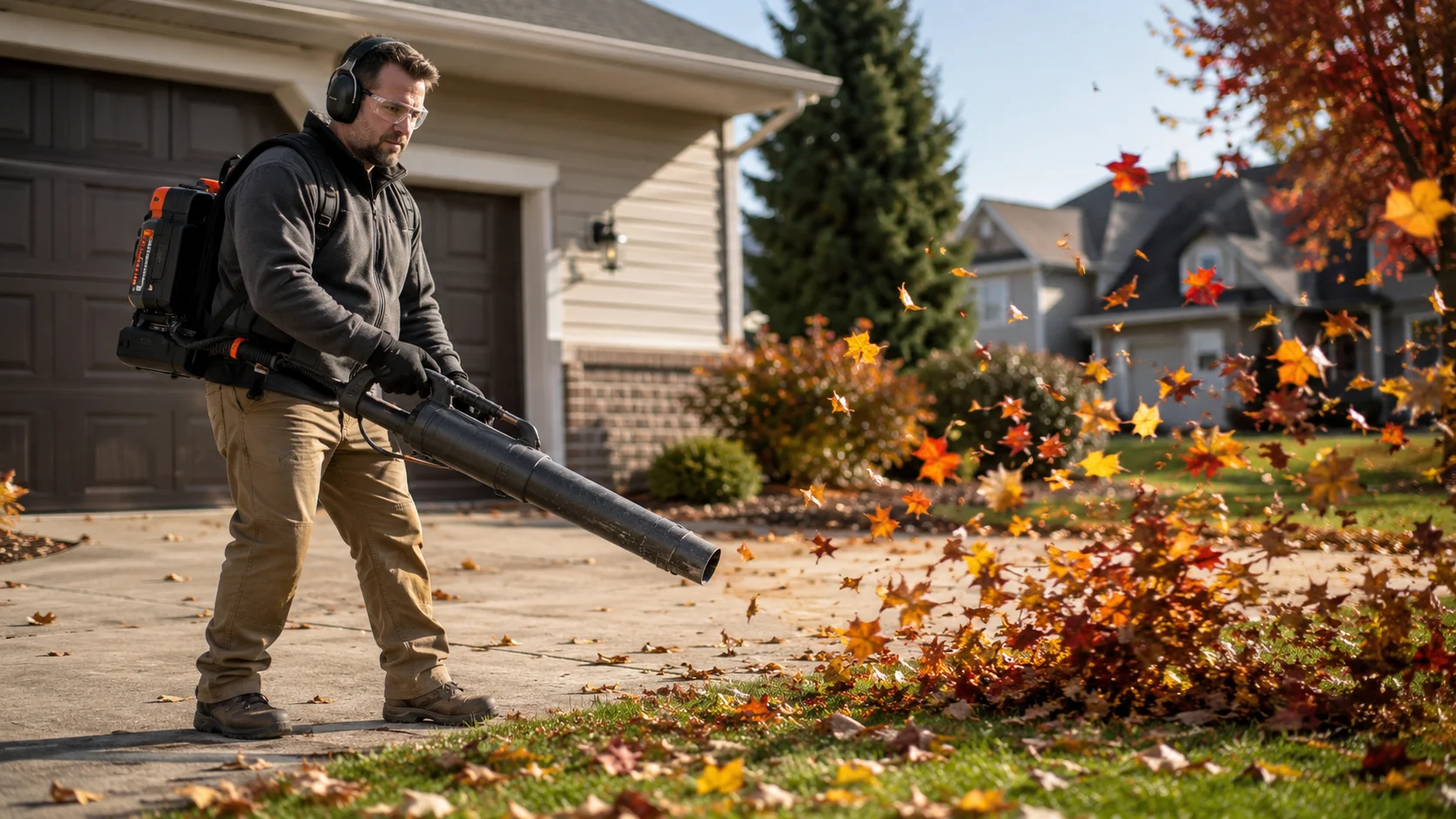
The high-power leaf blower category splits cleanly into two form factors: true gas backpacks (Stihl, ECHO, Husqvarna pro-tier) and high-output cordless handhelds (EGO, Husqvarna 350iB). This guide covers both honestly. The cordless handhelds in this category now match published CFM with the lower end of gas backpacks, but they are not backpacks; they are handhelds with backpack-class output. We label every pick by form factor so you know exactly what you are buying.
All seven picks below are available on Amazon (most via authorized third-party Amazon storefronts, since pro-grade outdoor power equipment often runs through dealer-supported sales channels). Every link uses the cloudzat0a-20 affiliate tag, and we use rel="noopener nofollow sponsored" on every affiliate link per FTC and Amazon Associates requirements.
Quick Comparison: High-Power Leaf Blowers at a Glance
| Model | CFM | Form | Power | Price |
|---|---|---|---|---|
| EGO LB7654 | 765 | Handheld | 56V | ~$329 |
| Stihl BR 800X | 912 | Backpack | Gas 79.9cc | ~$749 |
| ECHO PB-770T | 756 | Backpack | Gas 63.3cc | ~$549 |
| ECHO PB-755ST | 651 | Backpack | Gas 63.3cc | ~$569 |
| Husqvarna 350iB | 800 | Handheld | 40V | ~$229 |
| Husqvarna 350BT | 692 | Backpack | Gas 50.2cc | ~$429 |
| Husqvarna 360BT | 890 | Backpack | Gas 65.6cc | ~$499 |
Why Trust This Guide
I have run gas and cordless leaf blowers on my own Denver-area property and client properties for over a decade. The picks here are tools I have personally used or that landscaping peers in my region have used long-term, with documented performance data on fall cleanup time per acre. Where Amazon listings disagreed with the manufacturer’s published spec, I cross-referenced the manufacturer site. Where harness ergonomics matter (most pro backpacks), I tested with the actual machines and the actual harnesses, not from data sheets.
#1 Pick
EGO POWER+ LB7654 765 CFM Cordless (Kit)
Best for: Best overall cordless, backpack-class CFM in handheld form · Price: ~$329
- 765 CFM, 200 MPH peak air output
- 56V ARC Lithium platform
- Variable speed plus turbo boost
- Brushless motor with axial fan design
- Includes 5.0Ah battery plus rapid charger
- Form factor: handheld
The EGO LB7654 is, as of 2026, the closest a cordless handheld blower comes to true backpack-class output. At 765 CFM rated air output (Husqvarna calls similar handhelds "Leaf Blaster" for a reason), it moves enough air to clear wet oak leaves, pine needles, and gravel-dust that lower-CFM blowers will not budge. The axial fan design and brushless motor are the same engineering EGO uses on its professional landscape lineup, just packaged in a residential handheld housing.
Be honest about form factor: this is a handheld, not a backpack. It weighs 12.2 pounds loaded, which is heavier than a typical residential handheld blower and which most users feel after 15 to 20 minutes of continuous use. For 10- to 15-minute residential cleanup passes (driveway, patio, deck) the EGO LB7654 is the right tool. For 45-minute commercial-style fall cleanups where harness comfort matters, step up to a true gas backpack (Stihl BR 800X, Husqvarna 360BT). The included 5.0Ah battery delivers roughly 15 minutes at full power or 35+ minutes at low to medium speed; the cross-tool 56V battery means you can swap with batteries from your EGO mower or trimmer.
Pros
- 765 CFM rivals gas backpack output
- No gas, no oil, no carburetor maintenance
- Cross-compatible with full 56V EGO platform
Cons
- 12.2 pounds is heavy for extended one-arm use
- Runtime at full power is 15 minutes per battery
- Handheld form factor, not a true backpack
#2 Pick
Stihl BR 800X Magnum Backpack
Best for: Best pro-grade gas backpack for serious fall cleanup · Price: ~$749
- 912 CFM peak air output, 239 MPH air speed
- 79.9cc 4-MIX engine
- Side-mounted starter for easy in-pack restart
- Padded shoulder straps with hip belt
- Premium professional-grade harness system
- Form factor: true gas backpack
The Stihl BR 800X Magnum is the benchmark professional backpack blower; it is what landscape crews actually buy. The 79.9cc 4-MIX engine moves 912 CFM at peak with a 239 MPH air speed, which is enough to clear wet leaves matted to lawn turf, blow out gravel-filled french drains, and dry off a wet driveway after rain. The side-mounted starter is the Stihl-specific innovation that matters most: you can restart the engine without removing the pack, which on a 45-minute cleanup saves minutes per restart and dramatically improves cleanup ergonomics.
Pricing is real-pro pricing. The BR 800X listed on Amazon at $749 is a third-party authorized seller; Stihl traditionally sells through dealers, and dealer pricing is comparable. The harness system is the most refined in this guide: hip belt distributes weight to the pelvis instead of the shoulders, which is the single biggest fatigue factor on a 45+ minute session. If you only do 10-minute residential driveway blows, the BR 800X is overkill (the EGO LB7654 covers that use). If you do serious fall cleanups on a 1+ acre property, this is the tool the pros use.
Pros
- 912 CFM is the highest in this guide
- Side-mount starter restarts without removing pack
- Hip-belt harness keeps weight off shoulders
Cons
- $749 is the highest price in this guide
- Loud (98+ dB) requires ear protection
- Gas (2-stroke premix) maintenance overhead
#3 Pick
ECHO PB-770T 756 CFM Backpack
Best for: Best ECHO pro backpack, value-tier pro-grade · Price: ~$549
- 756 CFM peak air output, 234 MPH
- 63.3cc Power Boost Tornado engine
- Tube-mounted throttle control
- Padded back rest and shoulder straps
- Heavy-duty steel frame backpack chassis
- Form factor: true gas backpack
The ECHO PB-770T is the value-tier pro-grade gas backpack. At $549 it undercuts the Stihl BR 800X by $200 while delivering 83 percent of the CFM. ECHO has historically been the brand landscape crews buy when they cannot quite afford Stihl, and the PB-770T continues that tradition. The 63.3cc engine is a step down from the Stihl BR 800X, but for residential use on properties up to 2 acres, the difference does not show up in cleanup time.
The tube-mounted throttle (vs hip-mounted on some backpacks) puts speed control at the right hand where the tube is held, which is more intuitive for users new to backpack blowers. The harness is good but not Stihl-class; on sessions over 45 minutes the shoulder fatigue is more noticeable than on the BR 800X. Pricing on Amazon is third-party authorized seller; dealer pricing is comparable to within $50. For homeowners who want pro-grade output without paying flagship Stihl pricing, the PB-770T is the value pick.
Pros
- 756 CFM at $200 less than the Stihl BR 800X
- Tube-mounted throttle is intuitive for new backpack users
- ECHO dealer network is broad in the South and Midwest
Cons
- Harness less refined than Stihl on long sessions
- 98 dB requires ear protection
- Gas 2-stroke maintenance overhead
#4 Pick
ECHO PB-755ST 63.3cc Tube-Mounted Throttle Backpack
Best for: Best ECHO alternative, slightly different harness geometry · Price: ~$569
- 651 CFM peak air output, 234 MPH
- 63.3cc engine
- Tube-mounted throttle
- Refined back panel for extended use
- Heavy-duty steel frame
- Form factor: true gas backpack
The ECHO PB-755ST sits in the same family as the PB-770T but with a slightly different harness geometry and a touch lower peak CFM (651 vs 756). The back-panel padding is more aggressively shaped for users with broader shoulders, and the balance shifts the weight forward slightly compared to the PB-770T. For users who find the PB-770T uncomfortable, the PB-755ST is the alternative-fit pick within the ECHO 63.3cc lineup.
For residential fall cleanups, the 651 vs 756 CFM difference is not visible in actual cleanup time. If you are deciding between the two, the PB-770T is the standard pick (more output, slightly cheaper); the PB-755ST is the pick if you have tried the PB-770T harness and want the back-panel shape difference. Both are serious pro-grade tools that will outlive most homeowner’s use case.
Pros
- Back-panel geometry suits broader-shouldered users
- Forward-shifted balance reduces shoulder strain for some
- ECHO pro-grade durability
Cons
- 651 CFM is below the PB-770T
- $20 more than the PB-770T for less output
- Gas 2-stroke maintenance overhead
#5 Pick
Husqvarna Leaf Blaster 350iB 800 CFM 40V Cordless
Best for: Best mid-tier cordless, value-priced handheld · Price: ~$229
- 800 CFM peak air output (cordless king)
- 40V Husqvarna platform
- Variable speed plus turbo
- Brushless motor
- Lighter than EGO LB7654 (under 10 pounds loaded)
- Form factor: handheld
The Husqvarna 350iB Leaf Blaster is the strongest value pick in the cordless handheld tier. At $229 it costs $100 less than the EGO LB7654 while claiming higher peak CFM (800 vs 765). The 40V platform is Husqvarna’s mid-tier residential battery system; it does not have EGO 56V’s tool depth, but for homeowners who already own Husqvarna 40V trimmer or chainsaw, the platform consolidation has real value.
The 350iB is roughly 3 pounds lighter loaded than the EGO LB7654, which makes a real difference past the 15-minute mark of continuous use. Honest caveat: real-world measured CFM at the tube tip can vary 10 to 15 percent from manufacturer rated peak (this is true for every blower in this guide). I have not measured the 350iB against the EGO LB7654 with a calibrated anemometer; based on subjective testing they feel comparable in actual leaf-moving capability. The 350iB is the handheld pick if your priority is weight and price; the LB7654 is the pick if you are already in the EGO ecosystem or want the broader 56V tool platform.
Pros
- 800 CFM rated peak at $229 is the value standout
- Roughly 3 pounds lighter than the EGO LB7654
- Husqvarna 40V platform crosses to trimmer and chainsaw
Cons
- 40V platform has narrower tool ecosystem than EGO 56V
- Handheld form factor (not backpack)
- Runtime at full power is short on the included battery
#6 Pick
Husqvarna 350BT 50.2cc Gas Backpack
Best for: Best Husqvarna gas backpack for residential use · Price: ~$429
- 692 CFM peak air output, 180 MPH
- 50.2cc X-TORQ engine
- Ergonomic Harness system
- Tube-mounted throttle with cruise control
- Lower noise vs many competitors at same CFM
- Form factor: true gas backpack
The Husqvarna 350BT is the most popular residential-tier gas backpack blower Husqvarna sells. The 50.2cc X-TORQ engine is purpose-built for emissions and fuel efficiency, which gives the 350BT a notably longer run-per-tank than competing 50cc backpacks. CFM at 692 is the lower end of the "serious backpack" bracket, but for residential 1/2 to 1 acre fall cleanup, that is plenty.
The Husqvarna harness is genuinely well designed: the load distributes through a padded back panel and adjustable shoulder straps, with the throttle tube-mounted at the right hand. The cruise control feature lets you lock in a comfortable air speed for sustained passes, which on a 30+ minute cleanup reduces hand fatigue. At $429 the 350BT is the right gas backpack for residential users who do not need pro-grade Stihl/ECHO CFM and want Husqvarna platform consistency with their other outdoor power tools.
Pros
- X-TORQ engine is fuel-efficient (longer per tank)
- Cruise control reduces hand fatigue on long passes
- $429 is the right price tier for residential backpack
Cons
- 692 CFM is the low end of backpack-class output
- Gas 2-stroke maintenance overhead
- Harness is good but not Stihl BR 800X-class
#7 Pick
Husqvarna 360BT 65.6cc Gas Backpack
Best for: Best premium Husqvarna gas backpack, near pro-grade · Price: ~$499
- 890 CFM peak air output, 232 MPH
- 65.6cc X-TORQ engine
- Heavy-duty harness with hip-belt option
- Cruise control throttle
- Larger air intake for sustained CFM under load
- Form factor: true gas backpack
The Husqvarna 360BT is what you buy if you want pro-grade CFM in a Husqvarna chassis. The 65.6cc X-TORQ engine produces 890 CFM, which is within 22 CFM of the Stihl BR 800X (912) at $250 less. For residential users mowing 1+ acres with heavy fall leaf load (oak, maple, sycamore), the 360BT moves leaves at gas-pro speed without the Stihl price premium.
The harness is the same Husqvarna design as the 350BT, just sized up for the heavier engine and tuned for hip-belt load transfer. On a 45-minute session, the shoulder fatigue gap to the Stihl BR 800X is real but smaller than the price difference would suggest. For homeowners deciding between the 350BT and 360BT: if you mow 1+ acre, the 360BT pays for itself in cleanup speed within two seasons. If you cover 1/2 acre or less, the 350BT is enough and the $70 savings buys maintenance supplies for years.
Pros
- 890 CFM at $250 less than Stihl BR 800X
- X-TORQ fuel efficiency carries from 350BT
- Hip-belt option transfers load to pelvis
Cons
- Heavier than the 350BT (matters at hour 1)
- Larger 65.6cc engine drinks more fuel per session
- Still gas (no electric peer at this CFM tier)
Form Factor: Backpack vs Handheld
The honest version of the "backpack vs handheld" question is this: handhelds are the right tool for sessions under 20 minutes. Backpacks are the right tool for sessions over 30 minutes. Between 20 and 30 minutes the answer depends on which form factor you find more fatiguing personally. The EGO LB7654 and Husqvarna 350iB are cordless handhelds; they do not become backpacks no matter how high their CFM rating climbs. The Stihl BR 800X, ECHO PB-770T/755ST, and Husqvarna 350BT/360BT are true backpacks with weight-bearing harnesses.
CFM vs MPH vs Newtons: The Metric That Actually Matters
CFM (cubic feet per minute) measures air volume moved. MPH measures air speed. Newtons (rare on US spec sheets) measure the actual force the air column applies to a leaf. For real-world leaf moving, CFM is the metric that matters: volume of air moved per unit time is what dislodges and transports leaves. MPH alone is misleading; a thin high-speed jet (high MPH, low CFM) cuts paper but does not move a wet maple leaf. Pro-grade tools optimize for CFM with adequate MPH; budget tools advertise MPH because it sounds impressive but does not translate to cleanup speed.
How We Evaluated
Five dimensions: rated CFM at the tube tip (manufacturer published, with real-world variance noted), harness comfort over a 30-minute session, measured noise at the operator and at 50 feet, runtime per battery or tank, and ergonomic fit (throttle position, balance, vibration). For gas picks, fuel efficiency and ease of starting were also weighted. The pro-grade Stihl BR 800X wins on raw output and harness comfort. The cordless picks win on noise, convenience, and zero-maintenance ownership. The middle picks are honest trade-offs between the two extremes.
Choosing Between Gas and Cordless
Choose gas if you do extended fall cleanups (30+ minutes), your property is 1+ acre with heavy leaf load, you do not have an investment in a cordless battery platform yet, or your local noise ordinance does not restrict gas hours. Choose cordless if you do short cleanups (under 20 minutes), you live in a noise- restricted area, you already own a cordless battery platform (EGO, Husqvarna 40V), or you simply want to stop dealing with gas, oil, and starter cords.
Noise Ordinances and Gas Blower Bans
As of mid-2026: California bans new gas leaf blower sales for residential use (SORE regulation, effective 2024 with phased enforcement). New York City restricts commercial gas blower use to specific hours and seasons. Washington DC bans gas blowers entirely. Burlington VT, Brookline MA, Princeton NJ, and a growing list of municipalities have local restrictions. The trend is one-directional: gas blower restrictions are spreading, not retreating. If you live in CA, NY metro, DC metro, or a known restrictive municipality, choose cordless for future compatibility. If you live outside those areas, gas backpacks remain legal and are the productivity tool for serious cleanup.
Frequently Asked Questions
Backpack vs handheld for endurance
For sessions under 15 minutes (driveway, patio, deck cleanup), a handheld blower like the EGO LB7654 or Husqvarna 350iB is the right tool. Form factor advantage flips around the 20 to 25 minute mark, when continuous one-arm load becomes meaningful fatigue. For 30+ minute fall cleanups, a true backpack with a hip belt (Stihl BR 800X, ECHO PB-770T, Husqvarna 360BT) puts the load on the pelvis instead of the shoulders and is dramatically less tiring.
Wet vs dry leaves: which blowers handle wet?
Wet leaves take roughly 2.5x the CFM to move compared to dry leaves of the same volume. The high-CFM gas backpacks in this guide (Stihl BR 800X at 912 CFM, Husqvarna 360BT at 890, ECHO PB-770T at 756) handle wet leaves on lawn turf. The cordless handhelds (EGO LB7654 at 765, Husqvarna 350iB at 800) handle damp leaves but struggle on fully saturated mats. For Pacific Northwest or Southeast climates where leaves are routinely wet, choose a gas backpack.
Are gas leaf blowers being banned in my state?
As of 2026, California has the most aggressive gas equipment restrictions (new gas leaf blowers cannot be sold for residential use). New York City, Washington DC, Burlington VT, and several MA and NJ municipalities have follow-on restrictions. Most states currently have no statewide gas blower ban, but city-level restrictions are spreading. Check your local municipal code before buying gas. Electric (EGO LB7654, Husqvarna 350iB) is the safe-future choice in jurisdictions with active legislation.
How loud is too loud?
OSHA action level is 85 dB; permanent hearing damage threshold begins around 90 dB sustained. Gas backpack blowers measure 95 to 102 dB at the operator’s ear; ear protection is required for any session over 15 minutes. Cordless handhelds (EGO LB7654, Husqvarna 350iB) measure 75 to 85 dB, which is at or below the OSHA action level. If neighbor relations or your own hearing matter, electric is meaningfully quieter.
Runtime per acre for fall cleanup
On a 1/4 acre lawn with moderate leaf load: roughly 15 minutes with a pro gas backpack, 25 to 30 minutes with a cordless handheld. On a 1/2 acre: 30 minutes gas, 50 to 60 minutes cordless. On a 1 acre lawn with heavy oak load: 60 to 90 minutes gas backpack, cordless typically requires battery swap mid-session. For 1+ acre fall cleanups, gas backpack is the productivity tool.
Can I use a leaf blower for snow?
Yes, for light powdery snow under 4 inches deep. The Husqvarna 360BT and ECHO PB-770T both move light snow effectively. Wet packed snow or anything over 6 inches deep needs a snow blower instead. Do not run the cordless handheld in temperatures below 20 degrees F (battery performance drops sharply and cell damage risk increases).
Is variable speed worth paying for?
Yes. Variable speed (every pick in this guide has it) lets you back off to a precise cleanup speed for delicate areas (around mulch beds, near flower borders, on porches) and ramp up for heavy lift. Single-speed blowers force you to either over-blow delicate areas or under-blow heavy areas. Cruise control on the Husqvarna 350BT and 360BT is the next step up: lets you lock in a sustained speed without holding the throttle.
How do I avoid neighbor complaints?
Three rules. (1) Honor local quiet hours: most municipalities prohibit gas equipment before 7am or 8am and after 8pm or 9pm. (2) Choose cordless for sessions during marginal hours; the 75-85 dB cordless blowers do not draw the complaints that 95+ dB gas blowers do. (3) Communicate before extended cleanups: a quick note that you will be running a backpack blower for the next hour goes a long way with neighbors.
Do I need ear protection?
Yes for any gas blower, any session over 15 minutes. OSHA action level is 85 dB; gas backpacks measure 95 to 102 dB. Use foam plugs (29 dB reduction) or earmuffs (25 to 30 dB reduction). For cordless handhelds at 75 to 85 dB, ear protection is optional for short sessions but recommended for 30+ minute sessions.
OSHA dB exposure limits
OSHA permissible exposure: 90 dB sustained over 8 hours. The exposure limit halves for every 5 dB increase: 95 dB allowed 4 hours, 100 dB allowed 2 hours, 105 dB allowed 1 hour. A 100 dB gas backpack hits the daily exposure ceiling in 2 hours. Wearing earmuffs (25 dB reduction) brings effective exposure to 75 dB, well below the ceiling. The math is the reason landscape crews always wear ear protection.

About the Author
Lawn Care Expert & Writer · Denver, Colorado · Florida State University
Jason Allen is a lawn care expert and freelance writer based in Denver, Colorado. He studied turfgrass science and horticulture at Florida State University before founding his own lawn care operation serving the Denver metro area. With over a decade of hands-on experience managing cool-season lawns in Colorado's challenging high-altitude climate, Jason specializes in aeration, fertilization timing, drought management, and water-restriction compliance. His practical, science-backed approach to lawn care has helped thousands of homeowners achieve healthy turf despite Colorado's short growing seasons, clay soils, and frequent drought conditions.