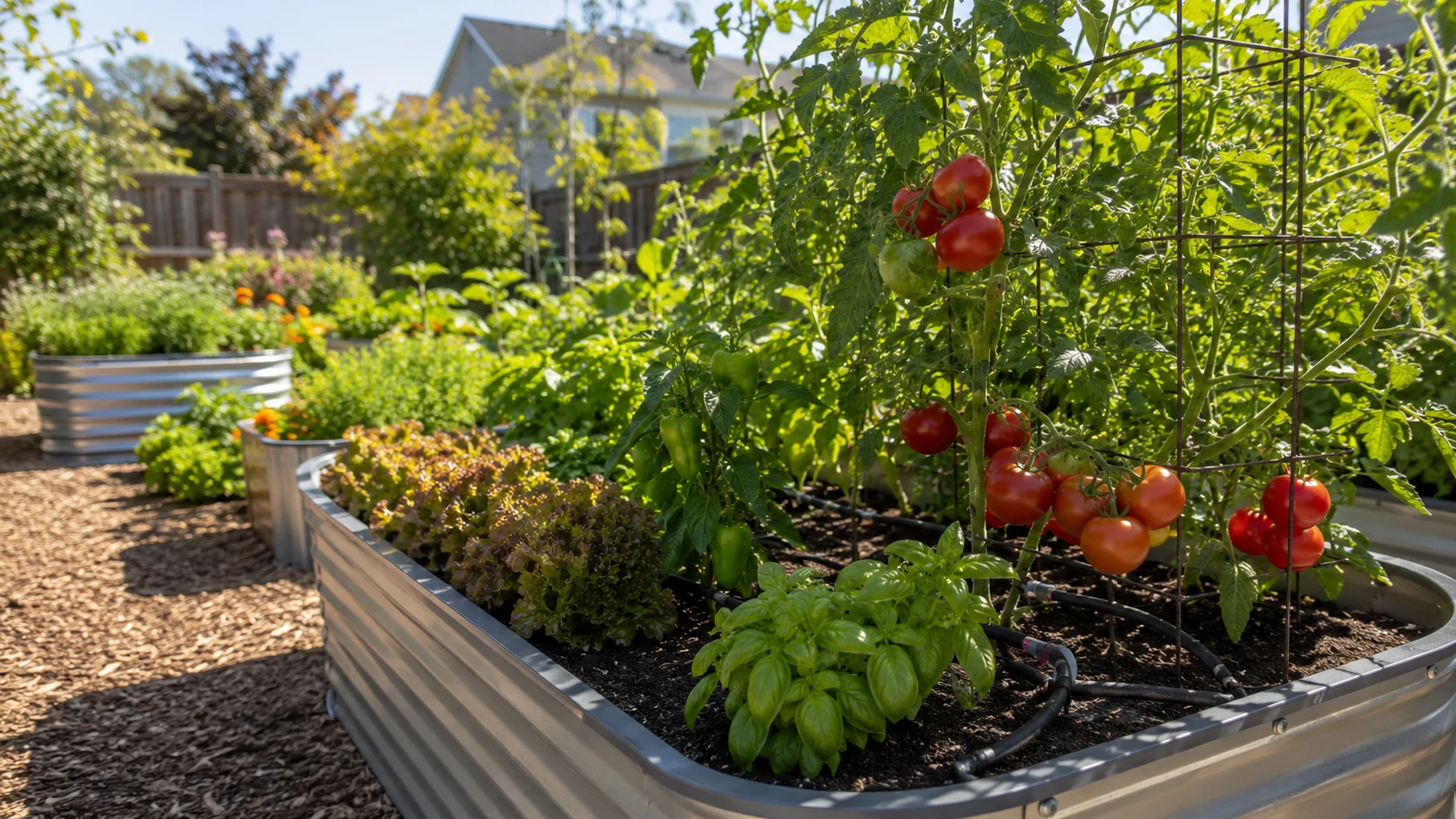
A raised garden bed is the single most productive investment a homeowner can make for vegetable gardening. Compared to in-ground gardens, raised beds warm faster in spring, drain better in summer rain, isolate from invasive weeds and grass runners, and put the growing surface at an ergonomically reasonable working height. For Carolinas and Mid-Atlantic gardeners dealing with heavy red clay soil, raised beds essentially side-step the soil-building decade that in-ground gardening requires.
This guide covers seven raised bed options ranging from $29 budget kits to $269 premium elevated beds, all currently available on Amazon. The picks are organized by use case: elevated standing-height beds, deep-root vegetable beds, budget entry beds, herb-focused beds, and decorative beds for visible landscape placement.
Quick Comparison: Raised Garden Beds at a Glance
| Model | Footprint | Height | Material | Price |
|---|---|---|---|---|
| Vego Rolling V 2x4 | 2x4 | 32" elevated | Aluzinc steel | ~$269.95 |
| Vego Slim 1.5x3.5 | 1.5x3.5 | Standing | Aluzinc steel | ~$189 |
| Extra Tall 4x8 | 4x8 | 32" deep | Galvanized | ~$319 |
| Budget 4x2x1 Kit | 4x2 | 12" | Galvanized | ~$29 |
| 17" Round Herb 24" | 24" diameter | 17" | Galvanized | ~$169 |
| Sunnydaze 5x5 L | 5x5 L-shape | 12" | Woodgrain galv | ~$79 |
| Sunnydaze 4x2 Gray | 4x2 | 12" | Dark gray galv | ~$63 |
Why Trust This Guide
I run a landscape design practice in Raleigh, NC, where heavy red clay soil and humid Southeast summers make raised bed gardening the default approach for serious vegetable growing. Over 15 years of installs I have specified raised beds in every material category, and I have personally maintained galvanized metal, cedar, and elevated beds at my own home through multiple full life cycles. The picks here reflect what survives a decade in real Carolina conditions, not what looks good on a 30-day review window.
#1 Pick
Vego Garden Rolling Elevated V Series 2x4 (700 lbs capacity)
Best for: Best premium elevated bed for patios and back-saving gardening · Price: ~$269.95
- 2 ft x 4 ft growing area, 32-inch standing height
- 700 lbs total loaded capacity
- Galvanized steel construction with food-safe Aluzinc coating
- Heavy-duty caster wheels with locking brakes
- Integrated lower storage shelf
- Drainage holes plus liner included
The Vego Garden Rolling V Series is the elevated bed I recommend most often to clients who want serious vegetable growing without the back strain of in-ground or ground-level beds. The 32-inch standing height puts the soil surface at the right ergonomic level for most adults; no kneeling, no bending. The 700-pound loaded capacity is the real differentiator: this is not a flower-pot stand, it is a structurally serious vegetable bed designed to hold roughly 6 cubic feet of soil plus mature tomato or pepper plants.
The Aluzinc coating is the upgrade over standard galvanized: it includes aluminum plus zinc in the coating, which extends rust resistance by roughly 3 to 5 times compared to standard galvanized steel in humid Carolinas conditions. The locking caster wheels let you reposition the bed to chase sun through the seasons (sun in spring shifts to shade by August in many yards), which is impossible with a fixed ground bed. The integrated lower storage shelf is genuinely useful for tools, fertilizer bags, and the watering can. The drainage holes plus liner combination prevents the bed from holding water (root rot) while keeping soil from washing through.
Pros
- 32-inch standing height eliminates back strain
- Aluzinc coating outlasts standard galvanized 3-5x
- 700 lb capacity supports mature vegetable plants
Cons
- $269.95 is premium for a 2x4 elevated bed
- Caster wheels add height (may be too tall for shorter gardeners)
- Storage shelf adds weight when planning to roll
#2 Pick
Vego Garden Slim Series Elevated 1.5x3.5 (500 lbs)
Best for: Best for renters and narrow patio spaces · Price: ~$189
- 1.5 ft x 3.5 ft growing area
- 500 lbs loaded capacity
- Galvanized steel with food-safe coating
- Standing height design
- Compact footprint for narrow patios
- Drainage system integrated
The Vego Garden Slim Series is the right answer for the narrow patio, the rented apartment with a small balcony, or the side-yard strip that is too narrow for a standard raised bed. At 1.5 feet wide by 3.5 feet long, the Slim Series fits where a standard 2x4 bed does not, while still giving you 5.25 sq ft of growing space. The 500-pound capacity is plenty for typical patio vegetable growing (lettuce, herbs, peppers, cherry tomatoes).
The standing-height design carries the same back-saving benefits as the V Series, and the smaller footprint means lower total soil cost to fill (roughly 4 cubic feet of soil vs 6 for the V Series, a savings of $40 to $80 depending on soil source). For a renter or apartment patio gardener, the Slim Series can be disassembled at move-out and reassembled at the new place; it is treated as movable property rather than a permanent garden investment. This is the elevated bed I recommend to clients who are not sure they will be in their current home long-term.
Pros
- Fits narrow patio and balcony spaces other beds do not
- 500 lb capacity handles patio vegetable load
- Disassembles for renter portability
Cons
- 5.25 sq ft growing space limits scale of operation
- $189 is premium for the size
- Same standing height (may be too tall for shorter gardeners)
#3 Pick
32-inch Extra Tall 4x8x2.7 Modular Metal Bed (10-in-1)
Best for: Best deep-root growing for tomatoes and root vegetables · Price: ~$319
- 4 ft x 8 ft x 32-inch tall floor area (32 sq ft)
- 32-inch (2.7 ft) soil depth for deep-root vegetables
- Modular 10-in-1 configuration
- Galvanized metal construction
- Reinforced corner braces
- Open bottom for ground drainage
The 32-inch Extra Tall 4x8 modular bed is the right pick when you want to grow serious deep-root vegetables (tomatoes, peppers, root crops, potatoes) without the drainage and accessibility compromises of a shallow bed or in-ground planting. The 32-inch (2.7-foot) soil depth gives tomato roots the full development they want (mature tomato plants can put down roots 24+ inches deep when given the space), and root vegetables (carrots, parsnips, beets) have the depth to develop straight and long.
The 10-in-1 modular design lets you reconfigure the bed shape (4x8 rectangle, square, L-shape, U-shape) to fit different yard geometries. The reinforced corner braces are the upgrade that prevents the bowing-out that plagues cheaper modular metal beds when filled with damp soil (which is heavy). The open bottom drains well and lets earthworms move freely between the bed and the underlying soil, which improves soil biology over time. At 32 sq ft of growing area, this is the serious-gardener pick for a household that wants real vegetable production. Soil fill quantity: roughly 28 to 32 cubic feet, which on average runs $200 to $400 in mixed topsoil and compost depending on local pricing.
Pros
- 32-inch depth supports deep-root vegetables fully
- Modular shape options fit varied yard geometries
- Reinforced corners prevent damp-soil bowing
Cons
- Soil fill cost runs $200 to $400 on top of bed price
- 32-inch height is too tall for some gardeners to reach center
- 32 sq ft footprint requires real backyard space
#4 Pick
Galvanized 4x2x1 Raised Bed Kit with Safety Edging
Best for: Best budget entry for first-time raised bed gardeners · Price: ~$29
- 4 ft x 2 ft x 1 ft footprint (8 sq ft, 12-inch soil depth)
- Galvanized metal panels with safety edging
- Open bottom for drainage
- Tool-free assembly
- Folded safety edges prevent skin cuts
- Lightweight, easy to relocate
The Galvanized 4x2x1 kit is the right pick for a first-time raised bed gardener who wants to test the format without spending real money. At $29 it costs less than two bags of premium topsoil; if you decide raised bed gardening is not for you, the financial loss is trivial. If you decide it is for you, this kit can serve as a satellite bed (herb garden, salad bed) when you upgrade your main growing space to a larger bed.
The safety-edging detail is genuinely important: cheaper galvanized beds have raw cut edges that produce skin lacerations during planting and harvesting. The folded safety edge eliminates that hazard. The 12-inch soil depth is the lower end of functional (lettuce, spinach, herbs are fine; tomatoes and root vegetables need more); plan accordingly. The 8 sq ft growing area is enough for a serious herb garden (12 to 15 herb plants) or a focused salad bed (4 to 6 lettuce plants rotating through the season).
Pros
- Lowest-cost entry to raised bed gardening
- Safety-edged panels prevent skin cuts during planting
- 8 sq ft is the right size for herbs or salad
Cons
- 12-inch depth is too shallow for tomatoes or root vegetables
- Standard galvanized (not Aluzinc) has 8 to 12 year lifespan
- Light panels can bow with very wet soil
#5 Pick
17-inch Tall Round Herb Raised Bed (24-inch wide)
Best for: Best for herbs and aesthetic centerpiece beds · Price: ~$169
- Round 24-inch diameter footprint
- 17-inch tall (mid-height for herbs)
- Galvanized steel with safety edging
- Bottom-mesh fabric included
- Compact for patios and entryways
- Decorative-grade finish
The 17-inch Tall Round herb bed is the right pick when you want a serious herb growing space that also functions as visual landscape design. Round beds break up the rectangular geometry that dominates most backyard gardens, and the 24-inch diameter circle is the right scale to anchor a patio corner or punctuate a path intersection. The 17-inch height is mid-tall: easier to reach the center than a 32-inch bed, taller than a standard 6-inch ground bed, comfortable for working while seated on a low stool.
The included bottom-mesh fabric is a thoughtful detail: it lets water drain while keeping soil from washing out the bottom and keeping invasive ground roots from colonizing the bed from below. For herbs specifically, this configuration works well: most culinary herbs (basil, parsley, thyme, oregano, chives) have shallow root systems that thrive in 12 to 18 inches of soil. The galvanized finish is decorative-grade, intended for visible placement; the safety edging matches the finish quality. Honest framing: $169 is a premium price for 24-inch diameter growing space, and the value proposition is partly aesthetic. For pure utility, the 4x2 kit at $29 is more soil-efficient.
Pros
- Round shape breaks up rectangular garden geometry
- 17-inch height is comfortable seated
- Bottom mesh drains while blocking invasive ground roots
Cons
- $169 for 24-inch diameter is premium pricing
- Round geometry less space-efficient than rectangular
- Decorative-grade finish prioritizes look over scale
#6 Pick
Sunnydaze 5x5x1 L-Shaped Galvanized Woodgrain Raised Bed
Best for: Best decorative L-shape for corner placements · Price: ~$79
- 5 ft x 5 ft L-shape footprint (approx 12 sq ft growing area)
- 12-inch soil depth
- Galvanized steel with woodgrain printed finish
- Decorative powder-coat detail
- Open bottom for ground drainage
- Designed for corner installations
The Sunnydaze 5x5 L-shape bed is the right pick when you have a backyard corner (against a fence, against the house, in a 90-degree turn of pathway) that begs for a defined planting area. The L-shape conforms to the corner geometry far better than a rectangle, which always leaves dead space at the corners. At $79 the price-per-growing-area is reasonable for a decorative-grade bed; cheaper plain rectangles exist, but they look less intentional in the landscape.
The woodgrain printed finish is the design feature: it gives the galvanized panel the look of weathered wood without the actual rot and replacement cycle of real wood. The finish holds up to UV exposure for 8 to 12 years with minimal fading; beyond that the original galvanized substrate is still intact, the finish just looks aged. The 12-inch soil depth is appropriate for the bed’s intended use (mixed ornamental plus salad crops, herbs, low annual flowers); not deep enough for serious tomato or root crop growing. For corner planting that needs to look intentional, this is the most cost-effective option in this guide.
Pros
- L-shape conforms to corner geometry better than rectangles
- Woodgrain finish gives the look of wood without the rot
- Affordable price for a decorative-grade bed
Cons
- 12-inch depth limits crop choices
- L-shape is awkward to fill evenly with soil
- Decorative finish prioritizes look over depth
#7 Pick
Sunnydaze Galvanized 4x2x1 Dark Gray Raised Bed
Best for: Best Sunnydaze mid-budget rectangle for clean modern aesthetic · Price: ~$63
- 4 ft x 2 ft x 1 ft footprint (8 sq ft, 12-inch depth)
- Galvanized steel with dark gray powder-coat finish
- Modern clean lines
- Open bottom drainage
- Easy assembly with included hardware
- Stackable for double-depth configuration
The Sunnydaze 4x2x1 in dark gray is the right pick when you want clean modern aesthetics rather than the raw-galvanized look that some homeowners find too industrial. The dark gray powder-coat finish reads as intentional modern landscape design and pairs naturally with modern home exteriors, slate or bluestone patios, and clean-line landscape architecture. At $63 it is $34 more than the safety-edge galvanized 4x2x1 (pick #4) but the finish difference is meaningful in visible yard locations.
The stackable design is the under-appreciated feature: two of these beds stacked gives you a 24-inch deep bed at $126 total, which is competitive on price with dedicated 24-inch deep single-piece beds. For homeowners who want to grow tomatoes or root crops but want to start with shallower planting and upgrade later, buying two stackable beds at different times spreads the investment. The 12-inch base configuration is appropriate for lettuce, herbs, peppers, and other shallow-root crops; stacked, it handles tomatoes and root vegetables.
Pros
- Dark gray powder coat is clean modern aesthetic
- Stackable design supports phased depth upgrade
- Easy assembly with quality hardware
Cons
- 12-inch single-stack depth limits crops
- Powder coat can scratch over time exposing galvanized substrate
- $63 is premium for an 8 sq ft footprint
Galvanized vs Cedar vs Composite: Material Trade-offs
Galvanized steel (every pick in this guide) is the modern default for raised beds because it does not rot, stays cool enough that summer soil temperatures stay reasonable, and holds up for 8 to 30 years depending on coating grade. Aluzinc coating (Vego V Series, Slim Series) extends life roughly 3x over standard galvanized.
Cedar is the aesthetic premium choice; the natural weathering ages beautifully and the warm wood tone harmonizes with most home exteriors. Cedar beds last 7 to 10 years in humid Southeast climates before significant rot (12 to 20 years in drier climates). Plan on replacement before that 10-year mark if the bed is visible.
Composite (recycled plastic plus wood fiber) lasts 20+ years without rot or rust, but the material has lower thermal conductivity than metal or wood, which means slower spring warm-up and slower summer cooling. Pricing is typically 2x to 3x cedar for the same dimensions. Not included in this guide; available from specialty suppliers.
Sizing Your Raised Bed
Depth by crop. 6 to 12 inches: lettuce, spinach, herbs, salad greens, shallow-root annual flowers. 12 to 18 inches: bush beans, peppers, smaller squash, most ornamental perennials. 18 to 24 inches: tomatoes, larger squash, cucumbers, root vegetables. 24+ inches: potatoes, parsnips, full-size tomato plants with deep root development. The 32-inch Extra Tall pick handles everything; the 12-inch budget picks limit you to the first list.
Width by reach. Maximum 4 feet wide if accessible from both sides (allows 2-foot reach from each side). Maximum 2 to 2.5 feet wide if accessible from only one side (against a fence, against a wall). Wider beds create a center zone that is hard to reach for planting, weeding, and harvesting; the work suffers and yields drop.
Length. Limited mainly by available space and lumber/panel efficiency. 6 to 8 feet long is the sweet spot for a single 4-foot-wide bed. Longer beds become harder to walk around for tending; shorter beds waste corner efficiency.
Soil Filling Strategy
Hugelkultur (logs and brush in the bottom third, soil and compost on top): saves on soil cost for deep beds and improves long-term soil biology, but the logs decompose and the soil level drops over 2 to 3 years (plan to top up annually).
Lasagna gardening (alternating layers of brown organic matter and green organic matter with soil): builds soil over time, lower up-front cost, slower start.
Straight topsoil and compost mix (60 percent quality topsoil, 40 percent compost): highest cost, fastest start, most predictable results. This is the approach I recommend for clients who want to plant immediately and not wait for soil to mature. For a 4x8 bed at 12-inch depth, plan on 32 cubic feet of mix at roughly $40 to $80 in bulk delivery cost.
Drainage Considerations
Most raised beds in this guide have open bottoms, which drains directly into the underlying soil. This works in most installations. For beds on concrete or hard surfaces (patio installations of the Vego or Sunnydaze rectangles), the bed needs drainage holes plus a gravel base layer. For beds on slopes, terrace and level the underlying surface first; never install a raised bed on a slope because water will pool unevenly and the soil will wash out the low side. For heavy clay underlying soil that does not drain well, dig a 6-inch gravel layer below the bed footprint before placing the bed; this gives water somewhere to go.
How We Evaluated
Five dimensions: build quality and material rust or rot resistance, ease of assembly (one-person vs two-person, tool-free vs hardware-heavy), drainage and soil retention, 5-year projected durability in humid Southeast conditions, and value-per-square-foot of growing space. The Vego V Series wins on longevity and ergonomics; the Extra Tall 4x8 wins on growing capacity; the budget 4x2 kits win on accessibility for first-time gardeners.
Frequently Asked Questions
Is galvanized metal safe for growing vegetables?
Yes, modern galvanized steel raised beds are safe for vegetable growing. The galvanizing process bonds zinc to the steel substrate; the zinc layer does not significantly leach into soil at typical garden pH ranges (6.0 to 7.5). Aluzinc coating (Vego V Series, Slim Series) adds aluminum to the zinc for additional rust resistance; both are food-safe. Avoid older galvanized beds (pre-2010) from unknown sources that may have used cadmium-containing coatings. New beds from reputable brands are tested to food-safe standards.
How deep do I need for tomatoes vs lettuce?
Lettuce, spinach, herbs, and shallow-root salad greens: 6 to 12 inches is sufficient. Bush beans, peppers, smaller squash: 12 to 18 inches. Tomatoes, larger squash, cucumbers: 18 to 24 inches preferred. Root vegetables (carrots, parsnips, long beets): 18 to 24 inches for proper development. Potatoes: 24+ inches if you want serious yield. The 32-inch Extra Tall pick covers all crops; the 12-inch shallow picks limit you to the shallow-root list.
What should I put on the bottom of a raised bed?
For open-bottom beds (most picks in this guide) on existing soil: nothing, let the bed drain into the ground. For open-bottom beds on concrete or hard surface: 2 to 3 inches of gravel for drainage, then landscape fabric, then soil. For beds with rodent or gopher concerns: hardware cloth (1/2-inch mesh) across the bottom before any soil. Avoid cardboard or newspaper layers in beds over 18 inches deep; they compact and impede deep drainage.
How much soil do I need for a 4x8 bed?
For a 4 ft x 8 ft x 12-inch deep bed: 32 cubic feet of soil mix. For a 4 ft x 8 ft x 32-inch tall bed (the Extra Tall pick): 85 cubic feet. Soil cost varies by region: bulk topsoil and compost mix runs $30 to $60 per cubic yard ($1.10 to $2.20 per cubic foot). Premium bagged garden soil runs $4 to $7 per cubic foot. For the Extra Tall pick, bulk delivery is the economical choice; for smaller beds, bagged is convenient.
Can I move a raised bed later?
Empty bed: yes, all picks in this guide disassemble or lift for relocation. Filled bed: practically no, even an empty-frame 4x8 bed gets very heavy when filled (soil weighs roughly 90 lbs per cubic foot wet). The Vego Rolling V Series and Slim Series have casters and are designed to roll filled, but typical filled raised beds are immobile. Plan placement carefully before filling.
How do I prep the soil for next season?
Each spring: remove last season’s root masses, add 2 to 4 inches of fresh compost on top, lightly fork into the top 6 inches of existing soil. Each fall after harvest: add 2 inches of compost as a winter cover layer, optionally plant a cover crop (crimson clover, winter rye) for the soil-building benefit. Every 3 to 4 years, replace roughly 25 to 30 percent of the soil with fresh mix to refresh structure and nutrients. Test soil pH annually; raised beds tend to drift slightly acidic in humid climates.
Do raised beds need more fertilizer than ground beds?
Slightly yes, because the contained soil volume means nutrients leach out and are not replaced from below. Plan on top-dressing with slow-release organic fertilizer twice per season (early spring and mid-summer). Liquid feeding (fish emulsion, kelp) every 2 to 3 weeks during peak growing season is the high-end approach. If you build the soil with compost-heavy mix initially (50 percent compost minimum), fertilizer needs are lower for the first 2 to 3 years.
Can I put a raised bed on a concrete patio?
Yes, with two considerations. First, drainage: an open-bottom bed on concrete will pool water at the bottom. Solve with 2 to 3 inches of gravel as the bottom layer, then landscape fabric, then soil. Or use a bed with integrated drainage holes (Vego Rolling V Series, Slim Series). Second, weight: a filled 4x8 raised bed weighs roughly 2,500 to 3,000 pounds. Verify the concrete pad can handle the point load (most modern patios can; older thin pads or balcony decks may not).
Lifespan of galvanized vs cedar raised beds?
Standard galvanized steel (Sunnydaze, the budget 4x2 kit): 8 to 15 years before significant rust through. Aluzinc-coated galvanized (Vego V Series, Slim Series): 20 to 30 years. Cedar raised beds: 7 to 10 years before rot in humid Southeast climates, 12 to 20 years in drier climates. Pressure-treated lumber: 15 to 25 years but raises questions about chemical leaching for food gardening. For pure longevity, Aluzinc-coated galvanized wins; for aesthetic preference, cedar wins for the first 7 to 10 years.
How do I keep gophers out of a raised bed?
Hardware cloth (1/2-inch galvanized mesh) across the entire bottom before any soil goes in. Bend the mesh up the sides 4 to 6 inches to prevent burrowing entry from the perimeter. Skip flimsy chicken wire (1-inch mesh); gophers chew through it. For Vego elevated beds on legs, the height plus the bottom barrier essentially eliminates gopher access. Open-bottom beds on the ground need the hardware cloth treatment in any region with gopher or vole pressure.

About the Author
Landscaping Expert & Writer · Raleigh, North Carolina · North Carolina State University
Jennifer Hall is a professional landscaper and lawn care writer based in Raleigh, North Carolina. She studied landscape horticulture at North Carolina State University, home to one of the country's leading turfgrass programs, and went on to build a specialized landscaping service serving the greater Raleigh-Durham region. Jennifer's expertise spans the Southeast and Mid-Atlantic transition zone, where she advises homeowners on warm-season grass selection, seasonal lawn care calendars, landscape design, and water-efficient gardening. Her writing brings together professional horticultural training and real-world experience in one of America's most challenging grass-growing climates.