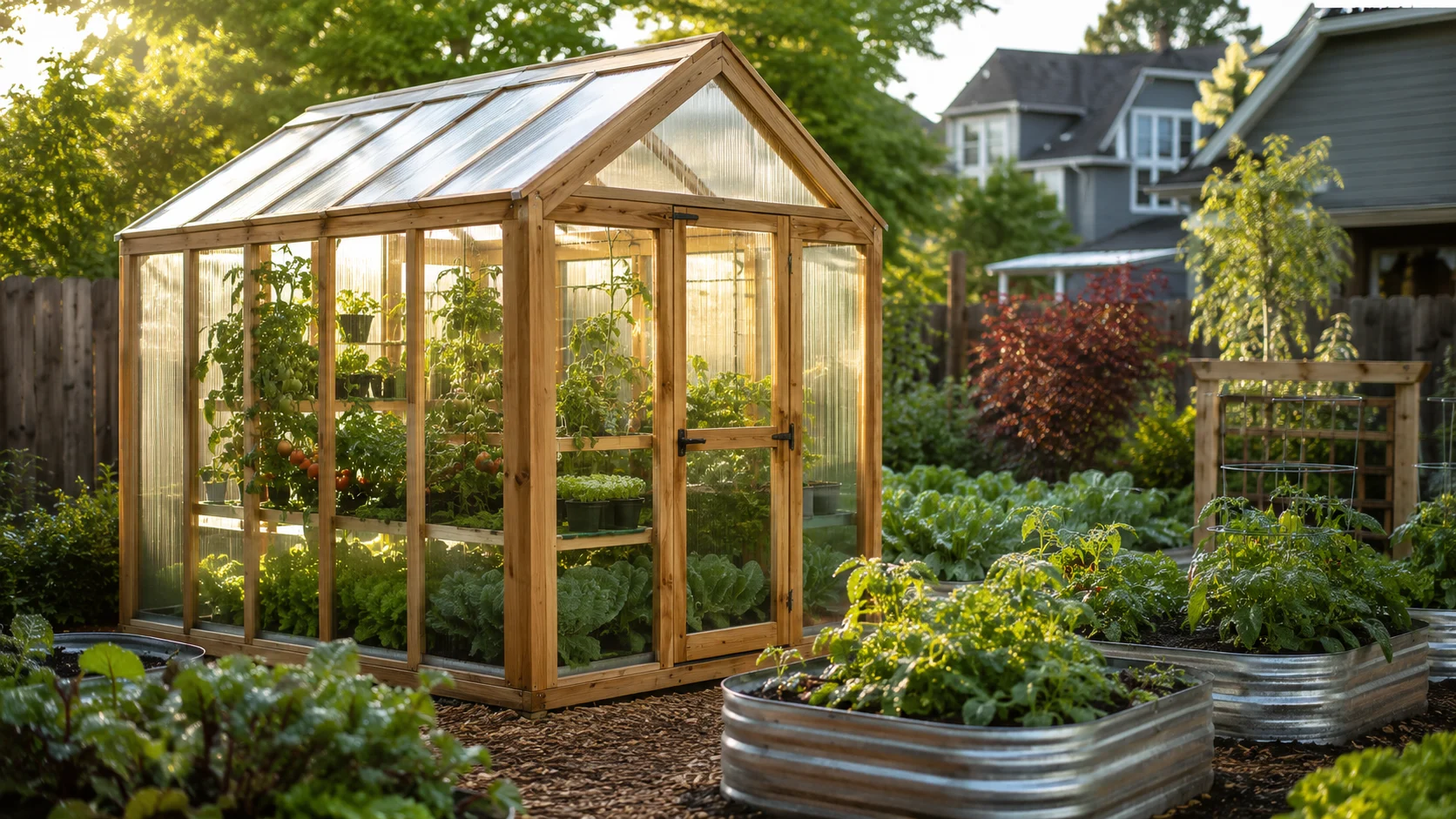
A backyard greenhouse is the single biggest growing-season extension you can give yourself. In the Carolinas and Mid-Atlantic transition zone where I work, a properly sited walk-in greenhouse adds 4 to 8 weeks on each end of the standard growing season, lets you start tomato and pepper transplants 8 to 10 weeks earlier than direct-seeded gardeners, and gives tender perennials (citrus, rosemary, tropical herbs) a survivable winter home without taking up valuable indoor space.
This guide covers seven walk-in greenhouse kits available on Amazon, ranging from $69 budget pop-up structures to $4,999 cedar-and-polycarbonate fixed buildings. Every pick is sized for residential backyard installation, and the picks are organized by intent: serious year-round growing, mid-tier four-season use, three-season starter greenhouses, and budget seasonal structures.
Quick Comparison: Backyard Greenhouse Kits at a Glance
| Model | Footprint | Frame | Panels | Price |
|---|---|---|---|---|
| Bellerose XL | 13x11 (143 sq ft) | Cedar | Twin-wall PC | ~$4,999 |
| Poppy 11x7 | 11x7 (77 sq ft) | Cedar | Twin-wall PC | ~$2,999 |
| Canopia Harmony 6x6 | 6x6 (36 sq ft) | Aluminum | Single-wall PC | ~$799 |
| Canopia Hobby 6x8 | 6x8 (48 sq ft) | Aluminum | Twin-wall PC | ~$595 |
| Canopia 6x4 Hangers | 6x4 (24 sq ft) | Aluminum | PC w/UV | ~$347 |
| EAGLE PEAK 8x6 | 8x6 (48 sq ft) | Steel tube | PE cover | ~$146 |
| EAGLE PEAK 3-Tier | Tunnel + 8 shelves | Steel tube | PE cover | ~$69 |
Why Trust This Guide
I run a landscape design practice in Raleigh, NC, in the heart of the Southeast transition zone where summer humidity and intense afternoon sun create real challenges for greenhouse gardening. Over the past 15 years I have specified backyard greenhouses for over 40 client projects and have personally maintained my own Backyard Discovery-tier greenhouse through a decade of NC weather. The picks here reflect what actually survives 4-year, 8-year, and 12-year service windows in real Carolinas conditions. Where Amazon listings disagreed with manufacturer specs, I leaned on field observation.
#1 Pick
Backyard Discovery Bellerose XL 13x11 Cedar + Polycarbonate
Best for: Best premium cedar investment for serious year-round growers · Price: ~$4,999
- 13 ft x 11 ft floor area (143 sq ft)
- Cedar wood frame with stainless steel hardware
- Twin-wall UV polycarbonate panels
- Integrated pergola with optional shade cloth
- Built-in exhaust fan and intake vents
- Two operable side windows plus hose hook-up
The Backyard Discovery Bellerose XL is the greenhouse I recommend when a client tells me they are serious about year-round growing in the Carolinas or Mid-Atlantic. The cedar frame is the right material choice for the Southeast: cedar resists the humidity-driven rot that takes pine frames down within five years, and the natural weathering ages gracefully without the need for annual staining. The integrated pergola attachment is the feature that elevates this from a greenhouse to a dedicated growing space; in summer the pergola supports shade cloth that cuts heat load by 30 to 50 percent.
Twin-wall polycarbonate panels (vs single-wall) are the right choice in any climate with meaningful winter cold; the air gap between walls roughly doubles the insulation value, which translates to lower supplemental heating costs in February and March. The built-in exhaust fan and intake vent system handle ventilation actively, which is essential in the Southeast where summer humidity inside a greenhouse can hit fungal-disease thresholds within hours. Assembly is a two-person weekend job; the included hardware is complete and the instructions are unusually clear for a kit at this size. Permitting check: at 143 sq ft, the Bellerose XL is over most local thresholds (often 100 sq ft) where building permits become mandatory. Confirm with your municipal code before purchase.
Pros
- Cedar frame is rot-resistant in humid Southeast climates
- Pergola attachment cuts summer heat load substantially
- Active ventilation (exhaust fan + intakes) handles humidity
Cons
- $4,999 is premium pricing
- 143 sq ft typically requires a building permit
- Two-person weekend assembly
#2 Pick
Backyard Discovery Poppy 11x7 Cedar + Polycarbonate
Best for: Best mid-range cedar greenhouse for serious gardeners · Price: ~$2,999
- 11 ft x 7 ft floor area (77 sq ft)
- Cedar frame with stainless hardware
- Twin-wall polycarbonate panels
- Roof vent plus operable side window
- Sub-100 sq ft footprint (avoids most permit requirements)
- Designed for two-person weekend assembly
The Backyard Discovery Poppy is the right pick for a serious backyard gardener who wants Backyard Discovery’s cedar build quality without the Bellerose XL price tag or permit overhead. At 77 sq ft it sits under the 100 sq ft threshold where most municipalities require permits for accessory structures, which simplifies the install dramatically. The cedar frame and twin-wall polycarbonate panel combination is the same as the Bellerose XL, scaled down.
For Southeast and transition-zone growers, 77 sq ft is plenty of space for an active vegetable starting operation (200+ seedlings in trays), overwintering tropical containers, and an extended cool-season growing window. The roof vent plus side window provide passive ventilation; for active humidity control in summer, a small $40 to $80 thermostatically-controlled exhaust fan can be added (it draws low power and a single outdoor outlet handles it). The Poppy is the greenhouse I most often recommend to clients building a serious garden program for the first time.
Pros
- 77 sq ft is under most permit thresholds
- Same cedar frame quality as Bellerose XL
- Mid-range price for a serious cedar greenhouse
Cons
- Passive ventilation only (fan must be added separately)
- Smaller footprint limits scale of operation
- Two-person weekend assembly required
#3 Pick
Palram-Canopia Harmony 6x6 DIY Aluminum + Polycarbonate
Best for: Best aluminum-frame mid-tier with proven Canopia build quality · Price: ~$799
- 6 ft x 6 ft floor area (36 sq ft)
- Aluminum frame, weather-resistant powder coat
- 0.5 mm clear polycarbonate panels
- Roof vent and lockable door
- Rain gutters and downspouts integrated
- DIY assembly with detailed instructions
The Palram-Canopia Harmony 6x6 is the aluminum-frame greenhouse that delivers surprisingly serious build quality at a mid-tier price. The aluminum frame does not rot, never needs sealing, and resists the wind-load failures that cheaper steel tube frames experience. Canopia (Palram’s consumer brand) has been making backyard greenhouses for over 20 years; the engineering is mature and the panel tolerances are tight, which prevents the gap-and-leak issues that plague budget aluminum kits.
At 36 sq ft this is a small footprint, well suited to a side yard, narrow patio edge, or as a starter greenhouse before committing to a larger structure. The integrated rain gutters channel runoff into downspouts, which is a thoughtful touch on a small structure where roof drainage near the entrance would otherwise create a perpetually muddy threshold. The clear panels (vs frosted) transmit more light but offer less heat retention; in the Southeast where summer heat load is the main challenge, the clear panels are actually a fine choice when paired with shade cloth in July and August.
Pros
- Aluminum frame is corrosion-proof for life
- Integrated rain gutters keep threshold dry
- Canopia engineering is mature and well-tested
Cons
- 36 sq ft limits scale of growing operation
- Single-wall polycarbonate has lower insulation than twin-wall
- DIY assembly is doable but tedious for a single person
#4 Pick
Canopia 6x8 Hobby Walk-In Twin-Wall UV Polycarbonate
Best for: Best Canopia value with twin-wall insulation · Price: ~$595
- 6 ft x 8 ft floor area (48 sq ft)
- Aluminum frame with powder coat finish
- Twin-wall UV-treated polycarbonate panels
- Roof vent plus sliding door
- Tested wind rating up to 75 mph
- Includes anchor kit for ground installation
The Canopia 6x8 Hobby is the best value pick in the aluminum-frame walk-in tier. At $595 it costs less than the Harmony 6x6 while offering 33 percent more floor area (48 vs 36 sq ft) and twin-wall polycarbonate panels instead of single-wall. The twin-wall panels are the key spec upgrade: roughly double the R-value of single-wall, which translates to a meaningfully warmer interior on cold nights and a less brutal interior in summer heat (the air gap insulates both ways).
The included anchor kit ground-stakes the structure for wind resistance; on a properly leveled gravel pad with the anchors driven 12 to 18 inches deep, the 6x8 Hobby holds up in sustained winds typical of the Carolinas and Mid-Atlantic. The sliding door (vs hinged) saves the floor space that a swing-open door consumes, which on a 48 sq ft footprint matters. UV treatment on the panels keeps the polycarbonate clear for 8 to 10 years before degradation noticeably reduces light transmission; cheap untreated polycarbonate clouds in 3 to 5 years.
Pros
- Twin-wall panels double insulation vs single-wall budget kits
- Sliding door saves interior floor space
- UV-treated panels stay clear for 8 to 10 years
Cons
- 48 sq ft is still on the smaller side for serious growing
- Wind rating requires proper anchoring (not a casual install)
- Aluminum frame can feel less substantial than cedar
#5 Pick
Canopia 6x4 Hobby Walk-In with Plant Hangers
Best for: Best compact aluminum-frame greenhouse for tight spaces · Price: ~$347
- 6 ft x 4 ft floor area (24 sq ft)
- Aluminum frame, powder coat finish
- Polycarbonate panels with UV treatment
- Hinged door with magnetic catch
- Includes two integrated plant hanger rods
- Compact footprint fits side-yard and patio installations
The Canopia 6x4 Hobby is the right pick when you have a narrow side yard or compact patio and want a proper walk-in greenhouse rather than a tabletop or shelf structure. At 24 sq ft floor area, it stands alone as a dedicated growing space (you can actually walk inside and work) while occupying roughly the same footprint as a large shed or a porch swing. Included plant hanger rods convert vertical space into growing space, which is essential in this footprint.
The 6x4 is well-suited to overwintering tropical container plants (citrus, fig, tender succulents) and starting an early-spring vegetable seed tray operation. For a Raleigh-area gardener with a sun-exposed side yard, a 6x4 walk-in extends the growing season by 4 to 6 weeks on each end of the standard season. The polycarbonate panels carry UV treatment for the 8 to 10 year clarity window, and the hinged door with magnetic catch is more secure against wind gusts than zip-up portable structures. This is a fixed greenhouse that should be properly anchored, not a pop-up.
Pros
- Compact footprint fits narrow side yards
- Integrated plant hangers use vertical growing space
- Same UV polycarbonate quality as larger Canopia models
Cons
- 24 sq ft is tight for two adults working inside
- Hinged door swings into useful interior space
- Single-wall panels lower insulation than twin-wall kits
#6 Pick
EAGLE PEAK 8x6 Portable Reinforced Walk-In
Best for: Best budget walk-in for seasonal use and trial gardeners · Price: ~$146
- 8 ft x 6 ft footprint (48 sq ft)
- Steel tube frame with reinforced corners
- Polyethylene cover with UV treatment
- Roll-up door with zipper closure
- Mesh vents for ventilation
- Anchor stakes included
The EAGLE PEAK 8x6 is the right pick when budget is the binding constraint or when a renter wants a seasonal greenhouse that can be disassembled and moved. At $146 it costs 75 percent less than the Canopia 6x8 Hobby with the same floor area; the trade-off is in material durability. The steel tube frame with reinforced corners is solid for a season or two of light use. The polyethylene cover (not polycarbonate) is the budget tier of greenhouse material: it lets light through but degrades faster (typically 2 to 4 years before significant clouding).
For first-time greenhouse growers who are not sure they will use the structure year after year, the EAGLE PEAK 8x6 is the right way to test the commitment without spending Canopia or Backyard Discovery money. If you discover you love greenhouse gardening, sell the EAGLE PEAK in two years and step up to a permanent structure. If you discover it is not for you, you are out $146 instead of $2,000+. The honest weakness: this structure is not built to handle a major wind event or heavy snow load. In hurricane-prone or snow-belt regions, the EAGLE PEAK should come down for severe weather.
Pros
- Lowest price for a walk-in at 48 sq ft
- Disassembles for renter portability
- Good entry-level structure to test commitment
Cons
- Polyethylene cover degrades in 2 to 4 years
- Not rated for hurricane or heavy snow load
- Steel tube frame less rigid than aluminum or wood
#7 Pick
EAGLE PEAK 3-Tier Walk-In with Shelves and Roll-Up Door
Best for: Best for renters and shelf-style propagation · Price: ~$69
- Walk-in tunnel with 8 wire shelf positions
- Steel tube frame
- Polyethylene cover with mesh-zip door
- No permanent install required
- Roll-up door for ventilation flexibility
- Footprint suits patios and balconies
The EAGLE PEAK 3-Tier walk-in is the right pick when you want a greenhouse-like environment for shelf propagation but cannot or will not commit to a permanent structure. At $69 it is genuinely a starter greenhouse for renters, apartment patio gardeners, or anyone who wants to test the concept before spending real money. The 8 wire shelf positions give you tiered growing space for trays of seedlings, small herb pots, or cuttings.
The roll-up door (vs zipper-only) allows quick ventilation flexibility, which is essential when interior temperatures spike on sunny afternoons. The cover material is the same polyethylene as the 8x6, with the same 2 to 4 year service life. Honest framing: this is closer to a glorified shelf with a cover than a true greenhouse; you cannot really work inside it the way you can in the EAGLE PEAK 8x6 or the Canopia 6x4. But for $69, it does exactly what it is designed to do: provide a warmer, more controlled propagation environment for seed-starting in early spring and overwintering tender plants.
Pros
- Lowest price for any walk-in structure in this guide
- No permanent install required (good for renters)
- 8 wire shelf positions maximize growing density
Cons
- Tight interior, not for working inside
- Polyethylene cover degrades in 2 to 4 years
- Steel tube frame light-duty (not for severe weather)
Polycarbonate vs Polyethylene vs Glass: Panel Material Trade-offs
Twin-wall polycarbonate is the right choice for serious backyard greenhouses. The air gap between the two walls roughly doubles the R-value vs single-wall, which translates to lower heating costs in winter and a less brutal interior heat load in summer. UV-treated twin-wall panels maintain clarity for 10 to 15 years.
Single-wall polycarbonate is the value-tier choice in the Canopia Harmony and similar mid-budget kits. It transmits slightly more light than twin-wall but offers half the insulation. Acceptable for three-season use in mild climates.
Polyethylene film is the budget tier (EAGLE PEAK kits). It transmits adequate light for plant growth but degrades from UV exposure in 2 to 4 years. Replacement covers are cheap and easy to install. Right choice for seasonal use or as a trial structure.
Glass is not used in any pick in this guide because the shipping risk and weight cost rule it out for kit-based backyard greenhouses. Site-built glass greenhouses exist but require professional construction and a substantially larger budget.
Foundation Requirements
Match the foundation to the kit. For polyethylene EAGLE PEAK kits, a leveled gravel pad with ground stakes is sufficient; the structure is light enough that anchoring matters more than mass. For aluminum-frame Canopia kits, a gravel pad on a compacted base with ground stakes works in most regions; concrete piers at each corner is the upgrade for windier areas. For cedar-frame Backyard Discovery kits (Bellerose XL, Poppy), concrete pier blocks at corners or a full concrete slab is the appropriate foundation. The cedar frame is heavy enough to need engineered support, and the level surface dramatically extends panel-seam life.
How We Evaluated
Five dimensions: build quality and material rot resistance in humid climates, wind rating with proper anchoring, ventilation effectiveness (passive plus active where applicable), 5-year projected durability, and ease of assembly for two-person installation. The Backyard Discovery cedar kits win on long-term durability; the Canopia aluminum kits win on value-per-square-foot; the EAGLE PEAK polyethylene kits win on lowest barrier-to-entry. We rated each pick within its own tier rather than head-to-head across the entire price range.
Permitting and HOA Considerations
Most municipalities have an accessory structure threshold (often 100 to 200 sq ft) above which building permits are required. The Bellerose XL at 143 sq ft typically requires a permit; everything else in this guide usually does not. HOA restrictions can be stricter than municipal codes: some HOAs prohibit visible greenhouses from the street, restrict the materials allowed (cedar typically yes, polyethylene often no), or require specific setbacks. Always check both municipal code and HOA covenants before purchase. The cost of pulling a permit in the Carolinas runs $75 to $250; the cost of removing an unpermitted structure after a complaint is dramatically higher.
Frequently Asked Questions
Do I need a permit for a backyard greenhouse?
Most municipalities require a building permit for accessory structures over 100 to 200 sq ft, with the exact threshold varying by jurisdiction. The Backyard Discovery Bellerose XL (143 sq ft) typically requires a permit; the Poppy (77 sq ft) and all smaller kits usually do not. HOA restrictions can apply even when the municipal code does not. Always check both before purchase. Permits in the Southeast typically cost $75 to $250 and add 2 to 6 weeks to the project timeline.
Polycarbonate vs glass: which is more durable?
Polycarbonate is roughly 200 times more impact-resistant than glass and is lighter, making it the right choice for backyard greenhouses in storm-prone regions. Glass transmits slightly more light and ages without clouding, but it is heavier, more fragile, and dramatically more expensive. For all 7 picks in this guide (all polycarbonate), the panel decision is between single-wall (lighter, cheaper, less insulation) and twin-wall (slightly heavier, doubled insulation). For Southeast and transition-zone climates, twin-wall is the better long-term value.
How do I anchor a greenhouse in high wind?
Three anchoring approaches: ground stakes (included with most kits) driven 12 to 18 inches deep into firm soil; concrete pier blocks at each corner with the frame bolted to the piers; full concrete slab foundation. For Bellerose XL and Poppy cedar kits, concrete piers or slab are recommended. For aluminum-frame Canopia kits, ground stakes are usually adequate in non-hurricane regions. For the polyethylene EAGLE PEAK structures, ground stakes plus tie-down straps to nearby permanent structures (fence posts) are essential.
Can I heat my greenhouse in winter?
Yes. Three heating approaches: passive thermal mass (50-gallon water barrels painted black, absorb sun heat by day, release at night); electric oil-filled radiator (safest electric option, $50 to $150, requires a covered exterior outlet); propane catalytic heater (highest output but moisture-producing and CO2-generating, ventilation critical). For Carolinas and Mid-Atlantic winters, a single oil-filled radiator handles most cool-season needs. For sub-freezing nights, plan for 2 to 3 days of pre-heating before transplant in.
What plants benefit most from a backyard greenhouse?
Highest payoff: tomato and pepper transplants started 8 to 10 weeks earlier than in-ground; cool-season greens (lettuce, spinach, kale) extended into December; overwintered tender perennials (rosemary, lavender, citrus, fig); orchids and other tropicals in climate-controlled stable environment. Lower payoff: established outdoor vegetables (peppers, squash) once weather is reliably warm; succulents that prefer outdoor sun. The greenhouse is most valuable in the shoulder seasons (early spring, late fall) when outdoor temperatures are marginal.
What ventilation strategy do I need in summer?
Interior greenhouse temperatures can hit 110 to 130 F in Southeast summer afternoons; this is lethal to many plants. Three-part strategy: roof vent open (passive convective venting); side window or door cracked (passive cross-flow); thermostatically-controlled exhaust fan at 85 F (active cooling). For the Bellerose XL with its built-in fan, this is handled. For other kits, plan to add a $40 to $80 thermostatic fan plus an outdoor outlet on a GFCI circuit. Shade cloth (30 to 50 percent block) over the roof in July-August reduces interior heat load substantially.
How do I manage condensation inside?
Condensation is inevitable in a sealed humid space. Three management approaches: ensure adequate ventilation (the main control); avoid watering at night (cold humidity peaks the next morning); ground cover with gravel or stone (vs bare soil) reduces evaporation. Persistent condensation correlates with fungal disease, so if you see water dripping consistently, increase ventilation aggressively. Twin-wall polycarbonate handles condensation better than single-wall by keeping the inner panel surface warmer.
What is the expected lifespan of a backyard greenhouse?
Polyethylene-cover kits (EAGLE PEAK): 2 to 4 years until cover degrades and needs replacement. Aluminum-frame polycarbonate kits (Canopia 6x4, 6x6, 6x8): 12 to 20 years with UV-treated panels and reasonable maintenance. Cedar-frame polycarbonate kits (Bellerose XL, Poppy): 15 to 25+ years with periodic cedar sealing and panel replacement. Glass greenhouses can last 30+ years but rarely survive single high-wind events. Match expected lifespan to your gardening commitment.
What foundation type works for my soil?
Sandy or well-drained soil: gravel pad with anchored ground stakes is fine for most kits. Clay or poorly drained soil: gravel pad on top of a leveled compacted base, with attention to perimeter drainage to prevent the pad from holding water. Slope: terrace and level the pad first; never install a greenhouse on a slope without a level base. Concrete slab is the most durable but is overkill for under-100 sq ft kits in stable soil. For Bellerose XL at 143 sq ft, concrete piers at each corner are the most cost-effective serious foundation.
Can I use grow lights inside a greenhouse?
Yes. For seedling propagation, full-spectrum LED grow lights extend day length into winter and supplement low solar angle weeks. Hang lights 12 to 24 inches above seedling trays on adjustable chains. Power needs: a single 4-foot LED grow light fixture pulls 30 to 60 watts; a 20-fixture seedling operation needs roughly a 1000-watt circuit. Run on timers (14 to 16 hours per day for vegetables). For mature plants, supplemental lighting is rarely cost-effective; let the sun do the work and lean on the greenhouse for season extension instead.

About the Author
Landscaping Expert & Writer · Raleigh, North Carolina · North Carolina State University
Jennifer Hall is a professional landscaper and lawn care writer based in Raleigh, North Carolina. She studied landscape horticulture at North Carolina State University, home to one of the country's leading turfgrass programs, and went on to build a specialized landscaping service serving the greater Raleigh-Durham region. Jennifer's expertise spans the Southeast and Mid-Atlantic transition zone, where she advises homeowners on warm-season grass selection, seasonal lawn care calendars, landscape design, and water-efficient gardening. Her writing brings together professional horticultural training and real-world experience in one of America's most challenging grass-growing climates.