Grass Seeding Cost 2026 – Prices for New Lawns
Published:

Seeding a new lawn costs $0.05–$0.20 per square foot for DIY, or $500–$2,000 for a ¼-acre lot installed professionally. Hydroseeding — spray-applied seed with mulch and fertiliser — runs $0.06–$0.20 per square foot and delivers faster establishment than broadcast seeding on bare soil. This guide is specifically for new-lawn seeding (starting from bare soil or total renovation), not patch repair or overseeding. For overseeding costs, see our separate overseeding cost guide.
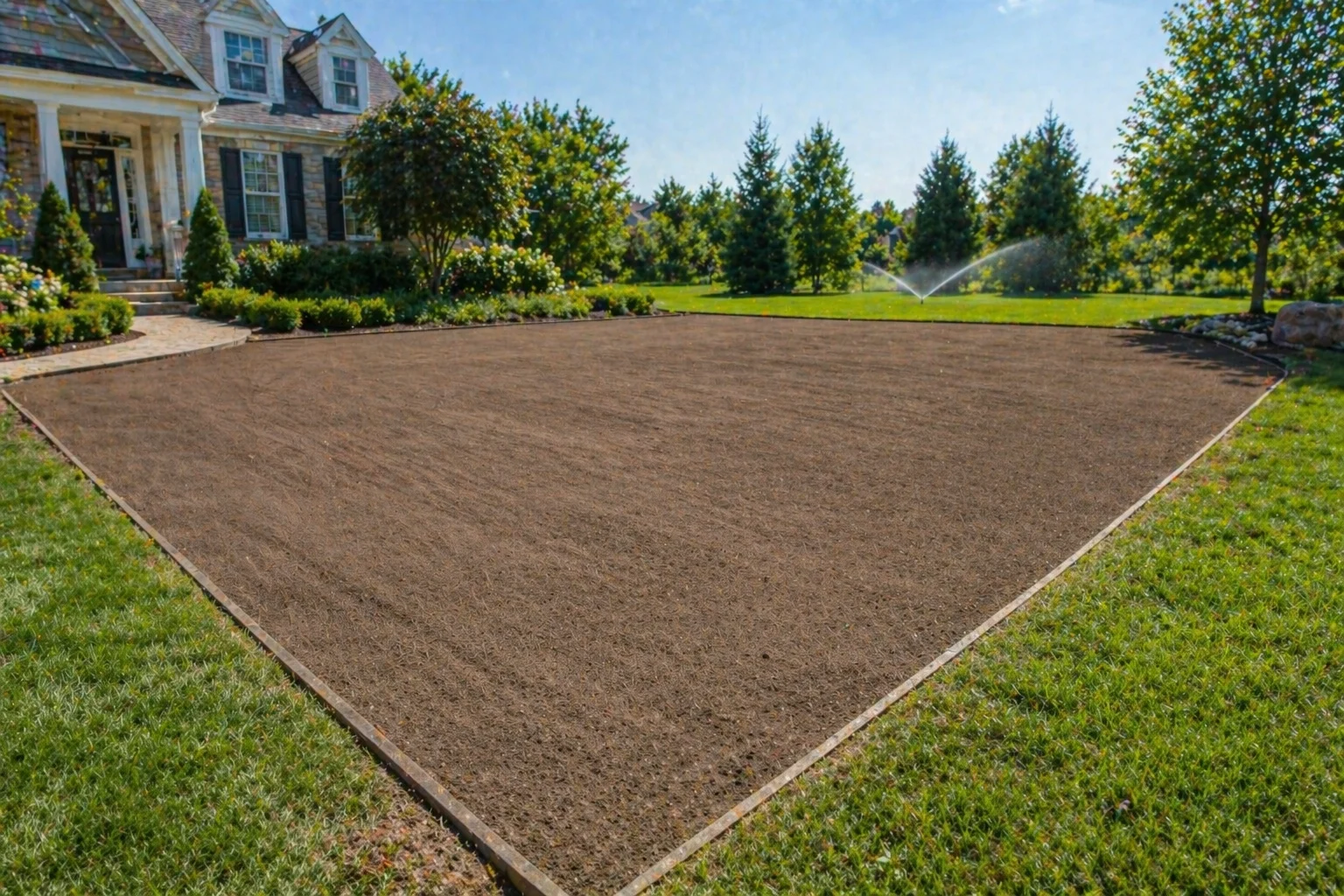
Cost by Method — Full New Lawn
| Method | Cost per sq ft | ¼-Acre Cost | Timing |
|---|---|---|---|
| DIY broadcast seeding | $0.05 – $0.12 | $545 – $1,300 | 6–8 weeks to full cover |
| Professional broadcast seeding | $0.08 – $0.20 | $870 – $2,200 | 6–8 weeks |
| Hydroseeding (spray application) | $0.06 – $0.20 | $650 – $2,200 | 3–4 weeks to cover |
| Slit-seeding (machine) | $0.10 – $0.25 | $1,100 – $2,700 | 4–6 weeks |
| Sod installation (alternative) | $0.90 – $3.00 | $9,800 – $32,700 | Instant |
| Plugs / sprigs (warm-season) | $0.15 – $0.40 | $1,600 – $4,400 | 8–16 weeks |
Cost by Seed Type
| Seed Type | Price per 50 lb bag | Coverage | Price per 1,000 sq ft |
|---|---|---|---|
| Kentucky Bluegrass (premium) | $300 – $500 | 12,500 – 16,650 sq ft | $18 – $40 |
| Turf-Type Tall Fescue (RTF) | $180 – $350 | 5,000 – 8,300 sq ft | $22 – $70 |
| Perennial Ryegrass | $150 – $280 | 5,500 – 7,100 sq ft | $21 – $51 |
| Fine Fescue blend | $220 – $380 | 7,000 – 12,500 sq ft | $18 – $54 |
| Bermuda (hulled) | $200 – $380 | 50,000 sq ft | $4 – $8 |
| Zoysia | $400 – $750 | 25,000 sq ft | $16 – $30 |
| Bahia | $180 – $280 | 16,600 sq ft | $11 – $17 |
| Centipede | $350 – $600 | 33,000 sq ft | $11 – $18 |
| Buffalo (treated) | $450 – $700 | 10,000 sq ft | $45 – $70 |
| Contractor mix (economy) | $100 – $200 | 5,000 – 7,000 sq ft | $14 – $40 |
Regional Price Variation
| Region | States | ¼-Acre Pro Cost | DIY Cost |
|---|---|---|---|
| Northeast | NY, CT, MA, NJ, PA | $1,200 – $2,200 | $650 – $1,300 |
| Mid-Atlantic | MD, VA, DE | $1,100 – $2,000 | $600 – $1,250 |
| Southeast | NC, SC, GA | $900 – $1,600 | $500 – $1,100 |
| Midwest | OH, IN, IL, MI, WI | $1,000 – $1,800 | $550 – $1,200 |
| Great Plains | KS, NE, IA, MO | $850 – $1,500 | $500 – $1,050 |
| Mountain West | CO, UT, ID | $1,100 – $1,900 | $600 – $1,300 |
| Pacific Northwest | WA, OR | $1,150 – $2,000 | $625 – $1,300 |
| Southwest | AZ, NM, NV | $950 – $1,700 | $550 – $1,150 |
DIY Seeding Cost Breakdown (5,000 sq ft New Lawn)
| Item | Cost |
|---|---|
| Soil test + amendment (lime / fertiliser) | $40 – $120 |
| Grass seed (KBG or TTTF blend) | $90 – $220 |
| Starter fertiliser (18-24-12) | $25 – $45 |
| Topsoil / compost topdressing | $60 – $180 |
| Straw mulch or seed-covering blanket | $40 – $120 |
| Broadcast spreader (reusable) | $40 – $80 (one-time) |
| Rake + roller rental | $25 – $60 |
| Total — 5,000 sq ft DIY new lawn | $320 – $825 |
What Affects New Lawn Seeding Cost
Site condition is the single largest cost variable. A flat, level, recently cleared lot with good topsoil is the lowest-cost seeding project. A site needing grading, rock removal, or topsoil import can easily double the base seeding cost. Get a contractor to inspect site condition before quoting — on-paper prices assume ideal conditions.
Seed type doubles or triples the material cost between economy contractor mix and premium named cultivars (RTF Tall Fescue, SOD Quality KBG). On a ¼-acre lot, the difference is $150–$500. For a lawn you'll live with for 15+ years, the seed upgrade is nearly always worth it.
Method: hydroseeding costs 30–60% more per square foot than broadcast seeding but delivers better establishment rates and faster visible cover — the mulch layer retains moisture and protects seed from wind and birds. Slit-seeding delivers the highest germination rate but adds equipment cost.
Irrigation is implicit in the success of a new seed job. Budget $50–$150 per month in summer water bills during the first 10 weeks of establishment. New seed requires 2–3 light waterings per day for the first 10–14 days; most failed new lawns failed because homeowners skipped the irrigation commitment.
Hydroseeding vs Broadcast Seeding
Hydroseeding applies a slurry of seed, mulch, fertiliser, and a tackifying agent directly onto prepared soil via spray. The mulch protects the seed from wind, holds moisture at the soil surface, and degrades into the seedbed. Results: more uniform germination, faster visible cover (3–4 weeks vs 6–8 weeks for broadcast), and better survival on slopes or wind-exposed sites.
Cost: $0.06–$0.20 per square foot installed — typically 30–60% more than broadcast seeding. On a flat, sheltered lot, the premium may not be worth it. On a sloped lot, a new-construction site with minimal topsoil, or a wind-exposed location, hydroseeding is worth paying for.
DIY hydroseeding is possible with rental equipment (hydroseeder spray unit, $200–$400/day from United Rentals) plus seed, mulch fibre, fertiliser, and tackifier. Material cost typically $0.08–$0.14 per square foot on top of rental. Worth it only for large lots (1+ acre) where the rental day amortises across meaningful coverage.
New Lawn Seeding vs Sod
Sod is 8–15x more expensive per square foot than seeding but delivers an instant mature-looking lawn. On a ¼-acre lot: seeding $500–$2,200 vs sod $9,800–$32,700. The price differential usually settles the question, but there are genuine reasons to choose sod.
Choose sod when: erosion risk on a slope over 20°, immediate use required (new construction with move-in date), HOA aesthetic requirements, or the lawn is small enough (under 1,500 sq ft) that the absolute dollar difference is modest.
Choose seed when: cost is the driver, the seeded lawn will be a long-term (15+ year) feature, you want access to cultivar options not available in sod, or you have the 6–10 weeks of establishment time.
Mixed strategies work too: sod the visible front yard, seed the backyard. Sod critical high-traffic areas (play zones, pet runs), seed remaining areas. Cost optimisation plus visual priority.
Timing New Seed Work
Cool-season new lawns (Kentucky Bluegrass, Tall Fescue, Perennial Ryegrass, Fine Fescue): seed in early fall. The window is 45+ days before your region's average first hard freeze — typically mid-August to mid-September across the Northern half of the country, through early October in the Mid-Atlantic. Fall seeding produces 80–90% establishment rates vs 50–70% for spring.
Spring seeding works as a second choice. Budget for fierce crabgrass competition if you spring-seed (and skip pre-emergent, which blocks new grass germination too). Spring-seeded lawns may need overseeding the following fall to reach full maturity.
Warm-season new lawns (Bermuda, Zoysia, Centipede, Bahia): seed in late spring once soil temperatures reliably stay above 65°F at a 4-inch depth. In Florida and the Gulf Coast that's April; in Texas and the Southeast May; in the Transition Zone (Tennessee, northern Arkansas) early June.
Warm-season grasses are often sodded or plugged rather than seeded because viable seed is limited (St. Augustine, hybrid Bermuda varieties) or produces inferior plants (common Bermuda seed). For Bermuda specifically, hulled seed of a named variety (Sahara II, Riviera) gives acceptable results; common Bermuda seed is a gamble.
Frequently Asked Questions
Is seeding cheaper than sod?
Yes — dramatically. Seeding a ¼-acre lot costs $500–$2,200; sodding the same area costs $9,800–$32,700. Seeding is 8–15x cheaper for the same final result, but takes 6–10 weeks longer to reach mature appearance. Choose sod only when instant coverage or erosion control justifies the cost.
Can I seed a lawn myself?
Yes, for any lawn size if you can commit to the site prep and watering schedule. Site prep (grading, topsoil, soil amendment) is the most time-intensive step — budget a full weekend. Watering is the single biggest failure point — 2–3 light waterings per day for the first 10–14 days is non-negotiable. Miss a day of watering and germination rates drop 40–60%.
What's the fastest way to establish a new lawn?
Sod — instant. For seed options, Perennial Ryegrass emerges in 7–10 days and reaches cover in 3–4 weeks. Tall Fescue reaches cover in 4–6 weeks. Kentucky Bluegrass is slowest at 6–10 weeks. Hydroseeding with a Ryegrass-Tall Fescue blend establishes fastest among seeding methods — 3 weeks to visible cover.
Do I need to till before seeding?
Yes for new construction with compacted subsoil; not necessarily for replacement lawns where the soil is already in reasonable condition. Tilling loosens the top 4–6 inches of soil and lets roots establish quickly. Skip tilling on slopes where erosion risk is high — instead, hand-rake the surface, apply seed, and cover with straw or a seed blanket.
How long until a new seeded lawn looks good?
First visible cover at 3–4 weeks for Ryegrass, 4–6 weeks for Tall Fescue, 6–10 weeks for Kentucky Bluegrass. Mature, thick, walkable lawn appearance at 6 months (cool-season) or 3 months (warm-season). The lawn reaches its final established appearance a full year after seeding as roots deepen and tillering fills in gaps.
About the Author
Lawn Care Expert & Writer · Denver, Colorado · Florida State University
Jason Allen is a lawn care expert and freelance writer based in Denver, Colorado. He studied turfgrass science and horticulture at Florida State University before founding his own lawn care operation serving the Denver metro area. With over a decade of hands-on experience managing cool-season lawns in Colorado's challenging high-altitude climate, Jason specializes in aeration, fertilization timing, drought management, and water-restriction compliance. His practical, science-backed approach to lawn care has helped thousands of homeowners achieve healthy turf despite Colorado's short growing seasons, clay soils, and frequent drought conditions.