When to Plant Hydrangeas — 2026 Planting Guide
Published:
Hydrangeas are the most popular flowering shrub in American gardens — and the most commonly mishandled. The right planting time depends on your zone (spring or fall both work in most areas), and the right pruning time depends on which type you have (bigleaf hydrangeas bloom on old wood; panicle and smooth hydrangeas bloom on new wood — pruning at the wrong time eliminates the next year's blooms entirely). This guide covers the right planting window for every US state, the four main hydrangea types and their pruning requirements, and the soil pH adjustments that turn bigleaf hydrangea blooms blue or pink.
Quick Answer
Plant hydrangeas in spring or fall. Spring: after last frost. Fall: at least 6 weeks before first frost to establish roots. Avoid midsummer planting in Zones 7–9. Bigleaf hydrangeas bloom on old wood — do not prune in fall.
Hydrangeas Planting Dates by State
Click your state for the exact hydrangeas planting window, the best varieties for your USDA zone, and a state-specific care calendar. All dates are based on average last frost dates and population-weighted USDA zone primary for each state.
How to Plant Hydrangeas
Sow method: transplant (shrub). Below are the practical steps — site selection, depth, spacing, and first-season care — that produce healthy first-year plants. Each step matters; skipping site selection or depth in particular dramatically reduces success rates.
- →Choose a site with morning sun and afternoon shade in Zone 7+; full sun in Zone 6 and colder.
- →Dig planting hole 2x the rootball width and equal depth — never deeper than the rootball.
- →Amend backfill with compost; avoid heavy peat amendment that holds too much water.
- →Plant the rootball with the top of the soil 1 cm (0.5 inch) above grade, never below.
- →Mulch 5–8 cm (2–3 inches) deep with shredded bark; keep mulch 5 cm (2 inches) from the stem.
- →Water deeply twice weekly the first month, then weekly during the first growing season.
- →Apply slow-release fertilizer in spring; bigleaf types benefit from a second application in late June.
- →Prune correctly by type: bigleaf and oakleaf in summer right after bloom (old-wood bloomers); panicle and smooth in late winter (new-wood bloomers).
Hydrangeas Care After Planting
First-season care for hydrangeas centers on consistent watering during establishment, light fertilization (or none for low-input species like lavender and natives), and protection from pests during the vulnerable early-season period. Established plants typically need far less attention than first-year plantings — this is the year-by-year payoff for choosing perennial and self-seeding species.
Bloom timing for hydrangeas is summer through fall. Match this expected bloom window to your garden design — pair hydrangeas with species that bloom before and after to extend total garden color from spring through fall. Most plants take 1 to 3 full growing seasons to reach mature size and full flowering performance, which is why first-year results often look modest. Plant for the third year, not the first.
Best Hydrangeas Varieties by Zone
The right variety for your garden depends on your USDA zone, sun exposure, and soil. Below are the top hydrangeas cultivars and species for each major US climate region.
Mophead and lacecap forms. Blooms blue in acidic soil, pink in alkaline. Blooms on OLD wood — do not prune in fall.
Cone-shaped white blooms, often aging to pink. Most cold-hardy hydrangea. Blooms on NEW wood — prune in late winter.
Large round white blooms. Blooms on NEW wood. Tolerates more sun and cold than bigleaf.
Cone-shaped white blooms aging to pink-tan. Brilliant fall foliage color. Native to Southeastern US.
Self-clinging vine reaching 9 m (30 ft). Lacecap white blooms. Slow to establish (3–4 years to bloom).
Common Mistakes When Planting Hydrangeas
The most common hydrangea mistake is pruning bigleaf hydrangea in fall or late winter. Bigleaf hydrangeas bloom on OLD wood — last year's stems carry this year's flower buds. Pruning in fall or late winter removes those flower buds entirely, producing a leafy plant with zero blooms the next summer. Bigleaf and oakleaf hydrangeas should be pruned in summer immediately after bloom finishes, before next year's flower buds form.
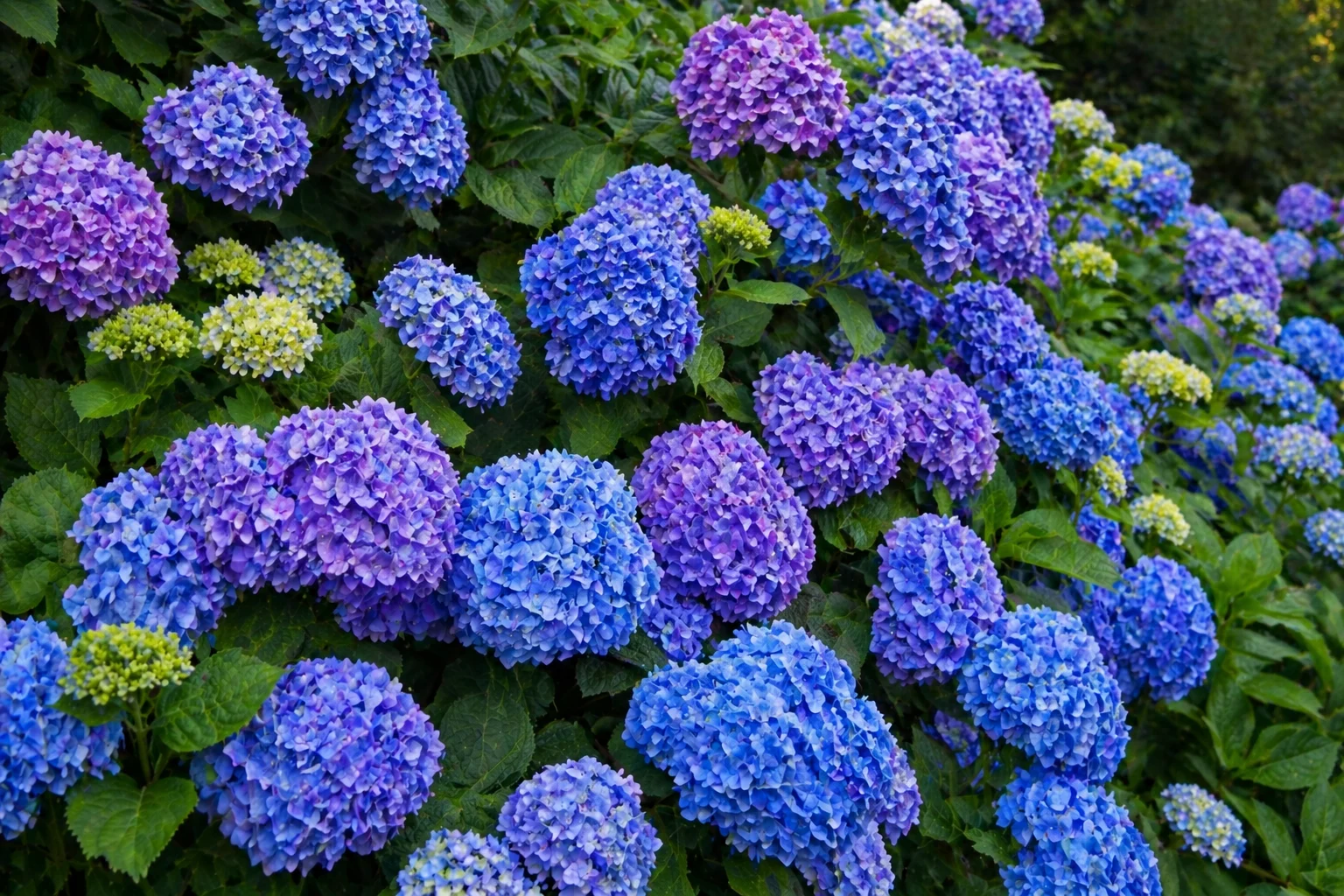
The second common mistake is misdiagnosing color failure. Bigleaf hydrangeas are blue in acidic soil (pH below 5.5) and pink in alkaline soil (pH above 6.5). Color failure usually means the soil pH doesn't match the desired color — adjust with aluminum sulfate (for blue) or garden lime (for pink). White hydrangeas (panicle, smooth, oakleaf) cannot be color-changed regardless of pH.
Third mistake: planting in full sun in Zone 7+. Bigleaf hydrangea leaves wilt and scorch in full afternoon sun south of the transition zone. Plant in morning sun and afternoon shade in Zone 7 and warmer; full sun is fine in Zone 6 and colder where summer heat is moderate.
Frequently Asked Questions
When should I plant hydrangeas?
Spring after last frost or fall at least 6 weeks before first frost. Spring planting (April through May in most zones) gives a full growing season to establish before winter. Fall planting (September through October in Zones 5–7) avoids summer transplant stress but requires watering until ground freezes. Avoid midsummer planting in Zones 7–9.
Why won't my hydrangea bloom?
The most common cause is pruning at the wrong time on a bigleaf hydrangea. Bigleaf hydrangeas bloom on OLD wood — pruning in fall or late winter removes flower buds for next year. Other causes: late spring frost killing buds, insufficient sun (less than 4 hours), or excessive nitrogen fertilizer pushing leaf growth at the expense of blooms.
How do I make hydrangeas blue or pink?
Bigleaf and mountain hydrangeas only — the other types are white. For blue: lower soil pH below 5.5 with aluminum sulfate (4 tablespoons per 4 L / 1 gallon of water, drenched around base each spring). For pink: raise pH above 6.5 with garden lime applied in fall. Color shift takes a full season; partial colors are common during transition.
How much sun do hydrangeas need?
Bigleaf and oakleaf: morning sun and afternoon shade in Zone 7+, full sun acceptable in Zone 6 and colder. Panicle and smooth: full sun in all zones (4–6 hours minimum). Climbing: north-facing wall or part shade. Less than 4 hours of sun produces few or no blooms regardless of variety.
When and how do I prune hydrangeas?
Pruning timing depends on type. OLD-wood bloomers (bigleaf, oakleaf, mountain): prune in summer immediately after flowering, before mid-August. NEW-wood bloomers (panicle, smooth/Annabelle): prune in late winter while dormant. For both types, remove dead wood any time and never remove more than one-third of the plant in a single year.