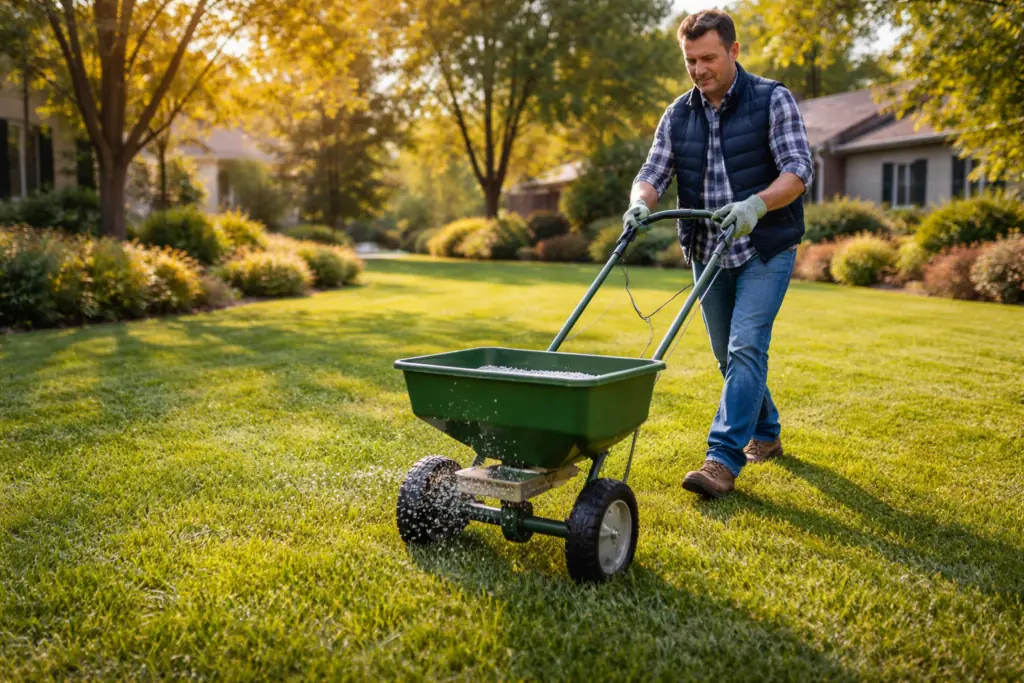
When to Fertilize Your Lawn in Sacramento, CA
Fertilizing at the right time makes the difference between a lawn that struggles and one that thrives. In Sacramento, California (USDA zone 9b), timing your fertilizer applications to match your grass's active growth period is essential.
Fertilizing Schedule for Sacramento
Early Spring
First application
Apply a balanced slow-release fertilizer once soil temperature reaches 55°F. Too early feeds weeds before grass wakes up.
Late Spring
Second application
Follow-up feeding 6–8 weeks after first. Use a fertilizer with lower nitrogen for warm-season grasses heading into summer.
Early Fall
Fall feeding
Most important application of the year for cool-season grasses. High potassium formula strengthens roots before winter.
Late Fall
Winterizer
Apply a winterizer 6 weeks before first frost. Helps grass store nutrients and recover faster in spring.
Soil Temperature Timing in Sacramento
In Sacramento’s warm climate, soil temperatures are a better guide than the calendar. Bermuda Grass roots wake up when soil hits 65°F — typically 2–4 weeks after January 15.
Key thresholds: 55°F — soil warming, hold off. 65°F — warm-season fertilizer window opens. 70°F+ — peak fertilizer uptake window. 85°F+ — heat stress, avoid high-nitrogen fertilizer. 55°F in fall — final application for root building.
Sacramento’s 350-day growing season allows 3–4 fertilizer applications. Space them 6–8 weeks apart from spring green-up through early fall.
Choosing the Right Fertilizer for Sacramento
Bermuda Grass and other warm-season grasses are nitrogen-hungry. Look for a fertilizer with an N-P-K ratio around 3-1-2 (e.g. 15-5-10 or 24-8-16). High nitrogen drives the dense, lateral growth these grasses need.
Use slow-release nitrogen formulas (look for “sulfur-coated urea” or “polymer-coated” on the bag) for summer applications in Sacramento’s heat — slow-release prevents burn and feeds consistently over 6–8 weeks.
In Sacramento’s alkaline soils, iron deficiency is common. If your grass shows yellowing between veins (iron chlorosis), add a chelated iron supplement or choose a fertilizer with added iron.
Signs Your Lawn Needs Fertilizer in Sacramento
Your Sacramento lawn may be nutrient-deficient if you see:
Uniform yellowing: The whole lawn looks pale rather than deep green — classic nitrogen deficiency. Most common in Sacramento after heavy rainfall leaches nutrients from soil.
Slow growth and thin patches: Grass grows slowly and thins even with adequate watering. Nitrogen fuels blade growth.
Yellow leaves with green veins: Iron deficiency, common in alkaline soils. Add chelated iron rather than increasing nitrogen.
Purple or reddish grass blades: Phosphorus deficiency, most common in newly seeded lawns or very acidic soils. A soil test will confirm this.
Note: Drought stress, disease, and overwatering look similar to nutrient deficiency. Always rule these out before fertilizing a struggling lawn.
How Much Fertilizer to Apply in Sacramento
The standard recommendation across university extension programs is 1 pound of actual nitrogen per 1,000 square feet per application.
To calculate: if the fertilizer bag shows 20-5-10, the first number (20) means 20% nitrogen by weight. A 10-pound bag = 2 lbs of actual nitrogen. Apply 5 lbs of product per 1,000 sq ft.
For Sacramento lawns on a typical suburban lot (5,000–8,000 sq ft): 25–40 lbs of product per application.
Always spread fertilizer on dry grass and water in immediately after application. Fertilizer granules left on wet grass can burn blades. Never fertilize a drought-stressed or heat-stressed lawn. In Sacramento’s summer heat, wait for a cooler week or water deeply 48 hours before.
Common Fertilizing Mistakes in Sacramento
These mistakes cost Sacramento homeowners money every season:
Fertilizing too early in spring: Before soil reaches 55°F, roots can’t absorb nutrients. Bermuda and Zoysia won't wake up until soil hits 65°F.
Skipping the fall application: A pre-dormancy potassium application helps warm-season grasses survive winter cold.
Applying too much: More fertilizer does not mean greener grass. Excess nitrogen causes thatch buildup, surge growth, and increases disease pressure.
Not watering after applying: Granular fertilizer must be watered in within 24 hours to prevent burn and activate release.
Best Grass Types for Zone 9b in Sacramento
Month-by-Month Timing for Sacramento
| Month | Action | Notes |
|---|---|---|
| February | Pre-emergent window approaches | Test soil temp |
| March–April | First fertilizer application | Soil temp 55°F+ |
| May | Second application if needed | Skip if lawn is lush |
| September | Fall fertilizer | High potassium blend |
| October–November | Winterizer | 6 weeks before frost |
More Lawn Care Guides for Sacramento
Looking for the right spreader? See our guide to the best broadcast spreaders →
Frequently Asked Questions
When should I fertilize my lawn in Sacramento?
The best times to fertilize in Sacramento are early spring (once soil hits 55°F), late spring, early fall, and late fall before the first frost. Avoid fertilizing in peak summer heat.
What fertilizer is best for Sacramento lawns?
A slow-release balanced fertilizer (like 10-10-10) works well for spring. For fall, switch to a high-potassium winterizer formula to strengthen roots before dormancy.
How many times a year should I fertilize in Sacramento?
Most Sacramento lawns benefit from 3–4 fertilizer applications per year: early spring, late spring, early fall, and a winterizer in late fall.
When should I NOT fertilize my lawn in Sacramento?
Avoid fertilizing during drought or heat stress — when daytime temps exceed 90°F for 5+ consecutive days. Also avoid fertilizing cool-season grass in midsummer (July–August) when it is semi-dormant, or warm-season grass within 6 weeks of the first frost.
Should I do a soil test before fertilizing in Sacramento?
A soil test every 2–3 years is strongly recommended. Soil pH dramatically affects nutrient availability — grass can’t absorb iron or phosphorus outside pH 6.0–7.0 regardless of how much fertilizer you apply. Contact your county cooperative extension office for low-cost soil testing.